Nepal Gen Z Revolt: What Should India Do?
India has to find the right balance between not interfering and not remaining indifferent, while supporting peace and stability in Nepal by offering financial and institutional assistance to the new government.
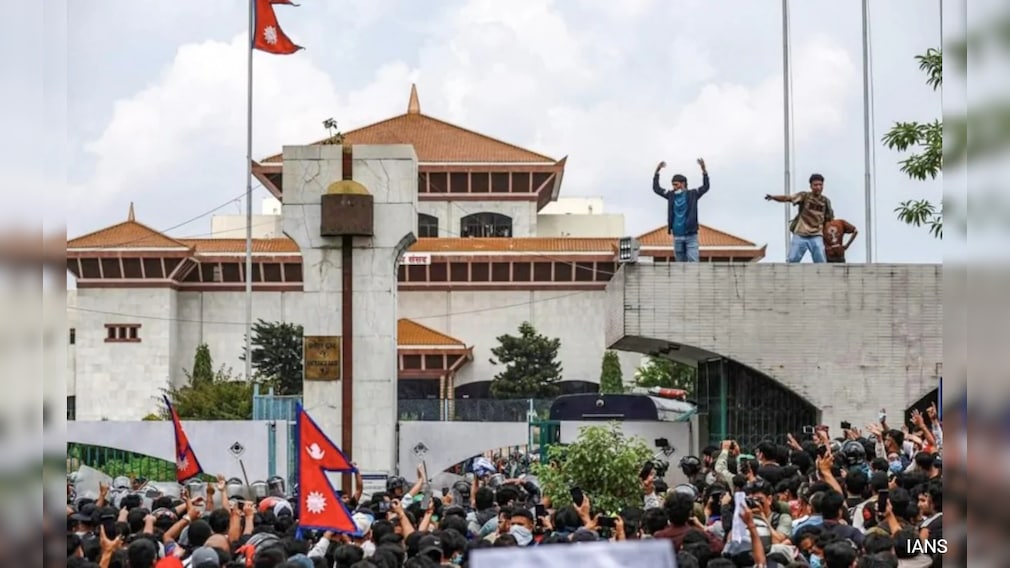
The recent political turmoil in Nepal, which saw the resignation of Prime Minister KP Sharma Oli and widespread protests led by the youth, may appear to be an internal affair. But for India, it's a matter of critical strategic concern. The events are a blaring siren for New Delhi, a reminder of the fragility in our immediate neighbourhood.
The protest movement, largely driven by Generation Z, wasn't just about the government's controversial social media ban, though it was portrayed as such. It was a culmination of deep-seated frustrations with corruption, nepotism, and chronic political instability. For decades, Nepal's political landscape has been dominated by a handful of leaders who have "played musical chairs" with power, failing to address core issues like unemployment and economic inequality.
The Big Picture
In other words, the protests - while sparked by the ban on social media apps, and triggered by a hit-and-run incident when a Minister's car ran over a 11-year-old schoolgirl, are rooted in weak political institutions, widespread misgovernance - and a profound sense of disillusionment among the youth. High youth unemployment and low GDP per capita have led to a mass exodus of young people seeking work abroad, further fuelling frustration. But it seems the protests were infiltrated by interlopers who were responsible for the subsequent violence and destruction. The Army stepped in to impose a curfew and lead negotiations, raising questions about the role of the country's President, who was largely seen as “missing in action”.
This kind of chaos has become a familiar story in India's neighbourhood, echoing the recent upheavals in Bangladesh and Sri Lanka. For India, it's clear that the old political establishment, which New Delhi has traditionally engaged with, has lost its hold and legitimacy. The youth are seeking a new kind of leadership, one that is not burdened by the baggage of the past. The younger generation is calling for the dissolution of the current parliament, viewing its members as discredited leaders. India must recognise that a new political generational shift has emerged in Nepal, and New Delhi's traditional levers of influence may be eroding.
Why India Must Be Cautious
What can we not avoid worrying about? Instability in Nepal poses several direct and indirect threats to India's interests. Security is foremost among them. An open border with Nepal is both a boon and a bane. Political chaos and a breakdown of law and order can lead to a surge in cross-border smuggling, human trafficking, and an increase in the activities of anti-India elements. The potential for a security vacuum in Nepal could be exploited by hostile actors, particularly Pakistan's ISI, to foment trouble in India. Our government understandably briefly closed the 1,700-kilometre border, though it has since been reopened and trade and traffic is now back to normal. Security remains tight, though, with identity verification and drone surveillance continuing along sensitive stretches of the border.
China's growing influence is also a concern. As India's clout has been waning in a politically unstable Nepal, China's footprint has been enlarging. Beijing has been actively engaged in Nepal through its Belt and Road Initiative (BRI) and various infrastructure projects, including roads and railways. At the same time, it's apparent that the young rebels in Nepal are wary of any perceived "India hand" or "China hand" in their internal politics.
Don't Buy Conspiracy Theories
Some in India, especially on social media, have given voice to the "Same Toolkit" theory, expressing concerns that the youth-led protests, while seemingly organic, bear an "uncanny resemblance" to the regime changes that have occurred in other South Asian countries. This, they say, raises suspicions of a larger, coordinated effort to destabilise the region - by implication orchestrated by the West. I tend to be sceptical of most conspiracy theories - the world is often more susceptible to random events than the paranoiacs believe - India must of course bear such concerns in mind and monitor these developments closely.
The Appointment Of Karki
Still, the appointment of Sushila Karki as the new Prime Minister undermines the theory that this was a "colour revolution" orchestrated by the West. Karki is a 73-year-old grandmother with a history of indigenous Nepali resistance, including participating in the overthrow of the monarchy and fighting government corruption. Her own education at Benares Hindu University, her fond references to India, her lack of foreign education or connections, should reassure us. Her staunch fight against corruption from within the judiciary, along with her husband's own anti-monarchy activism (including a famous 1973 hijacking), point to why she was picked. The protesters' use of a gaming chat app, Discord, to choose her, demonstrates the organic and chaotic nature of the movement, which contradicts the idea of a carefully managed coup.
Yet, India's specific involvement in Nepal in the short term might be affected. The unrest could stall or derail critical bilateral projects, particularly in the hydropower sector. Projects like the Arun-3 and Phukot Karnali are vital for India's energy security and its goal of becoming a regional energy hub. Delays in these projects would be a significant setback. During the protests, around 33,000 prisoners, including convicts for serious crimes like murder and rape, were released from jail. This poses a significant threat to society as many of them are now at large, some with looted arms.
India's Options
What can India do? New Delhi has limited but crucial options. A policy of non-interference - essential to show arms-length respect for the internal affairs of a sovereign neighbour - must be balanced with a proactive, yet subtle, strategy to safeguard our interests.
Of course we must avoid direct intervention: India must resist the temptation to micromanage Nepal's internal politics. Past attempts at heavy-handed diplomacy, such as the 2015 unofficial border blockade, have been counterproductive, fostering anti-India sentiment and pushing Nepal closer to China. A hands-off approach, for now, is the wisest course.
We should, at the same time, focus on Nepal's development and India's own “soft power”. Instead of political meddling, we should double down on our development assistance and cultural ties. Completing existing projects on time, investing in new ones that benefit the Nepali public directly, and promoting educational and cultural exchanges will build goodwill and strengthen the bilateral relationship from the ground up, will all help enhance India's standing in the eyes of the Nepali public.
And we must engage with the new generation. New Delhi should open new channels of communication with the emerging political leaders and youth activists in Nepal. Understanding their aspirations and grievances is crucial for formulating a forward-looking foreign policy. Ignoring this new demographic would be a grave mistake.
Secure The Border
Nonetheless, we cannot avoid strengthening our border management. With the political situation volatile, India must heighten vigilance along the porous border to prevent any spillover of violence or the infiltration of undesirable elements.
Nepal is at a crossroads. For India, the stakes are too high to treat this as just another “there they go again” moment. New Delhi must understand the deep-seated anger that led to this uprising and respond with a nuanced, long-term strategy that prioritises mutual respect, economic cooperation, and security, while leaving the political heavy-lifting to the Nepali people themselves. The new government's agenda will need to focus on preparing for elections, restoring law and order, and addressing youth unemployment and corruption. What follows later will be of vital interest to us, but is not for us to help determine.
Nepal matters to us as a neighbour, a fraternal nation and a country bound intimately to our own by ties of culture, religion, geography and history. We have to find the right balance between not interfering and not remaining indifferent, while supporting peace and stability in Nepal by offering financial and institutional assistance to the new government.
Granted, striking the right balance is not an easy task for our diplomats. But that's what we taxpayers pay them to do.
(Shashi Tharoor has been a Member of Parliament from Thiruvananthapuram, Kerala, since 2009. He is a published author and a former diplomat.)
Disclaimer: These are the personal opinions of the author
-
Opinion | Sydney Sweeney And The Obsession With Asking Sportswomen To 'Take The Clothes Off'

There is a world of difference between an athlete choosing to be sexy and an advertiser deciding that sex is the most interesting thing about her
-
Opinion | The 'AIPC' Was Once Congress' Boldest Idea. What Happened To It?
Tharoor, to Chakravarti, to Yaskhi now, the fate of a Congress 'experiment' that started in 2017 will tell you a lot
-
Woman Biker Hit, Air Force Veteran Attacked: The Lawlessness In Gurugram
What gives confidence to some elements in Gurugram to break the law again and again in full public view and on camera?
-
Opinion | When The Feed Braves The Flood
NDTV drops the 24x7 and stakes its next chapter on presence as it inaugurates a new identity
-
The Politics Of Blue: Why Akhilesh Yadav-vs-Mayawati Over A Colour Is Just One Shade Of History
A movie starring Rajinikanth tells us how colours can carry meaning beyond what meets the eye. The latest row over Akhilesh Yadav's party adopting blue, and Mayawati objecting, can be a starting point for understanding the many shades of history.
-
2 Indians Survived 9/11, Then American Justice System Became Their Nightmare
Pulled off a Texas train hours after 9/11, two Indian men were plunged into America's largest terror manhunt.
-
Opinion | Building BRICS In New Delhi
For India as the host nation, chairing the summit tests the core tenet of its modern foreign policy: strategic autonomy.
-
Can India 'Mediate' Between Iran And UAE At BRICS? Gulf Envoy Suggested It Once
At the very start of the Israel-US war on Iran, it was a UAE diplomat who had suggested as much.