Opinion | Old Mistakes: Why Congress 'Bosses' Keep Silencing Their Strongest Leaders
There's a recurring flaw in the Congress's political culture. Leaders with regional charisma are treated as assets when convenient and as liabilities when they develop a voice and following of their own.
On February 6, the Congress formalised the expulsion of Navjot Kaur Sidhu, a former Member of the Punjab Legislative Assembly and wife of veteran politician Navjot Singh Sidhu. The decision was the final act in a long saga of intra-party tensions that has come to epitomise the Congress's strategic confusion in Punjab.
Read carefully, the Sidhu episode - encompassing both the treatment of Navjot Kaur Sidhu and, more importantly, the Congress's handling of Navjot Singh Sidhu - offers a revealing case study of how the party has repeatedly misjudged leadership, squandered momentum, and allowed its high-command culture to override electoral logic.
Punjab did not slip away because the Congress lacked numbers, networks, or history. It slipped away because the party spent its most critical pre-election period dismantling its own leadership, broadcasting confusion to voters, and subordinating state-level strategy to Delhi-driven calculations. The Sidhu story sits squarely at the centre of this failure.
An Avoidable Collapse
In the run-up to the 2022 Assembly elections, the Congress entered Punjab with several advantages. The BJP remained peripheral. The Shiromani Akali Dal (SAD) was weakened by years of anti-incumbency. The Aam Aadmi Party (AAP), while electorally ambitious, had yet to establish governance credibility in the state. The Congress, despite internal strains, still possessed organisational depth, sitting legislators, and a recognisable leadership bench.
What it lacked was coherence. Instead of consolidating authority and sharpening its electoral narrative, the party descended into a prolonged internal confrontation. The abrupt removal of Captain Amarinder Singh as Chief Minister - executed without a clear, consensual succession plan - destabilised the government and alienated a leader who retained significant credibility among voters. In the process, the party also lost figures such as Sunil Jakhar, whose appeal among Hindu voters and reputation for moderation had long anchored the Congress's broad coalition in Punjab.
This decision, driven largely by the central leadership, set off a chain reaction. Rather than resolving tensions, it opened new fault lines that the party proved incapable of managing.
Sidhu As An Underutilised Asset
It is important to state clearly what Navjot Singh Sidhu represented in 2021-22, because the Congress's failure lies not merely in his elevation, but in what followed. Sidhu was not an ornamental leader. As a Jat Sikh with urban appeal, a high-decibel orator, and a combative stance against the Akalis, Sidhu could mobilise attention in a way few Congress leaders in Punjab could.
His advocacy around the Kartarpur Sahib corridor, his articulation of Sikh identity without sectarian rhetoric, and his relatively clean personal image gave the party a leader who could speak both to sentiment and symbolism. The Congress high command recognised this potential when it elevated him as Punjab Congress president in 2021. That move was widely read as an attempt to reinvigorate the party and possibly position Sidhu as a future Chief Ministerial face.
The problem was not Sidhu's rise; it was the party's inability to define his role with clarity. He was empowered enough to challenge existing hierarchies, but denied the authority to shape outcomes. He was projected as a change-maker, but constrained by a leadership unwilling to commit to him. This ambiguity proved toxic. Sidhu, ambitious and impatient, grew restless. The leadership, wary of his unpredictability, attempted to manage him through informal restraints rather than clear decisions.
The result was a spectacle of public discord that distracted from governance, diluted the campaign message, and reinforced voter perceptions of a party at war with itself.
The High Command's Hand, And Its Abdication
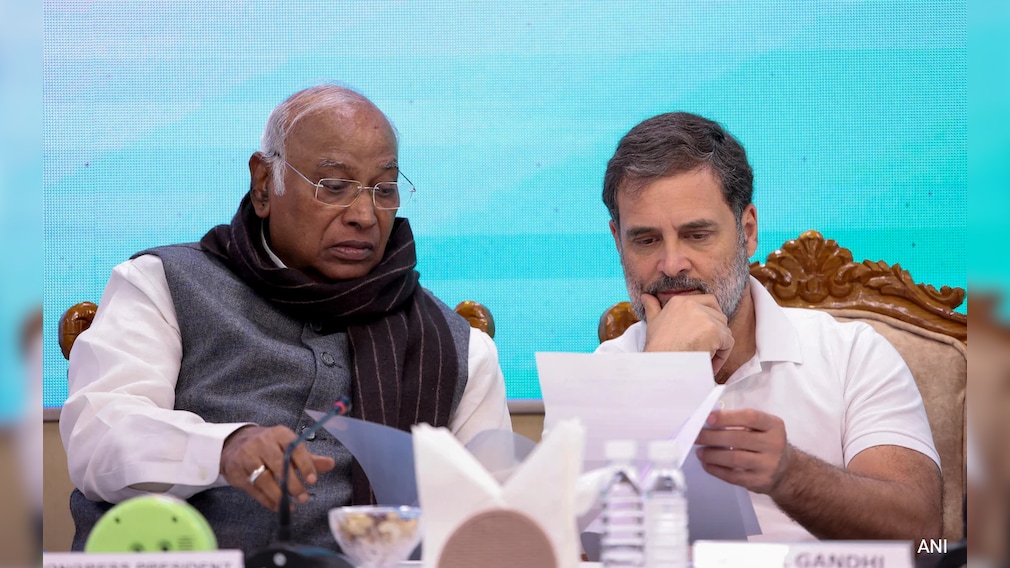
Much of the responsibility for this chaos lies with the Congress high command. That includes not just the Gandhis, but also the likes of Mallikarjun Kharge, Ajay Maken, and Harish Rawat, who were influential observers and AICC managers. Punjab was mismanaged through a pattern that has become familiar across Congress-ruled states. Decisions were centralised, but accountability was not. Authority flowed downward, but responsibility did not flow upward.
The elevation of Charanjit Singh Channi as Chief Minister exemplified this approach. Framed as a bold Dalit assertion, the move was driven more by Delhi's political imagination than by a grounded assessment of Punjab's electoral dynamics. Channi was neither given sufficient time nor institutional backing to consolidate authority. The symbolic gesture lacked the organisational and narrative scaffolding required to translate representation into votes.
Meanwhile, Sidhu was left suspended between promise and marginalisation. Amarinder Singh was pushed out without an honourable transition. Loyalists were alienated. The party's campaign drifted. Throughout this period, senior leaders in Delhi appeared more focused on managing internal equations than on building a disciplined electoral machine.
Perhaps the most telling detail is that those who shaped this strategy paid no price for its failure. The loss of Punjab did not result in meaningful introspection or restructuring at the top. Instead, the party moved on, leaving unresolved tensions to fester.
Defeat To Breakdown
After the 2022 defeat, the Congress had an opportunity to reset. But it did not do so. Navjot Singh Sidhu, having lost his own seat, was neither rehabilitated nor decisively sidelined. He was left in political limbo - visible enough to matter, powerless enough to frustrate. This vacuum was not merely personal, it was organisational.
It is against this backdrop that Navjot Kaur Sidhu's eventual expulsion must be understood. Her public allegations, including intemperate attacks on party leaders and the controversial "₹500 crore suitcase" remark, provided the immediate cause for disciplinary action.
Her continued public criticism of her own party's leadership - calling Amrinder Singh Raja Warring "incapable" and accusing senior leaders of patronage politics and moral bankruptcy - made the situation untenable. In response, Congress's Punjab affairs in-charge Bhupesh Baghel and PPCC president Warring moved to expel her completely.
Sidhu, for her part, struck back on social media, accusing the party's central leadership, particularly Rahul Gandhi, of being out of touch with ground realities and surrounded by aides more interested in protecting their own fiefdoms than in winning elections. Gandhi's tactless remark recently in calling BJP MP Ravinder Singh Bittu a "traitor" and Prime Minister Narendra Modi's suggestion that "this was a reflection of the deep hate that the Congress has towards the community (Sikhs)" reinforces Sidhu's argument about Gandhi's enduring naivete.
Whether or not one agrees with Sidhu's exact choice of words - and her critics in the party argued rightly that her public allegations harmed the party's image - the fact remains that the collapse of discipline around intra-party debate reflects deeper structural ailments in the Congress's approach in Punjab. This includes the party's prolonged inability to manage dissent internally or resolve its relationship with the Sidhu family.
By the time Sidhu's expulsion came, it felt less like a firm assertion of discipline and more like administrative closure. The Congress appeared keen to signal toughness, but in doing so only underlined how far the situation had been allowed to deteriorate.
A Party Uneasy With Its Own Talent
The Sidhu saga reveals a recurring flaw in the Congress's political culture. Leaders with regional charisma are treated as assets when convenient and as liabilities when they develop a voice and following of their own. They are elevated without being trusted, constrained without being replaced, and discarded only after the damage is done.
This tension is inseparable from the party's high-command model. Unlike centralised parties like the BJP, whose leadership can compensate for state-level weaknesses through mass appeal, the Congress exercises authority without transferable popularity. State leaders are expected to defer, but cannot rely on the centre to offset local losses. The result is a chronic imbalance between control and effectiveness.
Punjab exposed this contradiction starkly. A party that should have been prosecuting its opponents' failures and offering a coherent vision instead turned inward. Voters, confronted with noise rather than clarity, chose an alternative.
Lessons Still Unlearnt
The expulsion of Navjot Kaur Sidhu closes a chapter, but it does not resolve the larger questions raised by the Sidhu episode. How does the Congress identify and nurture leadership? How does it balance ambition with discipline? How does it ensure that authority comes with accountability?
Until the party confronts the role of its high command in these repeated failures, similar stories will continue to unfold - different names, same outcome. Punjab was an opportunity lost not to circumstance, but to strategy. The Sidhu saga ensures it will be remembered as one of the most avoidable setbacks in the Congress's recent history.
(Rasheed Kidwai is an author, columnist and conversation curator)
Disclaimer: These are the personal opinions of the author
-
Blog | Nana Patekar, And The Sharp, Lasting Sting Of His 'Plain-Speak'

"Subah ghar se niklo, bheed ka hissa bano..." Nana Patekar's characters often spoke with the bluntness of men who had little patience for pretence. Just like Nana himself.
-
Opinion | Pakistan's Saudi Pact Is Now Entering Dangerous Territory - As Expected
On October 5, the ministers of the pact's member states met in Riyadh for an emergency session and agreed to move to a 'practical implementation' of the defence commitments.
-
Hindu ka khoon-Musalman ka khoon? Nana Patekar's Krantiveer Questions Still Hang
Krantiveer was released in 1994, after the communal violence that had scarred Bombay and other parts of India. Nana's voice carried the pain of every riot, every broken home
-
'SIR' In America Too? India Cue In Trump's Mass Citizenship Check For Voters
Having got the nod from the US Supreme Court, Donald Trump's push for a voter roll "cleanup" puts citizenship at its centre. Arguments for India's Special Intensive Revision (SIR) have also centred on "illegal immigrants". Data remains scarce. Let's map the similarities and the nuance.
-
Opinion | Gyanesh Kumar Row May Be Doing Something Unthinkable For India's 'Lost' Opposition
There seems to be a greater willingness within the Opposition to accept Rahul Gandhi's leadership, at least on the SIR controversy. But the INDIA bloc itself seems to be undergoing a strange renewal.
-
Opinion | flydubai Hijack, And How Syria's Descent Into 'Jihadism' Has Now Become Everyone's Problem
Al Hammimi, the Omani pilot who tried to crash a plane with 175 passengers on September 30, is a symptom of Syria's long-raging sectarian and extremist fire that has now reached far beyond Syria's borders.
-
"Feel Deeply Abandoned By World": Tales Of Loss And Separation From Gaza
For Gazans, who have lived through the horrors of the last three years, life means a continuing encounter with impermanence and the repeated discovery that a home, a friendship, a livelihood, a familiar life and even one's former self can become things that exist only in memory.
-
Opinion | Gurugram Techie Suicide: Why Does A Woman Asking For Alimony Enrage Us So?
Social media, with its spectacular disregard for facts, turns one man's tragedy into an indictment of all women. The recent death of 28-year-old techie has become precisely that.
-
Bus Key Dash To 'Detain Me Please': How Protesters Outfoxed Delhi Cops
Videos capture the energy, nerve, camaraderie and creativity of protesters who have found ways to turn even moments of confrontation with the police into scenes of defiance
-
The New Global Power Map: 7 Political Movements Gaining Ground And What They Want
In the last one year, more than 100 protests have erupted across 57 countries. Though they look different, there's a common thread that binds these movements.