Opinion | Will Iran Actually Use Its Catastrophic 'Strait Of Hormuz' Card Against US?
Should the US launch any attacks on Iran - and every indication is that it means to very soon - it will be to implement a regime change. In which case, Iran could be forced to adopt extraordinary measures.
The winds of war are gathering at an alarming rate in the Gulf, in spite of ongoing talks between the US and Iran in Geneva over Iran's nuclear programme. Though negotiations have been characterised by both sides as being constructive, major differences still remain. The US seeks a total dismantling of Iran's nuclear programme. Iran, on the other hand, says it is not pursuing nuclear weapons but has the right to peaceful use of nuclear energy.
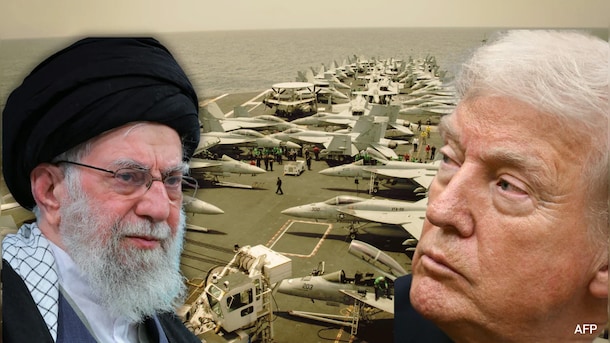
Meanwhile, the US has been building up a military presence in the region around Iran and has already dispatched two aircraft carriers. The USS Gerald R Ford is currently heading to the area, where the USS Abraham Lincoln is already present. According to open-source intelligence, a large fleet of US aircraft, including F-22 Raptor stealth fighters and KC-135 refuelling tankers are also operating across the region, necessary in case of any military operations.
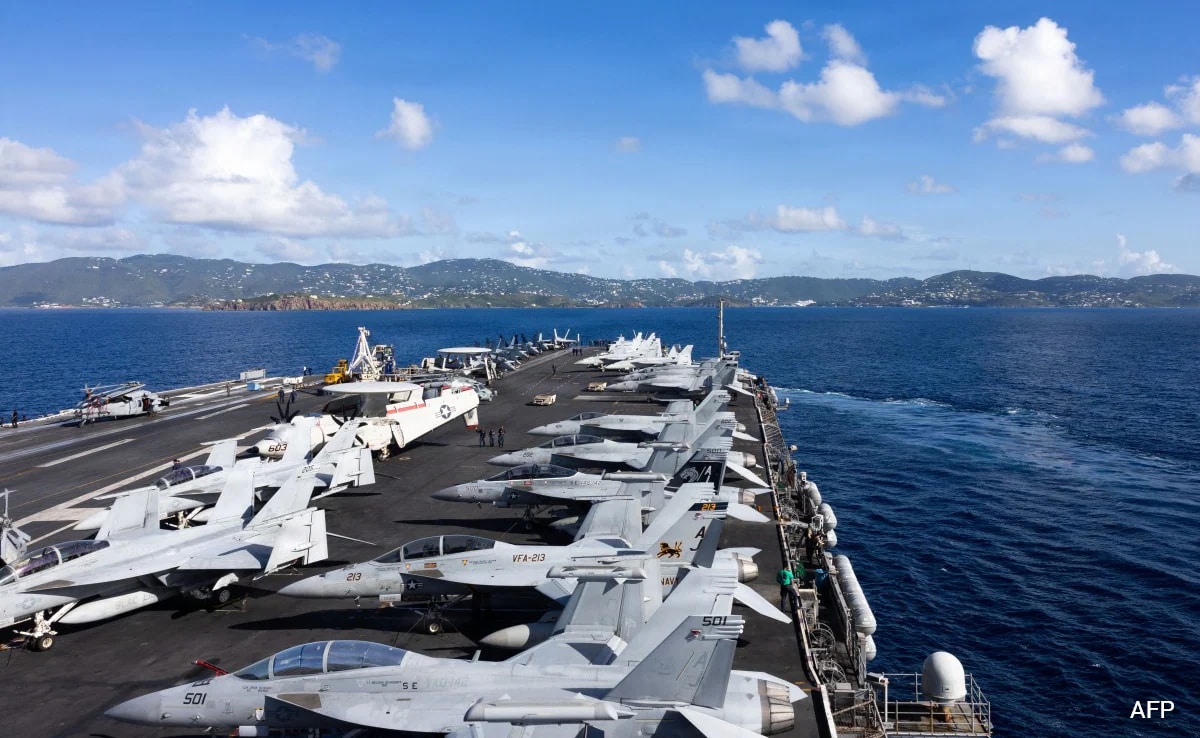
(In photo: The USS Gerald R. Ford is the world's largest aircraft carrier.)
As happens with every crisis around Iran, global attention immediately turns to the strategic Strait of Hormuz and the security of the global energy trade. Each time Iran has felt threatened, it has warned it would shut down the Strait.
All The Times Iran Has Waved The Hormuz Card
In January 2012, Iran had threatened to block the Strait in retaliation for the US and European sanctions that targeted its oil revenues. In July 2018, then Iranian President Hassan Rouhani hinted Iran could disrupt oil flows through the Strait in response to America's calls to reduce Iran's oil exports to zero. In 2019 again, when tensions flared between Iran and the US over the assassination of Iran's IRGC (Islamic Revolutionary Guard Corps) chief Gen. Qasim Soleimani, Iran threatened to close the critical chokepoint. During the Iran-Israel-US war last year in June, as the US struck Iran's nuclear sites, the Iranian parliament even voted to authorise its potential closure.
This time, too, the world's most critical oil shipping chokepoint has assumed significant importance for the international community since the outbreak of the current conflict in the region, with Iran threatening to shut it down. Closing the Strait is a strategic card that Iran holds.
But why does the threat of closing the Straits send a shiver throughout the world?
Hormuz Is Very, Very Important
The waterway separates Iran and Oman, linking the Persian Gulf to the Gulf of Oman and the Arabian Sea. It is 33 km wide at its narrowest point, is the world's most important oil transit chokepoint - narrow channels along widely used global sea routes - and it is critical to the world's energy security. What makes the Strait so strategic is that almost a fifth of the world's oil passes through the Strait. In 2025, 34% of all seaborne-traded oil had transited the Strait of Hormuz. It handled approximately 20 million barrels of crude, condensate, and petroleum products daily in 2024-2025.
Iran in the north and Oman in the south have sovereignty over their respective coastal waters, claiming 12 nautical miles each, but given the narrow width, the waters overlap. This gives Iran considerable leverage over the chokepoint. The UN Convention on the Law of the Sea grants transit rights to global shipping.
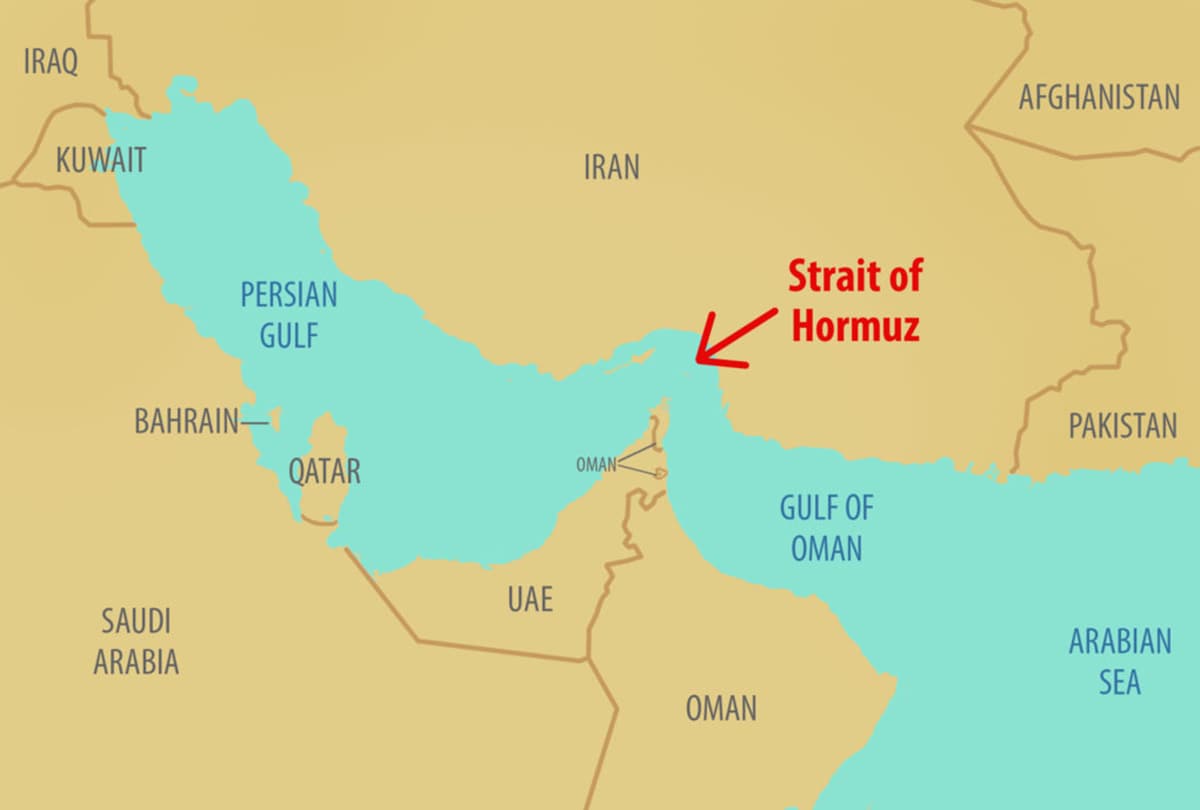
(In photo: The Strait of Hormuz is 33 km wide at its narrowest point and is the world's most important oil transit chokepoint.)
Most crude exported from Saudi Arabia, Iran, the UAE, Kuwait and Iraq - all members of the Organization of the Petroleum Exporting Countries (OPEC) - is shipped through the waterway. Saudi Arabia moves more crude oil and condensate through the Strait of Hormuz than any other country. In 2024, Saudi exports accounted for 38% of total Hormuz crude flows (5.5 million b/d). Nearly all the liquefied natural gas (LNG) produced by Qatar, the world's biggest LNG exporter, also traverses through this Strait.
According to the US Energy Information Administration, in 2024, 84% of crude oil and condensate and 83% of liquefied natural gas that moved through the Strait of Hormuz went to Asian markets.
Despite investments in alternative trade routes and pipelines, the Strait of Hormuz remains a vital artery in the global energy trade. A closure would have far-reaching implications for the global economy, which is already navigating great uncertainty. The results could be cataclysmic - disruptions to global energy supplies, skyrocketing oil prices, and compromised global energy security.
Is Iran's Threat Real?
Earlier this week, the IRGC launched separate drills in the waterway. Iran even partially shut down the Strait for several hours. This was posturing, an attempt to project power and play the Hormuz card.
Yet, would Iran really close down the strategic strait?
In all its history of confrontation, Iran has never actually shut down the Strait - not even during the "Tanker Wars" in the 1980s, when, during its conflict with Iraq, both countries targeted each other's shipping.
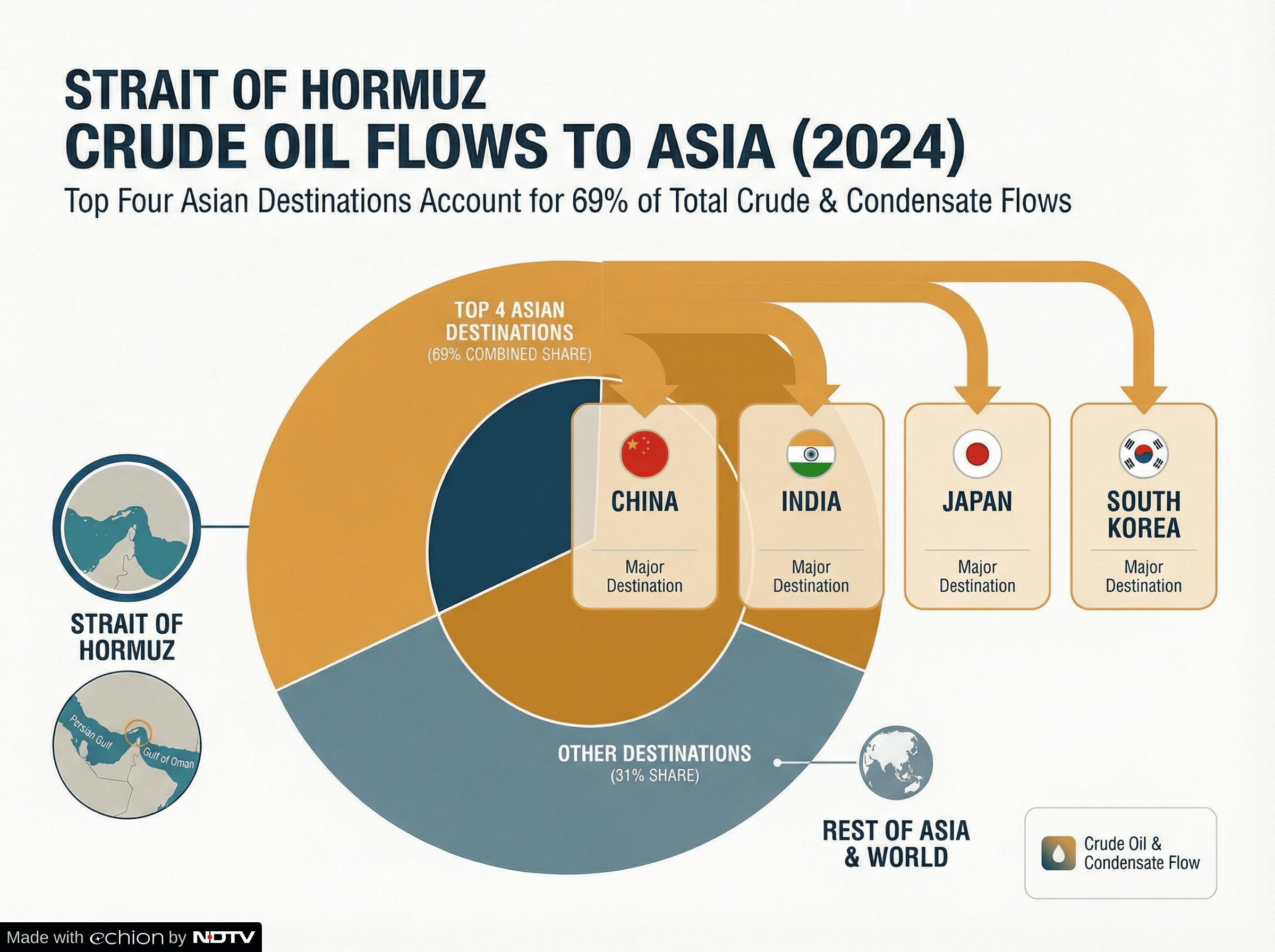
In 2024, China, India, Japan, and South Korea were the top destinations for crude oil moving through the Strait of Hormuz to Asia, accounting for a combined 69% of all Hormuz crude oil and condensate flows. These are the markets that would likely be most affected by disruptions at Hormuz. China and India are two of the largest energy-consuming and importing markets.
The Few Iran Doesn't Want To Upset
But China is one of Iran's few friends and has always called for restraint to keep shipping lines open. This time, the Chinese navy will be joining Iran and Russia for naval drills in the Sea of Oman; these are slated to begin today. Iran would not wish to disrupt energy supplies to its friend and ally. India, on the other hand, has diversified its crude procurements, sourcing mostly from Russia and other sources and would be less affected by any closure. Iran would not wish to trouble the Asian markets.
Moreover, given the vulnerabilities, the Saudis and the UAE, two major crude exporters, have over the years created alternatives with pipelines operating to the Red Sea coast and to the port of Fujairah, which lies beyond the Strait of Hormuz, though with lesser capacity than sea-bourne trade. The main LNG exporter, Qatar, is also a friend whom Iran would not wish to alienate with its closure. A closure of the Strait would also hurt Iran's own oil trade, which would be a catastrophe for it.
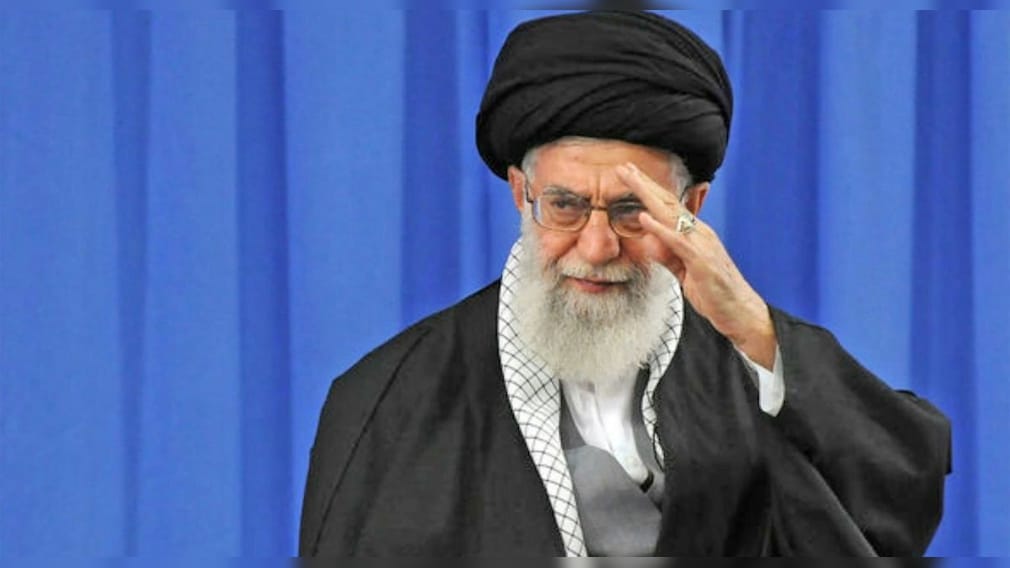
If the past is a precedent, then it is improbable that Iran, in spite of its threats and angry rhetoric, would actually close the Strait of Hormuz. Yet, the situation today is unparalleled. Years of economic sanctions, the war with Israel and the US last year, and the recent unprecedented country-wide protests and violence have left the theocracy in a state of extreme fragility. On Tuesday, Iran's Supreme Leader, Ayatollah Khamenei, struck a defiant note and, taking a swipe at the US military build-up in the region, declared, "A warship is, of course, a dangerous tool - but more dangerous than a warship is the weapon that can send it to the bottom of the sea."
Should the US launch any attacks on Iran - and every indication is that it means to very soon - it will be to implement a regime change. In which case, Iran could be forced to adopt extraordinary measures. This may well include the closure of the Strait of Hormuz. For, if Iran goes down, it will make sure it takes others down with it.
(The author is a senior journalist)
Disclaimer: These are the personal opinions of the author
-
Opinion | India's Hit-And-Run Crisis: Cases Grow By 67%, 90% Pending In Courts

The share of hit-and-run cases in total road fatalities has expanded from roughly 13-14% to nearly 18%, indicating that fleeing the scene has become a pattern in a growing proportion of fatal crashes.
-
The Hormuz Threat: Iran's Most Powerful Card Against The US
In Tehran, Iran's Supreme Leader Ayatollah Ali Khamenei has responded with rhetoric that leaves little room for ambiguity. American power, he said, would not succeed in destroying the Islamic Republic.
-
Opinion | India's Northeast Has A New Problem - 'Jamaat' Surge Along Bangladesh Border
Most of Jamaat's victories have come from the north-west and south-west regions adjoining Indian states such as West Bengal, Assam and Meghalaya.
-
Opinion | 'AI-Enabled' Soldiers? What An India-China-Pak Crisis May Soon Look Like
AI compresses the decision-action loop, turning hours of analytical deliberation into seconds of machine-assisted judgment. In warfare, that compression is the difference between survival and defeat.
-
Opinion | Pak 'Impostors' To Jamaat Trolls, The Sea Of Misinformation Around Bangladesh Polls
The largest single spends on social media were from DailyNews24, which masquerades as a news organisation but is, in reality, a Jamaat organ. The second and fourth spenders are also Jamaat sites.
-
4 States, 4 Elections, 4 Potential Crises For Congress Hoping For Poll Wins
Four states - Kerala, Bengal, Tamil Nadu, and Assam - are scheduled to hold Assembly elections in April/May, with the Congress seen as strong contenders in the former.
-
Opinion | What ChatGPT Is Now Doing With Your Darkest 'Secrets'
For over three years now, millions across the world have treated ChatGPT like a confidante. And one company - OpenAI - holds the keys to this vast digital locker.
-
Opinion | 'Team Rahul' And 'Team Priyanka': Inside Congress' Plans For Kerala And Assam
The two siblings don't function at cross-purposes or differ on key ideological issues. However, in practice, they are often seen following slightly different 'chaal, chalan, chehra', as they say, from each other.
-
Opinion | Sonia-Rahul To Maken, Why Mani Shankar Aiyar Keeps Ditching His Verbal 'Filter'
The former Rajya Sabha parliamentarian used to joke that in the time of Rajiv Gandhi, he was on "arsh" (cloud nine), while in the UPA regime under Sonia Gandhi, he was brought down to "farsh" (ground).
-
Opinion | Pakistan Cricket And Lessons In How To Destroy A Sport, Completely
In March last year, I had written about why Pakistan cricket is in ruins - simply because it is its own worst enemy. Pakistan just proved that again yesterday.