What The IndiGo Crisis Reveals About The Fragility Of Indian Aviation
The indelible images of passengers sleeping rough on cold terminal floors, captured and broadcast across every channel, will outlast a thousand corporate advertising campaigns by IndiGo. The urgent push for reform can no longer be ignored.
The recent, spectacular operational collapse of IndiGo, our dominant and once-vaunted airline, was more than just a logistical hiccup. This week's meltdown was an unvarnished crisis of planning, trust, and accountability, which has delivered a catastrophic blow to the carrier's carefully cultivated reputation for reliability - and, more important, exposed the fragility of the Indian aviation industry.
In the space of just a few chaotic days, IndiGo, which controls 60% of the domestic market, suffered a nationwide meltdown, grounding thousands of passengers and exposing the deep-seated fragility within India's aviation ecosystem. This crisis, catalysed by a lethal cocktail of regulatory change and corporate negligence, demands a fundamental reckoning with how passenger rights are treated in our nation.
The disruption, which quickly became a humanitarian and logistical disaster, escalated rapidly across India's major aviation hubs, including Delhi, Mumbai, Bengaluru, and Hyderabad. At its peak, the operational paralysis saw IndiGo cancel approximately 550 flights in a single day, contributing to a cumulative nationwide toll of over 1,000 scrapped flights within a short span. The numbers tell a grim story: 172 cancellations in Delhi, 118 in Mumbai, and 100 in Bengaluru alone.
A Self-Made Chaos
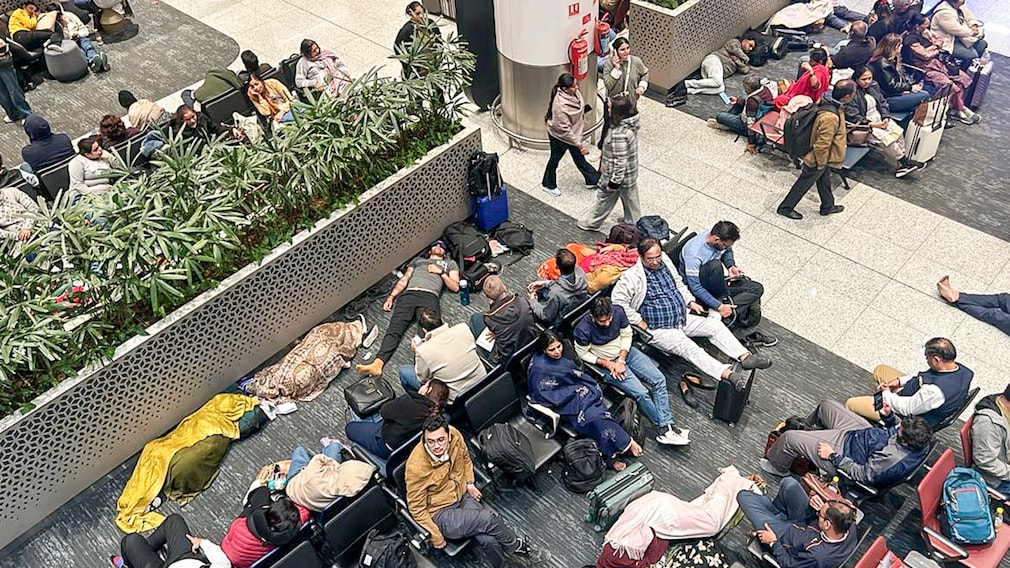
The consequences were immediate and appalling. Airports descended into a state of total pandemonium. Thousands of passengers - distraught families, high-stakes business travellers, and the vulnerable elderly - were left stranded overnight in terminals. They faced serpentine queues that led nowhere, a complete and toxic vacuum of information, and the anguish of total uncertainty. Departure boards turned into frustrating puzzles as arrivals vanished and stacked-up departures created an impossible bottleneck. Airline counters were overwhelmed not just by passengers demanding answers, but by a rising tide of desperation, fatigue, and anger. Many passengers were spotted sleeping on floors in the terminals.
In the belated aftermath, the carrier offered routine public apologies, full refunds, and free rescheduling, pledging to restore operational normalcy. The Ministry of Civil Aviation and the Directorate-General of Civil Aviation (DGCA) scrambled, setting up 24x7 control rooms and (immediately but I hope temporarily) relaxing pilot-rest rules (of course the pilot unions have protested this relaxation - and in the long run, they are right). But this a band-aid on a gaping wound. While obviously necessary, these governmental interventions were widely criticised as too little, too late, failing to prevent the widespread suffering that had already unfolded.
The core trigger for this spectacular failure was the sudden, unprepared implementation of the government's revised Flight Duty Time Limitations (FDTL). These mandates (which were reportedly communicated to airlines nearly two years ago) correctly aimed to enhance safety by enforcing expanded pilot rest periods and restricting night-time operations. However, IndiGo failed to prepare in time for their impact.
IndiGo Can't Recover From This Embarrassment
The airline has since confessed to a catastrophic strategic failure: it disastrously underestimated the rules' operational consequences, failed to proactively redesign its complex rostering system, and, crucially, neglected to adequately staff its operations. The carrier treated a safety-first structural overhaul as a routine compliance requirement.
The crisis, therefore, was not merely an accident; it was a predictable confluence of regulatory execution and severe corporate negligence. Crew requirements were fundamentally miscalculated, hiring was inexplicably frozen despite booming post-Covid pandemic demand, and contingency plans were utterly non-existent. Our national aviation regulator, the DGCA, must also shoulder a share of the blame for failing to anticipate or mitigate the massive operational shock these revised rules would inflict on our dominant carrier during a peak travel season. It was a crisis born of a toxic blend: a structural regulatory change amplified by profound corporate oversight failure.
For years, IndiGo has successfully positioned itself as the gold standard of Indian aviation, synonymous with punctuality, discipline, and operational clockwork. That reputation (which gave the airline high profits and a majority market share) is now fatally cracked. The indelible images of passengers sleeping rough on cold terminal floors, captured and broadcast across every channel, will outlast a thousand corporate advertising campaigns. This loss of physical comfort and dignity is a wound that goes beyond mere inconvenience.
Worse, the operational collapse has been compounded by a collapse in financial trust. Market whispers surrounding unusual stock movements in the days preceding the crisis have fuelled uncomfortable speculation about insider trading. Regardless of the eventual findings, the mere perception of financial malfeasance alongside operational chaos shatters a brand built on confidence and order.
An Existential Injury
When the system broke, the airline's communication broke with it. There were no timely updates on the app, no clear, empathetic communication at the airports, and virtually no meaningful, proactive assistance for stranded travellers. This operational silence was a profound breach of the airline's core promise. The chaos that ensued didn't just disrupt schedules; it violated the very brand identity of reliability, transparency, and empathy that Indigo has carefully constructed. For a company built on rigid discipline, this loss of public trust (exposed as Indigo's cost-cutting trumped its duty towards passenger welfare) is the brand's deepest, most existential injury.
As IndiGo's capacity evaporated, a second, equally galling tragedy unfolded: systemic market exploitation. The vacuum created by the airline's failure was instantly filled by predatory opportunism. Alternative flight fares surged instantaneously to 3x, 4x, and even 5x their normal rates. The market correction was not a stable readjustment but a raw grab for profit at the expense of human distress.
The exploitation was not limited to the air. Hotels near major airports, particularly in high-demand zones like Delhi's Aerocity, quietly and shamelessly raised room rates to over ₹25,000-₹30,000 per night, surpassing the pricing of many global luxury chains. Stranded passengers, many of whom received no prior cancellation notice, were forced into an impossible choice: sleep on a terminal floor or pay extortionate prices that few could afford. Families with infants slept rough, and elderly travellers wept in queues, their dignity stripped away by the combination of systemic failure and raw profiteering.
Sadly, throughout this period, no authority intervened. There were no structured customer care teams, no coordinated emergency accommodation, and most shamefully, no imposition of price controls or sanctions against gouging. The entire financial, logistical, and emotional burden of the crisis was allowed to fall squarely and exclusively upon the shoulders of the hapless airline passenger.
A National Scandal
What intensified the fiasco from a corporate misstep to a national scandal was that our entire aviation system itself was caught dismally unprepared. Government ministers offered routine, sanitised statements but provided no tangible relief on the ground. There were no emergency coordination teams deployed, no temporary fare caps imposed, no clear directive to hotels to halt gouging, and no decisive, visible regulatory intervention to protect citizens. The official establishment effectively chose to watch from the sidelines, allowing citizens to be squeezed between corporate failure and market opportunism.
A crisis of this magnitude is handled radically differently in most developed economies precisely because of robust passenger-rights regimes. In the United States, the Department of Transportation mandates free rebooking, hotel accommodation for controllable cancellations, and actively prohibits predatory fare hikes, with even a hint of gouging triggering investigations and class-action lawsuits. Europe goes further: EU Regulation 261 mandates free meals, hotels, transport, rebooking, and significant cash compensation ranging from EUR 250 to EUR 600 per affected passenger. Authorities cap emergency pricing, and airlines that mismanage operations face severe, punitive fines.
This is the fundamental divide: in the West, a traveller in crisis is a citizen with enforceable rights. In India, a traveller in crisis remains, fundamentally, a revenue opportunity. This lack of a structured, punitive, and empathetic regulatory safety net for airline passengers is the core reason operational disorder in India mutates instantly into human exploitation.
The episode has also exposed a hard, undeniable truth: scale without resilience is a profound corporate and national liability. IndiGo's spectacular stumble has stripped bare many of its pretensions. Restoring trust in the skies requires more than just fixing a roster; it demands a visible commitment that in India, too, passenger welfare must finally and unequivocally trump the pursuit of cost-cutting and profit.
Rival airlines, especially Air India (which is just recovering from its own setbacks) will aggressively leverage this trust deficit, positioning themselves as more dependable alternatives, pushing passengers to diversify away from IndiGo's near-monopoly.
Since IndiGo has also failed to implement its "stretch" service for high-value corporate travellers as widely or fully as needed, competitors like Air India and Akasa will surely seize the opportunity to aggressively poach corporate contracts by stressing service quality and schedule dependability, fundamentally restructuring the market share dynamics that IndiGo once dominated.
Investors, meanwhile, will demand stronger governance and more transparent risk modelling. Shareholders, bruised by the reputational and financial hit, will push for C-suite accountability and mandate detailed disclosures on operational risk assessment, treating pilot capacity as a critical, non-negotiable asset rather than a box to be ticked on a routine checklist.
Don't Defer Reforms
The lesson is clear: if IndiGo's dominance and market expansion is to continue, it must be backed by commensurate investment in infrastructure, redundancy planning, and crew capacity, ensuring that market dominance does not equate to systemic vulnerability.
This crisis must also serve as a fundamental inflection point for Indian aviation. The crisis has laid bare the fragility of our high-growth aviation ecosystem. Under intense public pressure, regulators should now be forced to tighten oversight, mandate genuine, stress-tested contingency planning, and rethink the potentially disruptive execution of vital safety reforms.
Specifically, the DGCA must now move beyond mere compliance checks to demand evidence of operational resilience, requiring carriers to demonstrate how their rostering systems can withstand unexpected shocks like sudden FDTL changes or mass sick leave.
The urgent push for deep-seated reform, visible accountability, and the establishment of a robust, compensated system of passenger protection can no longer be deferred. The government must use this moment to draft and implement a comprehensive Passenger Bill of Rights, complete with mandatory compensation structures and punitive fines for operational negligence, to bring India's standards in line with international norms.
Every crisis, they say, is an opportunity. Civil Aviation Minister Rammohan Naidu has promised decisive action. As a people's representative, I am counting on him not to waste this opportunity to undertake fundamental reform. As Indigo (and India's aviation industry) lie prostrate on the terminal floor, the time for change is now.
(Shashi Tharoor has been a Member of Parliament from Thiruvananthapuram, Kerala, since 2009. He is an author and a former diplomat)
Disclaimer: These are the personal opinions of the author
-
From Aircraft To Lives: Why "Friendly Fire" Can Be Such A Big Enemy

There is not even a millimetre of room for error in judgment - and this is one of the biggest contributors to friendly fire incidents
-
Opinion | Gulf Confronts An Ugly Truth About Aligning With America
That Iran is attacking bases and other sites in the UAE, Qatar, Bahrain, Saudi Arabia - even Oman - has caused disillusionment in these countries, which thought that they were protected by the US. They are now learning they're not.
-
Cheap Drones, Claude AI, Cyberattacks: Behind US-Israel's 'New' War On Iran
Cyber warfare, Claude, cheap drones - as the US and Israel jointly pound Iran, and Tehran hits back by dragging West Asia into a regional war, are these the backbone of a new kind of military conflict?
-
Opinion | How Khamenei's Killing Is Doing Exactly The Opposite Of What US-Israel Wanted
What Israel and the US have done is make Khamenei, who was running a country dealing with extreme economic hardships, protests and internal strife, a martyr. His killing has united Shias and Sunnis across the globe in anger.
-
NDTV Explainer: How Is A Supreme Leader Chosen, Who Will Succeed Khamenei
Khamenei, who ruled for 36 years, built Iran into a powerful anti-United States force, projecting military influence across the Middle East while suppressing repeated domestic unrest with force.
-
Opinion | Who Gets The 'Peace Prize' Now, Mr Trump - The Drones Or The Bombers?
A president who returned to the White House on the promise of ending 'Forever Wars' - and wanted a Nobel Peace Prize, no less - now presides over the largest American military build-up in the region since the infamous Iraq war.
-
Opinion | 'Insider' Info? Why US-Israel Couldn't Have Struck Khamenei Without Help
The only way actionable intelligence would reach Israel and the US on Khamenei's whereabouts, movements, and schedules, is if the calls were coming from inside the house itself.
-
Exclusive: How War In A Narrow Sea Could Reshape Global Economy Overnight
NDTV speaks to industry experts to gauge the impact of a major international conflict on the global shipping industry.
-
Opinion | What's Driving Pakistan-Afghanistan War? Islamabad's Never-Ending Cycle Of Insecurity
Islamabad has accused Kabul of drifting into an "India colony", a charge that was further sharpened following Afghan Foreign Minister Amir Khan Muttaqi's visit to New Delhi last year