
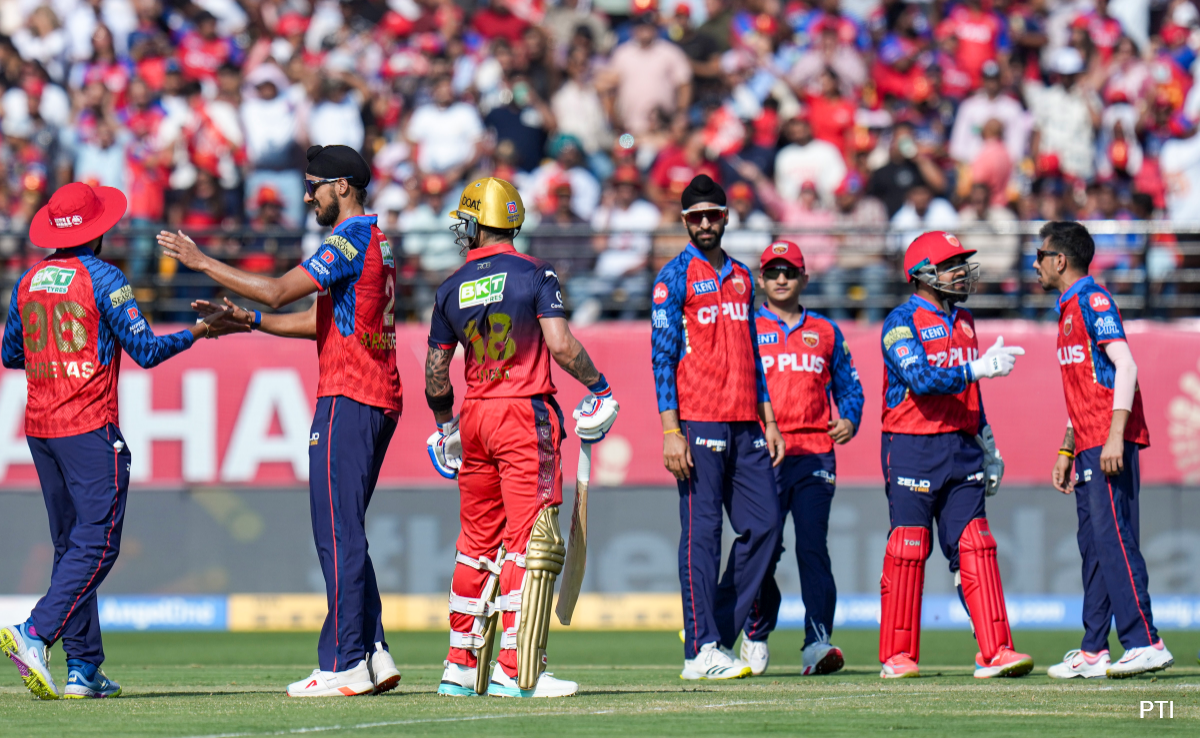



While Virat Kohli's evolution and Royal Challengers Bengaluru's win have been a major storyline of the week, the other big V who has dominated the consciousness of the sports-loving public is Vinesh Phogat - a mother, an Asian medallist, a wrestler par excellence, and above all, a fighter. I decided to call this essay Vinesh Phogat vs. the Will of the Universe because it almost seemed as though it required the conspiracy of the system, or the universe of Indian wrestling itself, to keep her off the mat.
After going back and forth with the courts-first the High Court and then the Supreme Court-Vinesh Phogat arrived at Delhi's Indira Gandhi Stadium on Saturday at around 6:45 a.m., having travelled 112 km from Julana in Haryana, leaving her one-year-old son behind.
Mental fortitude is a magnificent commodity that defines both Vinesh Phogat and Virat Kohli. It takes a rare kind of mental strength to become a champion despite the system, and not because of it.
When she arrived in the morning, WFI officials told Vinesh that she had previously competed in the 50 kg category before taking a break after the Paris Olympics to become a mother. However, Vinesh had already secured a court order allowing her to participate in the 53 kg trials. A squabble followed between her and the WFI officials. That was the first setback.
Round 1 went to Vinesh that morning as she was finally allowed to weigh in. Under intense scrutiny from WFI officials and the gaze of cameras, every sinew of her body appeared to be judged. She weighed within the approved limit at 53.9 kg.
The wait that followed was excruciating amid the heat and dust of the IG Stadium. TV cameras captured every move, including her support staff braiding her hair and making her "battle ready."
Vinesh Phogat, the gold medallist from the 2018 Asian Games in Jakarta, fully expected obstacles from the Wrestling Federation of India.
The wrestling ace complained that even the draw for the trials was not conducted fairly. She had to face one top-level wrestler after another. Before her first bout, she did not even appear to have a sparring partner. Amid the crowd of wrestlers and media personnel, she trained alone while cameras remained fixed on her. There were no pleasantries exchanged between the WFI and either her or her support staff. It was a "dangal" in every sense of the term.
The two-time World Championship medallist in the 53 kg category (Nur-Sultan 2019 and Belgrade 2022) found it difficult even to secure the opportunity to compete in her preferred weight class.
It was not until around 1:30 p.m. that her bouts finally began. By then, the group accompanying her had allegedly been intimidated by WFI officials time and again.
Then came Round 2 - the actual bouts.
BOUT 1
In the opening round, Vinesh defeated Haryana's Jyoti 7-1 in a one-sided contest. After the win, she walked back to her small support team, including her physiotherapist and husband Somvir, and waited for her next match.
BOUT 2
In her second bout against Nishu, Vinesh felt that neither the referees nor the opposing camp showed any empathy for her situation. When she challenged a point, the referee took considerable time to review it. Delays can distract a wrestler and hinder momentum, especially since they affect body temperature and rhythm.
Despite the disruption, Vinesh held her nerve and won 7-6. Nishu reportedly refused to shake hands after the match.
BOUT 3
In the semifinal, Vinesh faced Meenakshi. Amid what she viewed as interference from federation officials and a lack of neutrality from those overseeing the event, she lost 6-4.
Before leaving the mat, however, the big V made a declaration: "I will return to this very mat again."
She fought like a lioness until the semifinal before finally leaving the stadium, nearly eight hours after arriving and after navigating multiple battles with the WFI.
Vinesh said: "You saw this morning as well. Before the weigh-in, the WFI wasted a lot of my time, just as I expected. The intention was to keep me mentally disturbed and leave me with very little time to prepare after the weigh-in."
Sure enough, there are sports ministry directives that selections should be recorded and conducted under camera supervision. But who is there to see whether an athlete is allowed moments of peace and self-preservation? Who is there to notice the tiny moments of manipulation that can make the difference between victory and defeat?
Speaking after the matches, Vinesh said: "This defeat does not hurt me. I have lost before. I returned to wrestling just a year after becoming a mother. I am proud of my wrestling. I am fighting the entire system. That is why this loss does not sting."
She added that winning a medal at the Los Angeles 2028 Olympics remains her ultimate goal.
"My target is the Los Angeles Olympics, but the system turns every tournament into an Olympics for me," said Vinesh Phogat.
Speaking to NDTV, Vinesh's coach and husband, Somvir, said: "Vinesh had been preparing for this since around August last year. We will go back, regroup, and prepare even harder."
Barring the absence of an Olympic medal, Vinesh Phogat can arguably be considered India's most accomplished female wrestler. Across the last three Olympic Games, she came agonizsingly close to a medal, only to see it slip away each time. That is precisely why the Los Angeles 2028 Olympics have become her ultimate target.
After her defeat in the Asian Games trials, Vinesh left the mat with fierce criticism of wrestling officials and what she described as the system. Her resume-two World Championship medals and two Asian Games medals, including a gold-stands comparison with even India's Olympic medallists, including Sakshi Malik.
Vinesh competed in the 48 kg category at the Rio 2016 Olympics, where an ACL injury in the quarterfinals ended her campaign just as medal expectations were building.
At the Tokyo 2020 Olympics, she moved up to the 53kg division, but her relationship with the wrestling federation deteriorated, eventually leading to a suspension after the Games.
At the Paris 2024 Olympics, Vinesh competed in the 50kg category and stunned the wrestling world by defeating Yui Susaki, the former Olympic champion from Japan. She was one match away from securing at least a silver medal, but a heartbreaking disqualification for being 100 grams overweight denied her a place on the podium.
By Los Angeles 2028, Vinesh will be 33 years old. Maintaining a specific weight category over the next two years will be a major challenge. Women's Olympic wrestling features the 50kg, 53kg, 57kg, 62kg, 68kg, and 76kg divisions. Vinesh must first decide which category suits her best before tailoring her preparations accordingly.
Sports law expert and Supreme Court advocate Saurabh Mishra told NDTV: "I watched the Supreme Court hearing myself. The court told the Wrestling Federation that attempting to prevent an athlete of Vinesh's stature from competing was not appropriate. The High Court had also observed that the federation appeared to be acting with a sense of vendetta against her. That is why the Supreme Court upheld the Delhi High Court's decision and allowed Vinesh to compete in the Asian Games trials."
Mishra added: "I was surprised to see a national sports federation go all the way to the Supreme Court to stop one of its own athletes from competing. In my long career, I have never seen a similar example in another country."
Many within the wrestling community believe Vinesh may continue to face hurdles when it comes to participating in future tournaments. As Vinesh herself puts it, "For me, the battle for an Olympics often becomes a battle against the system."
In elite sport, access to international competitions and training camps is largely controlled through national federations. Even Sushil Kumar, a two-time Olympic medallist, faced a prolonged dispute with the Wrestling Federation ahead of Rio 2016. His demand for Olympic trials was rejected, and the London 2012 silver medalist ultimately missed the Games.
Given the federation's stance, Vinesh may encounter similar difficulties in securing opportunities on the international circuit. Yet, many believe her talent and determination keep her Olympic dream alive.
Vinesh became a mother last year, and her son Kridhav is now one year old. Even during the Asian Games trials, she frequently spoke about missing him. Over the next two years, her responsibilities as a mother are only expected to grow, something she readily acknowledges. Maintaining the focus and discipline required for an Olympic medal campaign while managing family responsibilities will be one of the toughest challenges of her career.
The Battle for Coaching, Exposure, and Competition
But Somvir reiterated that Vinesh has already invested months into preparing for her comeback.
Even so, Olympic success today requires access to world-class coaches, training camps, international exposure, and specialist support teams. Athletes across the globe work with top experts and regularly compete against elite opposition. Without strong institutional backing, rebuilding that ecosystem around Vinesh could prove to be one of the biggest challenges on her road to Los Angeles 2028.
The Vinesh Phogat story is a contradiction between what the sporting system demands of an athlete and what it is prepared to provide. It wants athletes on the podium but often fails to offer the facilitation and support required to get there. That is why many Olympians and medal winners continue to say they won their medals not because of the system, but despite it.
(Rica Roy is a Sports Editor and Anchor with NDTV)
Disclaimer: These are the personal opinions of the author


