Opinion | The Quiet 'Upheaval' Within US Military Over The Iran War
General Randy George's ouster carries echoes of a similar episode in 2003, in the run-up to the Iraq war. But much more is happening within the US military, courtesy Hegseth.
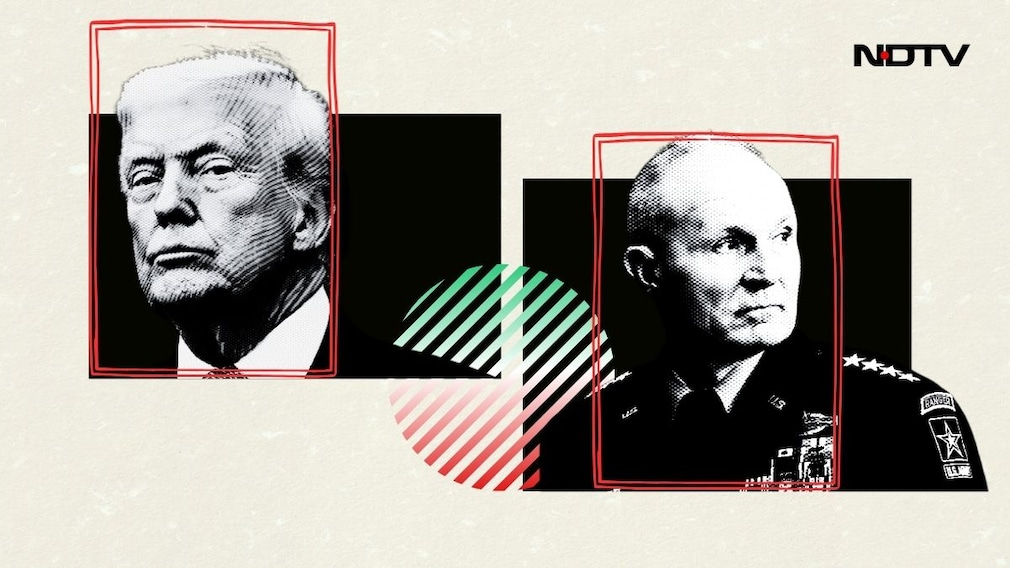
A series of developments inside the United States military has brought a deeper issue into focus: what happens when visible disagreement emerges between the military and political leadership during an ongoing war?
The sequence of events in the Iran campaign is now reasonably clear.
General Randy George, the US Army's chief and a highly decorated infantry officer who served in the Gulf War, Iraq, and Afghanistan, was removed while American forces remained engaged in operations against Iran. His tenure had not run its course. George's firing stemmed in part from Hegseth's long-running grievance with the Army and his troubled relationship with Army Secretary Dan Driscoll, with whom George had been an ally. Driscoll is widely seen as aligned with Vice President JD Vance, adding a dimension of internal political rivalry to what was formally presented as a routine leadership change.
The Rumsfeld-Shinseki Episode
The parallel with an earlier chapter of American civil-military history has not gone unnoticed. George's ouster carries echoes of Defence Secretary Donald Rumsfeld sidelining General Eric Shinseki after disagreements over troop requirements for the Iraq war. Shinseki paid professionally for his candour. The pattern, a serving chief removed mid-conflict amid reported differences over operational direction, is recognisable. Reporting suggests George opposed Hegseth's push for a land war in Iran, though whether Trump fully backs such a plan remains unclear.
Additional developments reinforce the picture. Hegseth has been linked to interventions in promotion processes, including instances where Black officers and women were removed from consideration at senior levels. He intervened to remove multiple Army officers from a promotion list after Driscoll refused to do so, an unusual step that drew White House attention. A close associate from the Secretary's own office has reportedly been positioned as the leading candidate for the next Army chief, suggesting that the basis for top appointments is shifting.
Institutional safeguards have been adjusted as well. Senior military legal officers, responsible for advising on the legality of operations, have been removed. These positions have traditionally served as an internal check within the chain of command, particularly during active operations.
A further strand concerns the framing of the Iran campaign itself. Throughout the month of attacks, service members reported rhetoric from commanders invoking the idea of a "holy war", and the Military Religious Freedom Foundation received over 200 complaints from active-duty personnel. One non-commissioned officer described being told the conflict is part of "God's plan" and that the President was "anointed by Jesus to light the signal fire in Iran". Hegseth has used Christianity to justify the US-Israeli war against a Muslim-majority country, telling Americans to take a knee and pray for victory "in the name of Jesus Christ". More than two dozen members of Congress have formally requested an Inspector-General-level investigation into whether such a war framing contravenes constitutional protections and professional military norms.
Taken together, these developments describe a moment in which the military and executive are not fully aligned on a major conflict, and where that gap is being managed through changes in leadership, process, and internal structure, simultaneously, and under operational pressure.
The Balance That Matters Most
Civil-military systems are designed to accommodate disagreement. Professional militaries are expected to offer candid advice; political leaders are expected to decide. The strength of the system lies in its capacity to absorb that tension without fracturing institutional coherence.
During wartime, that balance becomes especially consequential. An armed force engaged externally depends on internal stability, clarity of purpose, and continuity of command. When senior leadership changes frequently, when promotion processes attract scrutiny, and when advisory mechanisms are restructured, the institution is required to adapt at multiple levels simultaneously while managing an active conflict. These conditions place heavier demands on the system precisely when those demands are already high.
Lessons Closer Home
Pakistan offers the starkest regional lesson: decades of military-sponsored religious nationalism did not strengthen the state. It hollowed it out, producing institutional decay, democratic erosion, and a security apparatus that ultimately became ungovernable.
India is not immune to these pressures either, though it faces them on a far smaller scale; of late, veterans have flagged public displays of religious affiliations by some uniformed officers.
The American situation in the Iran campaign is still developing. Its long-term impact will become clearer with time. What it has already demonstrated is that the management of internal military coherence is a wartime requirement, not a peacetime luxury. Because when an armed force is asked to look inward while engaged outward, how it manages that adjustment shapes outcomes well beyond the battlefield.
(The author is a Former Visiting Fellow of the U.S. National Defense University and alumnus of the University of Wyoming. His current research interests include US domestic politics and foreign policy)
Disclaimer: These are the personal opinions of the author
-
Opinion | The 'Munir Doctrine' That Drove Pak's US-Iran Brokering Project

The spate of calls, social media messaging, and diplomatic efforts from Pakistan in recent weeks, especially involving PM Shehbaz Sharif and Field Marshal Asim Munir, raises many questions.
-
Opinion | War Ally To Mere Bystander: Is This The Loneliest Day For Netanyahu?
Israel, the US's closest partner in the region and which lured Trump to take on Iran, was ultimately a mere spectator to the ceasefire agreement.
-
Opinion | Iran Scorecard: A List Of Winners, Losers, And Those Who Rigged The Game
Iran is the clearest winner. America absorbed a lasting blow. Trump got what he wanted. Netanyahu is exposed. The Gulf is vulnerable. All these realities are true, and that is the paradox of this war 'of choice'.
-
Opinion | America Will Still Recover From The Iran Humiliation. And That's The Tragedy
While Trump goes on making social media threats to annihilate the entire civilisation of Iran, former Democratic presidents, Bill Clinton and Barack Obama, cannot muster anything other than sports tweets. The only thing the country is united in is tone-deafness.
-
Opinion | Has Pinarayi Vijayan Been Left All Alone?
The carefully constructed image of Vijayan as a leader in full control now lies shattered - in no small measure due to his own actions.
-
Ceasefire Announced, But It's Not A Full Stop To War: What Happens Next
The immediate test for this ceasefire is the next 24 hours; if Iran, the US, and Israel can control their trigger fingers, the Islamabad talks (or whenever the first round takes place) will begin on a positive note.
-
Opinion | Ceasefire Aside, Iran Won't Give Up On A Hormuz 'Toll'
Since February 28, when the United States and Israel struck Iran, the IRGC has been constructing its 'tollbooth' with methodical precision. This is what may happen to it now...
-
Pak's 'Global Power' Act Is Fooling No One - Least Of All Its Gulf 'Creditors'
Dubious oil claims to failed 'mediation' attempts and the UAE and Saudi now apparently asking for repayment of their loans, Pakistan's repeated attempts to project itself as a 'global player' must be taken with a grain of salt.
-
Opinion | 155 Aircraft For One Man - And Other Mysteries About US' Iran Rescue Op
When has it ever been the case that you need to deploy 155 aircraft on a Combat Search and Rescue (CSAR) Mission? Why were the two C-130s deployed when each has the capacity to carry up to 90 troops?
-
$4.5 Billion A Month Jackpot: Why Iran Wants World To Accept Hormuz 'Authority'
Reports from Iran indicate the country plans to use potential toll payment money to rebuild infrastructure destroyed by US-Israel strikes, and re-stock missile and drone arsenals.