


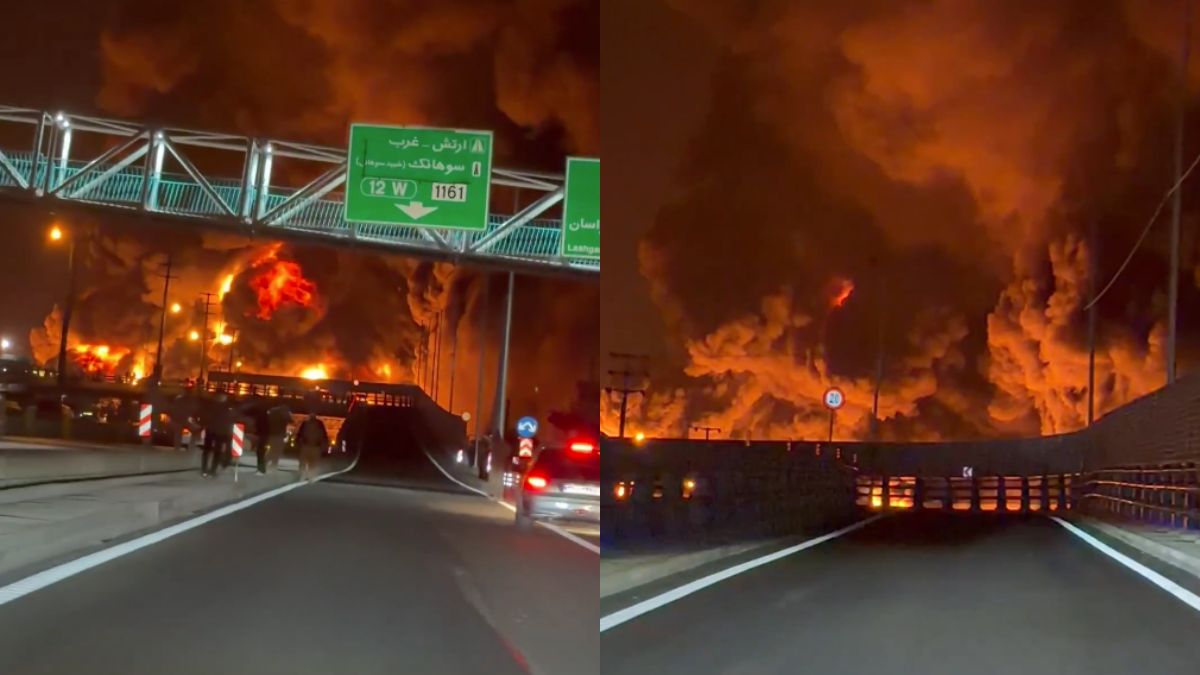







As the US and Israeli onslaught on Iran escalates, the question that is puzzling most analysts is why President Donald Trump, who declares that he wants to stop all wars, is starting one, that too in a region that has no good historical memories for the US. Many reasons, some of them surprising, have been put out by the White House and others, among which is that Iran was going nuclear, the regime change objective, and the most bizarre of all, that there was an imminent threat to the US, since a certain state was going to attack them anyway. That's not international relations, that's an excuse.
Trump's Ever-Changing Motives
Take those one by one. First, the charge that Iran was going nuclear was dismissed by Rafael Grossi, head of the International Atomic Energy Agency (IAEA), saying there was no structured programme on. He did qualify it by saying that the organisation had not been given full access to its 'near weapons-grade' uranium, meaning it could not provide full assurance.
Then came the statement by Omani negotiators that Iran had agreed to "zero accumulation, zero stockpiling, and full verification" by IAEA inspectors. Yet, the war started the next day.
Then came Peter Hegseth, who said that regime change was not the objective, but to destroy Iran's missile programme and navy, a point never earlier raised in negotiations. Israel's motives are clear given that Iran has never accepted the existence of Israel. Publicly, it said that it saw an opportunity to kill Ayatollah Khamenei, and took it. With US 'body bags' now reaching a reported six, and serious destruction of US assets in Qatar among others, the determination of Washington to go for a war that other Presidents refused despite Israeli cajoling, has analysts puzzled.
A Single Chinese Thread
Consider the recent regime change in Venezuela, the now desire for a 'peaceful takeover' of Cuba, and the Iran issue. The common factor in all of these is primarily this: all of these countries were trading their oil or good with China in yuan, with two routing cheap oil to China in the process. Venezuela's President Maduro had declared that the country would free itself from the US by using the yuan as currency in its oil trade. As sanctions intensified, Venezuela reduced discounts to China from $15 to $13 below Brent crude, much of it on black market trade, with this reaching 80% of totals. Chinese companies also held 440 million barrels of reserves in Venezuelan oil fields.
Remember that trade includes everything from refineries, the oil itself and all associated infrastructure, all of it in yuan.
Iran's Yuan Deals
In 2012, Iran negotiated a yuan deal through Russian banks, and thereby bought Chinese goods and services. Major Chinese companies were still chary of going against sanctions, and seem to have found another route, with oil transported via Malaysia. They paid through a small unknown bank. A completely dollar-free trade that saw cheap Chinese goods being imported by Iran and oil discounted at $8-$10 per barrel. In 2021,the China-Iran Agreement spanning 25 years set new benchmarks for trade, and by 2025 China bought more than 80% of Iran's shipped oil, imported by sea and bought by small refiners. China was also aiming at ending Teheran's isolation by including it in BRICS+ (Brazil Russia India China South Africa) grouping, against which Washington had no hesitation in warning of 'de-dollarisation' as an act against US interests.
And Cuba
Cuba's China deal is slightly different. From 2008 onwards, China's Exim Bank began to invest in the country, refurbishing its antiquated oil infrastructure, with a $6 billion funding in 2010 for a massive refinery, thus knitting it into a wider plan for tapping oil from the Gulf of Mexico. A CNG terminal is also being planned. This did not eventually materialise, but trade was in yuan, with the country integrating into the Chinese payment system, thus further increasing the yuan component. The importance of Cuba is apparent from an unusual statement from the Chinese Ministry of Foreign Ministry spokesperson Lin Jian recently, who said China "will do what it can" to assist Havana , though he did not name that action, as Havana grapples with economic and energy crises due to the stopping of oil from Caracas.
It's Not Just Oil
To analyse, the most likely reason for the war seemed to be the US's - and the UK's - historical fights to take control of oil. Margaret Thatcher is quoted as openly talking of protecting oil interests in Jordan in its intervention in 1958. Chuck Hagel, Secretary of Defence under President Obama, derisively noted that in interventions, "We're not there for figs".
But this is before the Shale oil revolution. Today, the US is the world's largest oil producer and has been a net exporter since 2021. So, it's not just oil. There is speculation that the whole approach is designed to deny China energy sources. This is possible too. But China has several alternatives, apart from holding their own massive strategic reserves of 1.3 billion. Rosneft exports 200,000 bpd via the Kazakhstan-China oil pipeline and probably most of the 600,000-700,000 bpd sent to China via the Eastern Siberian Pacific Pipeline. Exact volumes are unclear. The Venezuela supply, evident in Malaysia 'exporting' more crude than it actually produces, will hit, but there are other sources like Iraq, Brazil and Saudi Arabia. It will affect China, but not half as much as India
That Ultra-Secret Petrodollar Deal
Leaving out the fact that others like Saddam Hussein also sought to trade in yuan, the present reality is a steady downgrading of the US dollar. The yuan has been steadily rising, briefly overtaking the euro in 2024, as the second-most used currency in global trade finance, but still about 5.8% of the market versus the dollar's 82%.
Remember that once, the Bretton Woods system had pegged every currency to the dollar, which was backed by gold. That system collapsed in the wake of a deprecating dollar, and the Oil Crisis of 1973, and banks began turning back to gold. In June 1974, an agreement was signed with the Saudis, which spoke of 'economic cooperation' but said nothing of the actual deal, which was to price oil in dollars and to recycle revenues into US Treasury securities in return for military protection and sales of advanced weaponry. This later extended to the rest of the Gulf Cooperation Council (GCC). Notably, such arrangements include not just oil, but the entire upstream and downstream industry, all of which ensured not just that the US dollar reigned supreme, but, as Bloomberg notes, led to the Saudis underwriting US debt to the tune $117 billion (in 2016), Even at the time, this was considered just the tip of the iceberg, with a welter of data including all GCC states. In short, the strength of the dollar was maintained by oil and its linked industries.
Now that system is collapsing, as China buys in yuan, including with such reports coming from Saudi Arabia since late 2025. Others including India are paying for oil , and increasingly trade, in national currencies. India's trade in rouble with Russia doesn't really count for much - since the rouble is not now a traded currency - but it still reduces dependence on the dollar. Alongside, in a repeat of history, more and more Central Banks in the developing world are opting for gold to back their currencies, as the US weaponises the dollar.
In sum, if the trend is allowed to continue, that will break the back of the dollar system. The Iran war certainly seeks to limit oil to China, but it is about much more. The future of the US currency primacy is at stake. And for a businessman President, nothing matters more.
Meanwhile, to predict future wars, just look to see who is trading in the yuan.
Tara Kartha is a former Director, National Security Council Secretariat
Disclaimer: These are the personal opinions of the author


