Opinion | Trump's Claims vs Numbers: Can India Really Replace 87 Million Tonnes Of Russian Oil?
US and Venezuelan exports, even when taken together, fail to match the huge volume of crude India has been getting from Russia.
The stroke of midnight has historically been an important moment for landmark happenings in India, from gaining independence in 1947 to the recent agreement on the India-US trade deal. This comes amidst a constant state of tariff influx on India. In August 2025, Trump signed executive actions adding an extra 25% tariff on Indian imports as a punitive response to India's continued purchases of Russian oil. This was imposed on top of an existing 25% duty, bringing total US tariffs on many Indian goods to around 50%.
India has been constantly attributed by the US as having one of the highest tariffs in the world, with the country being termed the "Tariff King". This discontentment largely stems from the fact that India enjoys a trade surplus with the US. In FY25, India had a trade surplus of USD 40.82 billion with America. This is just one face of this quagmire, another being India's purchase of crude oil from Russia amidst the ongoing conflict between Russia and Ukraine. Though the final details are yet to be out, one of the things believed to be part of the agreement is India's purchase of a higher quantity of crude oil from the US.
The Math of Substitution
Let's dive deeper into the idea of India substituting Russian oil with that from the US and Venezuela. The idea looks promising theoretically, but the trade figures and overall trade scenario point to something absolutely different. This analysis is strictly based on international trade aspects, without taking into consideration political factors or the enhancement of crude oil capacity in the exporting countries.
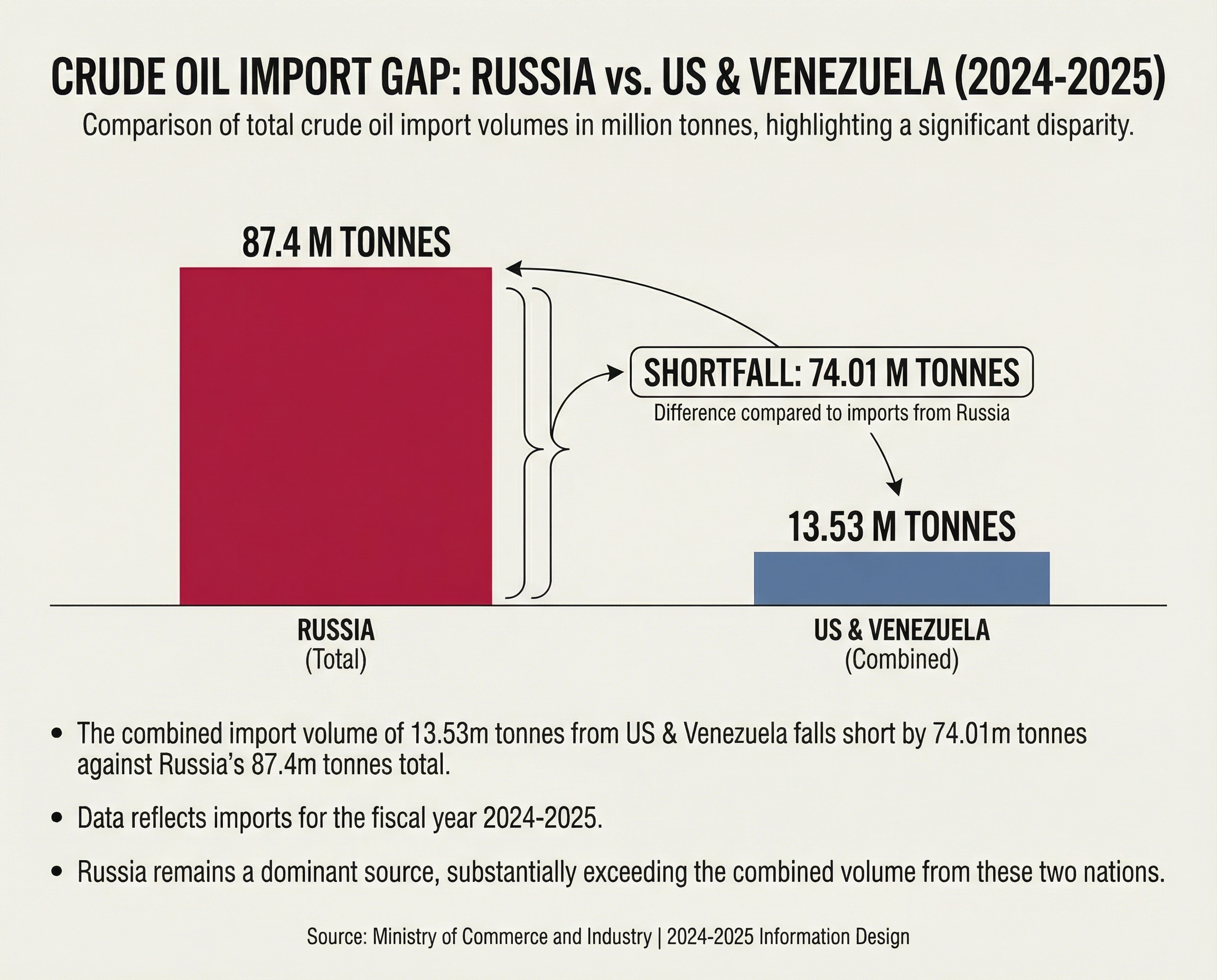
According to data from the Ministry of Commerce and Industry, India imported about 87.54 million tonnes of crude oil from Russia in the year 2024-25, registering a growth of about 72.1% from the year 2022-2023. On the other hand, India's imports of crude oil from the US were just 10.55 million tonnes in 2024-25, which in fact was a decline of about 30.4% from 15.16 million tonnes in the year 2022-2023.
In the case of Venezuela, India imported 2.98 million tonnes of crude oil in the year 2024-25. The growth in the case of Venezuela on a year-on-year basis from 2023-2024 to 2024-2025 was 74%, with zero imports in the years 2021-2022 and 2022-2023.
It's also important to note that the US exports the largest quantity of oil to Mexico (according to data from World Integrated Trade Solution), exporting about 26.50 million tonnes in the year 2024-2025, with a downward growth trajectory of about 27% from 2022-2023.
On a combined basis, India imported about 13.53 million tonnes of crude oil from the US and Venezuela in the year 2024-2025. Even this falls short by 74.01 million tonnes when compared to imports from Russia for the year 2024-2025. This pattern repeats itself for the years 2022-2023 and 2023-2024. Though oversimplistic, this analysis reveals that, keeping production capacity and political factors constant, the US and Venezuela would not be able to substitute Russia for crude oil imports.
Let's consider another ambitious scenario wherein the US diverts all its crude oil exports from Mexico to India. Even in that case, the combined capacity would only reach 40.03 million tonnes as per the 2024-25 data, again falling short by about 47 million tonnes when compared to crude oil imports from Russia.
India has registered a year-on-year growth rate of about 37% in crude oil imports from the US for the years 2023-2024 to 2024-2025. At a 32% annual growth rate, it would take approximately 4.5 to five years for American crude oil imports to reach the current level of Russia's imports. Venezuela's imports have grown at a 72% year-on-year rate. At a 72% annual growth rate, Venezuela alone would take approximately 6.2 to 6.5 years to reach the current level of India's crude oil imports from Russia.
The weighted average growth rate of US and Venezuela crude oil imports is approximately 40.8% per year for the year 2024-2025. At a 40.8% annual growth rate, it would take approximately 5.5 years to reach Russia's 87.54 million tonnes. In any case, such sustained growth seems highly improbable in the current volatile environment with conflicts raging across several parts of the world.
Divorced From Reality
The analysis clearly shows that while the idea of substituting Russian crude oil with supplies from the US and Venezuela may appear attractive at a theoretical level, it does not align with current trade realities. Venezuela has been dealing with internal political conflicts. The sheer scale of India's crude oil imports from Russia, coupled with declining or limited export capacities and unrealistic growth assumptions for alternative suppliers, makes such substitution structurally unviable in the near to medium term. Even under highly optimistic scenarios of sustained and accelerated growth, the time required to bridge this gap remains significant.
In this context, energy policy choices cannot be viewed in isolation from ground realities. For a developing economy like India, with rapidly rising energy demand, affordability, reliability, and continuity of supply remain paramount. While geopolitical pressures and trade negotiations will continue to shape discourse, India's energy security and economic stability must remain central to any strategic decision-making.
(The author is a research consultant at the Chintan Research Foundation)
Disclaimer: These are the personal opinions of the author
-
Why Doesn't Congress Boycott If Polls Are "Fixed"? Answer Lies Beyond Rahul Gandhi's "Distraction" Quip

The starkest demand for a boycott has come from outside the political Opposition, from the Cockroach Janta Party. But does a boycott help? Here's what research, examples, and expert analysis tell us.
-
'Sully' To Gimli, Sioux To Patna: When Pilots Got It Unbelievably Right
Captain Smit Machchhar fought off his co-pilot after being stabbed and opened the cockpit door, saving 174 people.
-
Opinion | Are Saudi Arabia And UAE Reuniting Again After 10 Years?
On Tuesday, the UAE's Vice President, Deputy Prime Minister and Chairman of the Presidential Court, Mansour bin Zayed, met Saudi Crown Prince Mohammed bin Salman.
-
Opinion | 'Lies, Damned Lies, Statistics': On The Controversy Around India's GDP Growth Figures
The debate is less about a single figure than about a decade-long erosion of trust in official statistics.
-
Opinion | Why India Cannot Keep 'Overestimating' Its Value To Washington
Some of India's value to Washington came from the tension between the US and China. That is changing now.
-
Opinion | India Has A 'Lobbying' Problem In Washington, And It Has Come Back To Haunt It
While the EU, Japan, the UK and South Korea secured quick deals, India's efforts were getting drained in prolonged negotiations and the wrong kind of lobbying.
-
India Is Getting Old Before Getting Rich, Will Turn 'Aged' In 16 Years: Moody's
Countries with the steepest fertility declines today will age the fastest in the coming decades. India's drop has been steep.
-
Opinion | Why Does Trump Want To Sell Arms To A US 'Adversary'? Inside His Strange Bargain
Trump's aides maintain that no such offer had been made. But the story points to a larger strategy
-
Opinion | The AI Boom Has Run Into A Big 'Debt' Trap Problem. Inside The 5% Danger Line
For most of the AI buildout's first two years, hyperscalers funded it the easy way: out of operating cash flow. That era is over.