The Beijing Spectacle: Two Weary Giants Carve Up Their Share Of The World
Rather than fighting to the death for absolute global hegemony, Washington and Beijing are learning to partition the global commons - with the rest of the world forced to watch from the periphery.
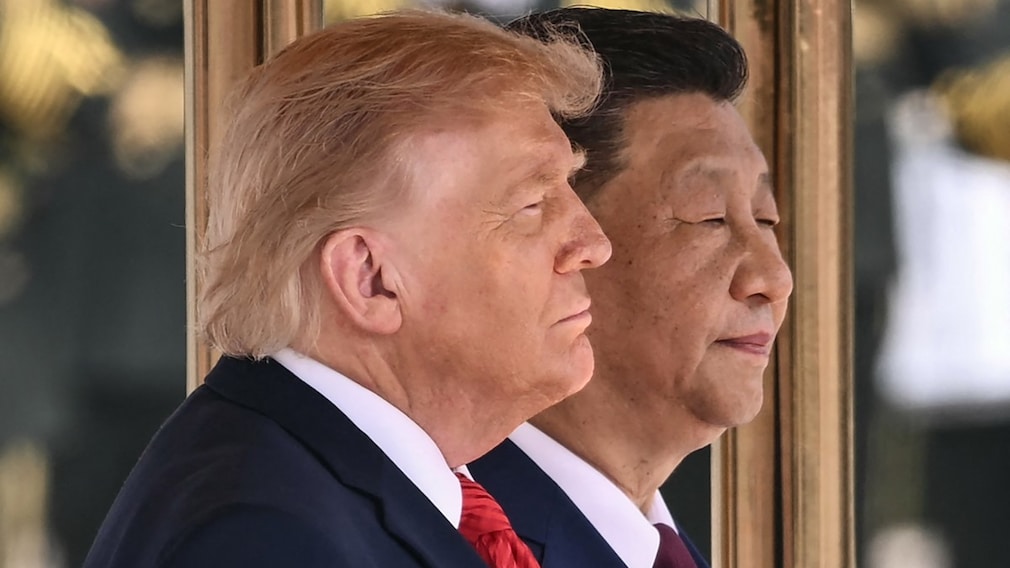
A striking image recently rippled through digital communication networks globally, capturing the attention of foreign policy observers and laymen alike. It depicts the President of the United States bending noticeably low, his spine curved in a posture that borders on deference, to take the firmly extended hand of Chinese President Xi Jinping. In an era dominated by hyper-realistic deepfakes and algorithmic manipulation, the image may well have been doctored - an artificial artifact designed to provoke the denizens of WhatsApp University. Yet, its viral currency stems from a deeper, psychological truth. The photograph conveys a potent conceptual narrative: Donald Trump travelling east as a diplomatic supplicant, executing a high-stakes charm offensive to court the favour of the Middle Kingdom, while Xi receives him with immaculate, imperial fanfare, offering immense theatrical hospitality but yielding absolutely no structural or geopolitical concessions. Beneath the curated optics of the Great Hall of the People, Beijing drew its red lines with absolute clarity, leaving little doubt that the global architecture is undergoing a profound and permanent architectural shift.
That Band Of CEOs
What the international community witnessed in Beijing was, fundamentally, a grand spectacle of statecraft. It was a production punctuated occasionally by transactional commercialism - packaged announcements of Boeing jet purchases and massive bulk orders of American soybeans - designed primarily to provide the American president with tangible domestic trophies to carry home on the weekend. Yet, even these commercial breakthroughs felt archival, functioning as superficial emblems of an older, mercantilist era. The retinue of marquee American chief executive officers who trailed the president through the crimson corridors of power did not resemble independent, hard-nosed global dealmakers. Instead, they performed a role more akin to modern factotums and courtiers, a corporate vanguard deployed to validate Trump's presence and add a veneer of industrial might to a deeply personalised executive pilgrimage.
The images broadcast to the world by Beijing from the Trump visit were meticulously produced, controlled, and distributed by Chinese state media apparatuses, reflecting an unmistakable, classical power aesthetic: a composed, serene, and immovably anchored Xi receiving a restless Western head of state who sought validation without receiving the structural kowtow. Both leaders were performing deftly for their respective domestic audiences, orchestrating a media event with a remarkably brief political half-life.
The Thucydides Trap, Reimagined
Yet, beneath the glittering theatre of the summit, a far more durable and historic reality is quietly taking shape. For over a decade, the transatlantic foreign policy establishment has lived under the dark shadow of the "Thucydides Trap" - the fatalistic realist construct, popularised by academic seminars, asserting that any rising revisionist power must inevitably collide in conflict, and probably warfare, with a dominant status-quo hegemon. Today, with Xi's China showing little appetite for armed conflict, that terrifying framework looks less like an iron law of history and more like a rigid, theoretical abstraction. Indeed, the common deployment of the Thucydides metaphor rests on a fundamental misreading of ancient history. The Spartans and Athenians did not exist in a permanent state of total kinetic warfare; rather, they coexisted across centuries of Greek civilisation, establishing complex networks of deterrence, trade, and regional accommodation. The Peloponnesian War was a tragic, bounded interlude, not the permanent organising structure of the ancient Mediterranean world.
Live And Let Live
What is actually emerging from the smoke of the 21st-century trade wars is not an inevitable military apocalypse, but a pragmatically managed, highly segmented spheres-of-influence settlement. Rather than fighting to the death for absolute global hegemony, Washington and Beijing are learning to partition the global commons based on their respective comparative advantages. The United States retains (at least for now) its structural dominance in pioneering high technology - commanding the software architectures, artificial intelligence frontiers, and the unmatched liquidity of Western financial markets. China, conversely, has consolidated its position as the world's foremost manufacturer and its pre-eminent physical trader, controlling the supply chains that undergird global material life. It is a division of labour born of mutual vulnerability and strategic exhaustion: a digital and financial empire in the West balancing a manufacturing and logistical colossus in the East.
Within this emerging bilateral matrix, Taiwan remains the one genuine, highly volatile flashpoint - a geographic and technological node capable of disrupting the entire global peace. Yet even here, a realistic, cold-blooded recalibration appears underway, conveyed by the American president's own characteristically transactional rhetoric during his stay in Beijing. By publicly reflecting on the brutal, immutable mathematics of distance - noting that the island of Taiwan is merely 59 miles from the Chinese mainland while remaining a vast 9,500 miles away from the American coast - Trump signalled an embrace of geographic realism over ideological commitment. This raw calculation reveals a changing strategic calculus. As the United States aggressively "onshores" its advanced semiconductor manufacturing capabilities and builds secure domestic chip foundries within its own borders, the foundational economic rationale for defending Taiwan begins to dissipate. Once the high-tech supply chains are structurally insulated, the old, ambiguous treaty commitments of the mid-20th century risk being quietly minimised, reinterpreted, or forgotten altogether.
This geopolitical containment of risk is further stabilised by a mutual recognition of military limitations. The Chinese leadership has consistently demonstrated a remarkable lack of appetite for overt, destabilising kinetic conflict, preferring the patient, asymmetric methods of economic coercion, maritime encirclement, and institutional capture. Concurrently, the American political establishment is learning the hard way that its overstretched empire cannot easily sustain or finance far-flung, prolonged military engagements in the terrifying context of modern electronic, drone-saturated, and hypersonic warfare. Even Iran, a much less formidable foe than China, has been able to hold off the ravages of the American imperium. The Beijing summit, therefore, reads like a historical preamble to a highly stabilised, bipolar future. It heralds an era defined by considerable verbal posturing, performative nationalism, and ritualistic sabre-rattling on digital platforms, punctuated by occasional live summits where heads of state gather to toast the stability of their managed partition with Chinese Moutai and California Cabernet.
Does The Rest Of The World Have Any Say?
As this new bipolar architecture hardens, the rest of the world is forced to watch from the periphery, navigating an increasingly treacherous diplomatic landscape. For the world's middle powers, including India, the solidification of Washington and Beijing's duopoly presents an acute, existential dilemma. These states, rich in institutional history, democratic pretensions, and diplomatic ambitions, find their strategic autonomy severely constrained. They are left to wonder which superpower makes the more reliable or attractive patron, or whether it is possible to survive in the spaces between the two spheres.
To align too closely with Washington's financial and technological architecture risks economic retribution from the world's premier trading state; to lean into Beijing's manufacturing embrace risks excommunication from the core institutions of Western capital and security. China has already weaponised its monopoly on rare earth minerals and other vital export assets Indian manufacturers cannot do without. America, too, has levied swingeing tariffs on us, now reduced but capable of being restored at any time. The theatre in Beijing has made one truth undeniable: the global order is no longer a unipolar playground, there are two main actors on the stage with one playing an ever more significant part - and the margins for error for the rest of the world have never been thinner.
(Shashi Tharoor has been a Member of Parliament from Thiruvananthapuram, Kerala, since 2009. He is a published author and a former diplomat)
Disclaimer: These are the personal opinions of the author
-
The Real Story Of France's Unrest Is Getting Lost In A Storm Of Online Lies

A man cosplaying Napoleon on the streets, looting at luxury fashion stores like Dior, France is currently confronting one of its most serious episodes of civil unrest in years.
-
Opinion | The Last Bet? What Trump's 'Mother Of All Bombs' Could Actually Do To Iran
Can an MOAB deliver a decisive blow to Iran that may force it to surrender immediately, as Japan did after Hiroshima and Nagasaki in World War 2?
-
Hit Songs, Empty Pockets: The Hidden Math Behind India's Viral Music Boom
Over 80,000 brands and five lakh creators in India make branded content. The opportunity is worth around Rs 1,500 crore.
-
Opinion | Great 'Exceptions': How The Oil India Was Attacked For Is The Oil Trump Now Seeks
A law written to punish the buyers of Russian oil was suspended by the US to protect a purchase of Russian oil. India spent fourteen months being lectured for less.
-
Opinion | Louis Vuitton Loot, Torched Cars: France Protests Have An Unlikely Beneficiary
It's an unbelievable moment. Crowds looting the most exclusive stores in Paris, including the famed Luis Vuitton. But what's behind this meltdown?
-
Blog: Kolkata Didn't Learn From 2015. Eleven Years Later, It Proved To Be Fatal
The City of Joy isn't a stranger to crowd control. Be it during Pujo or Christmas at Park Street, Eden Gardens cricket matches, or Derbies between Mohun Bagan and East Bengal. But during Pujo, the entire city is on alert.
-
Opinion | Slurs, Threats, Now A Temple Attack Plot: When Did America Become So Hostile To Indians?
The rising tide of anti-India, anti-Hindu, and racist attacks serves as a stark reminder that economic prosperity does not automatically guarantee social immunity from bigotry.
-
A Step Behind Neha Bora: What Rahul Gandhi's Gesture Says About Congress' Gen-Z Pitch
At INDIA bloc's march to Supreme Court, Rahul Gandhi placed himself a step behind two women, hands resting on their shoulders. One was his sister Priyanka. The one on his right was Neha Bora. Here's what the image means for the protest wave now, and for Rahul's politics in general.
-
Opinion | Imran Khan, And The Perils Of Having An 'Opinion' In Bollywood
The reality of the industry is quite grimy. More often than not, its inhabitants have been fairweather friends, happy to sing the praises of whoever is in a position of authority.
-
Exclusive: India's Food Safety Problem Goes Beyond Just Dirty Kitchens - By Tukaram Mundhe
On World Food Day, Maharashtra's Commissioner of Food Safety explains why instead of taking stopgap measures, the entire supply chain in India needs to be held accountable and made transparent.