Opinion | Trump Has Well And Truly Shot Himself In The Foot With China
So, China has been able to use its rare earth policy to extract concessions on US high-tech exports. In other words, Trump has shot himself in the foot, something inconceivable before the trade war.
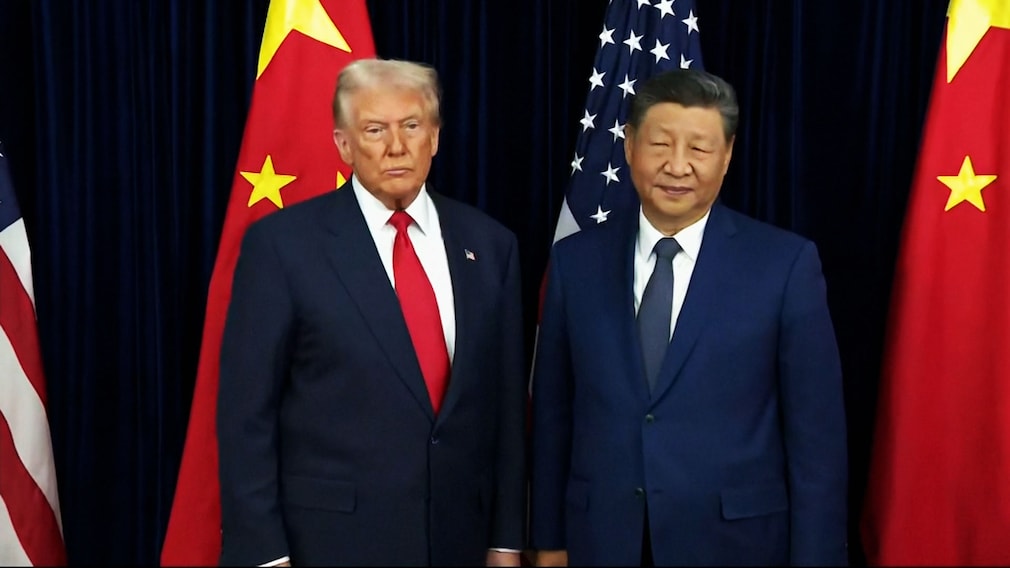
Their body language at the meeting in South Korea last week spoke volumes. Trump was animated but looked nervous. Xi was calm, showing hardly any emotions. When Trump came forward for a handshake, Xi stood unblinking. He even whispered in Xi's ear, something the Chinese dislike. Trump heaped praises on Xi for his leadership, a kind of flattery the US leader is accustomed to receiving for himself from other world leaders. Xi was unmoved and acted according to his plan.
Trump called his meeting with Xi "amazing" and "great success" and gave it a rating of 12 - on a scale of one to 10. The Chinese side didn't show such enthusiasm, but it knew that Xi had managed to secure a major victory for his country over the US and trumped the American president again.
Trump was desperate for a deal with China to end the trade war he started in April. Xi only offered him a truce. He didn't give up very much, largely withdrawing measures he'd taken in response to Trump's policies. In return, Xi won key concessions from Trump, which could have security implications for the United States.
China agreed to suspend for 12 months its latest export control measures on rare earth minerals, crucial for the production of almost every modern product, from smartphones to fighter jets and advanced military systems. It also agreed to resume the purchase of soybeans, which it stopped after Trump's tariffs, threatening the livelihood of American farmers and hurting Trump politically.
The Deal With The Chip
Trump agreed to reduce tariffs on Beijing and suspend port fees on Chinese ships. But he also decided to suspend US export controls that would have barred more Chinese firms from accessing advanced American technology, a move that has alarmed China hawks in the US.
The US security establishment will be even more concerned with Trump giving the green light to the American tech giant Nvidia to discuss the sale of advanced AI chips, which Beijing is keen to procure. Trump, though, asserted that he and Xi had not discussed access to Nvidia's state-of-the-art Blackwell chip.
Despite achieving remarkable progress in recent years, China is still not able to produce such chips. By allowing China to access these chips, Trump has been accused of helping America's most powerful rival to further not only its quest for dominance in AI but also its efforts to upgrade its military capabilities. A day before the Xi-Trump meeting, the US House Select Committee on China warned that selling AI chips to Beijing "would be akin to giving Iran weapons-grade uranium".
The White House denied that the Trump administration had reversed America's decades-old export control policy. "Any notion that President Trump is willing to make trade-offs between our national and economic security is flat-out false," said Kush Desai, the deputy press secretary. But if China manages to receive advanced American chips from Nvidia, Trump will not be able to escape those allegations.
A Trump-Made Crisis
This has been a crisis of Trump's own making, which began with his "Liberation Day" tariffs. In his first term, he himself tightened exports of cutting-edge technology to Beijing, when the United States took the China threat more seriously. His administration raised alarms about Beijing's growing technological prowess, its military buildup and its dominance over the critical minerals industry, and slapped sanctions. The Biden administration not only continued with these measures but imposed some of its own.
When he started his second term, Trump appeared set to continue those policies of containing China. He signed a document in February that promised to set new rules to prevent Beijing from exploiting what he called America's "crown jewels".
He was also aware of China's control of critical minerals, which explained his proposal to buy Greenland and to sign an early deal with Ukraine to exploit their massive reserves of rare earths. After Trump's meeting in Washington on February 13 with Prime Minister Narendra Modi, the two leaders announced the launch of the Strategic Mineral Recovery initiative, a new US-India programme to mine and process rare earths.
But what Trump didn't realise was that Beijing would weaponise critical minerals and put a chokehold on the US economy. When Trump launched his trade war against China in April, threatening tariffs as high as 145%, the Chinese government said it would never bow to blackmail and vowed to "fight to the end".
China Was Planning All Along
In fact, China has been planning for a war with the US - both trade and military - for at least a decade as part of its policy of taking a long-term view of its challenges and strategies. Soon after he came to power in 2012, Xi focused his country's economic policy on building China's high-tech manufacturing prowess. In 2015, he launched a ten-year Made in China policy to make the country self-reliant in high technology and energy. Most of its objectives have been fulfilled.
At the same time, Xi also asked his officials to find new markets for its products to reduce its dependence on the US and other Western countries. Thanks to that planning, China's global trade surplus this year is expected to be $1.2 trillion - higher than last year, more than making up for any losses in the US after the trade war. And this is not due to just China's export of critical minerals, which Xi has used as a weapon against the US.
Last December, Beijing first introduced restrictions on rare earth mineral exports, which it expanded in April in response to Trump's tariffs, a response that caught the Trump administration off guard, forcing it to compromise. Xi also realised how potent that weapon was, which he has now used more frequently. After the US added 10,000 Chinese firms to Washington's list of sanctioned companies in September, Beijing announced a tough licensing regime on the export of rare earths and the technology to process them.
Trump's Self-Sabotage
The Trump-Xi meeting halts the implementation of that licensing regime for a year, in exchange for the US also suspending its export controls on China at least for that duration. So, China has been able to use its rare earth policy to extract concessions on US high-tech exports. In other words, Trump has shot himself in the foot, something inconceivable before the trade war.
The 12-month truce with China may seem like an opportunity for Trump to work on a better and comprehensive deal and to find alternatives to China. In reality, though, it buys Xi time to push China further ahead in technologies of the future and reduce its dependence on the US. The 12-month period is also a very short time for the US to develop alternative sources of critical minerals.
Whether China and the US agree on a trade deal or continue to escalate or de-escalate, their actions have wider implications for India and the rest of the world. Caught between an assertive Beijing and an unreliable Washington, other countries will need to find their own path while devising strategies to deal with the two superpowers. Trump and Xi are too focused on bilateral relations. Both see other countries as markets for their produce. Unlike the Cold War era, the allies of the superpowers now hardly have any say.
Europe is now working on an independent defence policy. Hurt by Trump, Canada is now looking for new friends in Asia and working to improve relations with India. Japan, South Korea and Australia are forging closer ties with India, while continuing to embrace security cooperation with the US.
The Challenge For India
For India, the challenge is bigger. Any deal between China and India will have implications for New Delhi. Despite the exchange of pleasantries between Modi and Trump in recent weeks, India still faces the highest US tariff of 50%, along with Brazil. Trump has not even suspended the 25% tariffs he slapped on India for buying Russian oil. Although relations with China are improving, one can't deny the fact that Beijing remains our main strategic rival.
India is already diversifying markets for its products to reduce dependence on the United States. It has already signed a trade agreement with the UK and is at an advanced stage of concluding one with the European Union. It's also working more closely with African and South American countries.
New Delhi can learn from China and work to become more self-reliant, particularly in the defence and high-tech sectors. AI data centres are power hungry, so achieving a high growth rate in the energy sector should be a priority. The Trump administration's action on H-1B visas is an opportunity to develop India's high-tech industries. Despite the largest pool of engineers in the world, no Indian company currently finds a place in the world's top 100 tech companies. This can and must change.
It's believed in the West that Trump has hurt US interests by singling out India for Russian oil purchases and hobnobbing with Pakistan. Trump tariffs have already hit the American economy. They have adversely affected global supply chains, for which India has been a crucial partner. If the US regards China as its primary strategic threat - which is true - then it can't afford to isolate India. Perhaps Trump also knows that and the transactional businessman in him is persuading him to keep the pressure on to extract more concessions.
(Naresh Kaushik is a former editor at the Associated Press and the BBC News. He is based in London.)
Disclaimer: These are the personal opinions of the author
-
Before The Nepal Flood, A Glacial Fall: Tracing The Trigger, And A 100-km Killer Surge

A glacier came off a ridge on the Nepal-China border and travelled 100 km down multiple rivers, the longest part of the run being in the Trishuli.
-
Opinion | China To Pak To America, The Growing Dilemmas Of The 'General'
Recent civil military turmoil in the United States, China and Pakistan can be understood through two lenses.
-
Census Asks 40 Questions. Why Number 10 Is A Battleground | NDTV Explains
The caste question is a fill-in-the-blank for everyone other than SCs and STs. But there's a case for making it a dropdown with set options. Let's decode the history and math behind the politics.
-
Opinion | Why India's Bureaucrats Have Learnt That Doing 'Nothing' Is Safer
India's bureaucracy has perfected a peculiar survival strategy: make a decision, you may be punished; make none, and you are usually safe.
-
Opinion | 482 Dead, And Counting: How A Glacier Collapse Became A Himalayan Disaster
What looks like a sudden flood is actually the final link in a chain of events unfolding across an increasingly unstable Himalayas
-
Opinion | Rahul Gandhi Is Cleaning House - But At The Cost Of The Congress
In his search for a new organisation, Rahul Gandhi is making the big mistake of treating the Congress he inherited as dead weight.
-
One-Day Disaster, Multi-Season Economic Shock: Nepal's Sisyphean Curse
Nepal Flash Floods: Nepal cannot prevent every earthquake, landslide or glacial collapse. But it can reduce how much each disaster costs.
-
Meta Pays Billions Over Teen Harms In US. In India, Algo Runs Unchecked
The US Surgeon General has separately warned that heavy social media use roughly doubles adolescents' risk of depression and anxiety, and that nearly half of teens surveyed said it made them feel worse about their bodies.
-
Blog | 'No Calls, People Scanning Banks For Bodies': Nepal Journalist Describes Flood Aftermath
As of Thursday evening, it was still impossible to get through to mobile phones in Dhunche, the district headquarters, or the flood-ravaged towns of Syabru Bensi or Timure.
-
Opinion | Toxic Knows Exactly What It Is Doing To Its Hero. And You May Have Missed It
Toxic's bait-and-switch goes beyond its plot. Geetu Mohandas is almost making a subtle point - for those who can see it.