Opinion | The 'Real' Message To Trump And Pak In Taliban Minister's India Visit
To Trump, Taliban has made it clear that it is in no mood to rekindle American presence in Afghanistan. And to Pakistan, it seems to be signalling a newfound independence in its policies and activities.
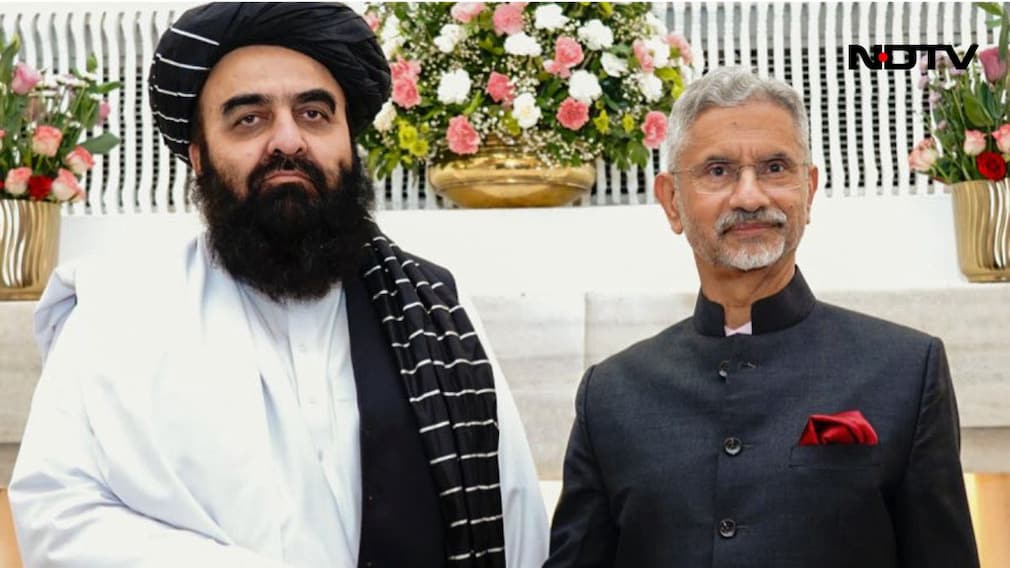
In what is being billed as a landmark visit, Taliban acting Foreign Minister Amir Khan Muttaqi began a week-long trip to India yesterday. This is the first ministerial-level engagement between India and the Taliban since the group's return to power in August 2021 and follows a temporary travel exemption granted by the UN Security Council's Taliban Sanctions Committee on September 30, lifting Muttaqi's long-standing travel ban.
Upon arrival, Muttaqi was welcomed by India's Ministry of External Affairs spokesperson, Randhir Jaiswal, who said New Delhi looked forward to "engaging discussions on bilateral and regional matters". Muttaqi has been holding meetings with External Affairs Minister S. Jaishankar and National Security Advisor Ajit Doval, and will also visit the Taj Mahal, Darul Uloom Deoband, and Afghan community representatives during his stay.
A Massive Shift In India's Approach
India had been amongst the last countries in the region to open channels of communication with the Taliban, when it was imminent that the US would withdraw from the country. But before that, it had been amongst the most consistent supporters of the Islamic Republic of Afghanistan, committing $3 billion to the war-torn country's reconstruction and capacity-building of the Afghan people.
India has not yet formally recognised the Taliban regime, and even ministerial interactions have been minimal. Till now, the first and only interaction has been when Minister of External Affairs S. Jaishankar held a telephone call with Muttaqi in the wake of Operation Sindoor. This visit, thus, heralds a massive, even if cautious diplomatic shift in India's approach to the regime.
The Message From Moscow
Muttaqi's Delhi sojourn follows a visit to Moscow, where he led a delegation for the first time and participated in the Moscow Format of talks on Afghanistan. The Indian Ambassador to Russia, Vinay Kumar, participated in the consultation along with representatives of Iran, Kazakhstan, China, Kyrgyzstan, Pakistan, Russia, Tajikistan, Uzbekistan, and, of course, Afghanistan. A joint statement was released at the end of the talks, where parties reaffirmed their unwavering support for the establishment of Afghanistan as an independent, united and peaceful state, and for strengthening counter-terrorism cooperation at both bilateral and multilateral levels "so that Afghan soil is not used as a threat to the security of the neighboring countries and beyond".
The statement made two key points. One was the aim to develop "regional economic projects with Afghan participation and ... the active integration of Afghanistan into the system of regional connectivity." The other was calling "unacceptable" the "attempts by countries to deploy their military infrastructure in Afghanistan and neighboring states, since this does not serve the interests of regional peace and stability".
Also Read | India Sides With Taliban, Pakistan, China, Russia Against Trump's Bagram Airbase Bid
The first points to the intent and determination of the participants of the talks - all in Afghanistan 's neighborhood - to continue building ties with and integrate Taliban-ruled Afghanistan in the regional economic, connectivity, and security framework. The second, on the other hand, was a thinly veiled reference to US President Donald Trump's demand to have the Taliban hand over the strategic Bagram air base to America. The Taliban leadership had refused to do so, and the joint statement from the Moscow Format talks reflects the opposition of all of Taliban's neighbours and regional countries to American or any other extra-regional presence in Afghanistan.
The Thorny Bagram Question
The Bagram issue may be far more complicated. Sources say that continuing with US military bases in Afghanistan is linked to the secret annexures of the 2020 Doha Accords that the first Trump administration signed with the Taliban, which, in turn, facilitated their return to Afghanistan. Muttaqi was a key interlocutor in these talks.
However, now, the Taliban leadership is hamstrung by the opposition of their other members and loyalists to a renewed US presence in the country, as well as that of its regional partners, on whom it is now dependent for trade, humanitarian aid, and, most importantly, the legitimisation of their regime.
Internal fissures in the Taliban also play a role, with divisions between the Quetta Shura and the Kandahar Shura, the pro-Pakistan and anti-Pakistan leaders within the Kandahar Shura, and so forth, starkly visible. Last night's bombing of Kabul by the Pakistan air force demonstrates just this.
A Break From The Past
What is important, nevertheless, is that India also joined in this statement, expressing its intent to deal with the Taliban, and, more importantly, conveying its opposition to renewed US presence in Afghanistan. This heralds India's alignment with the regional process and approach to the Taliban. It also indicates a shift in its Afghan policy from the days of the Islamic Republic, when New Delhi had aligned its interests with those of the US and NATO. Of course, this alignment had been imperative back then - think of the Taliban's close links at the time with the Pakistani Inter-Services Intelligence (ISI), the brutal hijacking of Indian aircraft IC 814, or the indiscriminate targeting of Indian personnel and workers in Afghanistan, or the Taliban's sheltering of Osama bin Laden and his Al Qaeda.
Also Read | Is Taliban's Social Media Ban Based on China Model? Here's The Inside Story
Now, however, in a startling demonstration that change is the only constant in this fickle world of ours, Muttaqi in his speech in Moscow has warned that terrorist organisations, such as Daesh, were setting up training and operational bases in neighbouring countries, which posed a growing regional threat.
Everything Has Changed
In fact, the singular risk of the emergence of Islamic State-Khorasan Province (ISIS-KP), which has wreaked death and devastation not just in Afghanistan but also in Iran and Russia - not to mention the dangers it poses to China and other Central Asian countries on the region - has been a major reason why countries from Russia to China, Iran to Uzbekistan have come around to recognising the Taliban as the de-facto rulers of Afghanistan. That's not all: the Taliban itself has been battling the very forces it had once aligned itself with. In Moscow, Muttaqi announced that Afghanistan faced threats from Daesh. In the four years it has been in power in Kabul, it has managed to take over much of the country, including the Panjshir Valley, which had been the stronghold of the opposition National Resistance. But no neighbouring country has been faced with any terror emanating from Afghanistan.
Pakistan Being Pakistan
The only country that has been at odds with it is Pakistan, but this is a result of the latter's own feckless policy of creating and nurturing terror groups, as well as its own indiscriminate bombing of Afghanistan's bordering provinces last December. This also proves that while the Taliban may have been created by Pakistan, it is no longer under the latter's control and is independent in its policies and activities, something that India welcomes.
Almost all regional countries and powers have extended the Taliban recognition. Russia became the first country this year to recognise them as the legitimate government of Afghanistan. Taliban envoys are also present in many other countries like China and Kazakhstan, with whom this author had the opportunity to meet and interact. Other countries like Iran, Uzbekistan, Turkmenistan, Kyrgyzstan, the UAE, Turkey, and, of course, Qatar and Pakistan, have been engaging with the Taliban for even longer.
Three main pillars undergird this recognition: regional security, as discussed above, trade and connectivity, and geopolitics.
A 'New' Taliban?
This Taliban is also not the Taliban of the past. Since taking over Afghanistan, they have made numerous overtures to the international community, including India, promising good neighbourly relations as well as security. The Taliban has on many occasions pledged against permitting Afghan territory to be used as launchpads for attacks on other states, something that has held true. It is also seeking investors and trade partners to develop its economy, without which its rule would be unstable. The freeze by the UN on some $9 billion Afghan foreign reserves has added to its woes.
Next, Afghanistan is a resource-rich country, whose geostrategic location at the heart of Asia makes it a natural roundabout connecting South and Central Asia. The trade routes through the Af-Pak region are the shortest ones for countries of both South and Central Asia for accessing each other's goods and markets, while Afghanistan reaps major transit dividends. In the same vein, India's Chabahar Port was intended for accessing not just Afghanistan but also, through it, the markets and resources of Central Asia.
India Is Playing It Safe
Finally, from a geopolitical point of view, neutralising any threats from Afghanistan is important for India as it faces renewed hostility from Pakistan and trade hostility from the US, which is now realigning itself with Islamabad. Moreover, there are fresh intelligence reports that the ISIS-KP is aligning itself with Pakistan-based terror groups, such as the Lashkar-e-Taiba (LeT). For Russia, China and Iran, locked in conflict with the West, it is important to align geopolitically with Afghanistan to preempt it from again becoming a base for Western powers.
India is now following a regional approach. It is protecting its strategic interests in the region while hedging against any threats. For, in spite of extending recognition to the Taliban and the latter walking the talk on preventing terror threats emanating from its territory, grey areas persist. One of them pertains to the internal rifts and rivalries that plague the organisation, and which can spill across its borders. Next are the Taliban's domestic policies towards sections of its own population - in particular women, girls, and minorities, which have brought it much global infamy.
India has always followed a non-prescriptive policy regarding every country. Still, practising democracy and the rule of law at home while turning a blind eye to a medieval regime goes against India's own values. By building bridges with the Taliban and continuing its humanitarian aid and capacity-building for the Afghan people, India can, as it has always done, encourage the regime to rethink many of its domestic policies.
(The author is a journalist and political analyst)
Disclaimer: These are the personal opinions of the author
-
Opinion | The Last Bet? What Trump's 'Mother Of All Bombs' Could Actually Do To Iran

Can an MOAB deliver a decisive blow to Iran that may force it to surrender immediately, as Japan did after Hiroshima and Nagasaki in World War 2?
-
Hit Songs, Empty Pockets: The Hidden Math Behind India's Viral Music Boom
Over 80,000 brands and five lakh creators in India make branded content. The opportunity is worth around Rs 1,500 crore.
-
Opinion | Great 'Exceptions': How The Oil India Was Attacked For Is The Oil Trump Now Seeks
A law written to punish the buyers of Russian oil was suspended by the US to protect a purchase of Russian oil. India spent fourteen months being lectured for less.
-
Opinion | Louis Vuitton Loot, Torched Cars: France Protests Have An Unlikely Beneficiary
It's an unbelievable moment. Crowds looting the most exclusive stores in Paris, including the famed Luis Vuitton. But what's behind this meltdown?
-
Blog: Kolkata Didn't Learn From 2015. Eleven Years Later, It Proved To Be Fatal
The City of Joy isn't a stranger to crowd control. Be it during Pujo or Christmas at Park Street, Eden Gardens cricket matches, or Derbies between Mohun Bagan and East Bengal. But during Pujo, the entire city is on alert.
-
Opinion | Slurs, Threats, Now A Temple Attack Plot: When Did America Become So Hostile To Indians?
The rising tide of anti-India, anti-Hindu, and racist attacks serves as a stark reminder that economic prosperity does not automatically guarantee social immunity from bigotry.
-
A Step Behind Neha Bora: What Rahul Gandhi's Gesture Says About Congress' Gen-Z Pitch
At INDIA bloc's march to Supreme Court, Rahul Gandhi placed himself a step behind two women, hands resting on their shoulders. One was his sister Priyanka. The one on his right was Neha Bora. Here's what the image means for the protest wave now, and for Rahul's politics in general.
-
Opinion | Imran Khan, And The Perils Of Having An 'Opinion' In Bollywood
The reality of the industry is quite grimy. More often than not, its inhabitants have been fairweather friends, happy to sing the praises of whoever is in a position of authority.
-
Exclusive: India's Food Safety Problem Goes Beyond Just Dirty Kitchens - By Tukaram Mundhe
On World Food Day, Maharashtra's Commissioner of Food Safety explains why instead of taking stopgap measures, the entire supply chain in India needs to be held accountable and made transparent.
-
Opinion | India Has Enough Coal. So Why Are Power Plants Running Short? A 76 Million 'Crunch'
As of October 5, as many as 82 of the 191 thermal plants monitored by the Central Electricity Authority were in the 'critical' category