Opinion | India Is Losing A Multibillion-Dollar 'Asset', Thanks To Trump
At a grand ceremony in Delhi in 2023, India unveiled its most ambitious trade corridor. Halfway across the world, forces beyond its control are now derailing that vision.
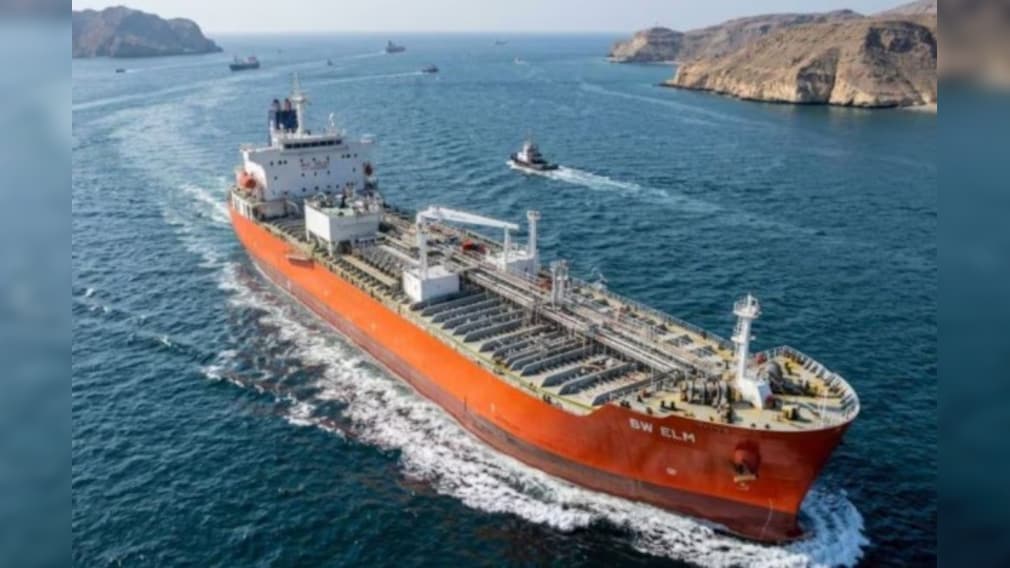
Recently, Turkey's transportation minister, Abdulkadir Uraloglu, announced that his country, and Syria and Jordan, have together agreed to modernise their railway systems in order to eventually create a contiguous corridor between southern Europe and the Persian Gulf. The network would take approximately four to five years to build, and billions of dollars in investment, primarily because of the devastated Syrian infrastructure. The railway network reconstruction in Syria alone needs at least $5.5 billion. Thereafter, it would be extended to connect with the rail system in Saudi Arabia. This would eventually create a North-South Gulf-Europe trade corridor between Europe, the Levant and the Gulf.
Such a corridor would revive the old Ottoman-era route connecting Damascus in Syria to Medina in present-day Saudi Arabia, through Jordan. It would also reopen more modern routes that Turkey had used through Syria to connect to Jordan, Lebanon and the Gulf before the Syrian civil war began in 2011.
Such a corridor makes sound sense as it would be the shortest and most cost-effective route for transportation of goods and services between the countries involved. But, at the same time, it would signal a setback to India's connectivity ambitions in the Middle East and Europe in an era of disruption of traditional trade routes.
The Vision Behind IMEC
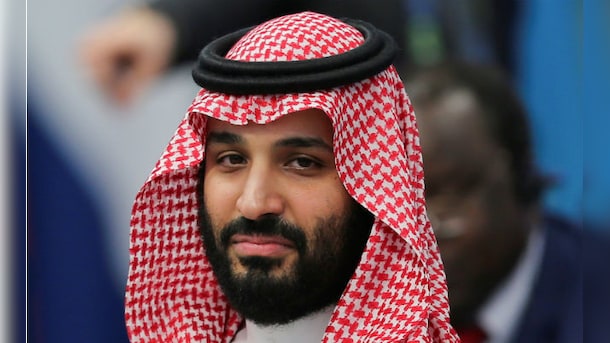
In September 2023, the ambitious India-Middle East-Europe Economic Corridor, known variously as IMEC or IMEEC, was unveiled during the Delhi G20 meet by Prime Minister Narendra Modi, Saudi Crown Prince Mohammed bin Salman and the then US President, Joe Biden. The multimodal route (see map below) was to start from Mumbai in India and would connect by sea to the UAE. From there, it would continue through a network of railways to Saudi Arabia, then to Jordan and further on to Israel. From Israel, through the Haifa Port, the corridor would continue to Europe. It was, in great part, envisioned as an alternative to the Suez route, where a ship had just a few days earlier got stuck, causing great disruption to global trade for more than two weeks. Europe had also been seeking such a network to find alternatives to routes running through the vast Russian landmass, since the Ukraine crisis had broken out. Given that the economies of India, the Gulf, and Europe were aligning, the IMEC was not only expected to cut down on freight and transportation costs but also to boost the economies of the participating states, as well as counter China's Belt and Road Initiative (BRI). Even Greece had evinced an interest in joining it. In all, the IMEC would have two routes, with each costing roughly US 3-8 billion.
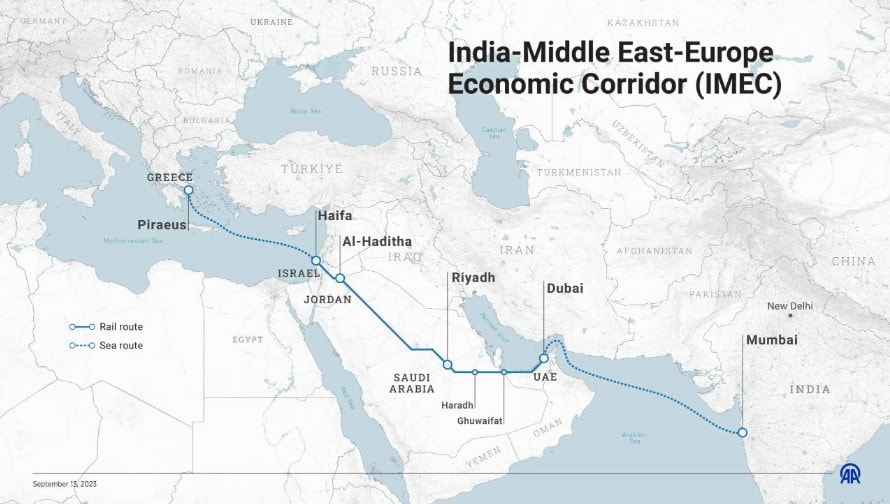
The India-Middle East-Europe Corridor that India has envisaged, which would connect India to Europe via the UAE, Saudi Arabia, Jordan, and Israel. (Source: Lowy Institute)
However, the IMEC received its first setback soon after all this, when a war broke out in the same year between Israel and Hamas following the latter's attack on October 7. The Yemen-based Houthis soon joined the conflict and targeted commercial shipping. This, in fact, added to the urgency of searching for alternative routes. However, the entire region stretching from Jordan to the Israeli ports became embroiled in violence and unrest and put paid to the IMEC's progress. Israel, after all, was meant to be a crucial node in the network.
The IMEC's success was also contingent upon the normalisation of relations between Saudi Arabia and Israel. That was a process still underway then. The UAE, another important node in the route, had already normalised ties with Tel Aviv in the previous years, as had Jordan. However, the continuation of the war complicated this process when it came to the Saudis, who publicly accused Israel of committing a genocide of Palestinians in Gaza, and making normalisation of ties conditional upon the creation of a Palestinian state.
Adding grist to the mill, reports have now started appearing that Saudi Arabia wants to replace Israel with Syria as the transit country for a fibre-optic cable designed to connect the Kingdom to Greece via the Mediterranean Sea (Greece and Saudi Arabia had announced the East to Med Data Corridor (EMC) project in 2022). More recently, in February this year, Saudi telecom firm stc Group announced that it will invest about USD 800 million in Syria's telecommunication infrastructure.
Shifting Equations
This move by the Saudis points to shifting regional alignments. For almost a decade, relations between Saudi Arabia and Turkey had been marked by suspicion and tensions, escalating particularly after the murder of Saudi journalist Jamal Khasshogi in Istanbul. However, regional tensions, in particular the Israel-Hamas war, and now the Iran war, have led to realignments as Saudi and Turkish concerns converge. Over the past month, the foreign ministers of Saudi Arabia and Turkey have met three times, together with their counterparts from Egypt and Pakistan, attempting to form a regional security alliance.
Similarly, the Gulf-to-Europe transport corridor (see map below) mentioned at the beginning of this essay can just as easily be rerouted through Jordan, Syria, and Turkey, bypassing Israel. Given this, the normalisation between the Saudis and Israelis seems even more elusive - almost as wishful an idea as the creation of a Palestinian state. Moreover, this also fits in with the broader Saudi objective of reintegrating Syria into the region and turning it into a telecommunications and transport hub. Major financing would give the Saudis tremendous leverage over post-war Syria.
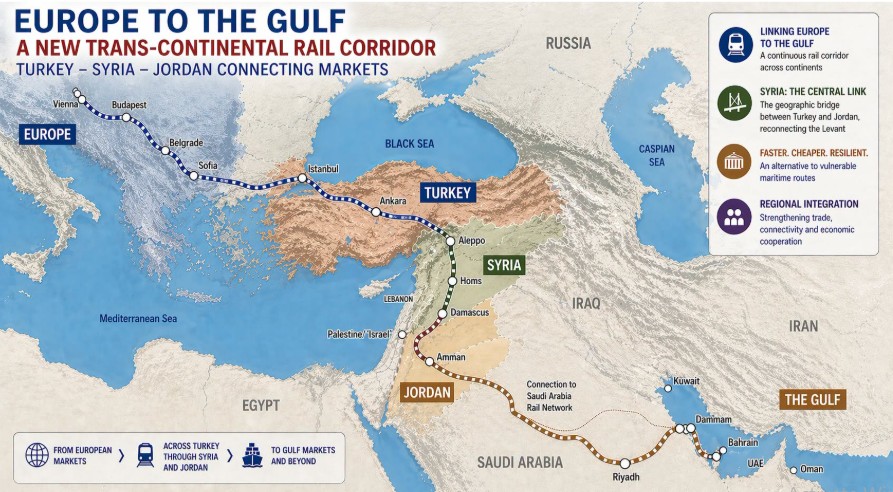
The Gulf to Europe rail corridor that Turkey has envisaged, which bypasses Israel and goes through Jordan and Syria, thus making it an easier route amidst the current tensions between the US-Israel and Iran (Source: radiofreesyria.com)
Adding to these complexities is the emerging rift between Saudi Arabia and the UAE, which are fighting proxy wars from Yemen to Sudan to Somalia. The recent move by Israel to station an ambassador in the breakaway region of Somaliland was strongly condemned by Arab countries, including Saudi Arabia. The UAE, in contrast, is the only Arab country to extend recognition to Somaliland.
The IMEC requires enormous infrastructure upgradation. While railway connections do exist between the UAE and Saudi Arabia and between Saudi Arabia and Jordan, many more kilometres of tracks will have to be laid. And given the current state of bilateral relations between the two nations, it is doubtful that things will move ahead in the near future.
Finally, the Iran war has dealt a big blow to regional infrastructure, both in the Gulf region and in Israel. The city of Haifa, through which the IMEC runs, has been repeatedly struck by Iranian missiles and drones.
Also, given the crisis in the Strait of Hormuz, the Saudis have been depending more on the Red Sea port of Yanbu. In case the Houthis join the war, then they can potentially close off the Bab-El-Mandeb, another critical chokepoint. Consequently, this makes the aforementioned Gulf-Europe route traversing Syria and Turkey highly appealing, particularly as it can circumvent the conflict-ridden West Bank territories and Israel without necessitating any normalisation of ties.
Turkey Raring To Go
All of this will only relegate IMEC further to the back burner. Just recently, India had stepped back from the Chabahar port, which was a major gateway for it to access Central Asia, Eurasia, and, thereafter, Europe. Now, the fate of IMEC, too, hangs in the balance.
Meanwhile, rival Turkey is already consolidating its position and role in the region, both in terms of trade, connectivity, and influence. It has been promoting its Development Road project with Iraq, which envisages a multimodal road and rail corridor from the Persian Gulf to Turkey and onwards to Europe. It is also connected overland to China, which, in turn, has been making full use of the continental "Middle Corridor" route to Europe.
India will, therefore, have to rethink and reconsider its approach to connectivity and trade routes in the Gulf.
(The author is a senior journalist)
Disclaimer: These are the personal opinions of the author
-
MK Stalin: The Boy From Chennai's Marina Beach

From a naming ceremony on Chennai's Marina Beach in 1953 to Tamil Nadu Chief Minister - this is the story of Muthuvel Karunanidhi Stalin, the DMK, and the 2026 election.
-
NTR, MGR, Jayalalithaa, Rajinikanth, Pawan Kalyan - Vijay, Respectfully, Is None Of Them
Vijay is unlike anything Tamil Nadu has ever seen. Comparing him to other star-turned-politicians is tempting, but unfair.
-
Opinion | 35 US Lawmakers Just Moved A Bill That Could Upend Indian Techies' Careers
For years, Indian students going to America have followed a set path: F-1 student visa, then OPT, and later an H-1B visa. That may soon be off the table, thanks to a group of American lawmakers.
-
Opinion | Iran May Be Doing With Its Nukes What Another 'Rogue' Regime Did 20 Years Ago
A rogue state got away with its nuclear weapons programme decades ago, defying all sanctions. Iran may be going down the same path.
-
UAE Quits OPEC: What It Means For India's Oil Prices, Fuel Bills
Being able to deal with the UAE as a separate seller should give India the chance to re-adjust risk levels and pricing, particularly if some volume of crude is routed via overland pipelines to bypass the Hormuz blockade.
-
Opinion | If Mamata Banerjee Wins Again, It Might Be Only Because Of One Particular Group
Anyone familiar with the recent political and electoral history of West Bengal knows that while the BJP has done extremely well in north Bengal, it has so far failed to breach the Mamata citadel of south Bengal.
-
Opinion | Pak Is Finally Back In Middle East's 'Good Books'. But Can It Stay There?
This is both an enviable and challenging space to be in for the only Islamic nation in the world that has nuclear weapons.
-
Opinion | Can Saudi Arabia, Now Alone At The Top, Manage To Keep Oil Stable?
With the UAE's exit, Saudi Arabia will remain the only swing producer in the cartel to deal with market shocks. Can it fulfil that role alone?
-
Opinion | UAE Can Now Easily Meet An Old American 'Demand'. But There's A Casualty: Saudi
For years, the US had been pressing the Gulf states over low oil prices. One country can make that possible now.