Opinion | Inside Pakistan's Twisted 'Empowerment' Project: The 'Lady Killers' Of Jaish
Why does Masood Azhar want to build an army of women suicide bombers? For both personal and political reasons, apparently.
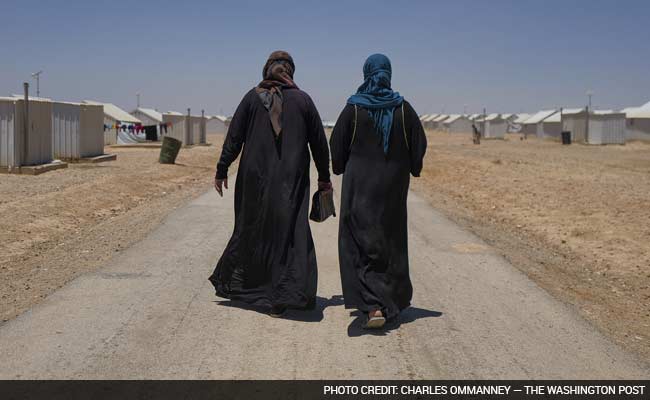
It might be, ironically, Pakistan's first "empowering" of women in decades. Except that this particular empowerment involves killing others, and is certainly not aimed at improving their lives. In fact, quite the reverse, since they are actually required to die themselves. At least that's what Masood Azhar wants. A clutch of women suicide bombers.
It is now common knowledge that during Operation Sindoor, Indian forces turned Jash E Mohammad's headquarters into a pile of dust. It really didn't need satellite imagery to prove it. Jaish leader Masood Azhar is on record , to say that his older sister and her husband, his nephew and his nephew's wife, his niece and five children from his family were killed, even while images shown around a dozen coffins. That would have peeved him no end notwithstanding the fact that he and his group are responsible for hundreds of deaths over the years. Following the attack, Azhar first announced a women's brigade headed by his sister, Sadiya Azhar, assisted by another sister Samaira Azhar, and Afeera Farooq, the wife of terrorist and Pulwama attack mastermind Umar Farooq. That's quite a trio. Now, an audio recorded perhaps at Markaz Usman Ali in Bahwalpur gives further chilling details.
A Course Of Their Own
It now appears that women will attend a 'Daure - e -Tazkiya' course - literally meaning a purification of the soul - but which in Masood's language means they blow themselves up to smithereens and thereafter go straight to paradise. There is no reference to any of the rewards promised to men in the Hadith, like the 72 houris (no such reference in the Quran). One assumes that laws on denial are probably strict even in his presumed heaven. There's a second course, too, which is based on Chapter 4 of the Quran; it is the longest and deals with the "proper" treatment of women. All of that is to be under the aegis of an organisation called Jamaat ul Monimnat, with branches to be spread across Pakistan.
In case any potential recruit thinks this would give them a certain freedom and sangfroid, they are sadly mistaken. Recruits would train under the strictest conditions and would not be allowed to talk to any men outside their own family. The assumption, therefore, is that the trainers will also be women. To assume that these women will go out into the field (where men will inevitably be present) armed with AK-47s and fight, is too much to believe. These are suicide bombers.
Azhar makes haste to say that he had conceived the plan long before his sister was killed (just in case there are some grumbles about his personal reasons and his personal fortune) and his crib seems to be that "Hindu women" are serving in the Indian army. Apart from that, he is also upset by female journalists for unknown reasons. Both categories are to be the target for the lady bombers. Apparently, his school will probably allow women to target only their own sex, though how that works is unclear. It's likely these 'empowered' women will go at anyone available. A little freedom at the very end.
Women As Haters
Research indicates that women's representation in such horrific attacks have been rising, with the first such being Sana'a Mehaydali, who at 16 years hit the Israelis. She belonged to the Syrian Socialist National Party, which while fiercely nationalist, was entirely secular. This was true to Sri Lanka's female bombers too, one of whom hit the then Prime Minister, Rajiv Gandhi. Then there were the Black widows of the Chechens. That last was religiously inspired, though there was also a strong hatred or sense of revenge due to the depredations of Russian soldiers. That led directly to the horrific 2004 attack on a school that killed 186 children.
In short, hate matters. From that period was the trend towards widespread attacks 'inspired' by online radicalisation done presumably by the Islamic State. That included the San Bernardino mass attack by a Pakistani couple, who had a six-month old child. The motives are obscure, though there is evidence that she was radicalised in Pakistan. Radicalism, in turn, comes from hate of the 'other'. Remember the Peshawar Army school bombing that killed 140 people, mostly children? The incident shocked everyone, with a two-minute silence across India in solidarity and protest against it. What few know is that attacks on schools in Afghanistan tripled between 2017 and 2018. Again, hate matters. The danger? That at present, hate is surging across Pakistan both against each other, particularly the Punjabis, as also against India. One is the result of Pakistan's own internal chaos. The other is deliberately engineered. After all, a Gallup poll after Operation Sindoor and the ceasefire saw some 46% people wanting trade and other relations with India to be stopped.
The Astonishing Ways Of The Pak Army
It's astonishing that the Pakistan army continues to foster hate and terrorism despite the certainty that it is this that has torn the country apart. Data indicate that in the 1980s, Pakistan's per capita income was 55% higher than India. Now, they know they can never catch up in the foreseeable future. Among other factors, it was after this that terrorism sponsorship became part of the body politic and ate into institutions and the army, with a dangerous ideology deliberately spread to get recruits not just for India but for Afghanistan as well. Now they are doing it again.
If Jaish is going towards this particular direction, it has clear establishment support. Recall that Jaish commander Illyas Kashmiri admitted that senior Pakistani army officers had attended the funerals of its killed personnel. Earlier, India's Foreign Secretary, Vikram Misri, had held up photographs of these stirring events, with coffins draped in the Pakistani flag. Now, the Jaish wants its women on board, and in those same coffins, with their faces spread across the media as 'warriors'. Even so, it's unlikely that senior army officers will attend those funerals given the strictures on women recruits as they prepare for death. Perhaps senior army wives will.
It can't get more pitiful for all concerned. Or more dangerous. Despite everything outlined above, make no mistake: these people are deadly serious. Counter-terrorism just got a whole lot more tricky, and not just in India. Given Pakistan's record of sending radicalised individuals across the world - most recently a radical cell led by women in Italy, the world better sit up and take notice.
(Dr Tara Kartha is a former Director, National Security Council Secretariat)
Disclaimer: These are the personal opinions of the author
-
Opinion | India's $18.3 Billion Forex Reserve Shock Is A Warning, Not Just A Number

The reported USD 18.34 billion decline in India's foreign exchange reserves in a single week has attracted attention for more than its size
-
Congress Falls Back On A Fullback: Where Pargat Singh Fits In The Punjab Poll Play
Vijay Inder Singla, a Hindu face, was reportedly the frontrunner before the Congress replaced one Jat Sikh with another as its Punjab unit chief. How far does such arithmetic work in the state's politics? Pargat's appointment holds some of the answers.
-
Why Doesn't Congress Boycott If Polls Are "Fixed"? Answer Lies Beyond Rahul Gandhi's "Distraction" Quip
The starkest demand for a boycott has come from outside the political Opposition, from the Cockroach Janta Party. But does a boycott help? Here's what research, examples, and expert analysis tell us.
-
'Sully' To Gimli, Sioux To Patna: When Pilots Got It Unbelievably Right
Captain Smit Machchhar fought off his co-pilot after being stabbed and opened the cockpit door, saving 174 people.
-
Opinion | Are Saudi Arabia And UAE Reuniting Again After 10 Years?
On Tuesday, the UAE's Vice President, Deputy Prime Minister and Chairman of the Presidential Court, Mansour bin Zayed, met Saudi Crown Prince Mohammed bin Salman.
-
Opinion | 'Lies, Damned Lies, Statistics': On The Controversy Around India's GDP Growth Figures
The debate is less about a single figure than about a decade-long erosion of trust in official statistics.
-
Opinion | Why India Cannot Keep 'Overestimating' Its Value To Washington
Some of India's value to Washington came from the tension between the US and China. That is changing now.
-
Opinion | India Has A 'Lobbying' Problem In Washington, And It Has Come Back To Haunt It
While the EU, Japan, the UK and South Korea secured quick deals, India's efforts were getting drained in prolonged negotiations and the wrong kind of lobbying.