Opinion | How A War Destroyed America's Strongest Financial Weapon, Built Over 50 Years
America's own Secretary of State has now publicly conceded that its most powerful financial weapon may be obsolete within five years.
In 1977, Danish chess grandmaster Bent Larsen was asked whether he preferred to be lucky or good. "Both," he replied. Kenneth Rogoff, in his recent book, Our Dollar, Your Problem, deploys this anecdote to make a point about the American dollar that Americans rarely acknowledge - that the dollar's extraordinary post-war dominance was the product of skill and luck in roughly equal measure. Had Russia liberalised its economy in the mid-1960s, had Japan not been browbeaten into a destabilising currency appreciation in the mid-1980s, had China floated its exchange rate in the 2010s, the dollar would still be on top, but less so. Interest rates would have been higher. The exorbitant privilege would have been less exorbitant.
The title of Rogoff's book comes from a remark by Nixon's Treasury Secretary, John Connally, to his foreign counterparts in the early 1970s: "It's our dollar, but your problem." For obvious reasons, the statement was the epitome of American arrogance. It also described, precisely, how the system worked. America issues the currency. The rest of the world absorbs the consequences.
The Saudi Deal
In 1974, Henry Kissinger struck one of the most consequential financial deals in modern history. Saudi Arabia would price its oil in dollars and park the surpluses in US Treasuries. America would provide security guarantees. The rest of the Gulf Cooperation Council followed. As recently as 2023, JP Morgan Chase estimated that roughly 80% of global oil transactions were still settled in dollars.
The elegance of the petrodollar system lay in its circularity. Oil importers paid in dollars. Those dollars flowed to Riyadh and Abu Dhabi. From there, they flowed back into American government debt. This structural demand for Treasuries subsidised Washington's borrowing costs for fifty years and cemented the dollar as the world's reserve currency. It also handed Washington an extraordinary weapon: by controlling SWIFT, the messaging infrastructure connecting banks worldwide, the US could freeze a country out of the international economy almost overnight. This happened to Iran starting 2012, and to Russia in 2022.
The Russian sanctions were, in retrospect, a turning point, though not the kind Washington intended. The United States demonstrated to every other government on earth that dollar reserves were not savings by simply freezing approximately $300 billion in Russian central bank assets. They were hostages.
Much had changed before the first American strikes on Iran this February. The shale revolution had made the United States energy-independent, which meant Saudi Arabia was now selling four times as much oil to China as to its American security guarantor. Eighty-five percent of Middle East crude flows to Asia. The foundational premise of the 1974 deal (that America was the indispensable customer) had quietly expired.
More concretely, Saudi Arabia had joined Project mBridge, a blockchain-based platform developed with the People's Bank of China, the Hong Kong Monetary Authority, and the central banks of Thailand and the UAE. It allows settlement in central bank digital currencies without touching SWIFT or dollar-correspondent banking. Deutsche Bank's research team, writing in March 2026, noted with some precision that mBridge is already at "minimum viable stage".
The rails to transact outside the dollar system have been built. They were not yet busy, but they were ready.
The War As Catalyst
The US-Israel war on Iran has cost the United States roughly $12 billion a week. It has also broken the petrodollar loop at both ends simultaneously.
On the importing side, central banks in Turkey, India, Thailand, and other oil-importing nations have been selling US Treasuries to defend their currencies against an oil-driven dollar surge. Holdings at the Federal Reserve Bank of New York dropped approximately $82 billion to $2.7 trillion, the lowest level since 2012. The 10-year Treasury yield rose from 3.9% at end-February to above 4.4% within weeks. In every major crisis of the past two decades - the Russia-Ukraine war, the Silicon Valley Bank collapse, the Hamas attacks of October 2023 - money had flooded into Treasuries, not out. This time, yields rose. The safe-haven playbook has failed.
On the exporting side, Gulf producers cut output by at least 10 million barrels per day in March. Qatar declared force majeure on LNG exports after strikes on its Ras Laffan facility. Kuwait, Saudi Arabia, and the UAE collectively held approximately $300 billion in Treasuries as of January. They are now earning less, spending heavily on air defence, and examining force majeure clauses in their investment commitments to Washington. There are no surpluses to recycle when there is no oil to ship. For the first time since 1996, global central banks hold more gold in aggregate than US government bonds.
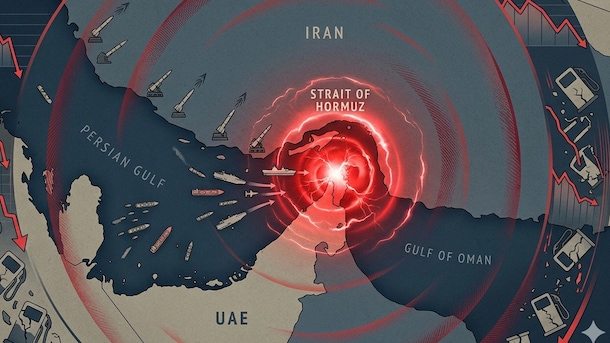
Into this vacuum, Iran has inserted a toll booth. Ships transiting the Strait of Hormuz are being charged approximately $2 million per vessel, denominated in Chinese yuan. Lloyd's List confirmed it. China's Ministry of Commerce acknowledged it in a social media post. Iran's embassy in Zimbabwe declared the era of the "petroyuan" had arrived. (One notes the choice of venue for this announcement with some curiosity.) The larger point still remains relevant despite Iran agreeing to open the Strait of Hormuz for commercial traffic for the rest of the ceasefire.
Right Answers, Wrong Questions
The sceptics deserve a hearing. Diana Choyleva of Enodo Economics argues in The Wall Street Journal that the war has actually reinforced the petrodollar: the Gulf states backed Washington, the security guarantee was tested and held, and China's years of patient infrastructure-building have been disrupted. Dan Alamariu of Alpine Macro calls the petroyuan "far-fetched". He notes, correctly, that the yuan is not freely convertible, that capital controls prevent it from moving across borders at will, and that its share of global reserves stands at 2% against the dollar's 57%. He adds a sharper point. Iran is also accepting cryptocurrency as a toll, and most stablecoins are effectively dollar-denominated instruments. Brad Setser of the Council on Foreign Relations has suggested that Iran may be collecting yuan tolls primarily as a route to acquire convertible currency, meaning, at the end of the chain, it may want dollars after all.
These are not wrong observations. They are, however, answers to the wrong question. The question is not whether the yuan will replace the dollar next year. The question is whether the dollar's most powerful attribute - its function as a financial weapon - can survive the construction of parallel systems designed specifically to route around it. A gun that only fires at targets inside the dollar system is not much of a gun once enough countries have stepped outside it.
The 'Petro' Threat
Deutsche Bank's research team points to a risk larger than any currency competition. The world may simply move away from globally traded oil. The 1973 Arab oil embargo accelerated North Sea development, Alaskan drilling, and the first serious investments in nuclear and renewable power. This shock may do the same, and more rapidly. China now produces 80% of the world's solar panels, 70% of its wind turbines, and 70% of its lithium batteries, and is positioned to supply whatever transition the Global South and Europe choose to undertake. A world that generates energy domestically trades less oil globally and, notwithstanding the dollar's other advantages, needs fewer dollar reserves. The petrodollar system faces pressure from both its components: the "petro" and the "dollar."
Rubio's Admission
Which brings us to the most striking data point of all. Recently, on Fox News, US Secretary of State Marco Rubio said, "Today Brazil - the largest country in the Western Hemisphere south of us - cut a trade deal with China. They're going to from now on do trade in their own currencies, get right around the dollar. They're creating a secondary economy in the world, totally independent of the United States. We won't have to talk about sanctions in five years, because there'll be so many countries transacting in currencies other than the dollar that we won't have the ability to sanction."
Not the substance, which economists have been saying for years, but the source. America's own Secretary of State has publicly conceded that its most powerful financial weapon may be obsolete within five years.
Barry Eichengreen notes that the Roman 'denarius' - the world's first international currency, stable in weight and purity for 300 years - began its decline under Nero, who debased it to fund wars, reconstruction after Rome's great fire of 64 AD, and an extravagant 300-room palace. The money went before the empire did. Rogoff, whose book title was drawn from Connally's arrogance half a century ago, writes simply that the Pax Dollar era has peaked.
The dollar will not disappear. No international currency ever simply vanishes; the pound sterling is still with us. But "no realistic alternative" and "unquestioned supremacy" are not the same thing, and the distance between them is growing. Bent Larsen was both lucky and good. The luck, it appears, is running thin.
(The author was with the Economic Advisory Council to the Prime Minister)
Disclaimer: These are the personal opinions of the author
-
Trump Vindicated? Iran Crisis Turning US Crude Into World's Safe Bet

As Iran blocks the Strait of Hormuz, a channel that supplies 20 per cent of global oil and gas, Asian refiners race to reroute US Gulf crude through the Panama Canal while paying historic premiums to pass.
-
Iran Found Its 'Nuclear Weapon'. Now The US Has To Adapt
Iran's ability to throttle tanker traffic through the Hormuz acts as a strategic, nuclear-like weapon without physical destruction, and the US must find a way around this particular challenge.
-
Opinion | Iran's Game Of Thrones: Inside The 'Group' That Wants Ghalibaf Gone, And No Deal
A section of the IRGC is firmly opposed to any negotiations and wants the key negotiator, Ghalibaf, gone. Here's why
-
The US Was Right: Iran Has A 'Nuclear' Weapon, But It's Not A Missile
The US-Israel war on Iran has taught Tehran a valuable lesson - it may not have a nuclear weapon, but it controls the Strait of Hormuz, a vital oil and gas shipping route that gives it strategic leverage akin to a nuclear deterrent.
-
Opinion | A Year After Pahalgam, India Contends With Desperate Enemies, Distracted Friends
The most challenging question on this anniversary is what might happen if another Pahalgam-scale attack were to occur today. New Delhi finds itself in a strategic pincer.
-
Vance Heads For A Deal Do-Over, This Time With No One Across The Table
US Vice President JD Vance - the 'good cop' to President Donald Trump's 'bad cop' - faces a 24 hour deadline in Pakistan as the Iran war ceasefire lapses April 22 but talks remain uncertain after US ship seizure.
-
Opinion | Trump Has Found His Iran 'Scapegoat'. The Scapegoat Doesn't Know It Yet
When all else fails, Trump might very well throw his Vice President, JD Vance, under the bus. Remember what happened to Mike Pence?
-
In Bombed Facilities, Unstable Tunnels, US' Toughest Uranium Extraction Yet
Before US and Israeli strikes in June 2025, the International Atomic Energy Agency estimated that Iran possessed roughly 441 kilograms of uranium enriched to 60 per cent, alongside approximately 200 kilograms enriched to 20 per cent.
-
Opinion | Pakistan's Ever-Running Saudi 'Lifeline' Has Its Limits
There is a gap between what Pakistan seeks from its Gulf partners and their willingness to offer it.
-
The 60-Day Clock That May Stop Trump's Iran War, And How He Could Ignore It
Under the War Powers Resolution, also called the War Powers Act, an American president who has activated the armed forces without Congressional approval has 60 days to stand down.