Opinion | In Trump's World, Wikipedia's Lesson On Collaboration
Wikipedia founder Jimmy Wales's life's work rests on a proposition that feels almost subversive in 2026: that most people, given the right framework, want to collaborate in good faith.
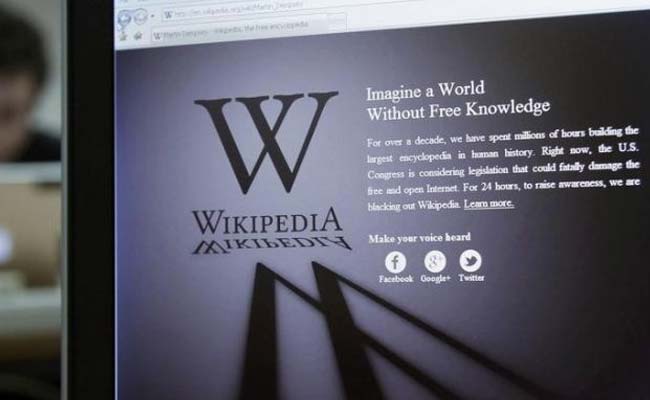
January 2026 has felt like one long stress test for the global order. The US administration parading Venezuela's President in handcuffs in New York City, renewed tensions over Greenland that rattled transatlantic trust, Trump openly alienating the European Union, and the rollout of an almost farcical Board of Peace for Gaza. In short, a new year reminding us that the world's stabilising institutions are either faltering or being reinvented on the fly. The headlines are heavy, the rhetoric sharper, the alliances thinner.
And yet, in the midst of this unease, it is worth paying attention to a figure who has spent the last quarter-century quietly disproving the idea that large-scale cooperation is impossible: Jimmy Wales.
This author spent an afternoon chatting with the 59-year-old founder of Wikipedia, who does not speak the language of geopolitics. His life's work rests, however, on a proposition that feels almost subversive in 2026: that most people, given the right framework, want to collaborate in good faith. And that optimism, even when it is not fully rational, can be a productive force.
He calls himself a "pathological optimist", and he means it. When Wikipedia launched 25 years ago, there was no guarantee it would succeed. It emerged from the failure of Nupedia, a more rigid, expert-driven project that collapsed under the weight of its own seriousness. Wikipedia, by contrast, was built on something lighter but more powerful: fun, openness, and trust in a self-organising community. It worked not because humans are flawless, but because they are persistent.
That distinction matters now.
A Persistent Loss Of Faith
The geopolitical turbulence of early 2026 has been fuelled in part by a loss of faith: in alliances, in norms, in institutions that once seemed unshakeable. When the United States openly flirts with transactional diplomacy toward Europe, when territorial rhetoric reenters mainstream discourse, when peace initiatives are announced with more spectacle than consensus, cynicism becomes the default posture. It feels safer to assume bad faith than good intentions.
Jimmy Wales offers a counterexample - not a naïve one, but a grounded one. Wikipedia has never pretended that people are angels. It has policies, moderation, and guardrails precisely because conflict is inevitable. But it also begins from a crucial assumption that most contributors are there because they care about knowledge, accuracy, and something larger than themselves. That assumption has scaled across cultures, languages, and political systems. Wikipedia now exists in over 300 languages, many maintained by communities Wales himself will never meet.
This matters because the crises of January 2026 are not just about power; they are about trust. Venezuela's uncertain transition has left citizens hopeful about economic relief but wary of democratic backsliding. Europe's reaction to US unpredictability has been less about outrage and more about recalibration - how much strategic autonomy is necessary when trust erodes? Even the Gaza Peace Board, however controversial, reflects a hunger for frameworks that might restore some measure of faith in diplomacy, however fragile.
Serving Knowldege
Wales would likely argue that the problem is not ambition but orientation. Wikipedia never set out to "create" knowledge. It set out to serve it. Its neutrality is not passive; it is worked on, debated, enforced, and constantly renegotiated. That process - messy, slow, human - is precisely what many global institutions now lack the patience for.
One of Wales's most striking observations is that Wikipedia's community would continue its work even if the outside world stopped paying attention. That is an extraordinary statement in an era obsessed with metrics, influence, and visibility. It suggests a form of faith that is not performative. Contrast that with the current global mood. Nations posture for leverage. Leaders speak to domestic audiences while quietly fraying international ties. Online spaces amplify hostility until it feels representative, even when it is not. Wales has long warned about this distortion. He says, "Spend too much time in the wrong corners of the internet, and you begin to believe that people are irredeemably angry and irrational. Step back into real communities - festivals, classrooms, collaborative projects - and a different picture emerges".
The danger of 2026 is not only instability, but resignation. The idea that fragmentation is inevitable, that cooperation is obsolete, that hope itself is unserious. Wales's life's work argues the opposite. Hope, in his framing, is not blind optimism; it is sustained effort in the absence of guarantees.
Wikipedia is not perfect. It has biases, disputes, and ongoing battles over representation and accuracy. But it has endured because it treats those flaws as reasons to improve, not excuses to abandon the project. Their ethos of incremental progress, anchored in shared values, is precisely what the world needs more of as geopolitical certainties wobble.
Truth Is Communal
In an age of artificial intelligence, Wales remains stubbornly focused on human-created knowledge. Not because technology is dangerous, but because meaning is communal. Trust is communal. Truth, when it lasts, is negotiated collectively. These are not technological problems but social ones.
January 2026 has reminded us how quickly systems can strain under pressure. It has also reminded us how much we depend on invisible forms of cooperation to keep the world intelligible. Jimmy Wales did not set out to build a metaphor for global resilience. He set out to build an encyclopedia. But in doing so, he offered something more enduring. Wikipedia is proof that faith in people, when paired with structure and humility, can scale.
That lesson may not resolve conflicts or stabilise markets overnight. But in unsettled times, it offers something just as vital: a reason to believe that cooperation is not a relic of a calmer past, but a tool we can still choose - again and again - if we are willing to do the work.
(Nishtha Gautam is a Delhi-based author and academic. She's currently researching Nationalism at Jindal School of International Affairs)
Disclaimer: These are the personal opinions of the author
-
Congress Falls Back On A Fullback: Where Pargat Singh Fits In The Punjab Poll Play

Vijay Inder Singla, a Hindu face, was reportedly the frontrunner before the Congress replaced one Jat Sikh with another as its Punjab unit chief. How far does such arithmetic work in the state's politics? Pargat's appointment holds some of the answers.
-
Why Doesn't Congress Boycott If Polls Are "Fixed"? Answer Lies Beyond Rahul Gandhi's "Distraction" Quip
The starkest demand for a boycott has come from outside the political Opposition, from the Cockroach Janta Party. But does a boycott help? Here's what research, examples, and expert analysis tell us.
-
'Sully' To Gimli, Sioux To Patna: When Pilots Got It Unbelievably Right
Captain Smit Machchhar fought off his co-pilot after being stabbed and opened the cockpit door, saving 174 people.
-
Opinion | Are Saudi Arabia And UAE Reuniting Again After 10 Years?
On Tuesday, the UAE's Vice President, Deputy Prime Minister and Chairman of the Presidential Court, Mansour bin Zayed, met Saudi Crown Prince Mohammed bin Salman.
-
Opinion | 'Lies, Damned Lies, Statistics': On The Controversy Around India's GDP Growth Figures
The debate is less about a single figure than about a decade-long erosion of trust in official statistics.
-
Opinion | Why India Cannot Keep 'Overestimating' Its Value To Washington
Some of India's value to Washington came from the tension between the US and China. That is changing now.
-
Opinion | India Has A 'Lobbying' Problem In Washington, And It Has Come Back To Haunt It
While the EU, Japan, the UK and South Korea secured quick deals, India's efforts were getting drained in prolonged negotiations and the wrong kind of lobbying.
-
India Is Getting Old Before Getting Rich, Will Turn 'Aged' In 16 Years: Moody's
Countries with the steepest fertility declines today will age the fastest in the coming decades. India's drop has been steep.
-
Opinion | Why Does Trump Want To Sell Arms To A US 'Adversary'? Inside His Strange Bargain
Trump's aides maintain that no such offer had been made. But the story points to a larger strategy