Opinion | Ain't No Mountain High Enough ... To Keep Them From Getting To Aravallis
A technical redefinition threatens to turn one of India's oldest mountain ranges into legally exploitable land. But even by the government's own standards, four questions remain unanswered.
"Ain't no mountain high enough
Ain't no valley low enough
Ain't no river wide enough
To keep me from gettin' to you, babe"
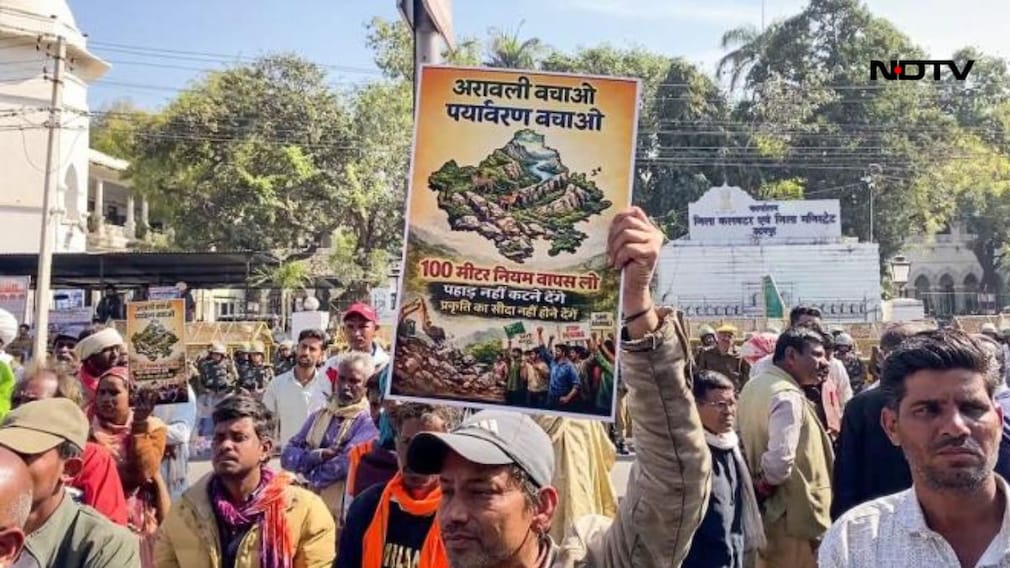
The lyrics of this 1960s song perhaps encompass the controversy surrounding the Aravallis best after the Environment Ministry came up with a new definition to allow for what is being termed 'sustainable mining' of the ancient mountain range. A wave of public euphoria for the Aravallis has even irked the Environment Minister, Bhupender Yadav, leading him to lash out at activists and blame YouTube reels for spreading false information.
The widespread anger from citizen groups and activists came in the wake of the Supreme Court judgment in late November, adopting the Environment Ministry's new criteria for defining what constitutes the Aravallis. The judgment says that only hills rising at least 100 metres above local relief, or clusters of such hills (of 100 metres and above) within 500 metres of each other, will now be recognised as part of the Aravalli range.
Why Do Away With 'Mean Sea Level' Formula?
Mr Yadav, whose Ministry submitted this new criterion, has vociferously defended this stand. The height of 100 metres will be measured from the base of the mountain structure, and mining will not be allowed around or beneath the hill's structure, clarified the Minister. But clearly, this clarification is not enough. Key questions remain. One of the most pertinent questions that the Minister has not responded to is that when hills are measured scientifically from mean sea level (MSL), why has the Ministry of Environment, Forest and Climate Change strangely decided to do away with this conventional standard and add the word 'local relief'?
Take the height of the Qutab Minar, once considered one of the most iconic minaret structures not just in India but in the world. Its height is less than 100 metres, standing at approximately 72 metres. Can we one day pass a rule stating that all heritage structures that are below 100 metres are no longer heritage buildings and therefore need to be razed to the ground to make way for roads and mining projects? That is exactly what we are doing to the Aravallis. In a press release, there is some attempt made to clarify the matter by stating, "Aravalli range has been explained as all the landforms which exist within 500 metres of two adjoining hills of height 100 metres or more. All landforms existing within this 500-metre zone, irrespective of their height and slopes, are excluded for the purposes of the grant of mining lease."
In spite of this, the operative term, '100 metres', remains intact.
Gaping Holes
Here is a list of 4 questions that remain unanswered.
1. Why did the Minister change the basis of the definition of the height of a hill from mean sea level to 'local relief'?
In the judgment passed by the Supreme Court (based on submissions by the Environment Ministry), it is stated in Para 31 that the reason why "the Government of India does not want to use the Forest Survey of India definition is that it will exclude large parts of Aravallis from their purview". There is no explanation why this was done, when in reality, using the criterion of height on the basis of 'local relief' will, in fact, end up excluding large tracts of the Aravallis.
2. What will happen in cases where the hillock is only 40 metres high but is an important landscape for leopards, or chinkara or a threatened floral species? And if so, why introduce height as a criterion at all? Do such areas now cease to be part of the Aravallis?
3. What the Minister has failed to share is that the definition of forests was also changed in August 2025 for the state of Haryana to facilitate mining in the Aravallis.
Haryana's new forest definition, notified in August 2025, defines a forest by minimum area (5 hectares isolated, 2 hectares contiguous) and canopy density (40%). Now, in some districts that include semi-arid and arid zones, a canopy density of 40% is not possible at all. Add the new definition of a height of at least 100 metres, and you will have mining companies and real estate sharks salivating over land tracts that can now be opened up for exploitation. So, when the Minister says 90% of the Aravallis will be protected, he forgets to couple it with other legal changes that have been brought in recently that actually throw open large swathes of land for mining.
4. Now, here is where the arguments get more complicated. Below is the list of areas that will now get completely excluded from the Aravallis -
- Areas like Manesar in Haryana, which is 265 metres above MSL. The highest hill in Manesar is 315 metres above MSL. So, the difference from local relief (which is the definition used by the Ministry) comes to 50 metres, which is less than 100 metres. Thus, the entire Aravallis in Manesar in Haryana would be excluded from the definition.
- Similarly, there are areas like Panchgaon in Haryana, which is 286 metres above MSL. The highest hill in Panchgaon is 320 metres above MSL. The difference from the surrounding terrain comes to 34 metres, which is less than 100 metres. So, the entire Aravalli in Panchgaon and further in the Nuh region is excluded now from the definition of the Aravallis.
- Kherala in Haryana is 257 metres above MSL, and the highest hill there is 300 metres above MSL. The difference from the surrounding terrain is 43 metres, which is less than 100 metres. So, the entire Aravalli in the Kherala area will be excluded.
- Gairtapur is 250 metres above MSL, and the highest hill there is 320 metres above MSL. The difference from the surrounding terrain is 70 metres, which is less than 100 metres. So, the entire Aravalli in the Gairtapur area will be excluded.
All of this information is available from the topographical sheets of the Survey of India. All these areas will now stand excluded under the new definition.
Concerning Discrepancies
Geological experts say that height is always measured from Mean Sea level (MSL), never from Surrounding Terrain, according to well-accepted parameters of height globally and in India. So, can the Minister explain why they are considering height on the basis of the surrounding region instead of MSL, which is standard practice?
Responding to the Minister's clarification, activists from the 'ARAVALLI VIRASAT JAN ABHIYAAN' also issued a statement pointing out discrepancies. "Our 1st area of concern is that there is divergence in statements made by Mr Bhupender Yadav, Union Minister of Environment, Forest and Climate Change, in his video speech and the information given in the official press release of the Bharatiya Janata Party dated December 21, 2025. The activists highlight that the press note states:
"Presently, there are 37 districts in the Aravallis. It is spread over approximately 1.44 lakh square kilometres in 37 districts. This mountain range extends to 20 districts of Rajasthan alone. In only 0.19% of the total geographical area, i.e., 277.89 sq. km area is under legal mining permits."
But Mr Yadav states in his comments:
"The total Aravalli area is 1,47,000 sq km. There are a total of 39 Aravalli districts. In only 217 sq km, i.e., 2% of the area, there can be mining. Hills will be protected from the bottom to the top till 100 metres in height".
The activists point to a clear difference in statistics, which may seem small on paper but makes a huge difference on the ground. Lastly, the activists ask whether Mr Yadav can assure that protection will take place for all hills irrespective of their height so long as they are part of the Aravallis.
Do It For The People
While Mr Yadav has clarified that no mining will be allowed in Delhi and surrounding regions, there is no clarity on specific areas surrounding Asola Bhatti or the areas surrounding the Dam-dama lake in Haryana, which are already places of high anthropogenic activity, even when they are the last repositories of fauna and flora for the region. A botanist who works in the Aravallis shared on condition of anonymity that it's not just areas around Delhi but also regions in Nuh in Haryana that have small hillocks, as well as other areas that still have natural springs and sources of water for local communities, which may not fit into this definition. All these may now be impacted and used for mining.
Once known as the 'spine' of North Indian states, the Aravalli hills form the most dominant geological structure in the formation of the North Indian terrain and drainage system. Policymakers ought to show some spine to protect not just its rich biodiversity but the people of the National Capital region, who are anyway struggling to breathe.
(Bahar Dutt is an author and environment journalist)
Disclaimer: These are the personal opinions of the author
-
Blog | Madhav Gadgil: The 'Durable Optimist' Who Believed Science, Too, Has Obligations

Gadgil, despite decades of frustration and bureaucratic sidelining, believed that people could organise, that knowledge could travel, and that democracy, however delayed, could still correct its course.
-
Blog | What's Stopping Vijay's Film? 6 'Conspiracy Theories' About Jana Nayagan
In Tamil Nadu, it turns out you don't need a release date for the promise of a blockbuster. Sometimes, just a missing censor certificate is enough.
-
Opinion | The $700-Billion-Big China Problem Behind Trump's Venezuela Blitz
Venezuela is only part of the story. China has assembled a formidable economic footprint across Latin America. Trade between China and the region crossed $518 billion in 2024, making Beijing the largest trading partner for much of South America.
-
From Trump And AI To Russia And Water: The 'Top Risks' Of 2026
Ian Bremmer's Eurasia Group, one of the world's top risk research and consulting firms, has released its 'Top Risks 2026' report.
-
Opinion | Suresh Kalmadi: The Man Behind The Legendary 5-Star Dinner That Unnerved Even Sonia Gandhi
Kalmadi proved that in Indian politics, the man who controls the guest list often has more power than those whose names appear on it.
-
Europe's Different Yardsticks To Judge Events In Venezuela And Ukraine
Russia has called the US strike on Venezuela and the subsequent capture of Nicolas Maduro an act of armed aggression
-
Opinion | How Venezuela's China-Made Weapons Failed To Keep The US Away
Unlike post-Operation Sindoor, when Beijing hailed Pakistan's air-defence operations against India as a success of Islamabad's "Made in China" military force, there is an eerie silence within Beijing this time.
-
Opinion | Donald Trump Has A New Project: 'Make Venezuela Great Again'
Trump's presidency, much like of those before him, reveals the structural constraints that limit any US leader's ability to disengage from global conflicts.
-
A History Of US-Led Regime Changes And Their Disastrous Consequences
There is a familiar theme to American power when it decides to reorder the world. It is against that historical backdrop that Donald Trump's latest foreign intervention must be understood.
-
Blog: In Manipur, The More Things Change, The More They Stay The Same
As 2026 arrives, where do things stand today for Manipur, a border state that faces a situation so unique that modern India has never seen or found the correct words to define it adequately