Opinion | Ain't No Mountain High Enough ... To Keep Them From Getting To Aravallis
A technical redefinition threatens to turn one of India's oldest mountain ranges into legally exploitable land. But even by the government's own standards, four questions remain unanswered.
"Ain't no mountain high enough
Ain't no valley low enough
Ain't no river wide enough
To keep me from gettin' to you, babe"
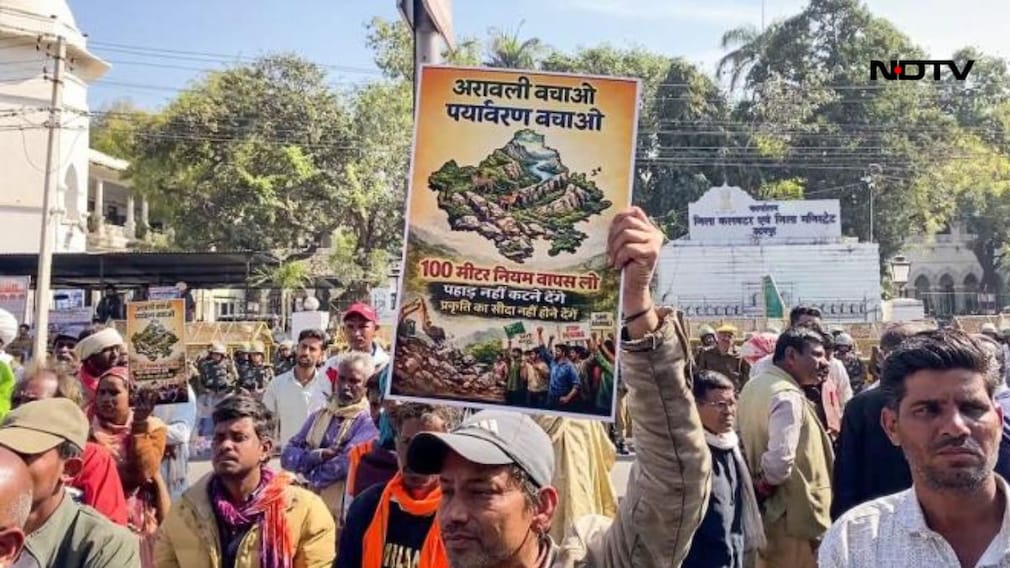
The lyrics of this 1960s song perhaps encompass the controversy surrounding the Aravallis best after the Environment Ministry came up with a new definition to allow for what is being termed 'sustainable mining' of the ancient mountain range. A wave of public euphoria for the Aravallis has even irked the Environment Minister, Bhupender Yadav, leading him to lash out at activists and blame YouTube reels for spreading false information.
The widespread anger from citizen groups and activists came in the wake of the Supreme Court judgment in late November, adopting the Environment Ministry's new criteria for defining what constitutes the Aravallis. The judgment says that only hills rising at least 100 metres above local relief, or clusters of such hills (of 100 metres and above) within 500 metres of each other, will now be recognised as part of the Aravalli range.
Why Do Away With 'Mean Sea Level' Formula?
Mr Yadav, whose Ministry submitted this new criterion, has vociferously defended this stand. The height of 100 metres will be measured from the base of the mountain structure, and mining will not be allowed around or beneath the hill's structure, clarified the Minister. But clearly, this clarification is not enough. Key questions remain. One of the most pertinent questions that the Minister has not responded to is that when hills are measured scientifically from mean sea level (MSL), why has the Ministry of Environment, Forest and Climate Change strangely decided to do away with this conventional standard and add the word 'local relief'?
Take the height of the Qutab Minar, once considered one of the most iconic minaret structures not just in India but in the world. Its height is less than 100 metres, standing at approximately 72 metres. Can we one day pass a rule stating that all heritage structures that are below 100 metres are no longer heritage buildings and therefore need to be razed to the ground to make way for roads and mining projects? That is exactly what we are doing to the Aravallis. In a press release, there is some attempt made to clarify the matter by stating, "Aravalli range has been explained as all the landforms which exist within 500 metres of two adjoining hills of height 100 metres or more. All landforms existing within this 500-metre zone, irrespective of their height and slopes, are excluded for the purposes of the grant of mining lease."
In spite of this, the operative term, '100 metres', remains intact.
Gaping Holes
Here is a list of 4 questions that remain unanswered.
1. Why did the Minister change the basis of the definition of the height of a hill from mean sea level to 'local relief'?
In the judgment passed by the Supreme Court (based on submissions by the Environment Ministry), it is stated in Para 31 that the reason why "the Government of India does not want to use the Forest Survey of India definition is that it will exclude large parts of Aravallis from their purview". There is no explanation why this was done, when in reality, using the criterion of height on the basis of 'local relief' will, in fact, end up excluding large tracts of the Aravallis.
2. What will happen in cases where the hillock is only 40 metres high but is an important landscape for leopards, or chinkara or a threatened floral species? And if so, why introduce height as a criterion at all? Do such areas now cease to be part of the Aravallis?
3. What the Minister has failed to share is that the definition of forests was also changed in August 2025 for the state of Haryana to facilitate mining in the Aravallis.
Haryana's new forest definition, notified in August 2025, defines a forest by minimum area (5 hectares isolated, 2 hectares contiguous) and canopy density (40%). Now, in some districts that include semi-arid and arid zones, a canopy density of 40% is not possible at all. Add the new definition of a height of at least 100 metres, and you will have mining companies and real estate sharks salivating over land tracts that can now be opened up for exploitation. So, when the Minister says 90% of the Aravallis will be protected, he forgets to couple it with other legal changes that have been brought in recently that actually throw open large swathes of land for mining.
4. Now, here is where the arguments get more complicated. Below is the list of areas that will now get completely excluded from the Aravallis -
- Areas like Manesar in Haryana, which is 265 metres above MSL. The highest hill in Manesar is 315 metres above MSL. So, the difference from local relief (which is the definition used by the Ministry) comes to 50 metres, which is less than 100 metres. Thus, the entire Aravallis in Manesar in Haryana would be excluded from the definition.
- Similarly, there are areas like Panchgaon in Haryana, which is 286 metres above MSL. The highest hill in Panchgaon is 320 metres above MSL. The difference from the surrounding terrain comes to 34 metres, which is less than 100 metres. So, the entire Aravalli in Panchgaon and further in the Nuh region is excluded now from the definition of the Aravallis.
- Kherala in Haryana is 257 metres above MSL, and the highest hill there is 300 metres above MSL. The difference from the surrounding terrain is 43 metres, which is less than 100 metres. So, the entire Aravalli in the Kherala area will be excluded.
- Gairtapur is 250 metres above MSL, and the highest hill there is 320 metres above MSL. The difference from the surrounding terrain is 70 metres, which is less than 100 metres. So, the entire Aravalli in the Gairtapur area will be excluded.
All of this information is available from the topographical sheets of the Survey of India. All these areas will now stand excluded under the new definition.
Concerning Discrepancies
Geological experts say that height is always measured from Mean Sea level (MSL), never from Surrounding Terrain, according to well-accepted parameters of height globally and in India. So, can the Minister explain why they are considering height on the basis of the surrounding region instead of MSL, which is standard practice?
Responding to the Minister's clarification, activists from the 'ARAVALLI VIRASAT JAN ABHIYAAN' also issued a statement pointing out discrepancies. "Our 1st area of concern is that there is divergence in statements made by Mr Bhupender Yadav, Union Minister of Environment, Forest and Climate Change, in his video speech and the information given in the official press release of the Bharatiya Janata Party dated December 21, 2025. The activists highlight that the press note states:
"Presently, there are 37 districts in the Aravallis. It is spread over approximately 1.44 lakh square kilometres in 37 districts. This mountain range extends to 20 districts of Rajasthan alone. In only 0.19% of the total geographical area, i.e., 277.89 sq. km area is under legal mining permits."
But Mr Yadav states in his comments:
"The total Aravalli area is 1,47,000 sq km. There are a total of 39 Aravalli districts. In only 217 sq km, i.e., 2% of the area, there can be mining. Hills will be protected from the bottom to the top till 100 metres in height".
The activists point to a clear difference in statistics, which may seem small on paper but makes a huge difference on the ground. Lastly, the activists ask whether Mr Yadav can assure that protection will take place for all hills irrespective of their height so long as they are part of the Aravallis.
Do It For The People
While Mr Yadav has clarified that no mining will be allowed in Delhi and surrounding regions, there is no clarity on specific areas surrounding Asola Bhatti or the areas surrounding the Dam-dama lake in Haryana, which are already places of high anthropogenic activity, even when they are the last repositories of fauna and flora for the region. A botanist who works in the Aravallis shared on condition of anonymity that it's not just areas around Delhi but also regions in Nuh in Haryana that have small hillocks, as well as other areas that still have natural springs and sources of water for local communities, which may not fit into this definition. All these may now be impacted and used for mining.
Once known as the 'spine' of North Indian states, the Aravalli hills form the most dominant geological structure in the formation of the North Indian terrain and drainage system. Policymakers ought to show some spine to protect not just its rich biodiversity but the people of the National Capital region, who are anyway struggling to breathe.
(Bahar Dutt is an author and environment journalist)
Disclaimer: These are the personal opinions of the author
-
Opinion | China's Quiet Power Grab Is Hiding In Plain Sight

China's greatest advantage may be neither its military nor its markets, but a world too distracted to see what it is building.
-
Reporter's Diary | Worse Than War: An Aerial View Of Nepal's Trishuli River Valley Tragedy
In many ways, reporting on natural disasters is far more harrowing than covering modern war
-
Opinion | The Indian Investor Has A New Problem: An SIP That Does Nothing
You keep doing everything right. So why aren't your stocks paying off, even as your investments rise?
-
The River Took It All: Aerial Visuals From Nepal Show Scale Of Catastrophe | NDTV Exclusive
Visuals from a helicopter showed narrow gorges now flattened and widened into valley-like spreads, with rocks, debris, mud, and bodies strewn across them.
-
Before The Nepal Flood, A Glacial Fall: Tracing The Trigger, And A 100-km Killer Surge
A glacier came off a ridge on the Nepal-China border and travelled 100 km down multiple rivers, the longest part of the run being in the Trishuli.
-
Opinion | How A 'Friendship' Pact With Russia Came To India's Rescue 55 Years Ago
With PM Modi set to meet Putin in Kyrgyzstan, a throwback to a historic treaty that helped India fend off Pakistan - and America's 7th Fleet - over 50 years ago.
-
Opinion | The OBC Fault Line That Could Shake Up Uttar Pradesh - And BJP
For years, the BJP was propelled by support from the OBCs. Now, cracks have begun to appear in that base
-
Census Asks 40 Questions. Why Number 10 Is A Battleground | NDTV Explains
The caste question is a fill-in-the-blank for everyone other than SCs and STs. But there's a case for making it a dropdown with set options. Let's decode the history and math behind the politics.