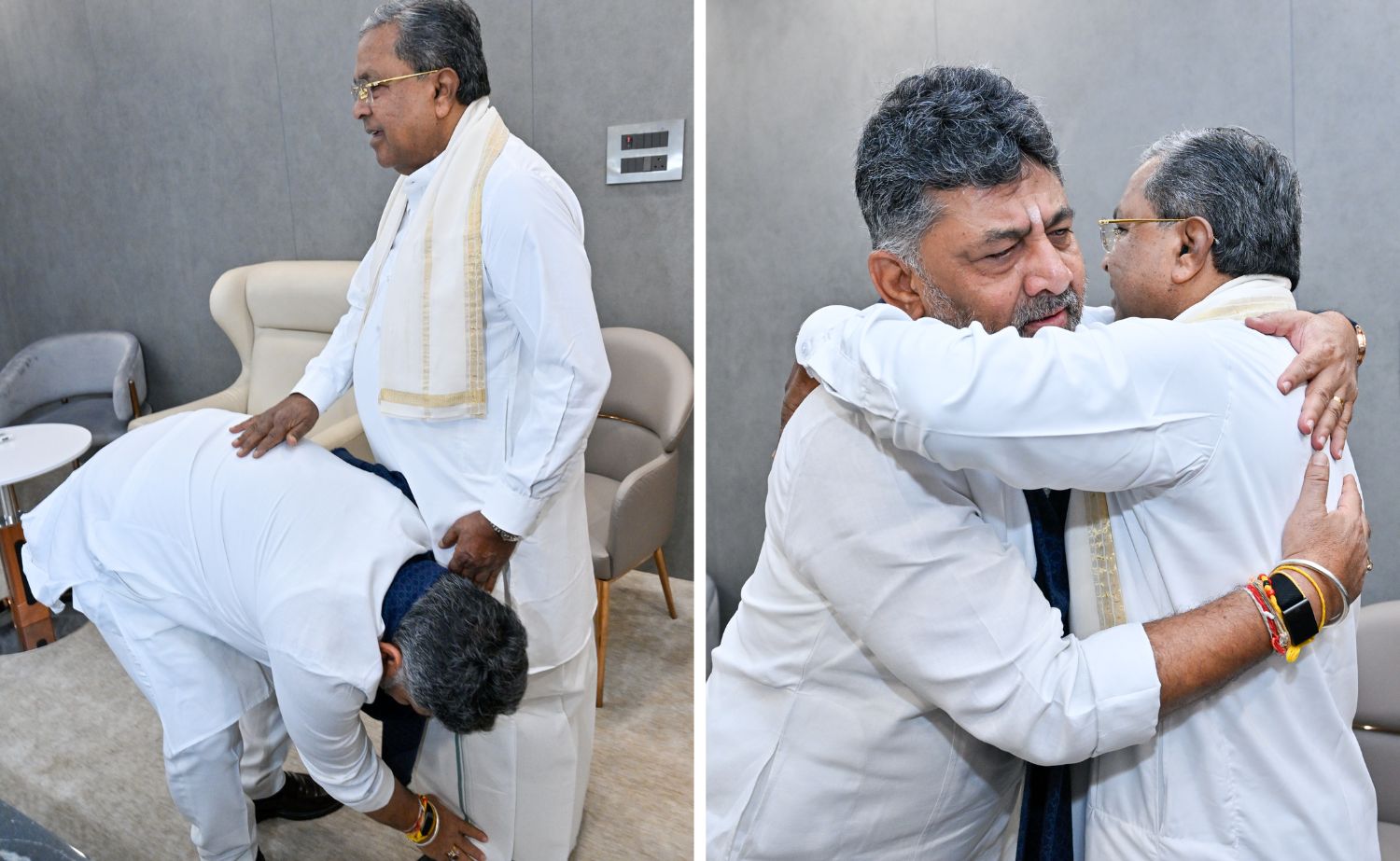









In Congress politics, timing is rarely accidental. What appears abrupt from the outside is often a decision taken late, after months of signals, denials, pauses, messages, and counter-messages. The emerging Karnataka leadership transition, with Siddaramaiah being eased out and DK Shivakumar waiting in the wings, belongs to that familiar Congress tradition. Yet, it also marks something new: Rahul Gandhi's willingness to act decisively where earlier he may have allowed drift to masquerade as consultation.
The story, however, is larger than one Chief Minister and one Deputy Chief Minister. It is about Rahul's new assertiveness after May 4, when the political map of the south offered the Congress both encouragement and instruction. In Kerala, the Congress-led front returned to power with a commanding verdict, with the Congress winning 63 seats and its alliance crossing the majority mark comfortably. In Tamil Nadu, Vijay's TVK emerged as the single-largest party with 108 seats, and the Congress chose pragmatism over nostalgia by joining the new government with two ministerial berths after decades outside power in the state.
These developments matter because Rahul Gandhi is no longer looking at Karnataka merely through the lens of Bengaluru politics. He is looking at it as part of a southern board. Karnataka goes to the polls in 2028; the Lok Sabha election follows in 2029. The five southern states and Puducherry together hold the kind of Parliamentary weight that can decide whether the opposition remains a protest formation or becomes a serious contender for power. Karnataka is, therefore, not just a state government. It is a staging ground.
Sidda's Borrowed Time
Siddaramaiah's difficulty did not begin this week. It began the day the Congress won Karnataka handsomely in 2023. The party secured 135 seats in the 224-member Assembly, its strongest Karnataka mandate in decades. But that very success contained an unresolved contradiction: Siddaramaiah had the mass base and social coalition, while Shivakumar had the organisational muscle and a strong claim as the man who had kept the party machinery alive.
The compromise of 2023 allowed Siddaramaiah to become Chief Minister and Shivakumar Deputy Chief Minister. Whether there was a formal rotational arrangement has always been denied, debated, or left deliberately ambiguous. But politics often functions on understandings that are never officially recorded. By November 2025, when the government completed two-and-a-half years, the Shivakumar camp believed the moment of transition had arrived. Reports at the time said MLAs close to him had gone to Delhi to press for the implementation of the suspected power-sharing formula.
Siddaramaiah survived that moment. The account from party circles is that Rahul Gandhi allowed him six more months, partly out of respect for his stature and partly because a premature change could have unsettled the government. That period has now ended. On May 26, after prolonged consultations involving the top leadership, the transition question returned with force. Some reports suggested Siddaramaiah had agreed to step down, while the official line continued to dismiss the matter as speculation. Finally, on the morning of May 28, Siddaramaiah confirmed, at a breakfast meet with 'DKS' and other senior leaders, that he was stepping down as Chief Minister. For now, he has also turned down the party's offer of a Rajya Sabha seat.
But the contradiction preceding this announcement was not unusual. In the Congress, denial is often not the opposite of decision. It is part of the choreography of the decision. It gives the outgoing leader dignity, the incoming claimant patience, and the High Command room to move.
The High Command Camp
Many observers misunderstand how Congress MLAs behave in states where the party enjoys a brute majority. They imagine legislators as fixed assets in one faction or another. In reality, Congress legislators are often more fluid, more cautious, and more attuned to signals from Delhi than television debates allow.
When a Chief Minister looks popular, electorally useful, and capable of leading the party into the next election, most MLAs appear to belong to him. They attend his meetings, praise his welfare schemes, and dismiss all speculation. But when they sense that the High Command is reconsidering his utility, they do not necessarily rush to the rival's camp. They move into a neutral space. In Congress lingo, they become available to the High Command.
Punjab offered the clearest example. Captain Amarinder Singh once appeared to command near-total loyalty in the legislature party. But when the perception changed, and he began to look electorally vulnerable, that support structure collapsed with surprising speed. Those MLAs did not automatically become ideological followers of one rival. They aligned themselves with the central decision.
Karnataka appears to be showing a similar pattern. It is not necessary to believe that MLAs have suddenly become devoted Shivakumar loyalists. Many simply signalled that they would accept a change if Rahul Gandhi and the High Command decided that the party's future requires one. This is how the Congress has traditionally worked. Faction is permanent; alignment is conditional.
What The Two Represent
Siddaramaiah and Shivakumar are not merely rivals. They represent two different political vocabularies within the Congress.
Siddaramaiah is the social justice politician: backward class assertion, welfare politics, ideological opposition to Hindutva, a certain old-world mass connect. He is not easily replaceable. Mishandling him would be costly, especially when the Congress needs backward class consolidation in Karnataka and beyond.
Shivakumar represents another quality the Congress also requires: relentlessness. He is organisationally aggressive, resourceful, combative, and willing to play politics as a full-contact sport. He has waited, negotiated, endured, and reminded the High Command that loyalty must eventually be rewarded. For a party often accused of taking its own workers for granted, elevating Shivakumar would carry a message beyond Karnataka.
Rahul Gandhi's challenge is to make this transition look less like a factional settlement and more like strategic renewal. If Siddaramaiah is offered a national role, possibly through the Rajya Sabha or a larger organisational assignment, the party can tell two stories at once: that experience is being honoured, and that generational transition is being attempted.
That balance is delicate. Too much triumphalism from the Shivakumar camp would have wounded Siddaramaiah's supporters. Too much indulgence towards Siddaramaiah would have convinced Shivakumar that promises in the Congress are made only to be postponed. Rahul's task is not to choose one man and discard another. It is to rearrange both within a larger southern strategy.
Rahul's Return To Command
For years, Rahul Gandhi's critics have accused him of being a moral commentator rather than an organisational commander. Karnataka may become a rebuttal to that charge, given he now appears to be acting with a sharper sense of timing. He has seen that the Congress can win in the South, can enter government pragmatically, can manage senior leaders, and can speak to younger voters. But none of this would have mattered had Karnataka, its most important southern state government, sunk into internal exhaustion.
The Bharatiya Janata Party (BJP) understands this well. It will watch every Congress hesitation, every Siddaramaiah loyalist's grievance, every Shivakumar supporter's provocation, and every administrative misstep. Karnataka is not only about the 2028 Assembly election. It is about whether the Congress can present itself in 2029 as a party capable of governing, renewing, and disciplining itself.
That is why May 26 may be remembered as more than a meeting date. It may mark the point at which Rahul Gandhi chose to stop letting Karnataka's succession question rot in the open. Whatever comes next for Karnataka, for now, the message from Delhi appears clear enough. Siddaramaiah had his mandate, his stature, and his extension. Shivakumar now gets his turn. And Rahul Gandhi, perhaps for the first time in a long while, seems willing to make the Congress behave like a party that knows the value of timing.
(Rasheed Kidwai is an author, columnist and conversation curator)
Disclaimer: These are the personal opinions of the author


