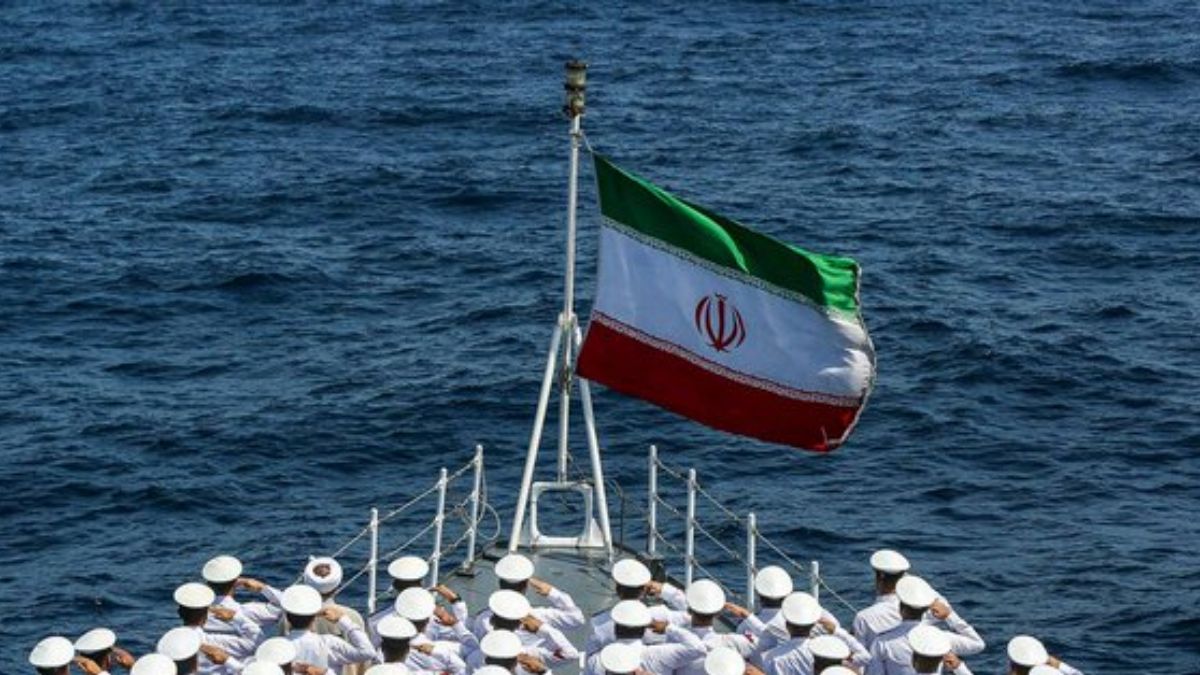
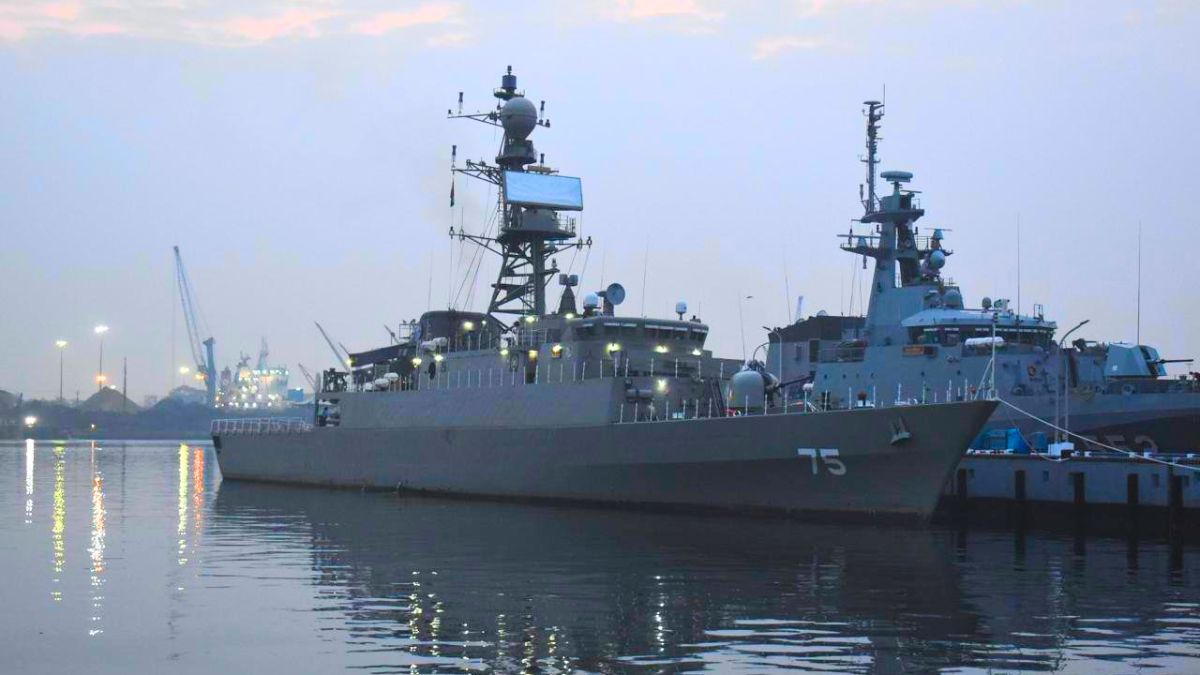







The coordinated action of the US and Israel against Iran has fast emerged as a watershed moment for security dynamics in the Middle East. On March 4, the US Department of War confirmed that a torpedo launched by an American submarine sank the Iranian frigate IRIS Dena off the coast of Sri Lanka, near Indian waters in the Indian Ocean. This attack has introduced a new naval dimension into the conflict, which has thus far remained limited to air power. Touted as the first major naval casualty in the Indian Ocean since the Second World War, the attack by the US on the Iranian warship is significant in many ways for the security dynamics in the Indian Ocean, as well as for India's own interests in the region.
Two Other Ships Waiting In Colombo
The IRIS Dena was subjected to the torpedo attack while it was returning to Iran after having recently participated in the Indian Fleet Review and Exercise MILAN in Vishakhapatnam in February 2026. Following the attack and destruction of the warship, in compliance with obligations under international laws, the Sri Lankan Navy and Air Force promptly initiated search and rescue efforts. At least 87 people on board the ship have died as a result of this attack. While those who have been rescued are being treated in Sri Lanka, two other Iranian warships have reportedly taken refuge in Colombo. Given that this took place close to India's territorial waters, and soon after the warship and its personnel participated in an exercise hosted by the Indian Navy, a rethink must be set in motion in New Delhi about what this development entails and how it can best be navigated.
The LEMOA Agreement
However, what appears to somewhat complicate matters for New Delhi is the Logistics Exchange Memorandum of Agreement (LEMOA) signed between India and the US in 2016, designed to facilitate logistical support, supplies, and services between the two countries for refuelling and replenishment. In a nutshell, the agreement mandates the scope for the US to use Indian facilities and bases to replenish and refuel its naval assets, and vice versa. At this juncture, when the US Navy's actions must cause unease in India, New Delhi must cautiously balance future demands for the use of Indian facilities from the US. Given President Trump's emphasis on ensuring that its partners live up to the expectations and demands of Washington, New Delhi must tread carefully on how to ensure that it does not become a party to this conflict, even indirectly. This is especially crucial at a time when India's neighbourhood finds itself at the cusp of being embroiled in this conflict. Importantly, speculations remain rife on whether Pakistan may join the conflict given its security pact with Saudi Arabia. Furthermore, the torpedo strike in the Indian Ocean has prompted many to believe that the conflict is now playing out in India's backyard.
While India and the US have significantly advanced maritime cooperation in the context of the wider Indo-Pacific to establish and sustain a rules-based order in the region, the latest US attack appears to have turned the Indian Ocean into a new flashpoint in Washington's actions against Iran. This significantly risks escalation of tensions in the Indian Ocean, rendering the sea lines of communication and maritime trade routes vulnerable to disruption, resulting in adversarial implications for New Delhi, whose interests remain deeply anchored in preserving a free and open order in the region. Escalating securitisation of its maritime neighbourhood remains a significant challenge for India.
India Is The Biggest Player
Given the logic of geographical embeddedness, the security and stability of the Indian Ocean is a stated objective of India's maritime security strategy. Furthermore, given the vast differential between the capabilities and resources of India and other resident countries in the Indian Ocean, India is a principal maritime security actor in the region. The US attack on the Iranian frigate is arguably the closest the region has come to a traditional security conflict in decades. In such a context, it is essential for India to ensure that sustained efforts are made to preserve order and stability in the region. For this, New Delhi must continue to engage with all actors diplomatically to ward off further escalation of conflict in the Indian Ocean.
From Air To Sea?
In addition to these, a significantly critical trendline is appearing to be taking shape. The conflict between US-Israel and Iran is starting to play out in the maritime domain. Recent campaigns by Israel and the US against Iran have been propelled by air power and missiles. Iran's recent declaration of the closure of the Strait of Hormuz was the first introduction of the maritime domain into this ongoing conflict. However, as a result of the torpedo attack launched by the US on the Iranian frigate, the nature of the conflict seems poised to be altered significantly. The extent to which the navies will shape this conflict will be the big-ticket question going forward.
(Sayantan Haldar is an Associate Fellow at Observer Research Foundation. He tweets at @sayantan_h.)
Disclaimer: These are the personal opinions of the author


