Opinion | Iran-Israel War, And The 'War Logic' Behind Bombing Oil Depots
The thinking presumably was that targeting economic interests may, in some sense, galvanise and mobilise the Iranian public against the current administration. But that didn't happen.
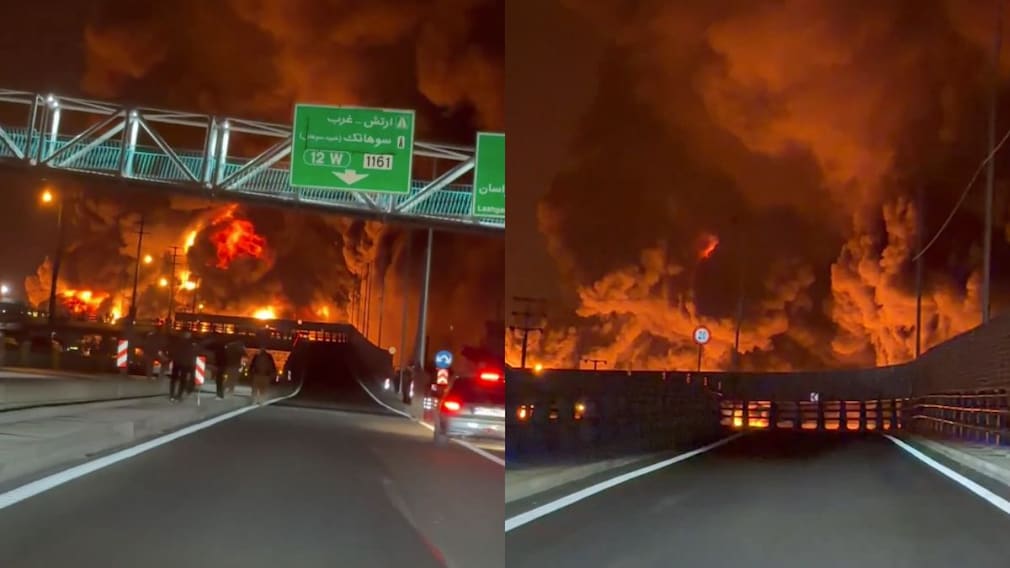
One of the defining images of the past week as Israel and the US continue their war against Iran has been the raging fires in oil depots surrounding Tehran, enveloping the capital of around 10 million residents under a thick black cloud of smoke. Amidst the ongoing war, wrapped around a cocktail of unclear kinetic and political aims ranging from regime change to controlling the nuclear file, the centrality of oil as a global energy anchor has been reestablished.
Oil, and by association, energy, has always been political. It remains a driving commodity for global trade and economic stability despite the narratives of alternative and greener fuels slowly taking over. However, that shift is predominantly affordable only in the West. For a large section of the developing world and the Global South, both oil and natural gas remain supreme when it comes to economic stability, and by association, political consistency.
Oil Attacks Aren't New
Striking energy-related infrastructure during a conflict in the Middle East is not new. In fact, it could be wagered that oil has been at the centre of many such geopolitical infractions for decades. It is this 'black gold' over which, in 1945, the US decided to become a net security provider for the Saudi kingdom and since then has been a proverbial military and political power in the region. Oil is synonymous with political power in the Arab and Persian Gulf regions since political stability is critical for smooth exploration, production and transport of oil and gas into global markets. However, today, oil itself finds itself in the midst of a transitional change of the global order.
Iran's response to the war has been on brand. Tehran, facing an existential crisis exacerbated by the assassination of its Supreme Leader, Ayatollah Ali Khamenei, in a joint US-Israel air strike against his compound, has, as of today, little room to de-escalate. In between losing their spiritual leader, failing to protect him, and knowing that US-Israeli aims are of regime change, Tehran and the all-powerful Islamic Revolutionary Guard Corps (IRGC), a militia that reports directly to the Ayatollah, have openly targeted oil and gas installations across the region in a bid to make a regional crisis an international one. And it may be working.
A Move That Backfired?
The US and Israel are trying to do the same within Iran. Reading the room as the Islamic Republic being heavily weakened, the thinking presumably remains that targeting economic interests may, in some sense, galvanise and mobilise the public against the current administration. Within the Iranian polity, even the moderates, led by the currently serving President Massoud Pezeshkian, have had to align with the Ayatollah under a nationalistic and patriotic branding to project a unified front against the war. The tensions of these political divisions are also palpable. Pezeshkian had recently announced that Iran will now stop conducting attacks against its Gulf neighbours, such as Qatar, Bahrain, the UAE, Oman, Kuwait, and Saudi Arabia. However, within hours, the IRGC was striking targets in these states, ignoring Pezeshkian's position outright.
For Iran, taking the war international and positioning itself as being ready for a long-term protracted conflict is one way to hit the US. President Trump seems to be struggling to gather support for his decision to strike Iran - in all probability, at the behest of Israel. Trump ran his political campaigns on not being interested in long-drawn wars, primarily focusing on 'America First', which means an insular America, and not being responsible anymore for policing the world. To add another layer, Americans are not used to expensive oil prices at home, and while supplies of oil can be managed from other markets, it is the pricing that often becomes ungovernable.
The IRGC's Failure - And Its Fallout
Iran seems to be aware of the above intricacies facing the US. But it's not a simple puzzle either. For Iran, and more specifically the IRGC, the failure to protect Ayatollah Khamenei from US and Israeli air strikes is a monumental failure, one that they can ill-afford not to respond against - not merely for revenge, but to reinstall confidence in the IRGC's abilities to serve and protect the Islamic Revolution, of which the Ayatollah is the seat of all power and purpose. For the IRGC, this may be the moment in this war - now that Mojtaba Khamenei has been announced as the new Supreme Leader - to deny a victory narrative to the US. The fact that the Gulf countries, at the receiving end of Iran's military response, are refusing to move into an 'offensive' posture despite being pushed to do so by Washington shows that calculations may have been made that show that the Iranian regime is going to survive. Entering this war from an 'offensive' position will also align the Gulf states directly with Israel regionally, a potentially bigger problem in the long-term. It will also restructure the war into Shia-Sunni blocks, making instability a long-term reality. These eventualities stand fundamentally against the economic endeavours the UAE and Saudi Arabia have embarked on.
Finally, the reality is this: it was never that 'tech is the new oil' or 'data is the new oil'. Oil, it turns out, was always the new - and old - oil. It constructs and deconstructs global economics and politics and has the power to decide if a family in rural India is going to cook their dinner on a gas stove or be pushed back to primitive methods of wood and fire.
(Kabir Taneja is Executive Director of the Observer Research Foundation Middle East)
Disclaimer: These are the personal opinions of the author
-
Hit Songs, Empty Pockets: The Hidden Math Behind India's Viral Music Boom

Over 80,000 brands and five lakh creators in India make branded content. The opportunity is worth around Rs 1,500 crore.
-
Opinion | Great 'Exceptions': How The Oil India Was Attacked For Is The Oil Trump Now Seeks
A law written to punish the buyers of Russian oil was suspended by the US to protect a purchase of Russian oil. India spent fourteen months being lectured for less.
-
Opinion | Louis Vuitton Loot, Torched Cars: France Protests Have An Unlikely Beneficiary
It's an unbelievable moment. Crowds looting the most exclusive stores in Paris, including the famed Luis Vuitton. But what's behind this meltdown?
-
Blog: Kolkata Didn't Learn From 2015. Eleven Years Later, It Proved To Be Fatal
The City of Joy isn't a stranger to crowd control. Be it during Pujo or Christmas at Park Street, Eden Gardens cricket matches, or Derbies between Mohun Bagan and East Bengal. But during Pujo, the entire city is on alert.
-
Opinion | Slurs, Threats, Now A Temple Attack Plot: When Did America Become So Hostile To Indians?
The rising tide of anti-India, anti-Hindu, and racist attacks serves as a stark reminder that economic prosperity does not automatically guarantee social immunity from bigotry.
-
A Step Behind Neha Bora: What Rahul Gandhi's Gesture Says About Congress' Gen-Z Pitch
At INDIA bloc's march to Supreme Court, Rahul Gandhi placed himself a step behind two women, hands resting on their shoulders. One was his sister Priyanka. The one on his right was Neha Bora. Here's what the image means for the protest wave now, and for Rahul's politics in general.
-
Opinion | Imran Khan, And The Perils Of Having An 'Opinion' In Bollywood
The reality of the industry is quite grimy. More often than not, its inhabitants have been fairweather friends, happy to sing the praises of whoever is in a position of authority.
-
Exclusive: India's Food Safety Problem Goes Beyond Just Dirty Kitchens - By Tukaram Mundhe
On World Food Day, Maharashtra's Commissioner of Food Safety explains why instead of taking stopgap measures, the entire supply chain in India needs to be held accountable and made transparent.
-
Opinion | India Has Enough Coal. So Why Are Power Plants Running Short? A 76 Million 'Crunch'
As of October 5, as many as 82 of the 191 thermal plants monitored by the Central Electricity Authority were in the 'critical' category
-
Opinion | Starlink, India, And Why Elon Musk Must Know His Billionaire Tantrums Won't Work
India should neither be intimidated by Musk's global influence nor distracted by his theatrics.