Opinion | Iran-Israel War And The Limits Of India's 'Strategic Autonomy'
India needs to figure out how to manage the fallout of the Middle East crisis without letting strategic autonomy start to look like a slogan.
In its first week, the conflict around Iran has spread across the Gulf and moved closer to India's maritime neighbourhood. For India, this is not a distant geopolitical theatre. It is an energy shock in the making, a shipping risk, a remittance risk, and a human-security problem. The conflict has already claimed Indian lives. Few countries are as exposed to this crisis and as well connected across the region as India is.
In such circumstances, caution was the correct instinct. The question is no longer whether India should be cautious in responding to this widening conflict. The question now is whether caution, by itself, is enough. The External Affairs Minister's statement in Parliament today underlines how serious the situation has become.
In India, the crisis is no longer being seen only through markets, migration, and maritime routes. It is also being read through the language of sovereignty and strategic autonomy. A war framed through pre-emptive force, leadership decapitation, and widening retaliation raises questions that many feel cannot simply be brushed aside.
Two Critical Incidents
Two recent American actions have pushed those concerns into sharper focus.
The first is maritime. The torpedoing of the Iranian frigate IRIS Dena off Sri Lanka has altered the geometry of the war. In India, this is not seen as just another battlefield incident in the Gulf. The vessel had taken part in India's fleet review in Visakhapatnam. That matters. It reinforces the uneasy sense that a war once treated as external is now entering waters India regards as part of its own security space. The Indian Ocean is no longer a distant backdrop. It is becoming part of the conflict's operating field.
Many in India see this not merely as escalation, but as a development that cuts directly against Indian interests at sea. If a Gulf war can intrude so quickly into waters off Sri Lanka, then India's concern cannot remain confined to oil prices and evacuation plans. It must extend to the security of sea lanes, the stability of its wider maritime neighbourhood, and the precedent being set in waters so close to home.
An Old Discomfort
The second is strategic autonomy under strain. The US decision to ease restrictions linked to India's purchases of Russian oil may have relieved immediate pressure. But the episode sharpens an older discomfort. The real question is what it says about the structure of Indo-US ties. If India's room for manoeuvre on energy can be publicly tightened and publicly relaxed by Washington, then strategic autonomy begins to look less like settled doctrine and more like a claim tested by circumstance.
That is the larger strategic point. India's autonomy is not tested only in moments when it is asked to choose sides. It is tested when its freedom to act begins to depend on the approval of others. If Russian supplies can be politically constrained while Gulf supplies become strategically insecure, India's energy choices narrow at both ends. Strategic autonomy then stops being a matter of rhetoric and becomes a question of whether India still has enough practical freedom to act independently under pressure.
For India, then, the issue is not just about how to describe the conflict. It is how to manage the fallout without letting strategic autonomy start to look like a slogan.
India Has Been Right...So Far
India's broad line so far has been defensible. It has emphasised restraint, diplomacy, civilian safety, sovereignty, and territorial integrity. That is not abdication. It preserves room for manoeuvre in a conflict where every public word can shut a private channel.
At a time when Washington is projecting military resolve in unusually stark terms, Prime Minister Modi's statement that military conflict is not a solution reads as more than a routine appeal for peace. It suggests a subtle shift in India's emphasis, from cautious observation to a clearer warning that further escalation will deepen instability and impose direct costs on India.
India is right not to reduce this crisis to bloc politics. It has an advantage that many others do not. It has working ties with Washington, Israel, Tehran and the Gulf states. That gives New Delhi something valuable in a crisis: access. In a conflict defined by shrinking channels and hardening rhetoric, access itself is leverage.
A louder public line may satisfy ideological camps, but it can also narrow the room India needs for de-escalation, evacuation, shipping reassurance, and energy adjustment. In that sense, India's emphasis on restraint is not abstract virtue. It reflects a hard reading of Indian interests. But a more measured tone should not mean a smaller role.
In crises, the diplomacy that matters most is often the least visible. Yet, quiet diplomacy cannot become a substitute for visible policy. If India wants its caution to remain credible, it has to show that it is preparing as seriously as it is speaking.
A Tightening Stance?
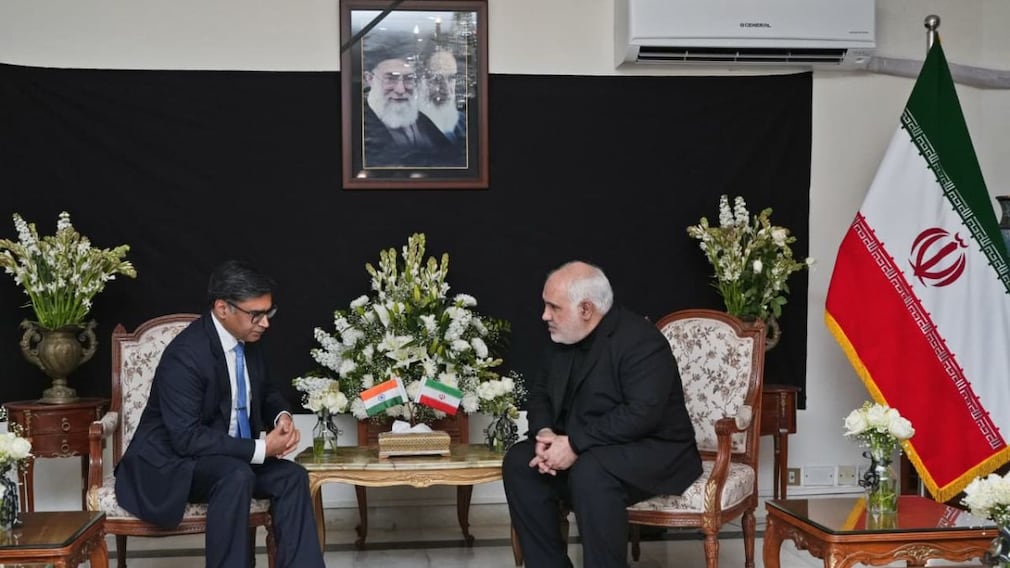
There are signs over the last few days that this is beginning to happen. The Foreign Secretary's visit to the Iranian Embassy in Delhi to sign the condolence book, the External Affairs Minister's telephonic calls with his Iranian counterpart, and discussions with Iranian Deputy Foreign Minister Khatibzadeh during the Raisina Dialogue all suggest that New Delhi understands the need to keep Tehran visibly in the frame. The same is true of the disclosure that India granted safe harbour to the Iranian naval ship IRIS Lavan at Kochi, where its crew has been accommodated at naval facilities since March 4. Strategic autonomy cannot survive on invocation alone. It has to be kept alive by engaging all sides when that is least convenient.
India has more options than it sometimes acknowledges. It can say more clearly, though without theatrics, that freedom of navigation and non-escalation in the Indian Ocean are core interests, not peripheral concerns. It can show more visibly that it is managing the risks around oil, LNG, fertiliser, freight, and insurance. It can deepen engagement with the diaspora through regular advisories and visible preparedness. And it can keep channels open not only with Gulf capitals and Washington, but also with Tehran. None of this requires grandstanding. It requires quiet firmness.
So, is India on the right track?
Broadly, yes. India is right not to turn a widening war into a contest of slogans. It is right to avoid rhetorical excess that narrows options. But it has now reached the point where caution must be backed by operational capability and visible balance, so that the credibility India has tried to preserve can now be seen at work.
For India, the Gulf is not a theatre. It is an artery. When an artery is under stress, what matters in the end is not the rhetoric of the response, but the steadiness of the hand.
(The writer was a Permanent Representative of India to the UN and now serves as Dean, Kautilya School of Public Policy)
Disclaimer: These are the personal opinions of the author
-
Opinion | Does The US See The 'Pattern' Behind Iran's Downing American Warplanes?

The downing of the American F-15E and two A-10 Thunderbolt II lay bare the vulnerability of non-stealth, low-altitude platforms operating in contested environments.
-
Eagle Down: How US Carried Out Precision Search And Rescue Op In Hostile Iran
How the United States transformed a tactical failure into a narrative of national resolve.
-
Opinion | 450 Missile, 2,000 Drone Attacks Later, Why Is UAE Still Not Fighting Iran?
The UAE is Iran's second-largest trading partner and also home to roughly half a million Iranians. Why, then, has it absorbed more fire than any other Gulf state?
-
In Numbers: How Has India Kept Fuel Prices Low Even As Europe Sees 70% Spikes?
India imports 88% of its crude. Why then is it not seeing massive price hikes for fuel and LPG? Inside the unique strategy it's following...
-
Opinion | India Just Decided To Let Chinese Capital In Again. But There's A Catch
In March 2026, India eased regulations that had restricted Chinese capital in local companies, in a development that marks New Delhi's cautious approach towards capital flows from Beijing.
-
Trump's Iran 'Knocked Out' Claim Blown Up By US Intel On Missiles, Drones
Donald Trump claimed this week the war would end in two to three weeks as he threatened to send Iran back to the Dark Ages. But based on these reports the fighting is far from over, even if US President wants to push a contrary narrative.
-
Opinion | Rs 30 Petrol Hike To Currency Crisis, What Oil At $150 Can Really Do To The World
At $125 per barrel, petrol and diesel retail prices will need to rise by Rs 8-14 per litre. At $150 - which experts think is now likely - these figures could touch Rs 26-30 per litre.
-
Opinion | The Problem With Trump's Fantasy Of A 'Crippled' Iran
Even a relatively insulated US economy cannot entirely escape the ripple effects of sustained disruptions in one of the world's most critical energy corridors.
-
Opinion | Trump's Iran War Is About To Become Someone Else's Problem Soon
Start alone, end alone - that may be the harshest lesson for Trump as he now tries to dash for the door in Iran.