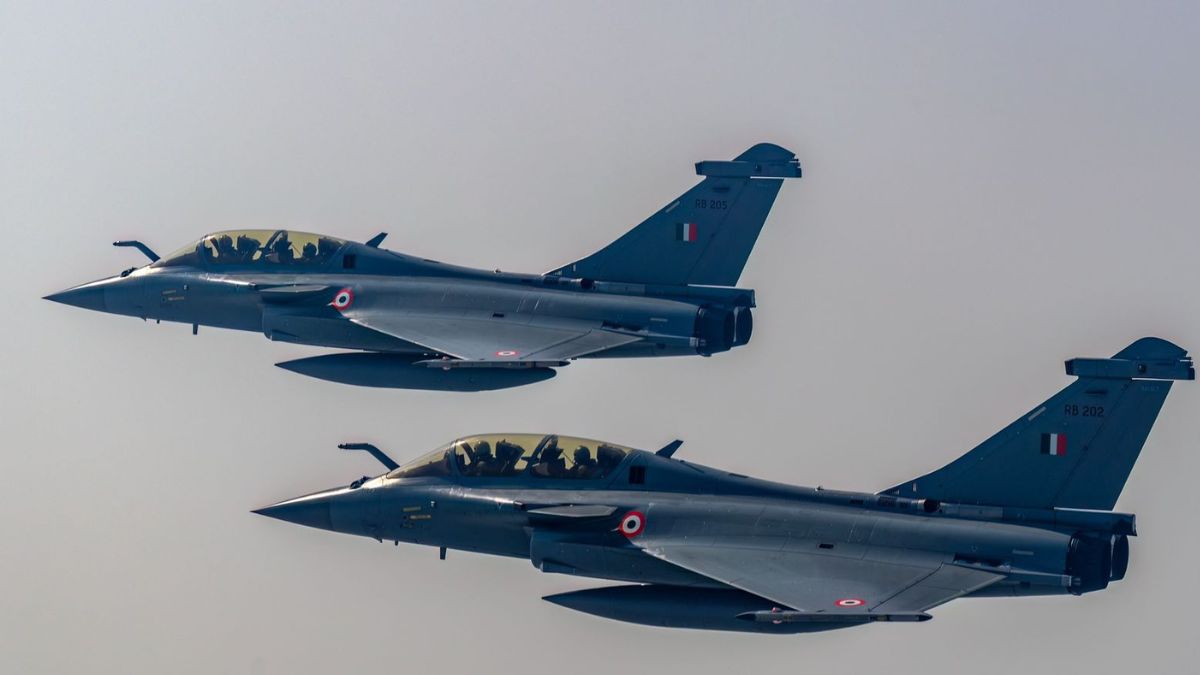


The year was 1987, and this writer was doing his test pilots course at EPNER, the French Test Pilots School located at a quaint place called ‘Istres', where all French aircraft prototypes were test-flown. In between our exhausting ground subjects (equations in the aerodynamics class whose length filled the span of the blackboard!) and flying instructions (all teaching in French!), we would, after every odd month, get a respite. All flying would stop, and the entire airbase would be out on the tarmac to see ‘vol Rafale', that is, Rafale flying! And the Rafale technology demonstrator (which it was then) would turn, loop and twist with its afterburners lit, astonishing the viewers with its tight manoeuvrability. Little did I know that one day it would fly in Indian Air Force colours.
Rafale in French means ‘a gust of wind'. While in the air, it is as elusive as a ‘gust' to the adversary, its story of induction in the IAF has actually kicked up a storm of hurricane proportions. This essay will look at the reasons and implications of the impending announcement of the acquisition of 114 Rafales during the forthcoming visit of President Emmanuel Macron; the order, supposedly worth Rs 3.25 lakh crores (!), would make it the largest acquisition ever for the Indian armed forces - as well as the largest order worldwide for M/S Dassault, the manufacturer of Rafale.
The evaluation process for the Medium Multi Role Combat Aircraft (MMRCA) project for 126 aircraft started in 2008 - special security was put in place for the evaluation process, and that there was not a single ‘leak' speaks of the high integrity of the evaluation. The team, over a period of almost two years, evaluated six leading aircraft in all types of the Indian environment and shortlisted the Eurofighter and Rafale. The government (not the IAF, as any acquisition is a government decision) decided to go for the Rafale in 2012; thereafter, the project went into prolonged slumber, a victim of inaction as the MMRCA project had become a political ‘touch me not.' The real effect was on the IAF's operational capability as its squadron strength gradually dwindled. All Air Chiefs after 2010 kept emphasising the imperative need to urgently acquire a new aircraft, but what finally came in 2016 was a truncated contract for the purchase of 36 Rafales to equip two Squadrons. This gave breathing time, alright, but as MiG-21 squadrons continue to be phased out, the situation has become critical, with IAF strength reducing to 29 Squadrons. The media has been agog with news of a new IAF project for 114 Multi Role Fighter Aircraft - and foreign companies have made their pitch again through media articles and participation in the AeroIndia shows at Bengaluru. In the interim, India's neighbours were up to their tricks and the Rafale was seen in action recently in Op Sindoor.
The decision to buy 114 more Rafales would be influenced by the following facts.
- First, the Rafale had been short-listed in the MMRCA project and has credited itself in Op Sindoor.
- Second, two IAF bases - Hasimara in West Bengal and Ambala in Haryana - have all the technical and administrative infrastructure to host possibly more Squadrons.
- Third, IAF has ready aircrew and technical manpower trained on the Rafale; hence, institutional memory and experience is available within the force for quick operationalisation of additional aircraft of the same type.
- Fourth, the Indian Navy would be inducting 26 Rafale M - the maritime version - the contract for which was signed in April 2025. So, acquiring more Rafales in addition to the earlier 36 aircraft for the IAF makes for sound logistical sense; a different aircraft type would entail an additional financial and logistical burden.
- Fifth, the Rafale brings to the IAF its multi-role capability, where it can seamlessly transit from one role to another, without any time lost in changing its configuration. Additionally, in the same mission, the Rafale can do many tasks; for example, conduct reconnaissance as well as deliver ordnance. With its high endurance and range capability, it can be redeployed over long distances - say from Dibrugarh in the East to Jaisalmer in the west - in quick time. It has fourteen hard points that can carry different types of armaments, including the Meteor beyond-visual-range air-to-air missile, SCALP and Hammer air-to-ground precision munitions. For self-protection, the Rafale has an integral electronic warfare suite called Spectra, which can defeat incoming missiles aimed at it. The data link equipment makes it ‘silent' to enemy electronic listening devices, as well as gives the aircraft a secure communication capability.
- Finally, but most importantly, the track record of France being a dependable defence partner would have influenced the political decision-making. India bought the Toofani and Mystere jet fighters in the 1950s and '60s, followed by the Mirage-2000 in 1984, which is still a go-to machine for IAF operations; the Indian Navy, too, has operated many French-origin equipment. Our experience with the reliability and potency of French machinery has been sound, and France has not been a party to sanctions and arm-twisting actions that the US and UK have resorted to due to geopolitical reasons.
It is understood that stringent Make in India clauses would be part of the contract, including the establishment of a global maintenance, repair and overhaul (MRO) facility. This would result in a boost for medium and small-scale enterprises as ancillary suppliers for the project. As part of the national indigenisation endeavour, media reports talk of the first few aircraft (some say between 14 and 20) coming from France and the rest being made in India. This is good, as we would otherwise be reduced to doing perpetual imports if the buyer's clout is not used to get technology for vital equipment like aero-engines and aircraft structures. If the power of such a huge purchase does not put New Delhi in the driver's seat to fast-track acquisition of technology, then nothing else will. The contract writers and acquisition managers have their work cut out.
Bienvenue, Rafale!
(The author is a former Additional Director General, Centre for Air Power Studies, and a retired Air Vice Marshal of the Indian Air Force)
Disclaimer: These are the personal opinions of the author


