Opinion | India Wants A 6th-Generation Fighter. But A Lot Could Go Wrong
India might just be building too many fighter jets to focus on any one of them well. A recalculcation is needed.
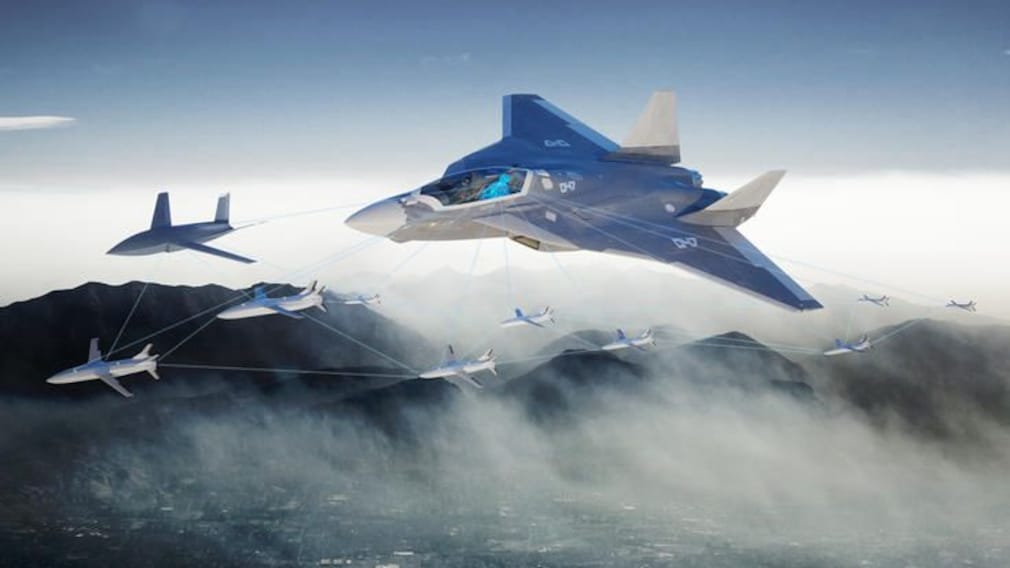
India's interest in sixth-generation fighter programmes is strategically understandable. It is also, at this stage, ambiguous at best. The Indian Air Force (IAF) is looking at a future in which a fighter aircraft will no longer be merely an aircraft. Let's be very clear: a fighter jet will be a flying command-and-control node - built around stealth, artificial intelligence, advanced electronic warfare, long-range sensing, secure communications, network-centric operations, and manned-unmanned teaming. A sixth-generation fighter is expected to operate with autonomous or semi-autonomous "loyal wingmen", drones, sensors, weapons, and other platforms as part of a connected combat system.
That is precisely why India's reported interest in international sixth-generation programmes deserves serious attention. But it should not become another fashionable acronym added to an already crowded defence-modernisation list.
Uncomfortable Numbers
India is simultaneously pursuing the Tejas Mk2, the 114-aircraft Multi-Role Fighter Aircraft (MRFA) programme, the Advanced Medium Combat Aircraft (AMCA), and now exploring participation in an international sixth-generation programme.
Each is strategically important. Together, however, they raise an uncomfortable question: does India have the financial, industrial, technological, and institutional capacity to pursue all of them at the speed required? India looks towards global collaborations, but is ambiguous at best when it comes to planning. India's interest in the two programmes comes at a time when the global combat-air landscape is undergoing a major transformation.
The United States is pursuing its next-generation air-dominance capability (F-47), while China is working on highly classified combat aircraft J-36 and Shenyang J50. Europe and its partners are attempting to create alternatives that reduce dependence on American technology.
The opportunities are immense: getting access to the highest level of technologies, global participation, and forging strategic alliances when you build a jet together. But the challenges are plentiful too, in terms of finance primarily.
The Aeronautical Development Agency (ADA) has indicated that AMCA is positioned to emerge as the most financially efficient fifth-generation fighter project globally. ADA puts the entire research and development (R&D) allocation for the aircraft at approximately $1.8 billion (Rs 15,000 crore). The Cabinet has cleared this, which is a fine point.
However, these costs are expected to increase. The Chinese J-20 Mighty Dragon, which has a similar operational role as the AMCA, is believed to have required approximately $5 billion to develop. Even Turkey's TF Kaan and Russia's Su-57 Felon (the Su-57E), historically assessed by the IAF, are estimated to have absorbed over $10 billion each in their development cycles.
Additionally, the Tejas MK 2 programme (4.5-Gen) is set to cost about $1.5 billion. Now, the MRFA is a whopping USD 39 billion and constitutes one of the largest defence modernisation commitments in India's history.
Further, the IAF has already expressed interest in joining one of the European sixth-generation fighter initiatives. The Ministry of Defence (MoD) has been examining both GCAP and FCAS as possible avenues for international cooperation, technology, and industrial participation.
Opportunity Meets Uncertainty
Defence Secretary Rajesh Kumar Singh said in April that India had approached both major international partnerships and expressed interest in participating in a sixth-generation fighter programme. He also pointed to the enormous investment involved as a reason why such a project would have to be pursued through partnership.
There are two options: the Global Combat Air Programme (GCAP), involving Britain, Italy, and Japan, and the Future Combat Air System (FCAS), then associated with France, Germany, and Spain.
But the landscape has already changed.
The GCAP's Challenges
Britain, Italy, and Japan merged their next-generation fighter efforts in 2022 and plan to field a new combat aircraft around 2035. The programme is being developed through Edgewing, a joint venture involving BAE Systems, Leonardo, and Mitsubishi Heavy Industries.
In July, the three governments awarded Edgewing a GBP 4.6 billion contract to take the programme into its next major design and development phase. The British government has also committed GBP 8.6 billion to GCAP over four years.
That is significant. It demonstrates that GCAP is not merely a concept displayed at an air show. It has an institutional structure, multinational funding, and an industrial framework moving into detailed development. Yet, this also creates a problem for India.
GCAP already has three founding partners. Britain, Italy, and Japan have invested political capital, money, and industrial capability into the programme. India cannot simply enter and expect the same workshare, intellectual property access, or decision-making authority as the original partners.
The important questions for India would be what it is allowed to design, what technologies it can own, what systems it can manufacture, what intellectual property it can access, and whether Indian companies can become genuine programme partners rather than suppliers.
FCAS Is Now A Cautionary Tale
The other option has become considerably more complicated.
The original FCAS/NGWS concept was designed around a next-generation fighter supported by unmanned systems, sensors, and a wider combat cloud. But the core fighter partnership between France's Dassault Aviation and Airbus, representing Germany and Spain, collapsed in June 2026 after years of disagreement over industrial responsibility and workshare. France and Germany abandoned the joint fighter project, although elements of the wider combat-system architecture are continuing, and new European approaches are emerging.
This is more than a European industrial dispute. If major European powers with decades of fighter-development experience cannot agree on who designs what, who receives intellectual property, and who gets the industrial workshare, India should not assume that its international fighter collaboration will automatically deliver technology and industrial autonomy. Joint development is as much about politics and industrial economics as it is about engineering.
The FCAS experience should thus make New Delhi more demanding, not less ambitious.
Engine Blues Again
For India's multiple fighter programmes, the most difficult technological challenge is not only the airframe, but its engine. Besides the technology, the estimated cost of developing the engine is approximately $10 billion, and that is a top priority for India.
For the initial AMCA prototypes, the programme is expected to rely on the GE F414. For the later AMCA Mk2, India wants a high-thrust indigenous engine developed jointly with an international partner. Safran has been associated with a proposed 120-kN-class engine collaboration, while Rolls-Royce has also made a major proposal for co-development, technology transfer, and Indian intellectual-property ownership.
This is precisely where the sixth-generation discussion must become more realistic. If India has not yet demonstrated the ability to independently design and produce a modern high-thrust fighter engine, how much sovereignty can it realistically claim over a sixth-generation combat aircraft?
An advanced engine is not a component that can be solved by procurement alone. It requires metallurgy, thermal management, turbine technology, precision manufacturing, testing infrastructure, materials science, and decades of accumulated design knowledge. The AMCA engine, thus, is a test for India's aerospace ecosystem, and the government should focus on that.
The broader point, however, remains valid: advanced fighter development becomes dramatically more expensive as requirements increase. India has to finance aircraft acquisition, missiles, drones, air-defence systems, electronic warfare, space assets, cyber capabilities, transport aircraft, helicopters, and naval aviation, while simultaneously building domestic defence manufacturing capacity.
A sixth-generation programme will thus have to compete not only with adversaries but with India's own procurement priorities. India's defence establishment has sometimes suffered from a familiar problem: too many programmes, too many announcements, and too little concentration of resources. Tejas Mk1A, Tejas Mk2, AMCA, MRFA, and a possible sixth-generation fighter could theoretically form a logical generational ladder. But only if they are sequenced properly. Otherwise, they risk becoming parallel demands on the same limited industrial base.
The temptation to announce another futuristic aircraft must, therefore, be resisted till there is a clear technology roadmap. India does not need five fighter programmes competing for attention. It needs a coherent air-power architecture. That distinction is crucial.
(The author is a national security expert, defence editor, and the founder of the military think tank Strategic Insights)
Disclaimer: These are the personal opinions of the author
-
Opinion | Indus Treaty, Hague, And Pakistan's Endless Search For Leverage Over India

If the IWT survived all the trials in the past, it is because India's threshold of tolerance had been unusually high. But Pakistan must know that it can't arm-twist India through international pressure.
-
Opinion | Nepal's 'Climate Compensation' Pitch Is Valid, But Its Demand From India Isn't
Nepal's vulnerability gives it a claim on multilateral climate finance. It does not follow that India bears responsibility for this.
-
Reporter's Diary | Worse Than War: An Aerial View Of Nepal's Trishuli River Valley Tragedy
In many ways, reporting on natural disasters is far more harrowing than covering modern war
-
Opinion | China's Quiet Power Grab Is Hiding In Plain Sight
China's greatest advantage may be neither its military nor its markets, but a world too distracted to see what it is building.
-
Opinion | The Indian Investor Has A New Problem: An SIP That Does Nothing
You keep doing everything right. So why aren't your stocks paying off, even as your investments rise?
-
The River Took It All: Aerial Visuals From Nepal Show Scale Of Catastrophe | NDTV Exclusive
Visuals from a helicopter showed narrow gorges now flattened and widened into valley-like spreads, with rocks, debris, mud, and bodies strewn across them.
-
Before The Nepal Flood, A Glacial Fall: Tracing The Trigger, And A 100-km Killer Surge
A glacier came off a ridge on the Nepal-China border and travelled 100 km down multiple rivers, the longest part of the run being in the Trishuli.
-
Opinion | How A 'Friendship' Pact With Russia Came To India's Rescue 55 Years Ago
With PM Modi set to meet Putin in Kyrgyzstan, a throwback to a historic treaty that helped India fend off Pakistan - and America's 7th Fleet - over 50 years ago.