Opinion | India-Pak Asia Cup Row: War, Minus The Shooting
George Orwell called sport "War Minus The Shooting" in an essay on sporting spirit, where he said that competitive sports trigger intense nationalistic rivalries and aggression. I am just wondering if that could be called "War PLUS the shooting" now.
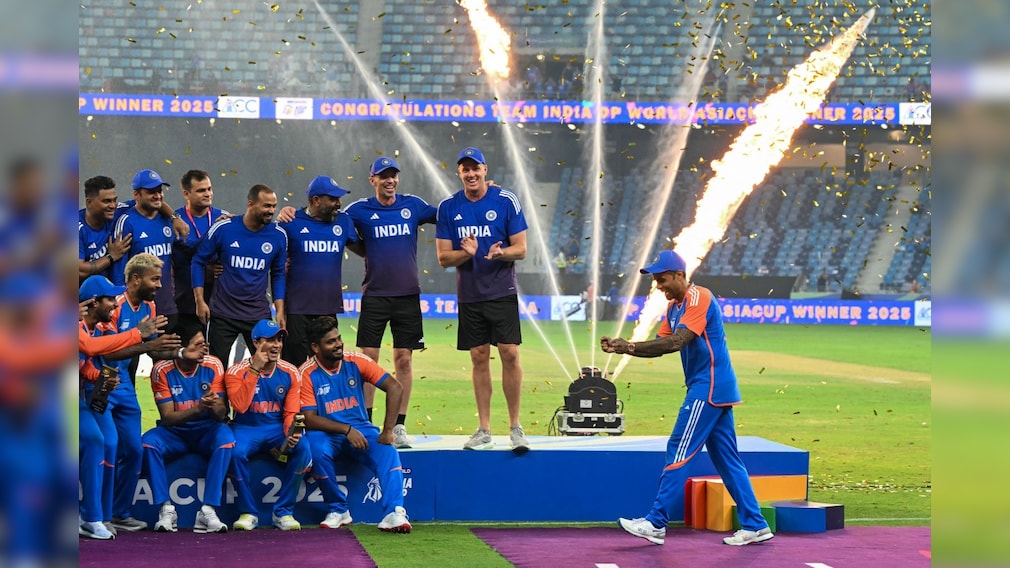
What would happen if we swapped the Asia Cup for an Intercontinental Cup in which Asia would play the other continents? The Chinese are not playing cricket yet, although Hong Kong does. However, even without them, a Pan-Asian team may change the script that we saw playing out in Dubai last month.
I can tell you a thing or two about Indian and Pakistani cricketers trying to stop a bloody war with a call for peace, but before that, we need to acknowledge a memorable expression by a British writer born in Motihari, Bihar.
Orwell Is Right Again
George Orwell called sport "War Minus The Shooting" in an essay on sporting spirit, where he said that competitive sports trigger intense nationalistic rivalries and aggression. I am just wondering if that could be even called "War PLUS the shooting" after fiery public remarks linking India's convincing Asia Cup victory last month to Operation Sindoor, the anti-terrorist air offensive carried out by Indian forces after last April's Pahalgam massacre in Kashmir.
In my own old-fashioned lexicon, what happened over the past few days is just not cricket - a metaphor for gentlemanly conduct that is increasingly losing its charm, proving right Orwell, who is more famous for his dystopian novel 1984 on totalitarianism and propaganda.
The Spectacle In Dubai
Images from Dubai of defeated Pakistani players menacingly pointing their bats towards the Indian crowd in rifle-like postures, Team India's refusal to shake hands with their rivals after a game, and finally, India's refusal to take the trophy they won from Pakistan's interior minister Mohsin Naqvi, speak to us of conflict, not playfulness. Naqvi simply took away the trophy that India had won after mocking the latter through social media posts during the tournament, forgetting that he was the Asian Cricket Council's chairperson, a capacity that allowed him, in the first place, to hand over the silver trophy.
'War Minus The Shooting' became the title of a book by American left-wing writer Mike Marqusee on the 1996 World Cup cricket tournament held in the subcontinent. The cup's stunning moments included a defeat of the West Indies by minnows Kenya in one of cricket's greatest upsets. Raw nerves were touched when a controversial, unverified story emerged about Trinidadian Brian Lara visiting the victors in their dressing room to congratulate them and apparently telling them that the upset would have been worse had the Caribbeans lost to a white team like South Africa.
Cricket Is Never Just Cricket
Politics is never quite far away from sport, particularly cricket. But there are occasions when it can mean something else, such as a joint effort to fight racism or stop a war. I spent much of my cricket-loving youth without seeing South Africa play a Test against India, and the careers of quite a few talented South Africans were ruined because of racism. South Africa was then still ruled by a white racist apartheid regime and Nelson Mandela was in jail, when the country was substantially isolated by the Gleneagles Agreement of 1977 between Commonwealth leaders to discourage sporting contacts with South Africa to put pressure on Pretoria's regime to end racist segregation.
All that only leads to my frequently used quote from Caribbean-born British historian C.L.R. James, who famously said: "What do they know of cricket, who only cricket know?". That was a reference to the deep connection of the game to its social, political, and cultural spheres that we saw in full view in the Asia Cup held in the United Arab Emirates. Somehow, fighting racism and injustice seems the fair thing to do. But there are grey areas that need to be watched carefully.
The West Indies Story
I once sat next to Stevan Riley in a South Delhi multiplex, watching his award-winning 2010 documentary, Fire In Babylon, about one of cricket's most controversial rivalries. Born to a Yugoslav mother and an English father in politically disputed Northern Ireland, Riley was the perfect person to make a documentary about the record-breaking West Indies cricket team of the 1970s and 1980s, featuring legends like Gordon Greenidge, Viv Richards, and Clive Lloyd. As the team, once seen as Calypso entertainers, became world beaters with ferocious bowling from Andy Roberts, Joel Garner, and Michael Holding to defeat Australia's formidable fast bowlers, what was at stake was not pace but race.
Complete with a goosebump scene featuring reggae music icon and rights activist Bob Marley, who inspired West Indies' cricketers, the documentary rubbed salt to wounds somewhere to show the rise of the underdogs beating their former colonial masters at their own game.
Ghosts Of The Gentlemen
So, where does that leave the gentleman's game? We live in difficult times when anti-immigration politics is peaking in the West, and Britain is seeing the rise of the Far Right. In Britain, Indians and Pakistanis may be cricketing foes, but become "South Asians" who join hands against white supremacists or anti-immigration groups to pursue common causes.
It all depends on the context.
Remember 1965 - Or 1996?
I can tell you about how an Indian and a Pakistani cricketer found themselves on the same side in 1965, when India and Pakistan fought a war over Kashmir. It so happened that 'Tiger' Mansur Ali Khan Pataudi from India and Hanif Mohammad from Pakistan both found themselves playing for a "Rest of the World" team against hosts England in a series of matches. Pataudi, better known to young Indians as Bollywood star Saif Ali Khan's late father, recounts in his autobiography, Tiger's Tale, that players, including Hanif and Mansur, got together to write an appeal to end the war.
While at that, we might also gently remind ourselves that the 1996 World Cup was jointly hosted by India, Pakistan and Sri Lanka, when it almost felt as if Partition did not happen in 1947. That World Cup was also, like the Fire In Babylon days, a moment to heal some of the colonial-era wounds.
By George, could old Bihar boy Orwell be wrong?
Oh, well! It is quite possible that when cricket is contemplated as a metaphor for fair play, which earned it the description of 'a gentleman's game', rather than a proxy for war, the game might just win and won't leave us stumped by the bodyline ways of borderline politics.
(Madhavan Narayanan is a senior editor, writer and columnist with more than 30 years of experience, having worked for Reuters, The Economic Times, Business Standard, and Hindustan Times after starting out in the Times of India Group.)
Disclaimer: These are the personal opinions of the author
-
Opinion | The 'AIPC' Was Once Congress' Boldest Idea. What Happened To It?

Tharoor, to Chakravarti, to Yaskhi now, the fate of a Congress 'experiment' that started in 2017 will tell you a lot
-
Woman Biker Hit, Air Force Veteran Attacked: The Lawlessness In Gurugram
What gives confidence to some elements in Gurugram to break the law again and again in full public view and on camera?
-
Opinion | When The Feed Braves The Flood
NDTV drops the 24x7 and stakes its next chapter on presence as it inaugurates a new identity
-
The Politics Of Blue: Why Akhilesh Yadav-vs-Mayawati Over A Colour Is Just One Shade Of History
A movie starring Rajinikanth tells us how colours can carry meaning beyond what meets the eye. The latest row over Akhilesh Yadav's party adopting blue, and Mayawati objecting, can be a starting point for understanding the many shades of history.
-
2 Indians Survived 9/11, Then American Justice System Became Their Nightmare
Pulled off a Texas train hours after 9/11, two Indian men were plunged into America's largest terror manhunt.
-
Opinion | Building BRICS In New Delhi
For India as the host nation, chairing the summit tests the core tenet of its modern foreign policy: strategic autonomy.
-
Can India 'Mediate' Between Iran And UAE At BRICS? Gulf Envoy Suggested It Once
At the very start of the Israel-US war on Iran, it was a UAE diplomat who had suggested as much.
-
I Went Looking For A PG In Delhi's Kamla Nagar. Here's What I Found
In every PG visited by NDTV in Delhi's Kamla Nagar, the conversation began with amenities. Nothing in the sales pitch was about how secure the building was.