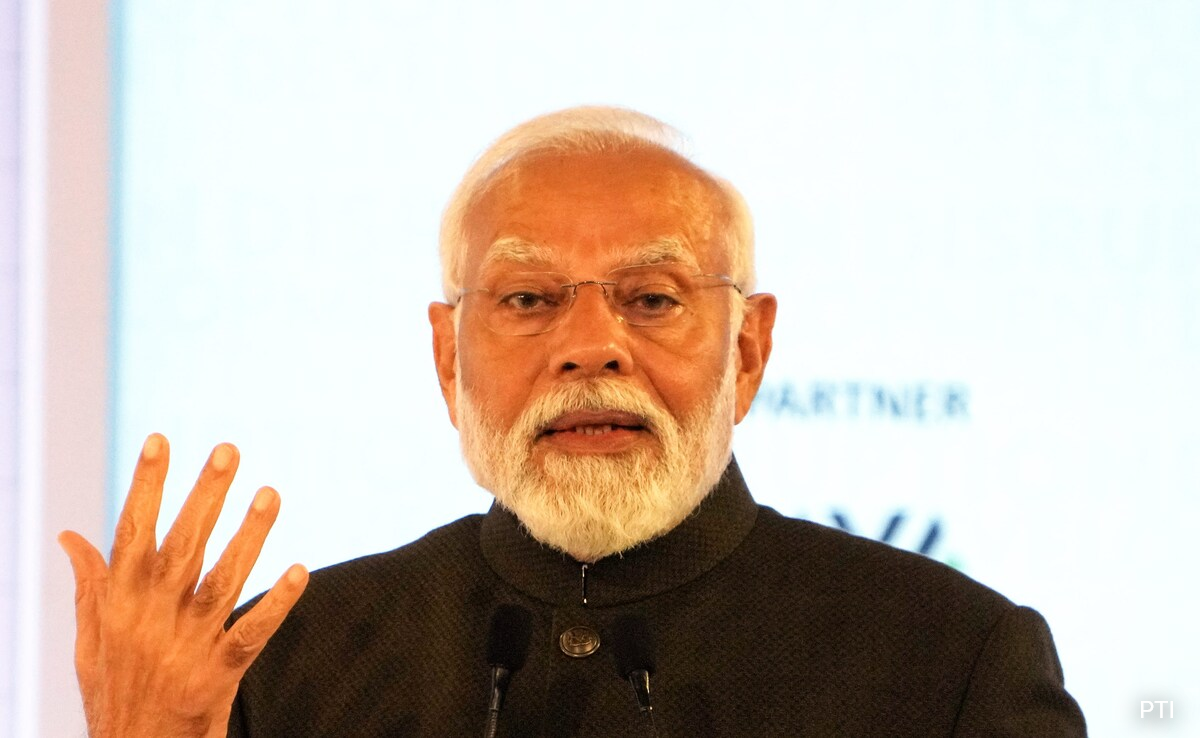












"In this occasion I present MANAV Vision - M for Moral and Ethical System, A for Accountable Governance, N for National Sovereignty; A for Accessible and Inclusive; and V for Valid and Legitimate." With this formulation, Prime Minister Narendra Modi did more than outline principles - he signalled India's strategic intent in artificial intelligence.
In this Summit, one message stands out clearly: India is no longer a participant in the global AI race; it is positioning itself to shape its direction. As the first country in the Global South to host a summit of this scale - drawing over three lakh participants - India demonstrated both ambition and execution under Prime Minister Modi's leadership.
The scale of global engagement reflected India's rising centrality in the AI ecosystem. More than 20 Heads of State, 60 Ministers, and over 500 global AI leaders joined policymakers, technology firms, innovators, academia, and industry stakeholders in New Delhi. India's approach stood out for its clarity of framework. The Summit was anchored in three foundational Sutras - People, Planet and Progress - offering a development-first lens to AI adoption.
The sheer scale of participation tells its own story. The India AI Impact Summit reportedly drew over three lakh attendees - far exceeding earlier global AI summits at Bletchley Park in the UK, Seoul in South Korea, and Paris in France. That scale reflects not only institutional momentum but also the depth of grassroots enthusiasm, particularly among India's young technologists and entrepreneurs.
A notable highlight of the Summit was India's growing capability in foundational AI. India's AI ecosystem took a decisive leap forward as Sarvam AI unveiled two fully home-grown large language models - both trained from scratch and benchmark-competitive in their class. The 30B model, built for real-time production use, is optimised for Indian languages, supports long-context conversations, and enables cost-efficient deployment at scale. Complementing it is the 105B Mixture-of-Experts (MoE) model, designed for advanced reasoning with a 128K context window and targeted at complex cognitive tasks.
Together, these developments signal the rapid maturation of sovereign AI in India - AI built in India, trained in India, and serving India's needs. From Digital Public Infrastructure to indigenous foundation models, the country is steadily transitioning from being primarily an AI consumer to becoming an AI creator.
Equally significant was the emphasis on deployable solutions. The AI Compendium released during the Summit, along with six sectoral AI Impact Casebooks, documented more than 170 deployed and scalable AI innovations across Health, Energy, Gender Empowerment, Education, Agriculture, and Accessibility. The message was unmistakable: India intends to become the use-case capital of AI, where innovation is judged by real-world outcomes rather than laboratory prototypes.
Global voices at the Summit reinforced this perception. French President Emmanuel Macron described Indian AI progress as "revolutionary," recalling that a decade ago many doubted whether India's 1.4 billion people could be brought into the digital economy - "India proved them wrong," he noted. Anthropic CEO Dario Amodei similarly observed after meeting Indian builders that "the energy to build together here is palpable, unlike anywhere else." Sundar Pichai, CEO of Google and Alphabet, echoed the sentiment: "Every time I visit, I'm struck by the pace of change, and today is no different."
On the sidelines of the event, Prime Minister Narendra Modi held nine high-level bilateral engagements in a single day. Seven of these were with national leaders - from Spain, Finland, Serbia, Croatia, Estonia, Kazakhstan and Bhutan - reflecting the breadth of India's strategic outreach across regions. The remaining two meetings, with Google CEO Sundar Pichai and Sun Microsystems co-founder Vinod Khosla, highlighted the parallel track of deepening engagement with global technology leadership. Taken together, these interactions signalled that India's AI push is being viewed internationally not merely as a domestic digital initiative, but as a platform for wider technological and economic partnership.
Perhaps the most decisive signal of India's leadership ambition emerged on the infrastructure front - with a clear philosophy of AI for All. Union Minister Ashwini Vaishnaw announced PM Modi's vision of expansion of national compute capacity beyond the existing 38,000 GPUs, with an additional 20,000 GPUs being added. Under the ₹10,300-plus crore IndiaAI Mission, access to high-end GPUs at approximately ₹65 per hour is already lowering entry barriers for startups, researchers, students, and public institutions. This democratisation of compute power reflects a uniquely Indian approach.
Investor confidence is rising in parallel. India could attract over $200 billion in AI and deep-tech investments over the next two years, citing growing venture commitments across all five layers of the AI stack - from foundational infrastructure and sovereign models to enterprise-scale applications. The projection reinforces the sense that India's AI ecosystem is entering a phase of serious scale economics.
India also enters the AI infrastructure race with a sustainability advantage. With roughly 51 percent of installed power capacity coming from clean energy sources, the country is well positioned to support the rising energy demands of AI data centres. Ongoing research aimed at reducing AI infrastructure's energy and water consumption by up to 35 percent further strengthens the long-term viability of large-scale compute expansion.
On the governance front, India is advancing a techno-legal AI safety architecture through the IndiaAI Safety Institute, combining regulatory oversight with technical safeguards to mitigate misuse risks. At the same time, the next phase of the Semiconductor Mission - "Semiconductor 2.0" - is sharpening focus on indigenous chip design, with projections of at least 50 deep-tech startups emerging from the ecosystem in the coming years.
Images from the Summit - with Prime Minister Modi alongside top global technology leaders - symbolised more than diplomatic optics. They reflected India's growing weight in the global technology landscape and the recognition that the next phase of AI growth will be deeply influenced by how large, diverse, and digitally connected societies deploy these systems responsibly.
The signal from New Delhi is now unequivocal. India is moving from being a large digital market to becoming a rule-shaper and solution provider in artificial intelligence.
(The author is national spokesperson, BJP)
Disclaimer: These are the personal opinions of the author


