Blog | Meet The Man Who Got Sunil Gavaskar's Cricket Bat In 1981, And Never Looked Back
Kiran More once remarked that Shyam Bhatia had done more for cricket than even the ICC.
On the evening of February 15, as India comprehensively outclassed Pakistan in the ICC Men's T20 World Cup in Colombo, the surprise wasn't the outcome. It was that the match happened at all. If anything, the lead-up to the encounter had way more drama than the match itself.
Just days earlier, Pakistan's cricket board had threatened a boycott, owing to political tensions. The ICC stepped in to break the impasse, and the game proceeded. But not before reopening wounds from last year's Asia Cup handshake controversy.
As 22 players with shared history and competing loyalties walked onto the ground, an 83-year-old watched with a mixture of sadness and hope. Steel baron, cricket philanthropist, and curator of one of the world's finest private cricket museums, Shyam Bhatia had seen this movie before. But he wasn't impressed with how the script was being re-written.
Before the game, Bhatia had told Khaleej Times, "I am fine with whoever wins, but I hope they will shake hands at the end of the match because the game should move forward, not backwards." In an era where cricket has become a multi-billion-dollar industry, intertwined with nationalism, geopolitics, and corporate interests, Bhatia represents an era in which cricket's greatest value lay not in television ratings or sponsorship deals, but in upholding the spirit of the game.
For the past six decades, Bhatia has been one of game's biggest champions, pouring not just money, but his heart into it. He could have easily utilised cricket's soft power for brand-building like Lalit Modi or Vijay Mallya. Instead, he chose to spectate.
Feeding Chappell, Getting Gavaskar's Bat, And More
Born in Mirpur Khas, Sindh, in 1942, Bhatia's family migrated to Ajmer during the upheaval of 1947, where he excelled in his school cricket team. From there, he went on to represent Rajasthan and Saurashtra in first-class cricket. A marketing job brought him to Dubai in 1965. Fifteen years later, he founded Alam Steel, which would go on to become one of the Middle East's largest steel companies. But entrepreneurship was merely the prequel for what Bhatia calls his "second innings".
When international cricket came to Sharjah in the early 1980s, Bhatia opened his home to players, umpires, media, and officials. His house guests included legends like Clive Lloyd, Ian Chappell, and Michael Holding, as well as journalists like Kishore Bhimani. They enjoyed the food from his kitchen so much that they would often leave behind a souvenir of gratitude.
Having cemented his name among the all-time Test greats, Sunil Gavaskar was in Sharjah in 1981 for an exhibition match against Pakistan. It was here that he crossed paths with Bhatia, commencing a lifelong friendship. Gavaskar was so touched by Bhatia's commitment to promote grassroots cricket in the UAE that he presented him with one of his cricket bats. This gift sparked the thought that culminated into the Shyam Bhatia Cricket Museum. A two-storeyed structure within Bhatia's private residence, it was inaugurated in the presence of all ICC directors in 2010, as a shrine to cricket.
The walls chronicle cricket history from 1887 to the present, with dedicated pillars for all Test-playing nations and separate areas for the 10,000-plus Test run-getters. It has over 2,000 cricket books and magazines dating back to 1900.
Gavaskar's bat has been joined by those of Sir Don Bradman and Virat Kohli. Bhatia's collection also holds Sir Viv Richards's blazer and Graeme Smith's boots from his 100th Test. The variety of rare trinkets in the museum has everyone in awe, from Sachin Tendulkar to Kiran More, with the latter even remarking that Bhatia had done more for cricket than the ICC.
This statement is exemplified by Bhatia's Cricket for Care Foundation, which he founded in 2007 to provide cricket equipment, facilities, and coaching to underprivileged children. The foundation has donated over a million dollars to more than 20 countries, including non-cricket-playing nations like Thailand, Indonesia, and Japan. Through this foundation, Bhatia has tried to ensure that no child's dream of holding a cricket bat remains unfulfilled, from war-torn Afghanistan to conflict-riddled Ukraine.
An Anomaly In These Hypercommercial Times
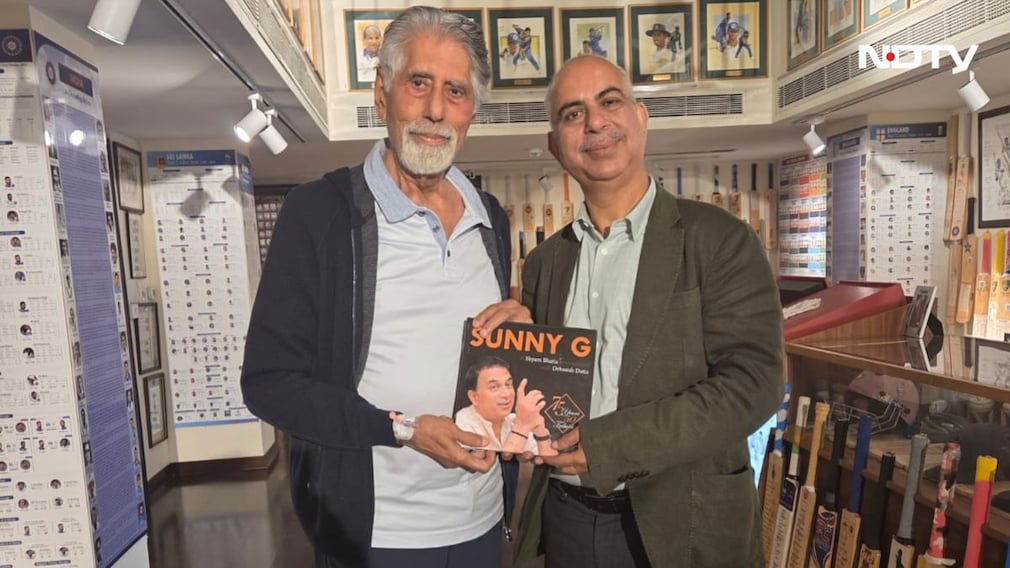
Bhatia has also published multiple books on cricket. Among these are Portraits of the Game and its sequel, Portraits, featuring interviews with cricketing legends about their career highlights. Proceeds from these books have been donated back to the game. He also co-authored Sunny G with journalist Debasish Datta, presenting his good friend with a chronicle of his career as a 75th birthday present.
For over two decades, he has celebrated local cricketing talent in the UAE with the Shyam Bhatia Annual Cricket Awards. Although it began as an intimate ceremony, it has since culminated into a coveted fixture on the cricketing calendar, drawing international stars including Ian Chappell, Ravi Shastri, and Andrew Flintoff.
In 2012, Bhatia received the prestigious Mother Teresa International Award for his contribution to the sport. His work also drew the attention of the Mumbai Cricket Association, which sought his help to build their first cricket museum at Wankhede Stadium.
In spite of all this, Bhatia remains essentially unknown outside cricket circles. His museum isn't meant to generate revenue, nor are his books published for general circulation. His foundation doesn't believe in photo-ops. At 83, Bhatia is still energetic, with hopes to move his museum to a larger venue that can be accessed by the public. This is in keeping with his motto to never make money off the sport.
It is this puritan vision that is often lost in cricket, amidst the sparkle of colourful jerseys and cola endorsements. In his quiet way, Shyam Bhatia shows us it's not too late to reclaim what is lost. Every child he empowers with a kit, every talent he honours with an award, and every visitor he guides through his museum is an act of resistance against cricket's hypercommercialisation. The cricketing world owes him more than a museum visit.
(Rasheed Kidwai is an author, columnist and conversation curator)
Disclaimer: These are the personal opinions of the author
-
Opinion | 10 Days After Bangladesh Polls, Lingering Questions About Pak, Hasina, US

No smooth sailing of bilateral relations can be expected. The effort would be to restore normalcy. The good days of India-Bangladesh ties under Sheikh Hasina are likely over.
-
Opinion | The 'Quiet Panic' That Led To Trump Blinking On Anti-India Tariffs
Experts estimate that this year, core goods inflation in the United States may reach levels comparable to the 2008 financial crisis. And Trump's tariffs aren't helping.
-
Opinion | In Bangladesh, A Story Of Many Wins
The rain is over, and the clouds are clearing. Now, the hard work of rebuilding a nation begins, and India must be standing right there alongside as a friend.
-
Opinion | Delhi Scorpio Tragedy: Why These Four States Top The Hit-And-Run List
The share of hit-and-run cases in total road fatalities has expanded from roughly 13-14% to nearly 18%, indicating that fleeing the scene has become a pattern in a growing proportion of fatal crashes.
-
Opinion | Will Iran Actually Use Its Catastrophic 'Strait Of Hormuz' Card Against US?
Should the US launch any attacks on Iran - and every indication is that it means to very soon - it will be to implement a regime change. In which case, Iran could be forced to adopt extraordinary measures.
-
The Hormuz Threat: Iran's Most Powerful Card Against The US
In Tehran, Iran's Supreme Leader Ayatollah Ali Khamenei has responded with rhetoric that leaves little room for ambiguity. American power, he said, would not succeed in destroying the Islamic Republic.
-
Opinion | India's Northeast Has A New Problem - 'Jamaat' Surge Along Bangladesh Border
Most of Jamaat's victories have come from the north-west and south-west regions adjoining Indian states such as West Bengal, Assam and Meghalaya.
-
Opinion | 'AI-Enabled' Soldiers? What An India-China-Pak Crisis May Soon Look Like
AI compresses the decision-action loop, turning hours of analytical deliberation into seconds of machine-assisted judgment. In warfare, that compression is the difference between survival and defeat.
-
Opinion | Pak 'Impostors' To Jamaat Trolls, The Sea Of Misinformation Around Bangladesh Polls
The largest single spends on social media were from DailyNews24, which masquerades as a news organisation but is, in reality, a Jamaat organ. The second and fourth spenders are also Jamaat sites.
-
4 States, 4 Elections, 4 Potential Crises For Congress Hoping For Poll Wins
Four states - Kerala, Bengal, Tamil Nadu, and Assam - are scheduled to hold Assembly elections in April/May, with the Congress seen as strong contenders in the former.