Opinion | Germany's First 'Military Strategy' In 77 Years Is A Wake-Up Call For India
Berlin's first military strategy since the Second World War is a historic document. It also lands in the week Rajnath Singh signed a defence industrial roadmap with Boris Pistorius. The two are connected
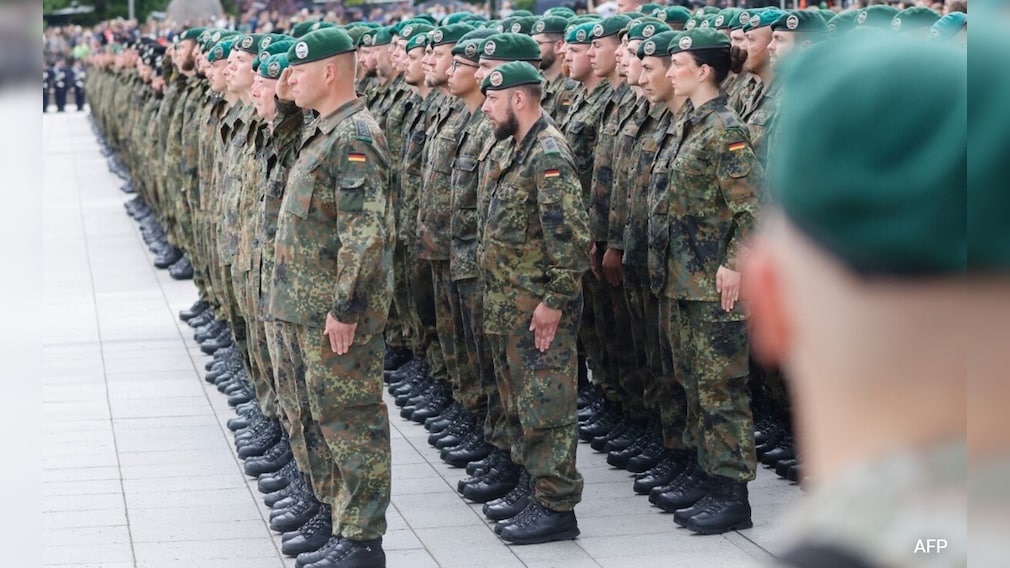
On April 22, India and Germany signed a Defence Industrial Cooperation Roadmap in Berlin, alongside a P-75I submarine deal inching towards closure between ThyssenKrupp Marine Systems and Mazagon Dock. On the same day, the Bundesministerium der Verteidigung released something far more consequential for Europe's strategic future: the public portion of the Gesamtkonzeption militärische Verteidigung, the "overall conception of military defence", Germany's first formal military strategy since 1949.
The timing is deliberate and tells us something important.
Why This Document Is Historic
For seventy-seven years, Germany has deliberately avoided having a "Militärstrategie". The word itself carried too much weight, too much memory. Post-war Bonn, and later Berlin, worked through Weissbücher, Verteidigungspolitische Richtlinien, and NATO planning documents. The deliberate vagueness was the point. A Germany with a signed military strategy was a Germany with strategic ambition, and strategic ambition was precisely what post-war German political culture had been built to suppress.
That reticence is now history. Signed by Generalinspekteur Carsten Breuer in April 2026 and publicly endorsed by Defence Minister Boris Pistorius, the Gesamtkonzeption promulgates a single organising objective: to make the Bundeswehr "die stärkste konventionelle Armee Europas", that is, the strongest conventional army in Europe. Pistorius puts it in language that would have been heretical in Berlin a decade ago. Germany, he writes, must be the "Schrittmacher unter den europäischen Nationen", the pacemaker among European nations. The document's subtitle, "Verantwortung für Europa" (responsibility for Europe), bears the same weight.
This is a rupture, and a deliberate one.
What Motivated It
The first force is Russia. The strategy names Moscow as the largest and most immediate threat to German, European and transatlantic security. It argues Russia is actively preparing the conditions for a war against NATO, already conducts hybrid operations inside alliance territory, including Germany, and views military force as a legitimate instrument of policy. Moscow's strategic goal, the document assesses, is the collapse of "Bündniskohäsion", that is, alliance cohesion, and the strategic decoupling of the United States from Europe.
The second force, arguably the more important one, is Washington. The Gesamtkonzeption openly references the US 2026 National Defense Strategy and its calls for allies to take greater responsibility for their own security. It accepts with rare clarity that Europe must now do more. The thesis is one line: "Die NATO muss europäischer werden, um transatlantisch zu bleiben." It means NATO must become more European to remain transatlantic. This is a document planning for a semi-absent America while remaining diplomatic about it.
The Significant Facets
The document organises the Bundeswehr's transformation across three phases running to 2039. Phase one, to 2029, focuses on "Maximierung Verteidigungsfähigkeit", that is, maximisation of defence readiness. Phase two, roughly to 2035, delivers "starker Aufwuchs durchhaltefähiger Streitkräfte", marked by the growth of sustainable forces aligned with the alliance. Phase three, from 2039, aims for "technologisch überlegene Streitkräfte" (technologically superior forces). The personnel target is 460,000 soldiers, minimum, by 2035, active and non-active combined, with full equipment for all units, as the document calls it, "Vollausstattung".
Six national capability priorities structure spending and procurement: long-range precision strike and integrated air and missile defence, "Informationsüberlegenheit", or information superiority, powered by artificial intelligence, a sovereign cloud-based "Digital Backbone", national command capability for Multi-Domain Operations, the "Operationsbasis Deutschland" or homeland as operational base for NATO forces, and national crisis response. The permanent deployment of the "Brigade Litauen" in Lithuania, the first such basing outside German soil in the Bundeswehr's history, is highlighted as the visible symbol of the new posture.
Ukraine, And The Lesson From It
The document's "Kriegsbild", its picture of future war, reads like a comprehensive distillation of three years of observation in Ukraine. It is organised based on six concepts. "Entgrenzung des Krieges", the dissolution of boundaries between civil and military, home and front, combatant and non-combatant. "Multi-temporaler Krieg", where state-of-the-art systems operate alongside legacy platforms and improvised drones. "Transparentes Gefechtsfeld", the transparent battlefield where real-time reconnaissance makes concealment nearly impossible. "Wirkung auf Abstand", long-range precision effects that eliminate safe rear areas. Automation and autonomy that compress decision cycles beyond human capacity. And most strikingly, "effiziente Masse", efficient mass, the recognition that cheap mass-produced systems combined with high-end assets produce decisive effects, and that the economy of war matters again.
The explicit warning against building "die Armee von gestern für den Krieg von morgen" - the army of yesterday for the war of tomorrow - is a direct rebuke of institutional inertia. It is the lesson every serious military has had to confront since February 2022.
Why This Matters For India
First, Germany's move towards a more autonomous European defence posture alters the balance India has historically managed between Washington, Moscow, and Europe. For India, this means the previous policy framework of triangulating among these powers, within the context of a stable, US-led transatlantic order, is now evolving. India will have to adjust its approach as Germany signals a more independent European role, making Europe a more active strategic actor. This change could influence India's foreign policy decisions, alliances, and its capability to navigate between competing blocs.
Second, the Russia dilemma. The Gesamtkonzeption treats Russia as an enduring adversary whose revisionism is beyond acceptable accommodation. This is precisely the framing India has worked hardest to escape. Delhi's continued purchases of Russian oil, its defence dependencies on Russian platforms, and its diplomatic position on Ukraine have long irritated European capitals. The timing now intensifies these contradictions further. On April 17, Moscow published the full text of the Reciprocal Exchange of Logistics Support Agreement (RELOS) with India, under which both sides may station up to 3,000 troops, five warships, and ten military aircraft on each other's territory. Five days later, Rajnath Singh was signing a defence industrial roadmap in Berlin. The split-screen is difficult to square. A Germany now committing to decades of confrontation with Moscow will be less patient with Indian ambiguity and more demanding on alignment. The Berlin roadmap is an opportunity, and also a quiet demand.
Third, a genuine military lesson. India has produced no equivalent document. The Naresh Chandra and Shekatkar Committees, and the ongoing theaterisation debate, have all gestured towards a publicly articulated military strategy. What exists instead is a motley collection of doctrines, directives, and leaked joint documents. The Gesamtkonzeption demonstrates the value of publishing a strategy that connects "Bedrohungslage", the threat picture, with force design, capability priorities, and procurement on a single timeline. It communicates intent to adversaries, reassures allies, and disciplines the bureaucracy. India's National Security Strategy, promised for years and repeatedly deferred, remains absent. Berlin's decision to publish should sharpen the argument for Delhi to do the same.
Fourth, the co-development opportunity is real and immediate. The Defence Industrial Cooperation Roadmap signed this week is timed precisely to the German procurement cycle that the Gesamtkonzeption will drive. The "Aufwuchs", the buildup, will require unprecedented volumes of munitions, air defence systems, unmanned platforms, and digital infrastructure. German firms face political pressure to scale rapidly, and Indian manufacturing capacity and engineering talent are attractive to them in ways they were not five years ago. The P-75I submarine deal is the visible tip of a much larger opportunity across drones, artillery systems, and digital command infrastructure. India's challenge is to convert this industrial interest into genuine technology transfer rather than licensed assembly.
What The Strategy Leaves Unsaid
Two silences are worth marking. The Gesamtkonzeption is mum on the Indo-Pacific beyond the Russian Pacific Fleet, suggesting a Germany with limited appetite for the region, and it stays equally quiet on European nuclear guarantees in a world of uncertain American extended nuclear deterrence, which is the most consequential strategic question Europe now faces related to Russia.
The Bigger Picture
Germany's first military strategy since the birth of the Federal Republic in 1949 is a signal event. The post-Cold War European security order is being rebuilt in real time, the transatlantic alliance is being renegotiated rather than preserved, and middle powers are now prepared to articulate strategic ambition in ways that were unthinkable a decade ago.
For India, the document is both an opportunity and a warning. The opportunity lies in a Europe that is rearming, industrialising, and actively seeking partners beyond the Atlantic. The warning lies in a Europe that is hardening its positions on Russia, on hybrid threats, and on the meaning of strategic partnership in an era of systemic rivalry.
Delhi would do well to read the Gesamtkonzeption carefully, and then to reflect on why, seventy-eight years after independence, India still awaits one of its own.
The author is a Research Fellow in the Geostrategy Program at the Takshashila Institution
Disclaimer: These are the personal opinions of the author
-
Two-Pronged Row At Heart Of Tata Sons' Trust Issue: It Goes Beyond The Chair

NDTV Explains: Overtly, the latest conflict is whether N Chandrasekaran continues as executive chairman of Tata Sons. The controversy involves at least one more issue.
-
Opinion | US Has Institutionally Weaponised India's Russia Oil Dependence. Can New Delhi Cope?
A new legislation can connect India's Russian energy purchases to its access to the American market over a five-year period
-
Opinion | Saudi Allies Are Now Discovering The Cost Of 'Commitment' - And Not Liking It
The spectacular no-show by Saudi Arabia's two defence allies - Pakistan, a nuclear power, and Turkey, which has NATO's second-largest army - is astounding
-
12 Years Of 'Modinomics': What Changed, What Worked, What Didn't
There is no single Modinomics textbook or formula. Instead, the term has come to describe a collection of choices made during the PM Modi years.
-
Opinion | How A Tiny 0.4% UPI Fee Could Change How India Pays
The introduction of a fee can have a psychological effect beyond its immediate financial cost. Businesses that have come to view digital payments as free may begin to look for alternative - split payments, cash, and so on
-
Opinion | Rs 75-Lakh Bounty, New Jaish Base, And The Case Of Pak's Ever-Missing' Terrorist
Pak's yearly act is back: finding Masood Azhar. But there are other questions FATF must be asking next month as it meets
-
For Years, Saudi Saw Houthis As Yemen's Problem. Then, A Knock On The Door
Actual fighting between the Houthis and Saudi Arabia began late in the overall timeline of the conflict that now involves powerful belligerents
-
Lal Topi, Blue T-Shirt: Akhilesh Yadav's 'PDA' For Blue Has A Coded Message
The message is clear: the Samajwadi Party wants to talk to voters beyond its traditional Yadav-Muslim support base, particularly to Dalits.
-
The Day 600 Men Lay Siege To Islam's Holiest Site And How They Were Gassed Out
Nearly 47 years ago, on November 20, 1979, the Grand Mosque itself was seized by an armed group in one of the most extraordinary episodes in modern Saudi history.
-
New UPI Charges: If Digital Payments Save Money, Why Charge For Them Now?
UPI Payments Free For Years: The government has subsidised UPI adoption for years. Official figures show thousands of crores in payouts over years.