Opinion | Delhi Scorpio Tragedy: Why These Four States Top The Hit-And-Run List
The share of hit-and-run cases in total road fatalities has expanded from roughly 13-14% to nearly 18%, indicating that fleeing the scene has become a pattern in a growing proportion of fatal crashes.

Two years ago, there was the Pune Porsche case - which still remains in court, by the way. Now, Delhi has been jolted by another fatal road incident: a 23-year-old was killed after being struck by an allegedly speeding Scorpio. Preliminary reports indicate that the vehicle was driven by a minor who did not apply the brakes at the point of impact and attempted to flee the scene, which places this harrowing episode within a troubling pattern of attempted hit-and-run cases.
While public outrage, particularly in metropolitan centres like Delhi, tends to frame such cases as sudden moral breakdowns from reckless teenage drivers making a panicked escape, national road safety data tells a more structural story.
Persistent enforcement gaps, low conviction rates, rapid motorisation, and uneven state capacity have together eroded credible deterrence. The pattern suggests not isolated deviance, but a systemic failure of governance.
India's Road Toll in Numbers
National data suggest that hit-and-run fatalities are not episodic spikes but part of a sustained upward trajectory. According to the National Crime Records Bureau and the Ministry of Road Transport and Highways, hit-and-run deaths increased from 18,702 in 2013 to 31,209 in 2023, a rise of nearly 67% over a decade. Their share in total road fatalities has expanded from roughly 13-14% to nearly 18%, indicating that fleeing the scene is accounting for a growing proportion of fatal crashes.
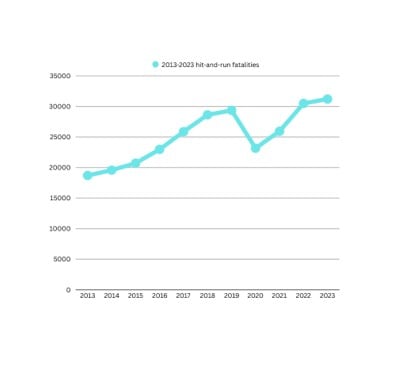
Hit-and-run cases have increased by 67% since 2013.
The post-pandemic rebound sharpened this pattern. Between 2021 and 2022 alone, hit-and-run deaths rose by about 18%, outpacing the increase in overall road fatalities. Delhi's recent cases have amplified public anger, but the capital is not statistically exceptional. The trend is national. The data points less to isolated moral collapse and more to a widening gap between rapid motorisation and credible enforcement.
UP Tops The List
The national aggregate masks sharp regional concentration. Data from NCRB and the Ministry of Road Transport and Highways show that Uttar Pradesh recorded roughly 16,300 hit-and-run cases in 2022, accounting for a disproportionately large share of the national toll. It was followed by Madhya Pradesh, with around 9,000 cases, Maharashtra with more than 3,600, and Rajasthan with 2,850. Together, these four states contributed close to two-thirds of all hit-and-run fatalities that year.
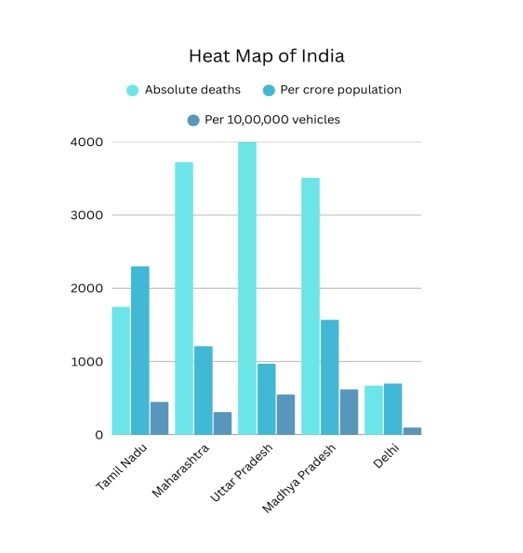
Yet, absolute burden does not equal density. When normalised by population, smaller states and Union Territories reveal different risk patterns. Even a few hundred cases in Delhi, with a population exceeding 20 million and with one of the highest vehicle densities in the country, translate into elevated per-lakh exposure. Crucially, high motorisation does not automatically imply higher hit-and-run density. Tamil Nadu, despite leading in overall crash volumes, performs differently from Madhya Pradesh and Uttar Pradesh on fatality intensity. Similarly, Kerala and Chandigarh combine high vehicle ownership with comparatively lower fatality ratios.
The divergence underscores a central inference: exposure is driven by traffic volume, but density of death is driven by other things.
Two-Wheeler Riders Are The Most Vulnerable
Data from the Ministry of Road Transport and Highways also show that in 2022, two-wheeler riders accounted for roughly 44.5% of all road deaths, while pedestrians constituted nearly 19.5%, together forming the largest victim categories. This aligns with findings from the World Health Organization (WHO) that in low and middle-income countries (LMICs), over half of fatalities involve vulnerable road users. Temporal clustering is equally stark. About 20.8% of accidents occurred between 9 pm and midnight, the single highest time band nationally. Darkness reduces detection probability, impaired driving increases impact severity. Geographically, nearly 68% of road fatalities occur in rural areas, where surveillance, lighting and emergency response infrastructure remain limited.
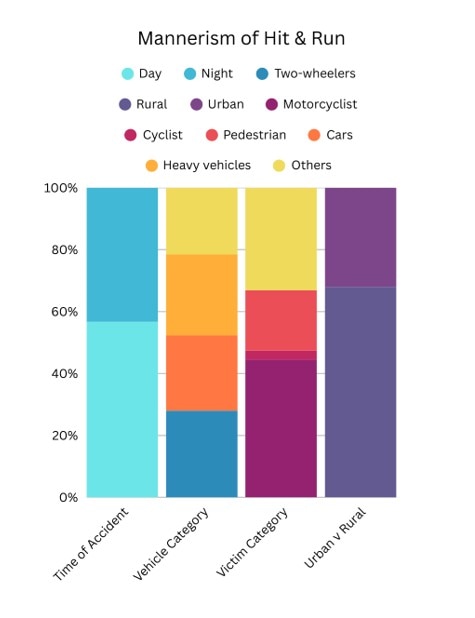
The convergence is structural: vulnerable victims, high-speed corridors, low-visibility hours, weak monitoring. Hit-and-run, in statistical terms, is patterned exposure meeting limited enforcement, not episodic deviance.
But Why Do Drivers Flee?
The data suggests that the problem is not merely reckless driving, but weak consequence management. According to the NCRB, nearly 47,800 hit-and-run cases were registered in 2022. Yet, the legal funnel thins dramatically thereafter. Conviction rates in negligent driving cases hover below 50%, while over 90% of cases remain pending at different stages of trial.
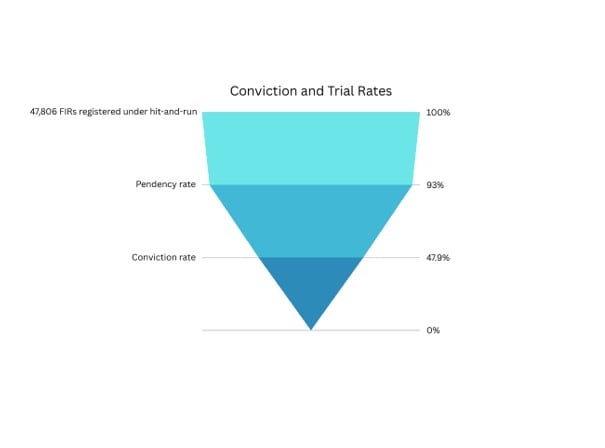
In deterrence economics, certainty outweighs severity. India has increased statutory penalties through the Motor Vehicles (Amendment) Act, 2019 and more recently under the Bharatiya Nyaya Sanhita, 2023. But if enforcement probability is low and adjudication is slow, harsher punishment does not automatically translate into better behaviour.
Structural variables compound the risk. Motorisation has expanded sharply over two decades, while surveillance and traffic-police density have not scaled proportionately. The World Health Organization notes that weak enforcement ecosystems in LMICs correlate with higher fatality exposure. Add poor lighting, limited CCTV coverage beyond major corridors, and insurance-liability anxieties, and the incentive to flee strengthens.
The deeper question is this: when the probability of being caught and convicted remains modest, does flight become a rational calculation rather than a moral aberration?
There Are Winners, Too
The sharpest declines show a unique pattern. In Kerala, the data tells a survival story. In 2023, over 48,000 crashes resulted in 4,080 deaths , roughly 8.5 fatalities per 100 accidents, dramatically below the national ratio. The variable here is not fewer collisions, but faster response. Dense trauma networks and near-universal golden-hour access compress fatality risk after impact. Post-crash care alters the denominator. Tamil Nadu tackled the problem upstream, institutionalising crash analytics through a road safety authority and district-level monitoring cells. The state treated accidents as datasets, not anecdotes. Continuous mapping sharpened intervention measures.
But enforcement needs more than just rhetoric. Gujarat embedded statutory authority into its road safety framework in 2016, linking penalties, funding streams, and administrative accountability. Compliance became enforceable, not advisory.
The lesson is that fatalities fall where systems tighten.
Public anger is not misplaced. Hit-and-run incidents represent a visible breakdown of civic trust, the moment when law, infrastructure and moral obligation fail simultaneously, with panicked drivers fleeing the scene. Yet, evidence suggests that punitive escalation alone does not generate deterrence. That depends less on the severity of punishment and more on the certainty of accountability. When detection rates are low, trials are prolonged, and enforcement is inconsistent, the rational calculus shifts in favour of flight.
Reform must move beyond symbolic outrage. Fast-track adjudication mechanisms, automated surveillance and challan systems, streamlined insurance liability frameworks, and pedestrian-centric urban redesign are structural correctives that governments need to take seriously. Accountability must become statistically inevitable.
(Deepanshu Mohan is Professor of Economics and Dean, O.P. Jindal Global University, Visiting Professor at the London School of Economics, and Academic Research Fellow, AMES, University of Oxford. Srisoniya Subramoniam contributed to this column. Saksham Raj & Srisoniya Subramoniam are both research analysts with CNES and students at O.P Jindal Global University.)
Disclaimer: These are the personal opinions of the author
-
Opinion | Will Iran Actually Use Its Catastrophic 'Strait Of Hormuz' Card Against US?

Should the US launch any attacks on Iran - and every indication is that it means to very soon - it will be to implement a regime change. In which case, Iran could be forced to adopt extraordinary measures.
-
The Hormuz Threat: Iran's Most Powerful Card Against The US
In Tehran, Iran's Supreme Leader Ayatollah Ali Khamenei has responded with rhetoric that leaves little room for ambiguity. American power, he said, would not succeed in destroying the Islamic Republic.
-
Opinion | India's Northeast Has A New Problem - 'Jamaat' Surge Along Bangladesh Border
Most of Jamaat's victories have come from the north-west and south-west regions adjoining Indian states such as West Bengal, Assam and Meghalaya.
-
Opinion | 'AI-Enabled' Soldiers? What An India-China-Pak Crisis May Soon Look Like
AI compresses the decision-action loop, turning hours of analytical deliberation into seconds of machine-assisted judgment. In warfare, that compression is the difference between survival and defeat.
-
Opinion | Pak 'Impostors' To Jamaat Trolls, The Sea Of Misinformation Around Bangladesh Polls
The largest single spends on social media were from DailyNews24, which masquerades as a news organisation but is, in reality, a Jamaat organ. The second and fourth spenders are also Jamaat sites.
-
4 States, 4 Elections, 4 Potential Crises For Congress Hoping For Poll Wins
Four states - Kerala, Bengal, Tamil Nadu, and Assam - are scheduled to hold Assembly elections in April/May, with the Congress seen as strong contenders in the former.
-
Opinion | What ChatGPT Is Now Doing With Your Darkest 'Secrets'
For over three years now, millions across the world have treated ChatGPT like a confidante. And one company - OpenAI - holds the keys to this vast digital locker.
-
Opinion | 'Team Rahul' And 'Team Priyanka': Inside Congress' Plans For Kerala And Assam
The two siblings don't function at cross-purposes or differ on key ideological issues. However, in practice, they are often seen following slightly different 'chaal, chalan, chehra', as they say, from each other.
-
Opinion | Sonia-Rahul To Maken, Why Mani Shankar Aiyar Keeps Ditching His Verbal 'Filter'
The former Rajya Sabha parliamentarian used to joke that in the time of Rajiv Gandhi, he was on "arsh" (cloud nine), while in the UPA regime under Sonia Gandhi, he was brought down to "farsh" (ground).
-
Opinion | Pakistan Cricket And Lessons In How To Destroy A Sport, Completely
In March last year, I had written about why Pakistan cricket is in ruins - simply because it is its own worst enemy. Pakistan just proved that again yesterday.





-
News Updates
-
Featured
-
More Links
-
Follow Us On
