Opinion | Biggest Takeaway From BRICS Meet? Nobody Knows What It Is Anymore
Iran and the UAE's competing calculations just lay bare the limitations of the grouping.
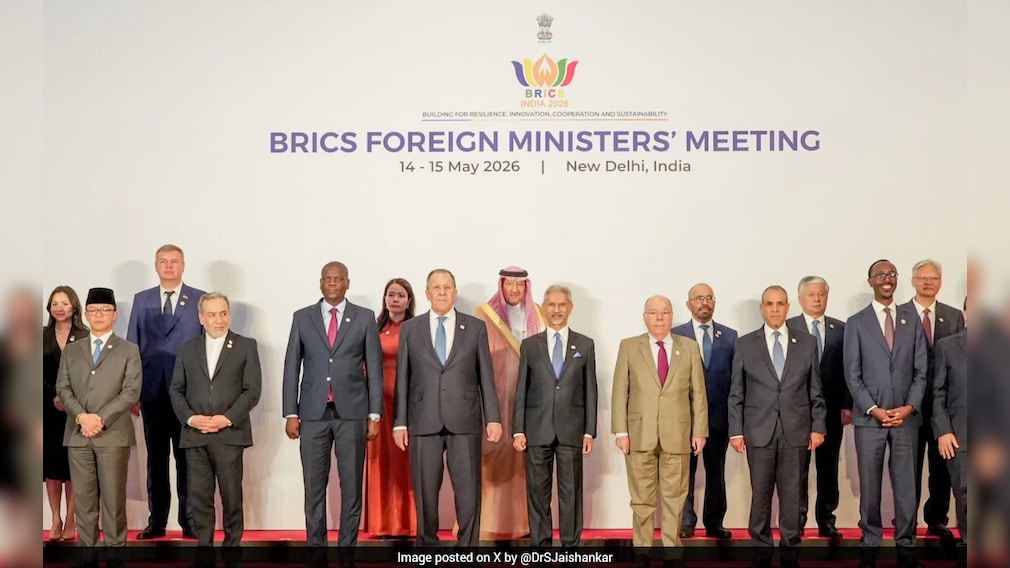
The 2026 BRICS Foreign Ministers' Meeting in New Delhi exposed the growing internal contradictions of an expanded BRICS at a moment of acute geopolitical instability. Convened under the theme "Building for Resilience, Innovation, Cooperation and Sustainability", the meeting was intended to consolidate momentum ahead of the BRICS Leaders' Summit scheduled for September 2026. Instead, the escalating US-Israel confrontation with Iran transformed the gathering into a revealing display of the strategic fissures increasingly shaping the bloc.
The clearest indication of these divisions was the inability of BRICS foreign ministers to agree on a full joint statement. In its place emerged a Chair's Statement and outcome document that reflected consensus on broad developmental priorities while carefully sidestepping irreconcilable disagreements over the Middle East crisis. The absence of a unified declaration was not merely procedural; it underscored the widening divergence in how BRICS members interpret security, sovereignty, regional order, and relations with the West.
The Iran-UAE Showdown
The emphasis on protecting maritime commerce and energy routes, especially through the Strait of Hormuz, revealed underlying anxieties among member states whose economic interests are directly threatened by regional escalation.
At the centre of the discord stood Iran and the UAE, whose competing regional calculations brought into sharp focus the limitations of BRICS cohesion. Iran sought to use the platform to rally political backing against the United States and Israel, framing the conflict as an attack on the sovereignty of a BRICS member and, by extension, on the broader non-Western order. Tehran pushed for explicit condemnation of what it described as "unlawful aggression" and attempted to portray BRICS as a potential counterweight to Western strategic pressure.
Iranian Foreign Minister Abbas Araghchi adopted a confrontational tone during the discussions. He described Iran as a "victim of illegal expansionism and warmongering" and urged BRICS to resist "Western hegemony and the sense of impunity that the US believes it is entitled to". Calling for a far more assertive collective response, Araghchi declared: "Iran therefore calls upon BRICS member states and all responsible members of the international community to explicitly condemn violations of international law by the United States and Israel." His remarks reflected Tehran's broader effort to transform BRICS from a developmental coalition into a more overtly political and anti-Western platform.
The UAE, however, approached the crisis from an entirely different security perspective. Abu Dhabi viewed the escalation not through the prism of anti-Western resistance but through immediate concerns over Gulf stability, energy infrastructure, maritime security, and the risk of Iranian retaliation spilling across the region. Tensions became especially visible when Araghchi later accused the UAE of being "directly involved in the aggression against my country", further exposing the depth of mistrust between the two BRICS members.
For the UAE and several other Gulf-oriented actors, heightened confrontation threatened both economic stability and domestic security. This divergence made consensus virtually impossible and demonstrated how BRICS expansion has imported regional rivalries directly into the organisation's internal dynamics.
A Structural Fault Line
The Iran-UAE divide highlighted a deeper structural contradiction within BRICS expansion. The grouping has sought to project itself as the institutional voice of the Global South, yet many of its members remain regional competitors with conflicting threat perceptions and incompatible geopolitical priorities. The inclusion of Middle Eastern rivals within the same forum has amplified these contradictions rather than diluted them.
Iran viewed BRICS as a strategic diplomatic shield capable of legitimising resistance to Western pressure. The UAE, by contrast, has increasingly positioned itself as a globally integrated commercial and financial hub dependent on stable relations with both Western powers and regional actors. These competing orientations reflect fundamentally different visions of international order within BRICS itself.
The meeting also revealed that BRICS is gradually evolving from an economic coordination platform into a far more contested geopolitical arena. Earlier iterations of the grouping benefited from relatively broad convergence around reforming global financial institutions and expanding the voice of emerging economies. The expanded BRICS, however, now contains states with active rivalries, overlapping spheres of influence, and sharply divergent foreign policy objectives.
Iran's effort to transform the gathering into a platform for collective resistance ultimately met only partial success. While members expressed concern over regional instability and supported calls for dialogue and de-escalation, several states resisted language that could be interpreted as endorsing Iran's confrontational posture. This reluctance reflected not only Gulf sensitivities but also the broader hesitation among many BRICS members to convert the organisation into an explicitly anti-Western alliance.
The episode further illustrated the paradox of BRICS expansion: enlargement has enhanced the grouping's global visibility and demographic weight, but it has simultaneously weakened internal cohesion. The inclusion of states with divergent regional agendas may increase representational legitimacy, yet it also complicates consensus-building on major international crises. As BRICS expands its geopolitical ambitions, these contradictions are likely to become more frequent and more difficult to manage.
India Still Held Its Own
In many ways, however, India demonstrated that effective leadership in the contemporary international order lies not in amplifying divisions but in managing them responsibly. By preserving dialogue, sustaining institutional momentum, and focusing attention on shared developmental priorities despite geopolitical turbulence, India reinforced its image as a stabilising power and a responsible voice of the Global South. New Delhi sought to shift the grouping's focus from reactive geopolitics toward constructive agenda-setting centred on development, resilience, technological cooperation, and institutional reform. Its push for greater representation of Asia, Africa, and Latin America in global governance structures reinforced India's long-standing argument that existing international institutions no longer reflect contemporary power realities.
As BRICS moves toward the September 2026 Leaders' Summit, the tensions witnessed in New Delhi are unlikely to disappear. But India's chairmanship has at least ensured that the grouping remains anchored in constructive engagement rather than descending entirely into geopolitical fragmentation. That may well prove to be New Delhi's most consequential contribution to BRICS at this critical juncture.
(Harsh V Pant is Vice President, Observer Research Foundation, New Delhi.)
Disclaimer: These are the personal opinions of the author
-
How El Nino And Warming Oceans Could Shape Earth's Climate In 2027

From changing ocean currents to extreme weather, scientists are watching a combination of climate signals that could influence temperatures, rainfall and ecosystems in the months ahead.
-
Blog | Nana Patekar, And The Sharp, Lasting Sting Of His 'Plain-Speak'
"Subah ghar se niklo, bheed ka hissa bano..." Nana Patekar's characters often spoke with the bluntness of men who had little patience for pretence. Just like Nana himself.
-
Opinion | Pakistan's Saudi Pact Is Now Entering Dangerous Territory - As Expected
On October 5, the ministers of the pact's member states met in Riyadh for an emergency session and agreed to move to a 'practical implementation' of the defence commitments.
-
Hindu ka khoon-Musalman ka khoon? Nana Patekar's Krantiveer Questions Still Hang
Krantiveer was released in 1994, after the communal violence that had scarred Bombay and other parts of India. Nana's voice carried the pain of every riot, every broken home
-
'SIR' In America Too? India Cue In Trump's Mass Citizenship Check For Voters
Having got the nod from the US Supreme Court, Donald Trump's push for a voter roll "cleanup" puts citizenship at its centre. Arguments for India's Special Intensive Revision (SIR) have also centred on "illegal immigrants". Data remains scarce. Let's map the similarities and the nuance.
-
Opinion | Gyanesh Kumar Row May Be Doing Something Unthinkable For India's 'Lost' Opposition
There seems to be a greater willingness within the Opposition to accept Rahul Gandhi's leadership, at least on the SIR controversy. But the INDIA bloc itself seems to be undergoing a strange renewal.
-
Opinion | flydubai Hijack, And How Syria's Descent Into 'Jihadism' Has Now Become Everyone's Problem
Al Hammimi, the Omani pilot who tried to crash a plane with 175 passengers on September 30, is a symptom of Syria's long-raging sectarian and extremist fire that has now reached far beyond Syria's borders.
-
"Feel Deeply Abandoned By World": Tales Of Loss And Separation From Gaza
For Gazans, who have lived through the horrors of the last three years, life means a continuing encounter with impermanence and the repeated discovery that a home, a friendship, a livelihood, a familiar life and even one's former self can become things that exist only in memory.
-
Opinion | Gurugram Techie Suicide: Why Does A Woman Asking For Alimony Enrage Us So?
Social media, with its spectacular disregard for facts, turns one man's tragedy into an indictment of all women. The recent death of 28-year-old techie has become precisely that.