Opinion | India's Northeast Has A New Problem - 'Jamaat' Surge Along Bangladesh Border
Most of Jamaat's victories have come from the north-west and south-west regions adjoining Indian states such as West Bengal, Assam and Meghalaya.
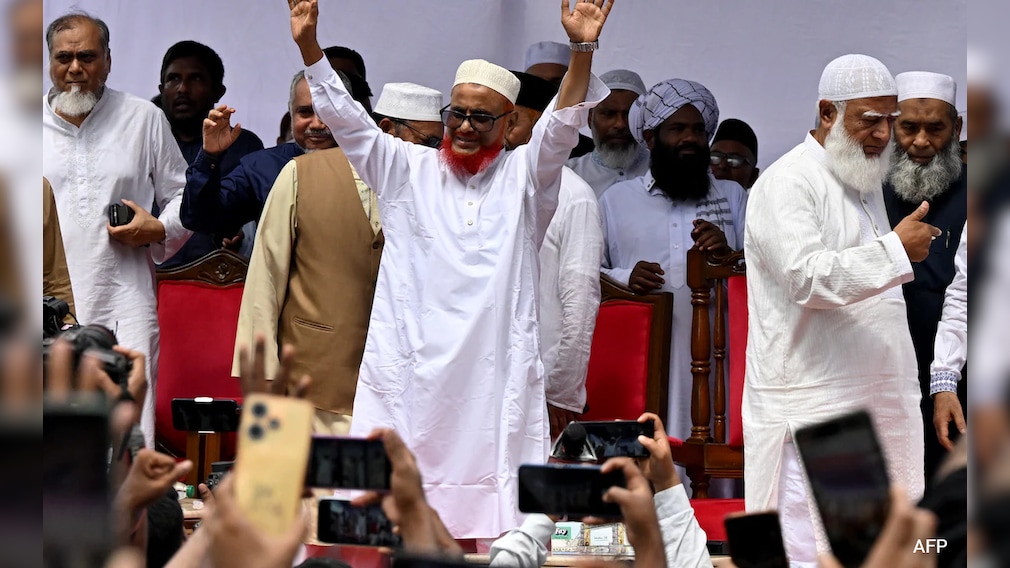
The 13th Bangladesh Jatiya Sangsad election of 2026 has produced two simultaneous political messages. First, the Bangladesh Nationalist Party (BNP) has won and will form the government. Second, and strategically more consequential for the region, the Bangladesh Jamaat-e-Islami (Jamaat) has registered an unprecedented surge.
Jamaat secured 68 seats and 31.76% of the vote, contesting 223 out of 300 constituencies. Its previous best was in 1991, when it won 18 seats with around 12% of the vote. Even more striking is the broader right-wing Islamist vote share, which has climbed to roughly 38% - far above the earlier ceiling of about 15%. This is not merely an electoral fluctuation; it is a structural shift in Bangladesh's political demography. Jamaat's registration was cancelled by Bangladesh's Supreme Court in 2013, and it could not contest elections in 2014, 2018, and 2024. However, some Jamaat leaders contested the 2018 election under the BNP party symbol, in a tacit understanding.
Whether deliberate or incidental, the transitional period when Mohammed Yunus helmed the interim government in Bangladesh helped create space for Jamaat's organisational consolidation and electoral preparation, aided by the vacuum created by the Awami League's ban from contesting the election. The 2026 verdict, therefore, reflects not just campaign momentum but also the gradual normalisation of a party that had once been politically marginalised.
For India, the correct lens is neither alarm nor indifference. The BNP is in power. Yet, the Jamaat's emergence as a major parliamentary force will shape the political tone, policy debates and street mobilisation in Bangladesh over the next five years.
The Border Geography
Geography adds a security dimension to India's concerns. Most of Jamaat's victories have come from the north-west and south-west regions adjoining Indian states such as West Bengal, Assam and Meghalaya. In Indian border districts like Khulna, Rongpur and Rajshahi, Jamaat completely dominated the election result.
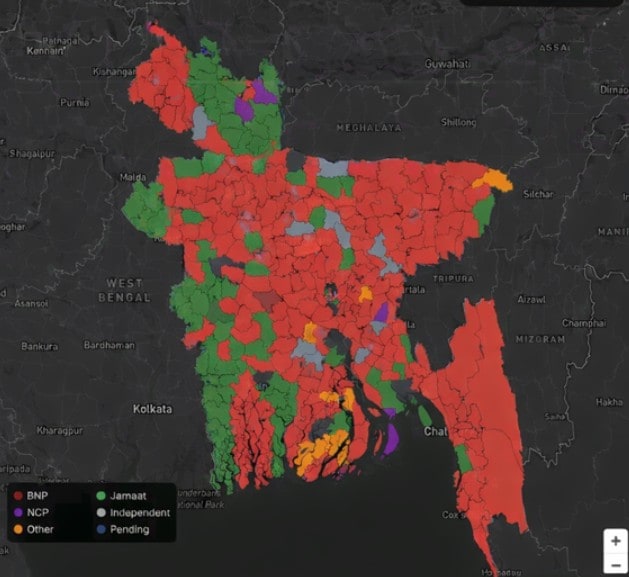
Bangladesh Election Result Map: Constituency and Winning Parties
This does not automatically translate into instability. Border management and intelligence cooperation between India and Bangladesh have improved significantly in recent years. However, political representation matters. When border constituencies are dominated by a party historically sceptical of India, New Delhi's security calculus inevitably adjusts.
The memory of the 2004 Chittagong arms haul remains relevant. Ten truckloads of arms were seized, allegedly destined for the United Liberation Front of Assam (ULFA) in India. Among those later convicted by Bangladeshi courts was Motiur Rahman Nizami, then Jamaat's Ameer (Chief) and a cabinet minister in the BNP-led government. Nizami and ULFA chief Paresh Barua (in absentia) were sentenced to life imprisonment with others. It is a different matter that Nizami was prosecuted in 2016 after Bangladesh's International Crime Tribunal found him guilty for his role in masterminding the Demra Massacre of May 13, 1971, in which 800-900 unarmed Hindu civilians were killed. The arms trafficking episode with direct association of high-profile figures underscored how cross-border insurgent linkages can complicate bilateral ties.
While today's leadership distances itself from militancy, the precedent explains why Indian agencies will watch border developments closely.
A Capital Breakthrough
One of the most underappreciated aspects of the result is Jamaat's breakthrough in the political capital. For the first time, the party has won seats in the Dhaka metropolitan area. Out of 20 seats in Dhaka, it has secured six. In symbolic and practical terms, this matters enormously. Dhaka is not just an electoral cluster; it is the centre of administrative authority, media influence, and ideological contestation. A stronger parliamentary presence from the capital gives Jamaat additional visibility, bargaining power, and narrative control.
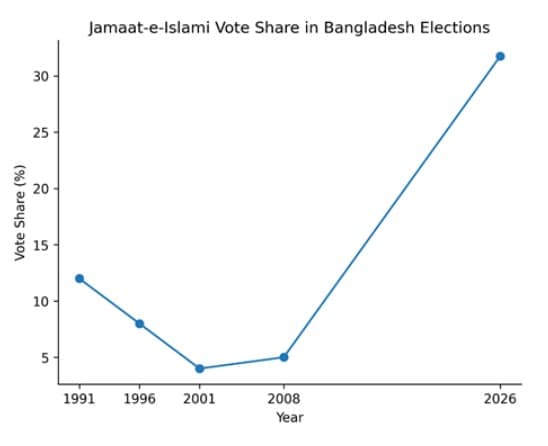
A graphical presentation of Jamaat's performances in the Bangladesh national elections
For India, this suggests that Jamaat's rise is no longer confined to peripheral districts. It now has a foothold in the heart of Bangladesh's power structure.
Jamaat And The Ideological Question
Jamaat's past continues to shape perceptions. During the 1971 Liberation War, elements within the party collaborated with the Pakistani Army and supported the Rajakar militia. Subsequent war crimes trials cemented its controversial legacy.
Cut to 2026, the party is seeking to moderate its public posture. It expressed support for minority rights and stepped back from explicit calls for establishing a Sharia-based state. It even fielded a Hindu candidate in the recently concluded polls, though unsuccessfully.
Yet, the outfit's core ideological positions remain unchanged. Full membership (rukon) is constitutionally restricted to Muslims, effectively excluding non-Muslims from leadership and policy-making roles. The party fielded no women candidates. Its Ameer publicly reiterated that women should not occupy leadership positions within Jamaat, citing religious doctrine. In the run-up to the election, he said to Al Jazeera, "On the question of women, Jamaat's position is neither confused nor apologetic - it's principled. We do not think women should come into leadership. In Jamaat, it is impossible. Allah did not permit it."
Allegations Of Extremist Links
Bangladeshi security assessments over the years have reported ideological overlaps between Jamaat, its student wing Islami Chhatra Shibir, and extremist organisations such as Jamaat-ul-Mujahideen Bangladesh (JMB) and Harkat-ul-Jihad al-Islami Bangladesh (HuJI-B). Jamaat has consistently denied such institutional links. However, investigations have pointed to similarities in recruitment pipelines and messaging ecosystems.
For India, the issue is operational rather than rhetorical. Any weakening of Bangladesh's internal counter-extremism vigilance could have spillover effects in India's North-East, where insurgencies have declined but not entirely disappeared.
BNP in Power, Jamaat in Ascent
Here, it is important to reiterate that Jamaat has not won the election - the BNP has. The government in Dhaka will be led by a party with its own strategic calculus and diplomatic priorities. However, the former's strengthened parliamentary presence introduces a new dynamic. As a powerful opposition or coalition influencer, it may adopt a sharper positioning to expand its base. One tactic could be to take a pronounced anti-India line, portraying the BNP as too accommodating towards New Delhi. Such anti-India rhetoric has historically resonated with sections of Bangladeshi politics.
A positioning of this kind could serve two purposes. First, it would help Jamaat consolidate nationalist-Islamist voters. Second, it could pressure the BNP government by framing any bilateral cooperation with India as a compromise of sovereignty.
There is also a risk of confrontationist politics in sensitive border districts and the capital city. Competitive radicalisation, where one party escalates rhetoric or mobilisation to outflank another, can destabilise local environments even if the central government remains formally cooperative with India.
For New Delhi, this means dealing with two layers simultaneously: engaging a BNP-led government while monitoring the political pressure exerted by Jamaat from Parliament and the street.
What Should India Do?
The first principle should be strategic patience. Democratic outcomes in neighbouring countries cannot be wished away. Jamaat's surge reflects domestic factors within Bangladesh - economic anxieties, identity politics, organisational discipline, and not external manipulation alone.
Second, India must institutionalise engagement beyond personalities. Security cooperation mechanisms must remain professional and insulated from political swings. Border coordination, intelligence-sharing, and counter-terrorism frameworks should continue irrespective of partisan shifts.
Third, strengthen domestic resilience. Development and governance in the border districts of West Bengal, Assam, Tripura and Meghalaya remain India's best long-term defence against cross-border ideological or militant spillover.
Finally, avoid rhetorical overreaction. Public alarmism in India could inadvertently strengthen hardline narratives within Bangladesh. Quiet diplomacy combined with firm security vigilance will yield better outcomes than megaphone messaging.
A New Phase, Not a Crisis
The 2026 election marks a new phase in Bangladesh's political evolution. Jamaat's leap from the margins to a major parliamentary force, combined with its breakthrough in Dhaka and dominance in border constituencies, signals that political Islam has gained fresh democratic legitimacy.
Yet, Bangladesh remains a plural polity. The BNP leads the government. Civil society is active. Institutions endure.
For India, the moment calls for watchful engagement. Geography ensures interdependence. Political currents in Dhaka will always ripple across the border. The task for New Delhi is to manage those ripples with composure - neither dismissing the signals nor exaggerating them.
India should consider that Jamaat's rise is a shift to manage, not a crisis to dramatise.
(M Biswanath Sinha is a senior policy analyst. These are his personal views.)
Disclaimer: These are the personal opinions of the author
-
Opinion | The Last Bet? What Trump's 'Mother Of All Bombs' Could Actually Do To Iran

Can an MOAB deliver a decisive blow to Iran that may force it to surrender immediately, as Japan did after Hiroshima and Nagasaki in World War 2?
-
Hit Songs, Empty Pockets: The Hidden Math Behind India's Viral Music Boom
Over 80,000 brands and five lakh creators in India make branded content. The opportunity is worth around Rs 1,500 crore.
-
Opinion | Great 'Exceptions': How The Oil India Was Attacked For Is The Oil Trump Now Seeks
A law written to punish the buyers of Russian oil was suspended by the US to protect a purchase of Russian oil. India spent fourteen months being lectured for less.
-
Opinion | Louis Vuitton Loot, Torched Cars: France Protests Have An Unlikely Beneficiary
It's an unbelievable moment. Crowds looting the most exclusive stores in Paris, including the famed Luis Vuitton. But what's behind this meltdown?
-
Blog: Kolkata Didn't Learn From 2015. Eleven Years Later, It Proved To Be Fatal
The City of Joy isn't a stranger to crowd control. Be it during Pujo or Christmas at Park Street, Eden Gardens cricket matches, or Derbies between Mohun Bagan and East Bengal. But during Pujo, the entire city is on alert.
-
Opinion | Slurs, Threats, Now A Temple Attack Plot: When Did America Become So Hostile To Indians?
The rising tide of anti-India, anti-Hindu, and racist attacks serves as a stark reminder that economic prosperity does not automatically guarantee social immunity from bigotry.
-
A Step Behind Neha Bora: What Rahul Gandhi's Gesture Says About Congress' Gen-Z Pitch
At INDIA bloc's march to Supreme Court, Rahul Gandhi placed himself a step behind two women, hands resting on their shoulders. One was his sister Priyanka. The one on his right was Neha Bora. Here's what the image means for the protest wave now, and for Rahul's politics in general.
-
Opinion | Imran Khan, And The Perils Of Having An 'Opinion' In Bollywood
The reality of the industry is quite grimy. More often than not, its inhabitants have been fairweather friends, happy to sing the praises of whoever is in a position of authority.
-
Exclusive: India's Food Safety Problem Goes Beyond Just Dirty Kitchens - By Tukaram Mundhe
On World Food Day, Maharashtra's Commissioner of Food Safety explains why instead of taking stopgap measures, the entire supply chain in India needs to be held accountable and made transparent.
-
Opinion | India Has Enough Coal. So Why Are Power Plants Running Short? A 76 Million 'Crunch'
As of October 5, as many as 82 of the 191 thermal plants monitored by the Central Electricity Authority were in the 'critical' category