'Vikram 3201': 'Aatmanirbhar Bharat's' Deep-Space Microchip, A Game-Changer
Nearly every modern electronic item needs microchips, and India is positioning itself to be a key player in this space, competing against Taiwan, China, South Korea, and the United States.
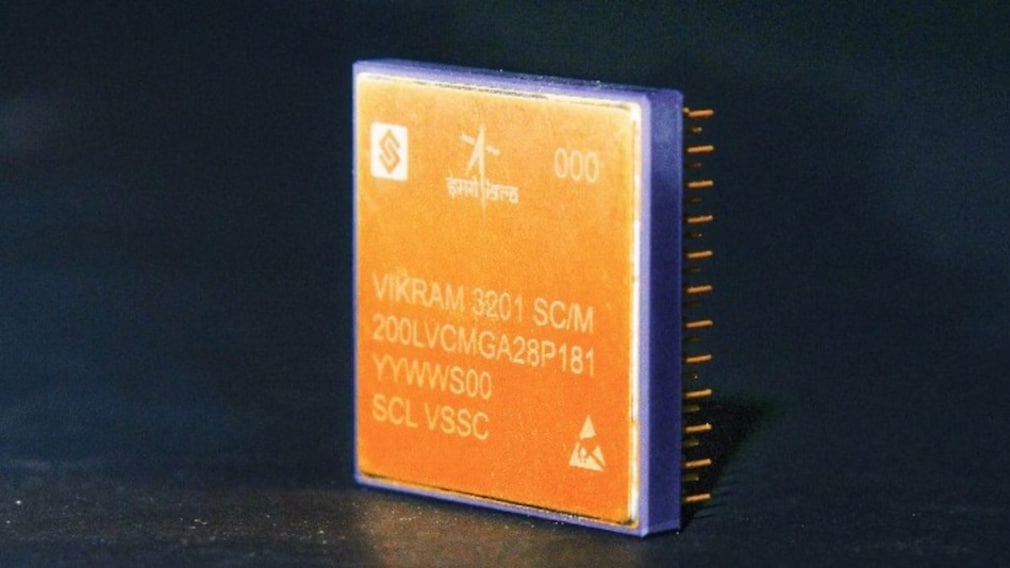
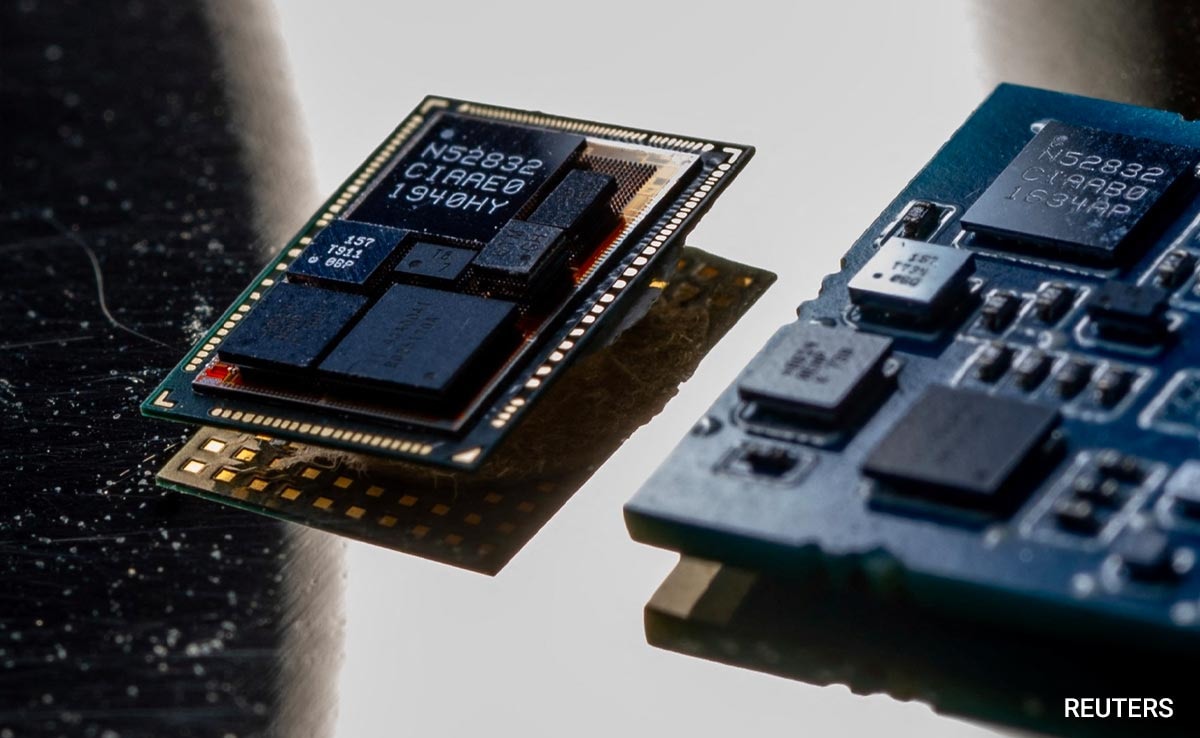
India on Tuesday unveiled a fully indigenous 32-bit microprocessor - 'Vikram', that has been developed by, and for, the Indian Space Research Organisation - at a semiconductor industry event in Delhi.
At the event Prime Minister Narendra Modi, fresh from China and the Shanghai Cooperation Organisation, called microprocessors 'digital diamonds'. "If the last century was shaped by oil, this is by a small chip," he said, emphasising the importance of these miniature powerhouses of computing.
The Prime Minister was, if anything, underplaying the significance of microprocessors in a world dominated by the digital, a world in which everything - from the watch on your wrist and the car in your garage to the life-saving medical equipment at hospitals - relies on microchips.
Nearly every modern electronic item needs microchips, and India is positioning itself to be a key player in this space, competing against Taiwan, China, South Korea, and the United States.
Pitching for increased global investment in India's nascent semiconductor and microprocessor industry - worth an estimated $50 billion today and projected to cross $100 billion by 2030 - the Prime Minister declared, "The world is ready to build the semiconductor future with India."
Sources told NDTV that explosion has already begun; $18 billion is to be invested across 10 fabrication facilities and, simultaneously, the government is building a 'comprehensive ecosystem' for the design and development, manufacturing, and packaging of microchips.
India's 'Vikram' Microprocessor
India's first fully home-made chip is a 32-bit microprocessor with a custom instruction set architecture.
This means it can handle 32 bits of data at a time and can be programmed - i.e., the instruction set architecture, or ISA - to understand and execute a wide variety of orders.
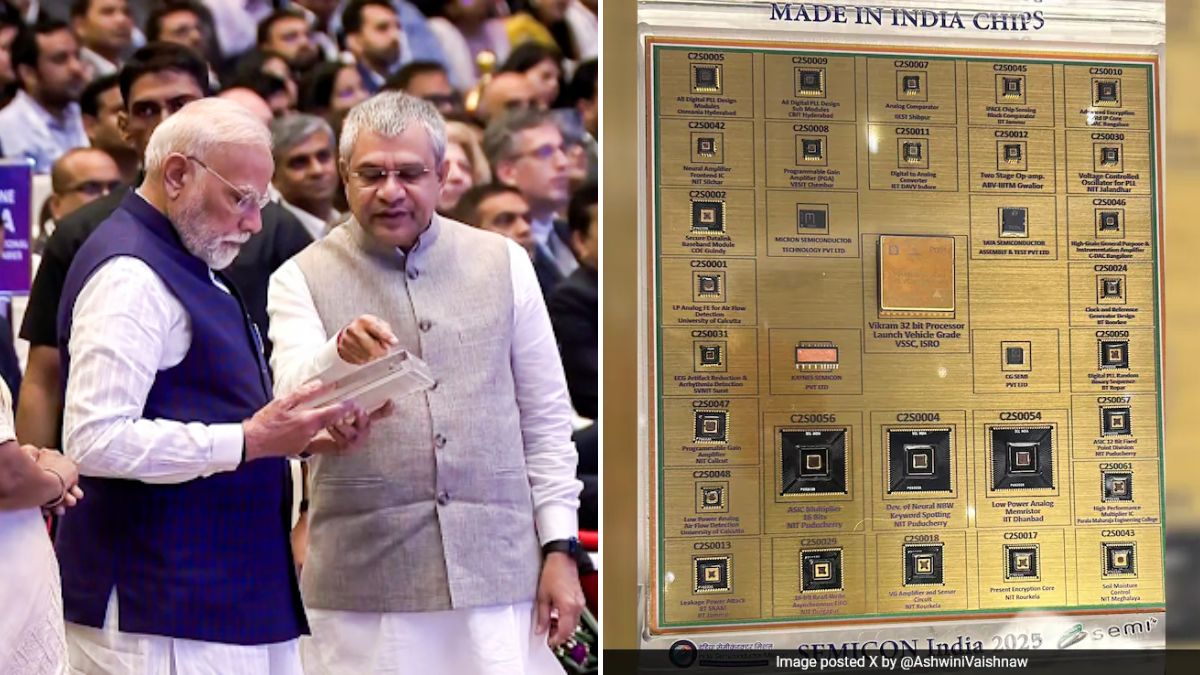
PM Modi and IT Minister Ashwini Vaishnaw at the 'Vikram 3201' launch event
It also has high-level support for the Ada programming language, which is widely known for its reliability and has applications in satellites, air traffic control systems, and launch vehicles.
That is not unexpected given 'Vikram' was designed by India's space agency for use in harsh conditions. In fact, it can withstand a range of temperatures - from -55 to 125 degrees Celsius.
Properly called 'Vikram 3201', it is an upgrade over the 1601 variant - which can compute only 16 bits of data at a time - that ISRO has been using since 2009.
The 'Make-in-India' Plan
'Vikram' is a big step in the government's 'aatmanirbhar', or 'self-reliant' India, push.
It is critical because it confirms India's capacity to design and manufacture space-grade microprocessors, chips that can withstand extreme temperatures and remain fully functional.
First ‘Made in India' Chips!
— Ashwini Vaishnaw (@AshwiniVaishnaw) September 2, 2025
A moment of pride for any nation. Today, Bharat has achieved it. 🇮🇳
This significant milestone was made possible by our Hon'ble PM @narendramodi Ji's far-sighted vision, strong will and decisive action. pic.twitter.com/ao2YeoAkCv
Being able to make this at home - and Mr Modi made mention of this during his Independence Day speech - will significantly reduce the cost of India's space missions.
READ | "Made-In-India Semiconductor Chip This Year": PM Modi
It will also pave the way for the design and manufacture of chips for civilian use.
That will feed a larger commerical ecosystem of electronics giants, like Apple or Samsung, or others for whom they are a critical component, such as the $240 billion automotive industry that accounts for over five per cent of India's GDP, and the nearly $18 billion appliances and consumer electronics industry.
China, Taiwan, South Korea, and the United States are the world's largest chip makers (File)..
Being able to source high-quality chips locally, rather than importing them from China or Taiwan, will incentivise them to set up production facilities here, rather than building abroad and shipping them in.
This will also keep prices low in a famously price-sensitive market.
Looking Forward
The country's semiconductor industry - the base on which its microcip and microprocessor plans must be built - is growing, rapidly, after several false starts.
Government investment has been substanial - under the India Semiconductor Mission, a nodal agency under the Ministry of Information Tech and Electronics, over $7 billion has already been committed towards building and operationalising fabrication plants across the country.
READ | Semiconductor Market To Explode By 2030, India To Play Key Role
The private sector has stepped up as well.
In July there were reports Tata Electronics had signed a $10 billion electronics and semiconductors deal with German tech giants Robert Bosch GmbH for plants in Assam and Gujarat.
And, in May the government greenlit a $433 million venture between HCL and Foxconn to produce display driver chips for mobile phones, laptops, and other devices in Uttar Pradesh.
Billions more have been committed to fabrication and packaging plants in Andhra Pradesh, Odisha, and Punjab. In the latter, the government has cleared a factory that can make 15.8 crore chips per year.
The investment is sizeable. The idea is simple - reduce purchase of semiconductors and chips from foreign countries to cut down the import bill and strengthen domestic manufacturing.
Local fabrication will also enhance the electronics sector's supply chain resilience, which is especially vital after global disruptions dating back to the pandemic have affected global manufacturing.
And all of this will boost the economy and provide more jobs, over 300,000 direct and indirect employment opportunities by 2026 alone, according to some estimates.
What's more, in terms of the raw materials needed, India is rich in chemicals, minerals, and gases, making it well-suited to support the production requirements of the semiconductor supply chain.
NDTV is now available on WhatsApp channels. Click on the link to get all the latest updates from NDTV on your chat.
-
Blog | Why You Should Care Whether Schrodinger's Cat Is Dead Or Alive

Imagine going on a romantic Alpine getaway and returning with the equation that runs the modern world. The only snag: nobody can quite agree on what it says about reality.
-
Promote, Punish, Repeat: Decoding Mayawati's Akash Anand Puzzle
The development in the BSP is unprecedented. Never before has any Indian party elevated a family member and dumped him or her unceremoniously thrice within a span of three years.
-
Opinion | Nepal Needs $5 Billion To Rebuild. World's Climate Fund Doesn't Have Even 10% Of It
The fund caps support at USD 20 million per project; Nepal needs two hundred times that. And the board is not scheduled to sit until December.
-
Mayawati's Tough Love: Nephew Akash Anand Benched Again. What It Means For BSP
Akash Anand, the 31-year-old foreign-educated nephew of BSP boss Mayawati, finds himself out of favour, for at least the third time in three years, with the latest turn coming in Lucknow on September 3.
-
Opinion | The Rise Of Indians In US Is Making Some Americans Very, Very Angry
A new report released yesterday shows how Indians are now among the biggest targets of racist attacks in America.
-
Opinion | China, Pak, A Stalled India Visit: How Signals From Bangladesh Are Getting Louder
A fighter jet deal with China, interest in Pakistan's military bloc, and a 'stalled' visit to India - all in a month. Bangladesh's drift is getting harder to ignore.
-
Opinion | Indus Treaty, Hague, And Pakistan's Endless Search For Leverage Over India
If the IWT survived all the trials in the past, it is because India's threshold of tolerance had been unusually high. But Pakistan must know that it can't arm-twist India through international pressure.
-
Opinion | Nepal's 'Climate Compensation' Pitch Is Valid, But Its Demand From India Isn't
Nepal's vulnerability gives it a claim on multilateral climate finance. It does not follow that India bears responsibility for this.
-
Opinion | India Wants A 6th-Generation Fighter. But A Lot Could Go Wrong
India might just be building too many fighter jets to focus on any one of them well. A recalculcation is needed.
-
Reporter's Diary | Worse Than War: An Aerial View Of Nepal's Trishuli River Valley Tragedy
In many ways, reporting on natural disasters is far more harrowing than covering modern war