Agni-Prime, With 2,000 km Range, Fired From Train: Why It's No Ordinary Test
"This successful test has put India in a group of select nations that have developed canisterised-launch systems from on-the-move rail networks," Rajnath Singh said.
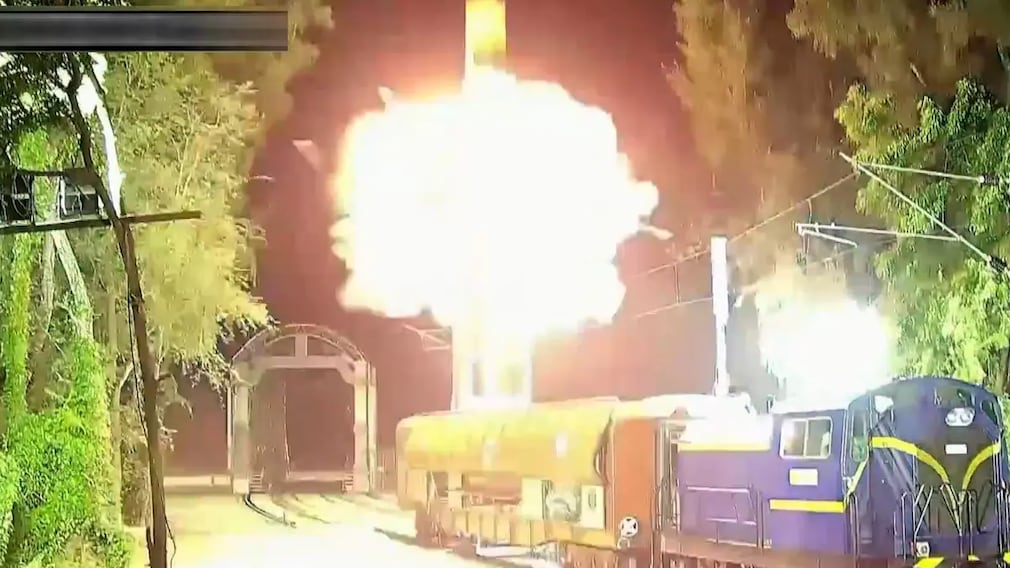
India has successfully test-fired an intermediate range Agni Prime missile, Defence Minister Rajnath Singh said early Thursday on X and shared videos of the explosive lift-off.
A weapons test, by itself, is generally not a headline event, particularly for countries like India, with a wide-ranging arsenal of short-, medium-, and long-range missiles.
This, however, was no ordinary missile test.
The nuclear-capable Agni Prime - with a range of 2,000 km - was fired from a launch bed pulled by an Indian Railways locomotive. That meant India joined an elite list - Russia, the United States, and China - capable, or which had the capability, of firing railcar-based intercontinental ballistic missiles, or ICBMs.
North Korea has claimed similar capacities; in 2021 it said missiles launched from a 'railway-borne system' travelled 800 km before striking a target off its eastern coast. Japan and South Korea confirmed the launch, though they could not confirm the platform.
"... the first-of-its-kind launch was carried out from a specially-designed, rail-based mobile launcher," the Defence Minister said, "... has the capability to move on the rail network without pre-conditions (and) that allows shorter reaction time and cross-country mobility."
India has carried out the successful launch of Intermediate Range Agni-Prime Missile from a Rail based Mobile launcher system. This next generation missile is designed to cover a range up to 2000 km and is equipped with various advanced features.
— Rajnath Singh (@rajnathsingh) September 25, 2025
The first-of-its-kind launch… pic.twitter.com/00GpGSNOeE
"This successful test has put India in a group of select nations that have developed canisterised-launch systems from on-the-move rail networks."
Rail-based Agni Prime. What does this mean?
Essentially, this means the Indian military can now launch the Agni Prime missile (and other suitable projectiles) from the remotest parts of the country, even without road support.
All the military needs is a rail track running to the launch point and, with nearly 70,000 km of tracks as of March last year, the Indian Railways is the fourth-largest network in the world.
The advantages of a rail-based missile firing system extend beyond a greater number of launch points. It also means the military can hide missiles from enemy satellites in train tunnels.
READ | India Test-Fires Agni-Prime Missile. It Can Hit Targets 2,000 km Away
That works particularly well if there is a tunnel near the launch point; that will allow the military to keep the missile concealed till the last minute, and catch the enemy by surprise when it is eventually fired.
Equally, it also offers an increased number of storage locations during times of war, when enemies might target military bases where the missiles might normally be stored.
That last point is, perhaps, critical, given the recent military conflict with Pakistan that saw that country target Indian military establishments with drones and missiles.
Rail-based launchers have drawbacks too
The most obvious limitation is the track itself. Missiles can only be launched from the track, which means if there is no railway line running to the launch point, then the system is useless.
Also, given the advanced technology that powers missiles and missile systems today, often these need to be fired from precise locations to ensure the target (and only the target) is hit.
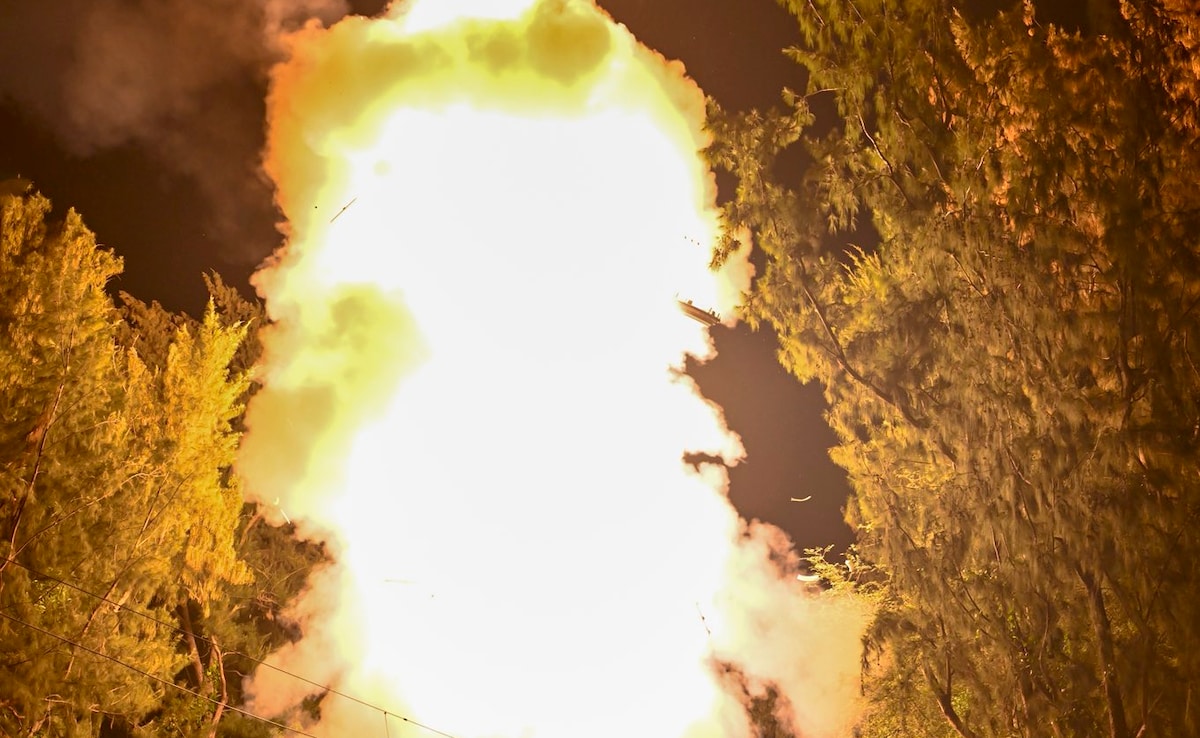
Successful test of the rail-based Agni Prime missile. Photo: Posted on X by @rajnathsingh
A rail-based launcher does not always offer that precision in launch parameters.
Additionally, rail tracks are also subject to sabotage, which would be a major concern in wartime, particularly since it is difficult to ensure security along the extensive network.
Ultimately, though, rail-based launchers are important because they offer the military more flexibility in responding to enemy threats and protecting the country.
Rail-based launchers history
Possibly the first instance of launching missiles from railway tracks was the former Soviet Union in the 1980s. The former country fired its RT-23 Molodets, a three-stage, solid-fuelled ICBM from special trains. Like India's Agni Prime, the Molodets could also carry nuclear warheads.
In 2017 there were reports of a new rail-mounted ICBM platform - the Barguzin BZhRK, each capable of carrying six missiles - being tested and scheduled for operationalisation by 2020.
However, there has been little news since, leading experts to believe the project is frozen.
Nevertheless, railcar-based ICBMs remain part of Russia's arsenal, which is understandable given that it too has a vast country with a massive rail network to exploit in wartime.
Around the same time (and in response to the Soviet innovation), the US established the Peacekeeper Rail Garrison which involved placing 50 MGM-118A ICBMs on trains.
The idea was to retain strike capability in the event of a nuclear war or a first-strike scenario by the Soviet Union disabling conventional launch platforms.
However, in 1991, after the Cold War between the two finished, the programme was cancelled and all missiles were returned to silos. The special train itself was placed in a museum.
The fundamental behind all of these efforts, including that by India, is not just to extend launch capabilities. The truth is that ICBMs are high-priority targets, particularly a nuclear war, simply because each side will want to neutralise their enemy's nuclear strike capacity.
And if all of India's missiles are sitting in silos - where they can be tracked and targeted by advanced satellites - then it leaves the country in a difficult spot. Railcar-based launches, therefore, offer, the country an additional shield in the event of an enemy strike.
With input from agencies
NDTV is now available on WhatsApp channels. Click on the link to get all the latest updates from NDTV on your chat.
-
Why Nepal Is So Vulnerable: Glacial Lakes, And A Himalaya That Moves Constantly

The August 26 inland tsunami was not an accident of weather. It sat at the intersection of processes that make Nepal one of the most hazard-exposed countries.
-
IRGC's New Boss Is No Ordinary Man. Meet Ahmad Vahidi, Iran's Ultimate Survivor
He has survived purges, sanctions, assassinations, secret deals, and Iran's most consequential wars. The IRGC's new chief, formally appointed by Khamenei this month, knows the regime - and its enemies - like few others do.
-
Analysis | BJP's Mother Of All Resets: An Overhaul To Fix Its Perception Problem
The battle this time is to regain credibility as BJP has entered a phase which is going to be the launch pad for a national face after a political force called Narendra Modi.
-
Opinion | Why Is India Cooler As The World Burns? A Heatwave 'Mystery'
Europe, which is warming at more than twice the global average, is now bracing for even worse climate impacts. But something strange and unexpected is happening in India, keeping it cooler.
-
Tukaram Mundhe: The IAS Officer Restaurants Fear Most In Maharashtra
As FDA commissioner, Tukaram Mundhe has his eyes on Maharashtra's plate. Food adulterators, storied restaurants and clubs, dark stores of quick commerce platforms, school and government canteens, surrogate advertisers of banned products - no one is out of bounds.
-
3 Minutes, 6 Stanzas, Century-Old Debate: The Many Turns In Vande Mataram's Journey
PM Narendra Modi launched a year-long commemoration of the song's 150th anniversary on November 7, 2025. In December, both Houses held special discussions on it, during which the 1937 Congress decision was scrutinised.
-
Opinion | Sajjan Kumar, Congress, And How To Keep Messing Up An 'Apology'
A sitting Congress MP has termed Sajjan Kumar's death an "irreparable loss", calling him a man whose bond with the people of Delhi was "an example". This was a tribute, delivered in full sentences, to a convicted killer of Sikhs.
-
Explained: Why Tamil Nadu Dropped Second Airport Near Chennai
While the government stands firm with the protesting residents, Chief Minister Vijay assured that Chennai's aviation needs will not be ignored. The state will soon announce a detailed plan for a new airport at an alternative site, he said.
-
Opinion | A 'Snub' Gone Too Far? The Story Of Bangladesh PM's Stalled India Visit
The abrupt cancellation of Prime Minister Tarique Rahman's scheduled visit to New Delhi this month raises many questions.
-
Inside Pak's New Law That Has One Man Written All Over It: Asim Munir
With a new act, Munir has truly reached the apex. At least most politicians in Pakistan will hope so.