Flights, Turbulence And Anxiety: Decoding The Mid-Air Scares
For many air travellers, turbulence turns out to be the most unsettling part of flying.
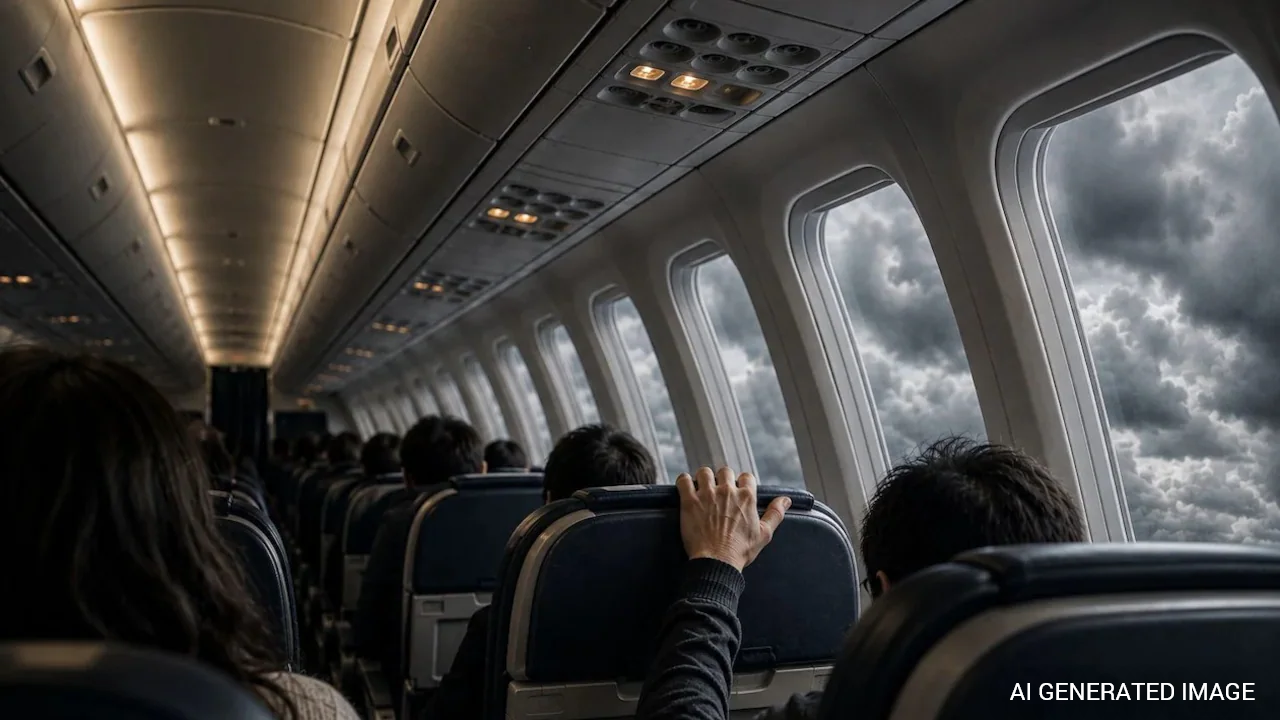
"Ladies and gentlemen, this is the captain speaking. We are starting to run into a bit of turbulence ahead. I have turned on the 'fasten seatbelt' sign. Please return to your seats and keep your seatbelts secured. The flight crew will also be securing the cabin for your safety. Thank you."
For most flyers, these have been words of routine that they hear on a flight.
Then comes the *ding*. The seatbelt sign illuminates. Moments later, the aircraft begins to shake, and an anxious emotional battle starts for many passengers.
In recent times, reports of turbulence have become more common, sparking headlines and social media discussions. In May this year, an Air India Delhi-Bengaluru flight encountered turbulence from a preceding Boeing 747 takeoff, causing a tail strike. The plane landed on a second attempt after going through a rough first attempt. Weeks later, an IndiGo Delhi-Patna flight went through severe turbulence amid strong winds. The flight was eventually diverted to Lucknow.
Last month, Telangana Chief Minister Revanth Reddy's flight from Delhi to Hyderabad was diverted to Bengaluru due to "unstable" conditions.
The chatter around turbulence grew louder this month when it was initially reported that an Air India flight from Phuket to Delhi encountered severe turbulence and experienced a sudden loss of altitude of 300 feet, leaving 20 passengers and four crew members injured.
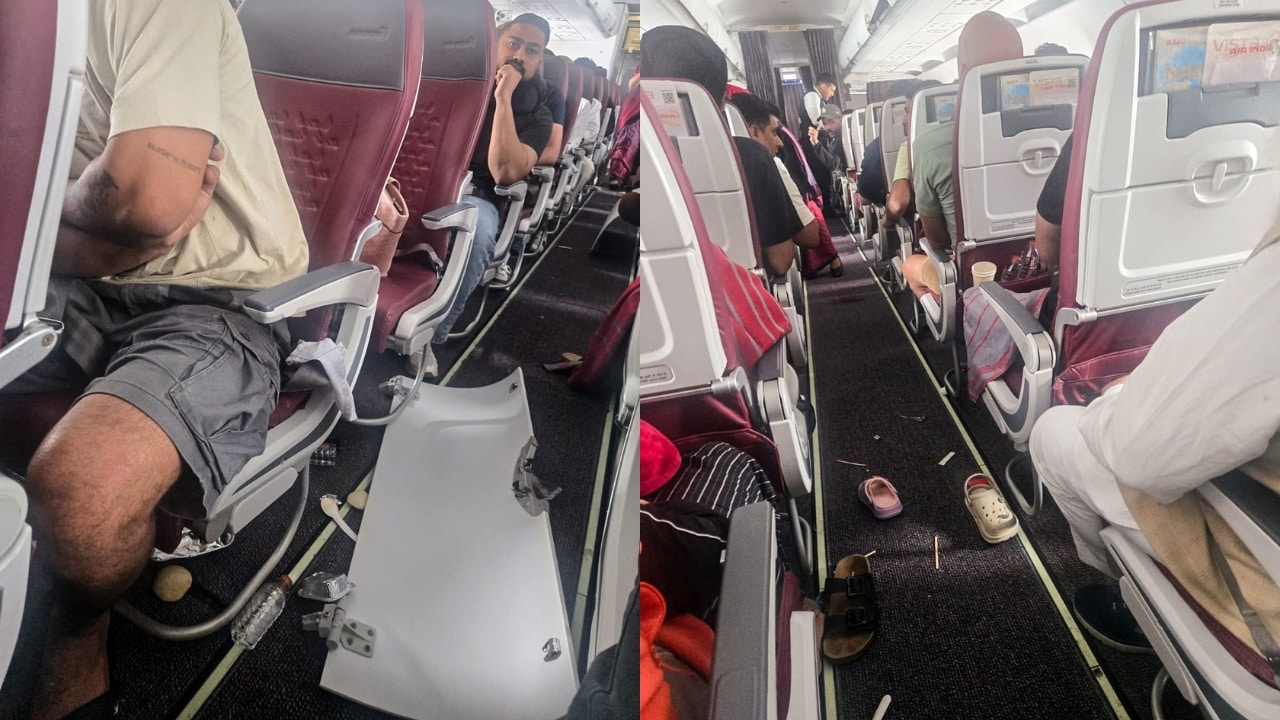
The probe, however, revealed that there was a total and simultaneous loss of key control surfaces, including the elevators and ailerons, for a period of 4 seconds - with the spoilers also lost as a consequence of the same hydraulic failure.
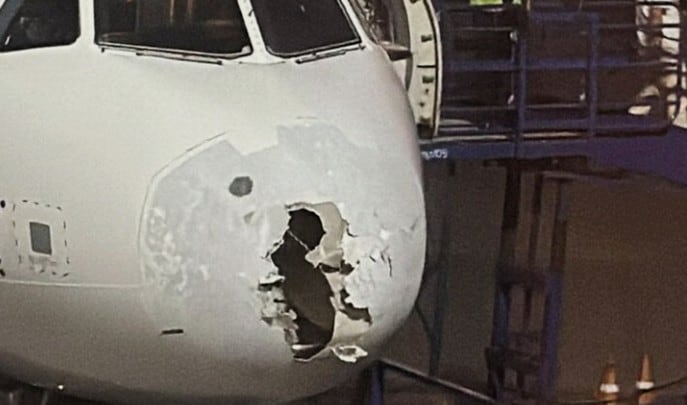
Last year, an IndiGo Delhi-Srinagar flight encountered a violent hailstorm and severe turbulence, leading to a terrifying 8,500-feet-per-minute descent. While there were no injuries reported to any passengers or crew, the aircraft's nose suffered significant damage.
Amid these incidents, every viral video of a flight hit by rough air, the fear grows stronger.
But what exactly is turbulence? Why does it occur, and is it really becoming more common?
Turbulence is an irregular, chaotic movement of air that causes an aircraft to pitch, roll, or bounce.
"It generally occurs where there is a mix of low-pressure and high-pressure air systems conflicting with each other. It occurs in all three places: oceans, mountains and land. The difference in severity is because of the nature of the atmospheric conditions and how the temperature differences impact the atmosphere," Sanjay Lazar, an aviation expert, told NDTV.
There are three types of turbulence - one is weather-related, another is clear-air turbulence, which is commonly known as CAT, and the third is wake turbulence.
Weather-related: This occurs in cloudy or stormy conditions when air is rising and falling vigorously. It is usually linked to thunderstorms, convective clouds, or weather fronts. Because the clouds contain water, they show up clearly on the aircraft's weather radar, making pilots see the intensity and avoid the areas. This kind of turbulence is threatening but detectable.
Clear-air turbulence (CAT): It is the riskiest of all, as it happens in cloud-free skies and is therefore invisible.
"Radar cannot detect this kind of turbulence. Before the flight, we get a briefing about the weather picture where satellites and other instructors are constantly monitoring the air. They predict, but they are not very accurate. We cannot exactly tell the intensity. Sometimes, these are even jet streams - cylindrical shafts of air that get very high speed, and if you fly through them, there will be a bump which will create turbulence," Captain Amit Singh, a former pilot, told NDTV.
Wake turbulence: This kind of turbulence is generated by other aircraft, especially the large ones such as the Airbus 380 or Boeing 777, Captain Singh said. These aircraft leave behind strong rotating vortices of air from their wingtips. During this time, if another plane flies too close - sometimes within 1,000 feet - it can encounter these vortices.
"Wake turbulence has caused some injuries to small aircraft. In some cases, they have flipped or overturned the smaller planes. The greatest risk occurs during take-off and landing, which is why strict rules are enforced," Captain Singh, who is also the founder of Safety Matters Foundation, said.
So, why has there been a rise in reports of air turbulence lately?
Courtesy: Climate change?
A widely cited 2023 study found significant rises in air turbulence at cruising altitudes since 1979, including a 55 per cent rise in severe clear-air turbulence over parts of the North Atlantic due to climate change. While the evidence does not yet show a uniform surge across every global route, clear upward trends have been recorded on several of the world's busiest flight corridors.
But experts say climate change alone cannot be a reason for turbulence all over the world - unless proven otherwise.
"Climate change is increasing clear-air turbulence in some areas, but we cannot attribute a particular turbulence event to climate change alone," Rudrath Avinashi, programme officer, Centre for Science and Environment (CSE), told NDTV.
He said that establishing a link for a specific region requires looking at longer-term trends and comparing them with studies.
"The main causes of turbulence also vary with the season. In winter, clear-air turbulence is more common, particularly over North India, and the India Meteorological Department links this to the strong winds associated with the jet stream. During the monsoon, the picture changes, with thunderstorms, convection and changing wind conditions becoming important sources of turbulence," he said.
He further explained that high up in the atmosphere, there are narrow river-like streams, commonly called 'jet streams'.
"These warm the upper atmosphere and cool the lower one. The wind speed or direction changes sharply over a short distance, and it creates instability. If a plane ends up there, it goes through turbulence. Currently, there is a growing temperature gap, and that is changing the strength of the wind bands," Avinashi said.
"Aviation produced roughly 2.5% of global CO2 emissions in 2019. If global aviation were a country, it would rank among the world's largest emitters," he added.
Avinashi said that while the forecast and nowcast are useful in detecting turbulence, they are not precise in terms of CAT.
"A forecast can tell about a region but cannot pinpoint exactly where. Both forecast and nowcast are useful, but neither is perfect. This is why pilots are heavily relying on real-time updates," he added.
How do pilots see turbulence?
Pilots feel turbulence the same way passengers do - the bumps, jolts, and changes in motion. The difference is that pilots must simultaneously assess the situation, communicate with air traffic control, and decide on the safest course of action - often within seconds.
"Lots of things cross our minds. We have to act very fast. There is no panic as such, but there are a lot of decisions to be made. As soon as we are aware of turbulence, our standard procedure is to turn on the seat belt sign. We then immediately reduce speed to an optimum level, ask the traffic controller about the situation, and then decide on a strategy whether to descend or go higher up," Captain Singh said.
From the safety perspective, the pilots have to think about the aircraft, passengers, and crew.
"The crew might be in the middle serving hot drinks...there could be spillages. We have to think about a lot of things. If there is too much turbulence, then the cabin crew has to be seated," he added.
Captain Yashodhan Dighe told NDTV that before flying, they are briefed on the weather conditions.
"We, as pilots, are trained to be prepared for incidents like turbulence...Turbulence is normal all over the world due to different weather conditions or patterns," he said.
The pilots' key criteria
The key criteria for a pilot while flying is that when they encounter turbulence - wait for some time, and if it doesn't go away, they decide on one of the three options -- descend lower where the turbulence may not be there, or change the altitude to over 4,000 feet, or change the route, Captain Singh said.
"We just have to experiment basically."
"Say, 20 years back, monsoon did not have any turbulence. Over the last few years, the weather patterns have changed. It has become more severe. But for us, the books are the same, and we follow the same protocols," he said.
Can turbulence alone cause structural failure?
No. Turbulence cannot cause a structural failure of an aircraft - unless it is "catastrophic turbulence" or something that causes explosive decompression or a lightning strike that causes fire, Sanjay Lazar said.
"Airliners are built to handle the severest air turbulence. Especially modern aircraft are certified and tested to handle high turbulence loads. In fact, they are certified to handle 150% of the worst possible turbulence factor. The FAA has structural norms for aircraft which are equivalent to gusts of 56 ft/s at sea level, reducing with altitude, or about 17.1 m/2 pr 38 mph at sea level. The certification also considers a gust gradient of 30 feet to 350 feet to identify an aircraft's critical structural response," he added.
Captain Dighe, too, made the same point. "Engineering marvels - the modern commercial aircraft are extremely safe during turbulence because they are rigorously engineered and stress-tested to withstand aerodynamic forces," he said.
The fear factor: What passengers experience
For many air travellers, turbulence turns out to be the most unsettling part of flying. A sudden jolt, or a series of sharp bumps, can instantly turn a routine flight into a stressful experience. Even some of the seasoned flyers often find themselves gripping armrests a little tighter when the aircraft begins to shake.
The fear is not always rational, but it is deeply human.
In an environment where travellers have virtually no control over events, a brief episode of turbulence can trigger panic.
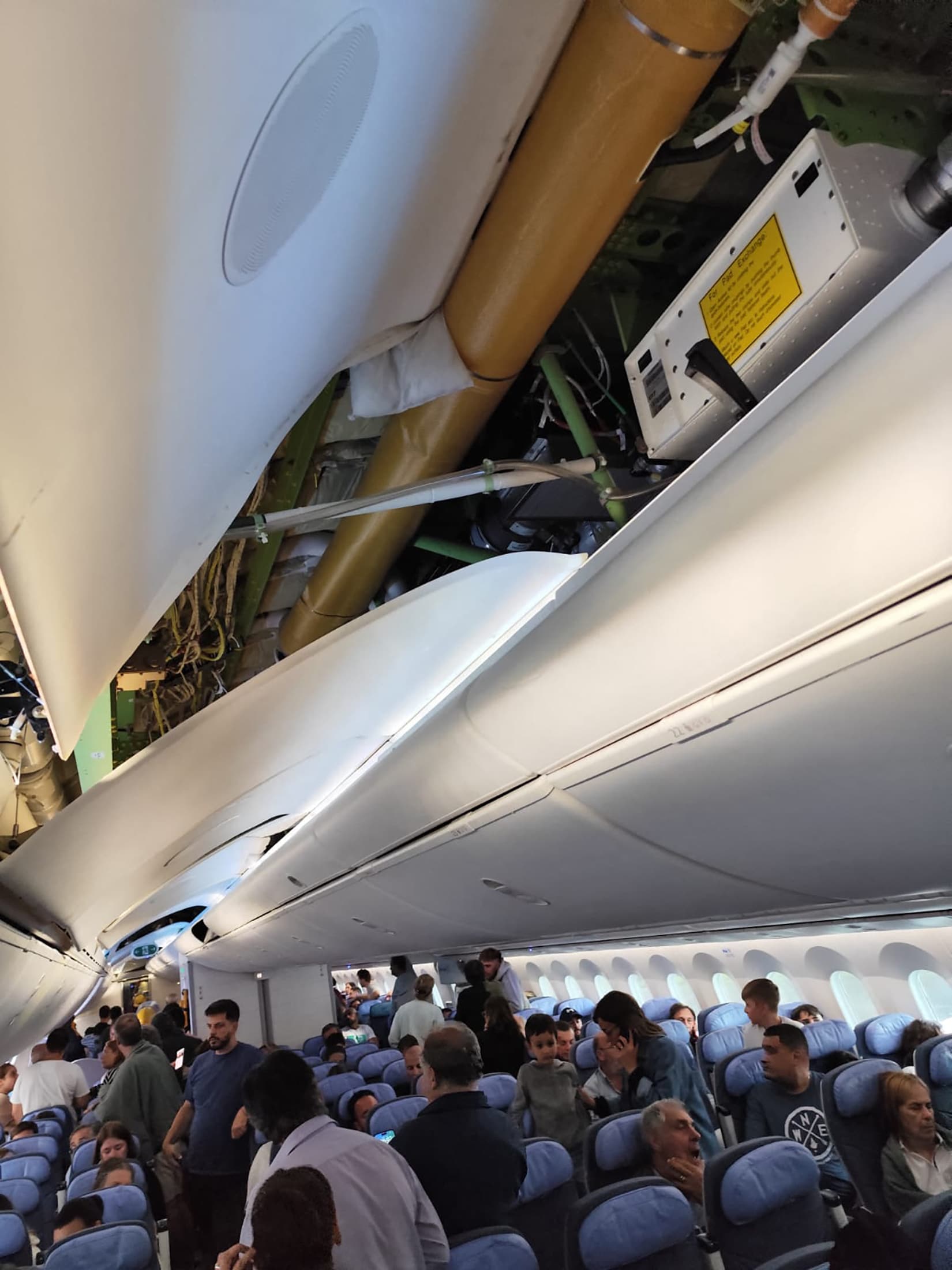
Damages in an Air Europa Boeing 787-9 Dreamliner after it made an emergency landing in Brazil after hitting strong turbulence
Recent encounters with severe turbulence have left a lasting impression on many travellers, some of whom describe the experience as among the most frightening moments.
Vipul Tiwari, an advocate who frequently takes flights, was travelling from Thiruvananthapuram to New Delhi last month. Suddenly, severe turbulence hit, causing panic inside the aircraft. "People started shouting. An airhostess who was serving food fell on her knees. It was immensely scary," he told NDTV.
Another flyer, Pratik Parvatikar, who recently encountered turbulence on a New Delhi to Mumbai flight, said, "I've never felt that kind of fear on a flight before. It felt like somebody was shaking me furiously. It was so intense that I felt completely helpless and scared."
Tulika Chaturvedi, who also encountered a similar experience while travelling from Sydney to Bangalore, said, "The flight crew always asks us not to worry, but it is a very unpleasant feeling. It's hard not to think about the worst when it does happen."
Part of the fear stems from a loss of control. Unlike driving a car or travelling by train, where passengers have visibility of what is happening outside, the aircraft offers no such thing. At over 35,000 feet, every movement of the plane can feel amplified, leaving flyers to imagine worst-case scenarios. But it is to be noted that the experience varies from person to person.
"This is not going to be a generic response that if 100 people are exposed to something, all 100 will have it. We all have various levels of vulnerabilities, predispositions, conditions, personalities, and experiences, which make a trigger or an activating stressful episode have different reactions. For example, let's say there are some people who like bungee jumping and some people who would feel anxious. So what happens is that there will be some people who would be more vulnerable," Dr Samir Parikh, Chairperson, Mental Health, Fortis Healthcare and Adayu Mindfulness, told NDTV.
He further explained, "There will be different kinds of people with different kinds of reactions. One, those who in any case tend to anxiety will feel anxious when turbulence happens. Second, those people who are worried about flying will have a lot more reaction. Third, some people who had that sudden jolt, which gave them a bit of an anxiety response, may continue to experience those fears in the future. More importantly, after being in a turbulent episode, their hesitation in continuing to fly again."
Of course, the more severe the experience, the more severe the distress, he said.
In some cases, if there has been an injury during turbulence, people may tend to be more anxious.
"For some people who may be predisposed to anxiety, they may even experience distress when they see this in media - especially the videos. And because sometimes you may experience the traumatic aspect of that visual by yourself when you see it, especially if you were planning to fly recently or did have a flight, then there is a greater correlation happening, and that's how one needs to see this," Dr Parikh said.
Safety first
While turbulence may be attracting more attention than ever before, aviation experts stress that it remains a normal part of flying. Forecasting tools are improving, pilots continue to rely on real-time information, and modern aircraft are engineered to withstand forces far greater than those encountered during routine turbulence.
For passengers, however, understanding the science does not always eliminate the fear. So, the most important thing, according to aviation experts, is that passengers must put on their seatbelts to prevent injuries during a turbulent incident.
"The primary risk during rough air is injury to unbuckled passengers or unsecured cabin items being tossed around, which is why keeping your seatbelt fastened is critical," Captain Dighe said.
-
Census Asks 40 Questions. Why Number 10 Is A Battleground | NDTV Explains

The caste question is a fill-in-the-blank for everyone other than SCs and STs. But there's a case for making it a dropdown with set options. Let's decode the history and math behind the politics.
-
Before The Nepal Flood, A Glacial Fall: Tracing The Trigger, And A 100-km Killer Surge
A glacier came off a ridge on the Nepal-China border and travelled 100 km down multiple rivers, the longest part of the run being in the Trishuli.
-
Opinion | China To Pak To America, The Growing Dilemmas Of The 'General'
Recent civil military turmoil in the United States, China and Pakistan can be understood through two lenses.
-
Opinion | Why India's Bureaucrats Have Learnt That Doing 'Nothing' Is Safer
India's bureaucracy has perfected a peculiar survival strategy: make a decision, you may be punished; make none, and you are usually safe.
-
Opinion | 482 Dead, And Counting: How A Glacier Collapse Became A Himalayan Disaster
What looks like a sudden flood is actually the final link in a chain of events unfolding across an increasingly unstable Himalayas
-
Opinion | Rahul Gandhi Is Cleaning House - But At The Cost Of The Congress
In his search for a new organisation, Rahul Gandhi is making the big mistake of treating the Congress he inherited as dead weight.
-
One-Day Disaster, Multi-Season Economic Shock: Nepal's Sisyphean Curse
Nepal Flash Floods: Nepal cannot prevent every earthquake, landslide or glacial collapse. But it can reduce how much each disaster costs.
-
Meta Pays Billions Over Teen Harms In US. In India, Algo Runs Unchecked
The US Surgeon General has separately warned that heavy social media use roughly doubles adolescents' risk of depression and anxiety, and that nearly half of teens surveyed said it made them feel worse about their bodies.
-
Blog | 'No Calls, People Scanning Banks For Bodies': Nepal Journalist Describes Flood Aftermath
As of Thursday evening, it was still impossible to get through to mobile phones in Dhunche, the district headquarters, or the flood-ravaged towns of Syabru Bensi or Timure.
-
Opinion | Toxic Knows Exactly What It Is Doing To Its Hero. And You May Have Missed It
Toxic's bait-and-switch goes beyond its plot. Geetu Mohandas is almost making a subtle point - for those who can see it.