India's cancer burden has grown steadily over the past decade-but what's alarming is that deaths have risen faster than new cases.
According to a written reply in the Lok Sabha by Minister of State for Health and Family Welfare Prataprao Jadhav on December 5, 2025, total cancer cases increased from 13.9 lakh in 2015 to 15.3 lakh in 2024, a 10.4% rise. Over the same period, mortality climbed from 6.8 lakh to 8.7 lakh, a 28.6% jump.
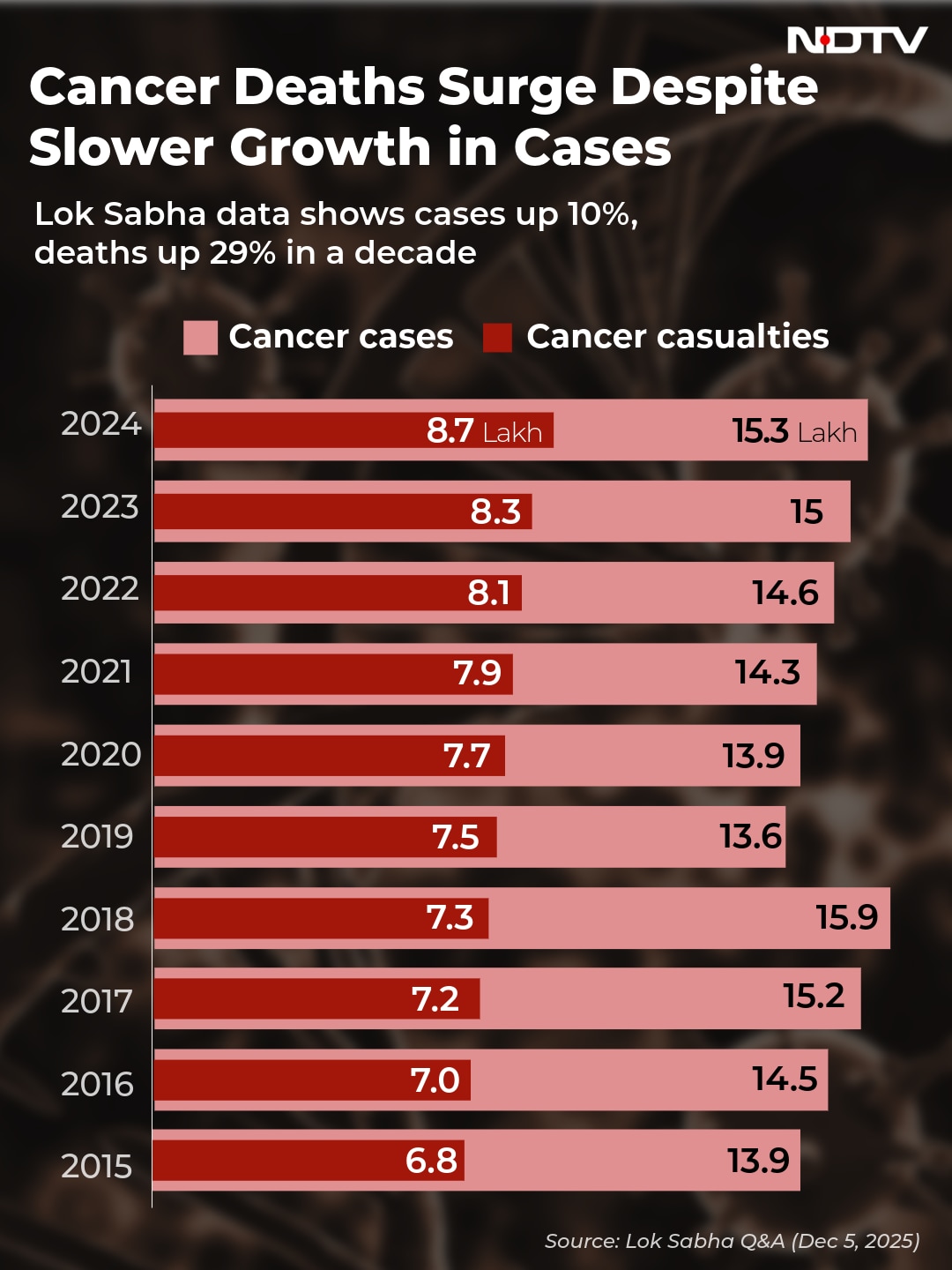
This pushed the mortality-to-incidence ratio from 49% in 2015 to 57% in 2024, meaning a larger share of diagnosed patients are dying now than a decade ago.
The same document cites data by the Global Cancer Observatory, International Agency for Research on Cancer (IARC), claiming that India accounts for the third-highest number of cancer cases globally. The estimated incidence of cancer cases in India (98.5 per lakh) is third after China (201.6 per lakh) and the United States of America (367 per lakh).
Trend Over Time
The time series shows a consistent upward trajectory in incidence through 2018, a notable dip in 2019, and then a gradual return to year-on-year growth till 2024.
State-Wise Burden: Sharp Per Capita Variations
In 2024, the national average stood at 109 cases per lakh population, but state-level figures varied sharply. The highest per capita cancer rates (that is, cases per lakh population) were recorded in Kerala (170) and Mizoram (169), followed by Andhra Pradesh (144), Karnataka (139), and Telangana (137). Urbanised and coastal states also show elevated rates with Tamil Nadu at 128, Delhi (131), Punjab (137), and Himachal Pradesh (127).
At the other end, low per capita figures were recorded in Daman & Diu (28), Dadra & Nagar Haveli (36), and Lakshadweep (46), with Manipur (69) and Tripura (69) also below the national average.
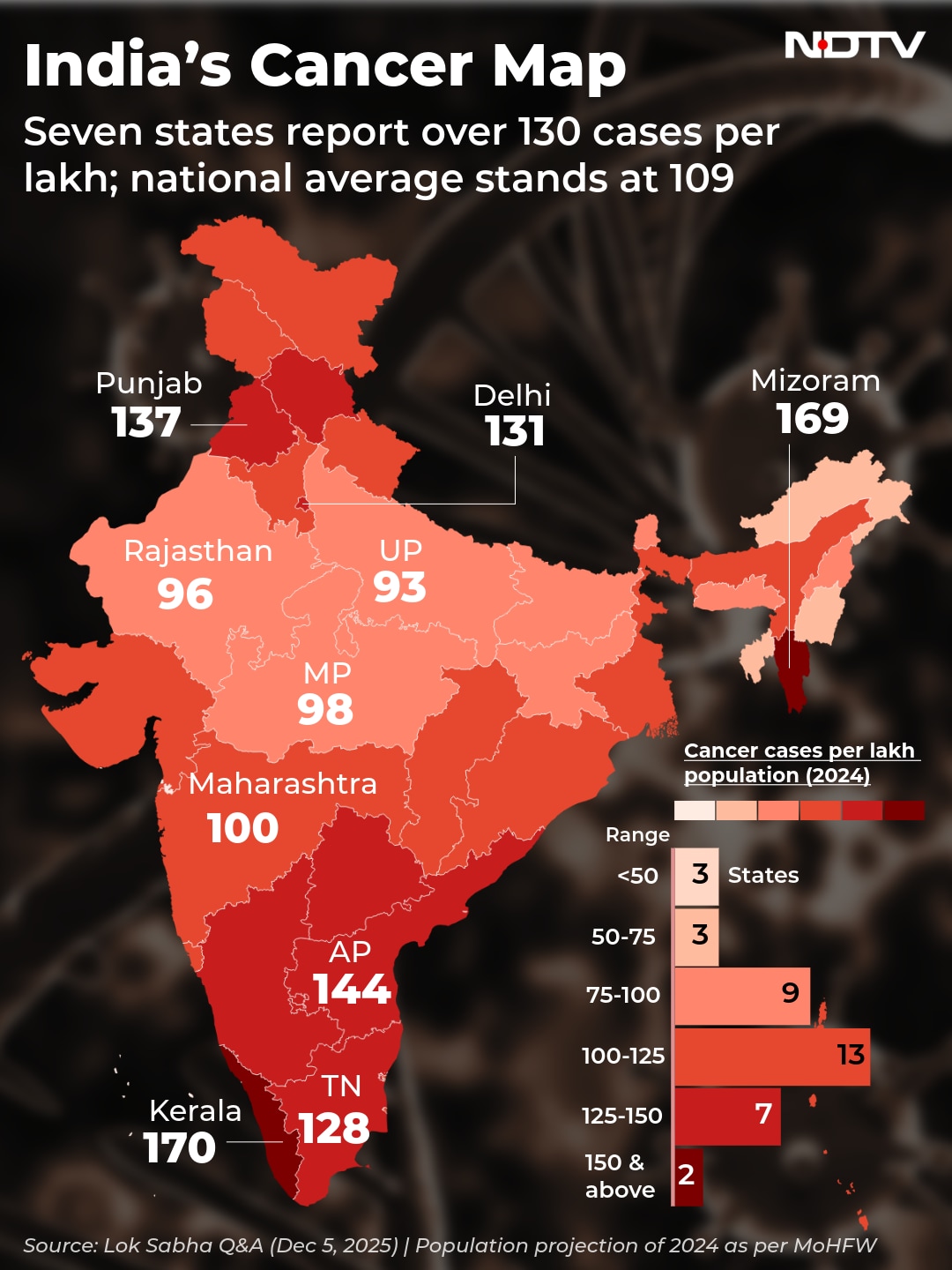
Large northern states, such as Uttar Pradesh (93) and Bihar (90), are below average in terms of per capita, but they contribute a huge absolute caseload. Uttar Pradesh reported 2.21 lakh cases, Maharashtra 1.28 lakh, West Bengal 1.19 lakh, and Tamil Nadu 98,386 cases in 2024. Together, these populous states accounted for a significant share of India's total burden.
The sharp rise in mortality compared to incidence signals gaps in early detection, treatment access, and affordability. As India's population ages and lifestyles change, cancer care infrastructure will need urgent strengthening to prevent this trend from worsening.
Disclaimer: This content including advice provides generic information only. It is in no way a substitute for a qualified medical opinion. Always consult a specialist or your own doctor for more information. NDTV does not claim responsibility for this information.