Countless narrow lanes with cafes, colourful storefronts and chic boutiques washed in soft yellow light and neon-lit pubs - all stacked one over the other like Jenga blocks. The buildings and lanes - with a maze of wires dangling over them and the competing sounds of live music from eateries and loud calls of hawkers and touts - are nearly jam-packed.
The scene could be from Hauz Khas Village, Humayunpur or Majnu ka Tila - some of Delhi's popular commercial hubs. But how would it shift if a fire breaks out?
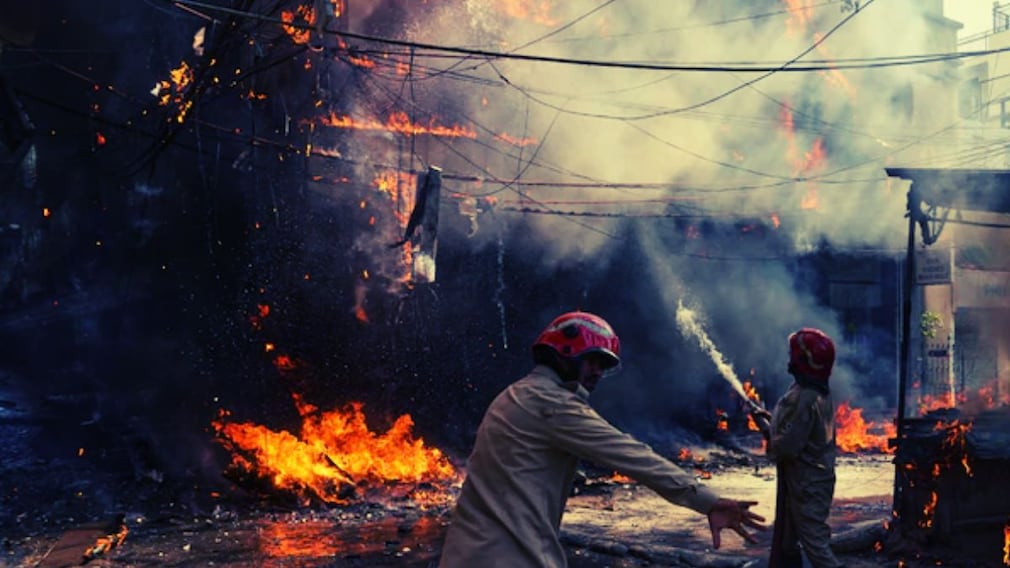
It has happened. Too many times to keep count, and too many times to ignore the reality of the tinderbox that these hotspots have become.
On October 24, 2025, NDTV's Prapti Upadhayay and her three friends were at Majnu Ka Tila celebrating personal milestones - two new jobs, a promotion and a PhD going well when the evening was briefly interrupted. By a cylinder blast.
A few months after this incident, the Delhi High Court directed authorities to take "appropriate action" against several cafes, bars, and restaurants in Majnu Ka Tila allegedly operating without sanctioned building plans and fire safety measures. The order came around the same time as a fire at a nightclub in Goa killed 25 people, a tragedy where the fatalities were attributed to a single entry-exit point, narrow lane access, and absent fire clearances. These are not Goa's problems alone. They define several commercial establishments in Delhi as well. Most share a single narrow staircase between multiple floors. All of them, poster bearers of a tragedy in waiting.
And Delhi has seen several of them.
December 8, 2019: Anaj Mandi
Forty-three people were killed and 56 injured after a fire broke out at an illegal shoe and schoolbag factory in a residential area in Anaj Mandi. The building had no fire licence, and there were iron grilles blocking entry. Rescue personnel needed gas cutters to get in. Most victims were labourers sleeping inside.
December 23, 2019: Kirari
Nine dead in a fire at a cloth godown. Reason: short circuit and no proper exits.
May 13, 2022: Mundka
Twenty-seven dead in a four-storey commercial building near Mundka Metro station. Reason: Short circuit, no fire exits, no fire extinguishers. It took officials nine hours to douse the fire.
February 15, 2024: Alipur
Eleven dead at a paint factory after a chemical explosion. What led to the scale of the tragedy: No proper exits, fire spread to an adjacent drug rehabilitation centre.
And then the tragedy, which renewed calls for safety audits yet again:
June 3, 2026: Hauz Rani, Malviya Nagar
Twenty-three people died after a fire broke out at a bed and breakfast establishment - licensed for six rooms, operating 25, with even the basement being used for accommodation. There was only a single entry-exit point. Several foreign nationals were among the dead. Initial investigations pointed to multiple fire safety violations and significant shortcomings in the building's safety measures.
Since 2019, 543 people have lost their lives in the city due to fire tragedies. Tracing back to 2016, the figure rises to more than 800, according to Delhi government data. In the first half of 2026 alone, more than 60 deaths in fire accidents have been reported.
In the first half of 2026 alone, more than 60 deaths in fire accidents have been reported
The City That Grew Faster Than Its Rules The Hauz Rani tragedy prompted authorities to announce a citywide enforcement drive targeting hotels, lodges, nursing homes, coaching centres, restaurants and other commercial establishments. Officials said premises violating safety norms could face closure, sealing and legal action.
However, if all fire rules were applied in Delhi tonight, its most beloved commercial hubs would shut down.
Many of Delhi's most vibrant commercial neighbourhoods evolved in areas never designed to handle their current density - urban villages such as Hauz Khas Village, Humayunpur, Shahpur Jat and Saidulajab, coaching clusters such as Mukherjee Nagar and Rajendra Nagar, and mixed-use markets operating out of converted residential buildings. And most of these areas come under Lal Dora.
Read | Body In Wheelchair, Couple's Last Hug: The Human Face Of Delhi Hotel Tragedy
The name Lal Dora comes from a colonial-era practice in which a red thread was used to separate abadi (residential) areas from agricultural plots by the land revenue department. This marking gave abadi areas immunity from the jurisdiction of municipal authorities and, by consequence, urban development plans. These areas are now Delhi's urban villages.
Several studies, including those by the Delhi School of Planning and Architecture and DUAC, indicate that villages like Zamrudpur, Mohammadpur, Shahpur Jat, Kotla Mubarakpur, Hauz Rani, Hauz Khas, Zia Sarai, Kalu Sarai, Katwaria Sarai and Yusuf Sarai have grown from 300-600 buildings to 10,000-15,000 buildings of up to seven floors in the last thirty years, said AK Jain, former Chief Town Planner of the Delhi Development Authority.
"These have overstressed services and civic amenities to a breaking point," he said.
Sandip Anand Goyal, Delhi Chapter Head of the National Restaurant Association of India, said areas such as Hauz Khas Village, Shahpur Jat and other Lal Dora pockets underwent gradual commercialisation as Delhi expanded. "These areas did not emerge overnight. They evolved over time as demand for business opportunities grew and authorised commercial spaces remained limited."
The rapid commercialisation, he acknowledged, "is well known to the government, planning authorities and administrators."
Humayunpur And A Fire Safety NightmareA case in point is Humayunpur - arguably Delhi's most popular pincode for north-eastern cuisine, and also a hostel district for the migrant population from the north east. It is defined by tightly packed buildings with shared staircases, paying guest accommodation above restaurants, extensive electrical load from kitchens and air conditioning, and extremely narrow lanes.
Days after the Hauz Rani fire, the Municipal Corporation of Delhi (MCD) pasted sealing notices outside more than 20 establishments in Humayunpur. Things were largely back to normal when Upadhayay visited the market on Saturday, June 27.
Humayunpur: Delhi's most popular pincode for north-eastern cuisine.
Photo Credit: Prapti Upadhayay
She asked people why they keep returning despite the safety risks.
"What brings me back is the food. And far away from home, I get a homely feel from this place," said Priya, from north-east India, who is doing her PhD at Delhi University.
For a 23-year-old woman student in Delhi, women's safety occupies her mind more than fire. "Basic women's safety concerns me when I visit a place, whether it feels safe in terms of the kind of people who will be there, not whether there is going to be a fire," she said. Then she paused and added: "With the rate at which fires are happening, it should be the first thought. But then there would be no establishments left to go to."
Twenty-four-year-old MBA student Shivam, name changed, said fire safety is not something he thinks about when picking a restaurant. "If I love the place, I will go anyway. If anything, I think about earthquakes more than fire."
All three said they were fine with the government shutting down every non-compliant establishment. "Human life is more important than anyone's business," said Shivam.
The Rule That Makes Compliance ImpossibleFire Department PRO Rajinder Atwal said the department makes no distinction between Lal Dora and other areas for fire safety checks. Then he listed the conditions under which a fire NOC cannot be issued.
"The department does not issue an NOC to an establishment if it doesn't have a 6-metre road. Even if it complies with all other requirements."
Most establishments in the narrow lanes of Delhi's urban villages would fail here. Most of them are not 6 metres wide. They will not become 6 metres wide without demolishing the establishments that line them.
"Multi-story buildings should not have just a single staircase. The fire department does not issue an NOC to such buildings if they lack two staircases," Atwal said.
An anonymous MCD official, when asked how many commercial establishments in urban villages are operating without completion certificates, said: "No such details are available."
The Racket That Fills The Gap
When compliance is structurally impossible, a parallel system steps in.
A restaurant owner in south Delhi, who requested anonymity, described it plainly. "There are liaison officers who manage all your licensing for a fee, between one and three per cent of the restaurant's investment, depending on how well you negotiate. It is never just one licence. Each department has its own process, its own people. The liaison officer talks to their contacts, who talk to someone else's contacts. There is no ease of doing business. There is just a chain of commissions, and you are at the end of it."
Hauz Khas on a weekend.
Photo Credit: Prapti Upadhayay
The story is not unique to Delhi. A former restaurant owner who ran four outlets across Mumbai's western suburbs before shutting during Covid described a system structurally identical in its dysfunction. "Laws in India are not designed keeping in mind the active situations. They are often designed by a bureaucrat who has little to no idea about fire safety." Where compliance is physically impossible, he said, documentation is manufactured instead, an empty shell of a door installed on a wall, photographed, and attached to the compliance file as proof of a fire exit. "In the unfortunate incident of a fire where lives are lost, the officer can wash his or her hands off, saying the door was present, and the restaurant owner then blocked the door or made a wall for whatever reason."
The south Delhi restaurant owner, whose building he claims is fully compliant - two floors, two staircases, thirty extinguishers against the required twenty - is an exception. But he pointed to an issue that restaurant owners can't fix: "The streets in areas like Hauz Khas are narrow. There is encroachment everywhere, and that is not the restaurant owner's responsibility to fix."
Is There A Fix?
Rajiv Babbar, DDA member, political wing, stressed, "Master Plan Delhi 2041 is expected to address several challenges relating to urban villages, infrastructure and future development."
"When it comes to commercial hubs and urban villages, where development has been driven by growing business activity and commercial demand, safety enforcement requires special attention. We have 23 agencies working in Delhi and all enforcement agencies need to work together. Better coordination is essential to prevent such incidents and ensure compliance with safety norms."
AK Jain said the answer lies in treating urban villages not as violations to be punished but as settlements to be upgraded - through in-situ improvement, cooperative redevelopment, plot amalgamation, and road widening done incrementally with community participation. "It is not only about housing, but building dignity, memory and identity within the urban fabric," he said.
But that is a long-term answer to an immediate reality.
After every fire, the same cycle: announcement of audits, promises of enforcement, sealing notices on a handful of establishments, and then things return to normal gradually. Every post-fire audit promise is made in the knowledge that full enforcement would shut down the neighbourhoods that define Delhi's identity as a city.
Meanwhile, in one of the busy Delhi hotspots, diners continue to climb narrow staircases long after sunset.
(With inputs from Ishika Verma, Ravish Ranjan)