How Batman: The Animated TV Series Predicted Modern AI In 1992
Long before ChatGPT and AI agents, Batman was already asking the questions the world is debating today.
Long before ChatGPT and AI agents, Batman was already asking the questions the world is debating today.
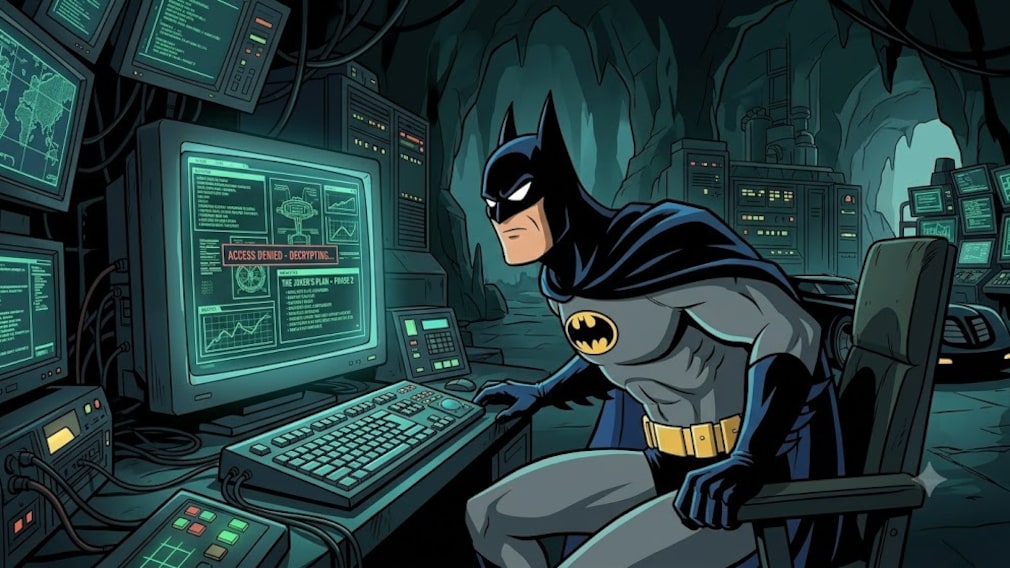
The year is 1992. Long before AI became a household term, Batman aka Bruce Wayne talks to his trusted butler Alfred about artificial intelligence (AI).
"I'm talking about AI, artificial intelligence, the missing link between computers and human thought," the Caped Crusader tells Alfred.
This is an actual scene from the two-part episode Heart of Steel from Batman: The Animated Series, which aired in November 1992. Bruce Wayne describes AI in terms that sound strikingly close to how we think about the technology today, more than three decades later.
Alfred asks: "You mean, machines that think?"
Batman replies: "Yes, and with a will of their own. They could process raw data a million times faster than we, yet still be able to make the leaps of intuition that inspired our greatest minds."
Looking back from 2026, that description feels remarkably familiar. Today's leading AI systems from companies like OpenAI, Anthropic and Google DeepMind can already analyse vast amounts of information in seconds, write software, solve complex scientific problems, generate realistic images and videos, and increasingly tackle tasks that once seemed to require uniquely human reasoning. The newest generation of AI agents can even plan and execute multi-step tasks with minimal human supervision.
Whether AI could ever develop consciousness or genuine free will remains one of the biggest and most contested questions in the field. AI systems' growing ability to reason, plan and make decisions has, in fact, sparked fresh debates about where AI is headed next. So yes, even the "will" part is very much in the modern discourse.
Flashing back to the 1992 episode, Alfred responds with his trademark dry wit: "Sounds as if the human race would become quite expendable. Except for butlers, of course."
Batman replies "of course," with a straight face.
That exchange, written more than 30 years ago, sounds surprisingly close to conversations happening today.
Tech mogul Elon Musk has predicted that AI could eventually become so capable that "probably none of us will have a job." Instead, he suggested work could become optional, with people choosing jobs only if they wanted personal satisfaction.
He's not alone.
Dario Amodei, CEO of Anthropic, has warned that AI could eliminate up to half of entry-level white-collar jobs within the next five years if society is unprepared. Jensen Huang has said AI won't simply replace people, but people who use AI are likely to replace those who don't. Meanwhile, Sam Altman has repeatedly argued that AI will transform the nature of work, even if entirely new jobs eventually emerge.
The disruption is already beginning to show.
Technology companies across the globe have announced thousands of layoffs over the last couple of years as they race to do "AI restructuring." Global giants such as Meta, Microsoft, Google and Amazon are investing billions of dollars into AI infrastructure while increasingly automating coding, customer support, content creation and other knowledge work.
Unsurprisingly, workers are worried. A recent Reuters/Ipsos poll found that a majority of respondents fear AI will reduce employment opportunities and make many professions less secure over the coming years. Even those optimistic about AI's benefits increasingly acknowledge that the transition could be painful for millions of workers.
Coming back to animated TV series, 'The Simpsons' is incredibly famous for its uncanny ability to predict real-world events years or even decades before they happen. Over the last four decades, The Simpsons has become famous for predicting everything from video calls and smartwatches to autocorrect, smart homes and even Donald Trump's presidency.
Truth, they say, can sometimes be stranger than fiction. But in this case, fiction may have paved the way for truth. Strange and fascinating, either way.
-
Opinion | Visa Shocks To Racist Attacks, When Did America Come To Hate Indians So?

Sometimes it is about H-1B visas. Sometimes it is jobs. Sometimes it is "foreigners." Sometimes it is about temples. The language of the attack varies, but the message is consistent
-
How El Nino And Warming Oceans Could Shape Earth's Climate In 2027
From changing ocean currents to extreme weather, scientists are watching a combination of climate signals that could influence temperatures, rainfall and ecosystems in the months ahead.
-
Blog | Nana Patekar, And The Sharp, Lasting Sting Of His 'Plain-Speak'
"Subah ghar se niklo, bheed ka hissa bano..." Nana Patekar's characters often spoke with the bluntness of men who had little patience for pretence. Just like Nana himself.
-
Opinion | Pakistan's Saudi Pact Is Now Entering Dangerous Territory - As Expected
On October 5, the ministers of the pact's member states met in Riyadh for an emergency session and agreed to move to a 'practical implementation' of the defence commitments.
-
Hindu ka khoon-Musalman ka khoon? Nana Patekar's Krantiveer Questions Still Hang
Krantiveer was released in 1994, after the communal violence that had scarred Bombay and other parts of India. Nana's voice carried the pain of every riot, every broken home
-
'SIR' In America Too? India Cue In Trump's Mass Citizenship Check For Voters
Having got the nod from the US Supreme Court, Donald Trump's push for a voter roll "cleanup" puts citizenship at its centre. Arguments for India's Special Intensive Revision (SIR) have also centred on "illegal immigrants". Data remains scarce. Let's map the similarities and the nuance.
-
Opinion | Gyanesh Kumar Row May Be Doing Something Unthinkable For India's 'Lost' Opposition
There seems to be a greater willingness within the Opposition to accept Rahul Gandhi's leadership, at least on the SIR controversy. But the INDIA bloc itself seems to be undergoing a strange renewal.
-
Opinion | flydubai Hijack, And How Syria's Descent Into 'Jihadism' Has Now Become Everyone's Problem
Al Hammimi, the Omani pilot who tried to crash a plane with 175 passengers on September 30, is a symptom of Syria's long-raging sectarian and extremist fire that has now reached far beyond Syria's borders.
-
"Feel Deeply Abandoned By World": Tales Of Loss And Separation From Gaza
For Gazans, who have lived through the horrors of the last three years, life means a continuing encounter with impermanence and the repeated discovery that a home, a friendship, a livelihood, a familiar life and even one's former self can become things that exist only in memory.