US' $240 Million Drone Over Cuba That's Strangling China's Oil Supply
From Venezuela to Hormuz to Malacca, the US has made three moves to strangle China's oil. Now a $240M drone over Cuba signals move four — and Trump wants the island. The chessboard is almost complete.
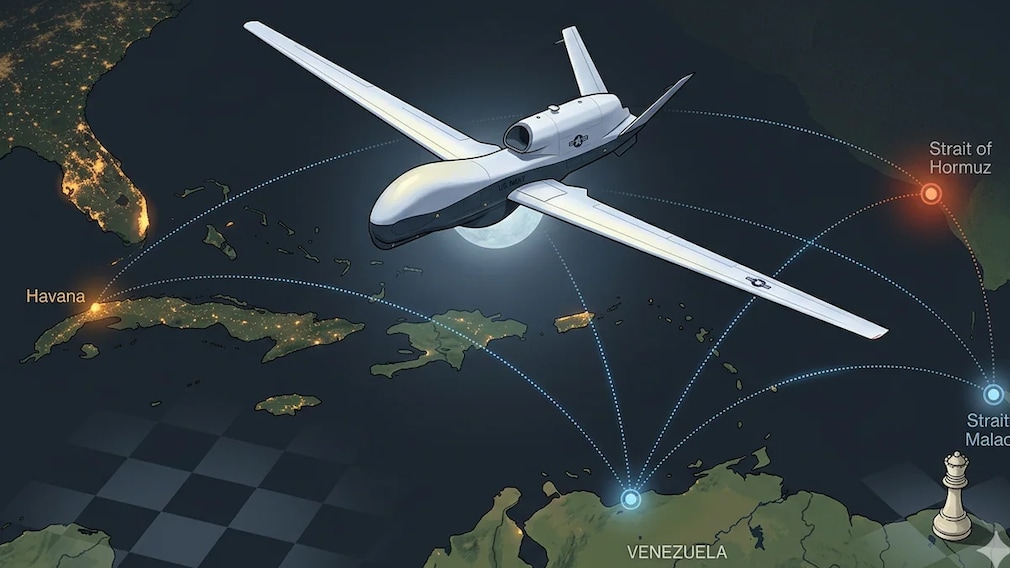
Somewhere above the deep, dark Caribbean Sea, at altitudes commercial jets cannot reach, a winged beast - as large as a Boeing 737 - drew lazy patterns in the night sky. It didn't have weapons. It didn't need any. It was the weapon.
The US Navy's MQ-4C Triton surveillance drone - callsign BLKCAT6 - is a US$240 million machine that can stay airborne for over 24 hours and has a 55,000+ feet operational ceiling. And it conducted extensive reconnaissance off Cuba this week.
Open-source flight tracking data caught it loitering off Havana Wednesday evening. Hours earlier it was monitoring the nearly 200 km-wide strait between Cuba and Jamaica - a key shipping route linking the Panama Canal to the Atlantic Ocean.
The Jamaica Channel, they call it, and it seems the US just made its fourth move on an oil-slicked chessboard linking Cuba, Venezuela, Iran, the Strait of Malacca… and China.
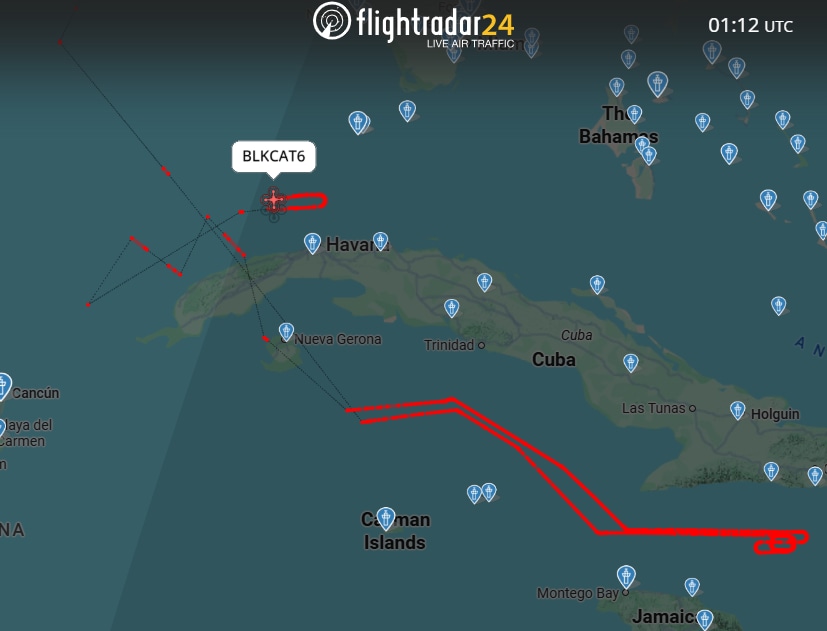
The drone flight map over Cuba. Image posted on X by @Osinttechnical
'China chokepoint calculus'
First, and this is important. Allowing a recon drone's flight path to appear on an open-source network was not an accident. It was a deliberate move, a 'we're watching' message to Beijing.
Second, given the MQ-4C's orbit, it likely also tracked the Windward Passage and Yucatan Channel. These, combined with the Jamaica Channel, are major Caribbean shipping routes.
But their value is not in volume of crude.
Venezuela-China oil shipments have dried up since the US seized the latter's 303+ billion barrels in January. Special forces kidnapped President Nicolas Maduro and installed his deputy, Delcy Rodriguez, who opened them to Washington.
Beijing pivoted to Russia; Jan-Feb 2026 imports from Moscow rose to 40.9 per cent YoY.
The US' second move - queen to Iran and Tehran's Hormuz blockade - plugged between 40 and 45 per cent of China's daily crude demand, though flow has stuttered rather than stopped. With the Israel-Lebanon ceasefire now in effect that flow could increase, but US warships in the GUlf of Oman will still likely play gatekeeper, particularly for China-flagged vessels.
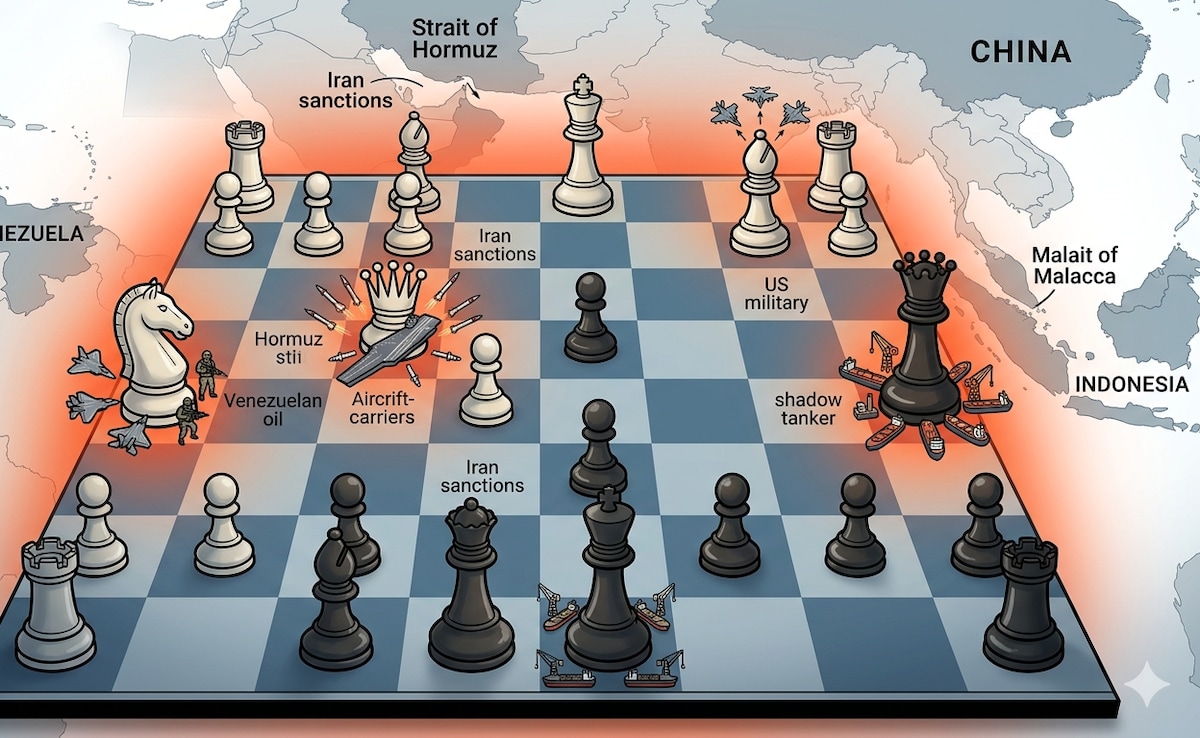
The Venezuela, Iran, Malacca Strait chessboard. Image generated by AI
And the third - bishop to Indonesia, to secure Malacca surveillance - means the US can tighten pressure on China's eastern flank, a route that supplies 80 per cent of its seaborne crude flows.
That underscored Beijing's 'Malacca dilemma' fears.
Move 1, 2, 3: Noose Tightens
Taken together, Venezuela, Iran, and Malacca emphasise what experts have been hinting at since early-2026 - the US is building coercive architecture around China's oil supply.
Malacca Gambit: How China Oil-Choke Strategy Could Backfire On Trump
Beijing has significant reserves, among the largest in the world, a large and diverse list of crude suppliers, and a network of pipelines running through Russia, Central Asia, and Pakistan.
But in a chokepoint scenario these buy time not immunity, though with the latter China could fashion escape routes, either by identifying alternate sources or via diplomatic or economic counterpressure. And its strong message of support to Cuba - reeling under an energy blockade after the US cut off Venezuela supply - offers an insight into what Beijing is planning.
"China expresses its deep concern and opposition to the US' actions on Cuba," its foreign ministry said back in January.
After that China began running fuel to the island.
US knight to Cuba, to control Caribbean sector
Cuba is the US' fourth move. The value of the Caribbean passages is strategic.
Control over the Caribbean means the US can deter Chinese presence and 'shadow tankers' and also extend surveillance and military coverage off its southern coast, specifically Florida.
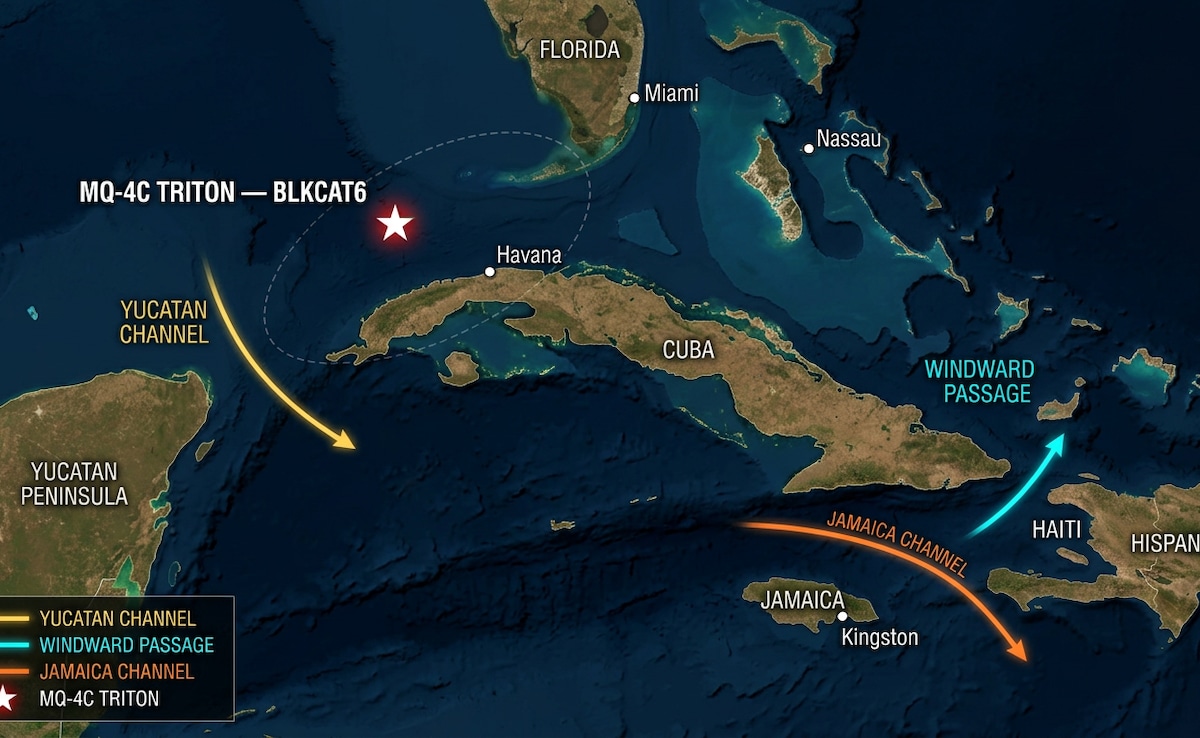
The Caribbean region and the three shipping channels. Image generated by AI
It will also eliminate Chinese local electronic counterintelligence posts, like the one in Bejucal, a small town roughly 30km inland from Havana, and which the MQ-4C was likely also tracking.
The strategic upgrade is significant. A drone can watch but a base offers a military threat to all Chinese ships in the area.
"I could do anything I want with it," Donald Trump said in March. He almost has it. His blockade has Cuba on its knees, except for China, for now. And that suggests a flip of the likely MQ-4C tasking - 'shadow tankers', yes, but carrying fuel to Cuba.
-
MK Stalin: The Boy From Chennai's Marina Beach

From a naming ceremony on Chennai's Marina Beach in 1953 to Tamil Nadu Chief Minister - this is the story of Muthuvel Karunanidhi Stalin, the DMK, and the 2026 election.
-
NTR, MGR, Jayalalithaa, Rajinikanth, Pawan Kalyan - Vijay, Respectfully, Is None Of Them
Vijay is unlike anything Tamil Nadu has ever seen. Comparing him to other star-turned-politicians is tempting, but unfair.
-
From Climbing On JP's Car To Ousting Left: Mamata Banerjee's Bengal Journey
Mamata Banerjee's political journey is a testament that she is at her most ferocious when she faces a difficult battle
-
Opinion | 35 US Lawmakers Just Moved A Bill That Could Upend Indian Techies' Careers
For years, Indian students going to America have followed a set path: F-1 student visa, then OPT, and later an H-1B visa. That may soon be off the table, thanks to a group of American lawmakers.
-
Opinion | Iran May Be Doing With Its Nukes What Another 'Rogue' Regime Did 20 Years Ago
A rogue state got away with its nuclear weapons programme decades ago, defying all sanctions. Iran may be going down the same path.
-
UAE Quits OPEC: What It Means For India's Oil Prices, Fuel Bills
Being able to deal with the UAE as a separate seller should give India the chance to re-adjust risk levels and pricing, particularly if some volume of crude is routed via overland pipelines to bypass the Hormuz blockade.
-
Opinion | If Mamata Banerjee Wins Again, It Might Be Only Because Of One Particular Group
Anyone familiar with the recent political and electoral history of West Bengal knows that while the BJP has done extremely well in north Bengal, it has so far failed to breach the Mamata citadel of south Bengal.
-
Opinion | Pak Is Finally Back In Middle East's 'Good Books'. But Can It Stay There?
This is both an enviable and challenging space to be in for the only Islamic nation in the world that has nuclear weapons.
-
Opinion | Can Saudi Arabia, Now Alone At The Top, Manage To Keep Oil Stable?
With the UAE's exit, Saudi Arabia will remain the only swing producer in the cartel to deal with market shocks. Can it fulfil that role alone?