US' $240 Million Drone Over Cuba That's Strangling China's Oil Supply
From Venezuela to Hormuz to Malacca, the US has made three moves to strangle China's oil. Now a $240M drone over Cuba signals move four — and Trump wants the island. The chessboard is almost complete.
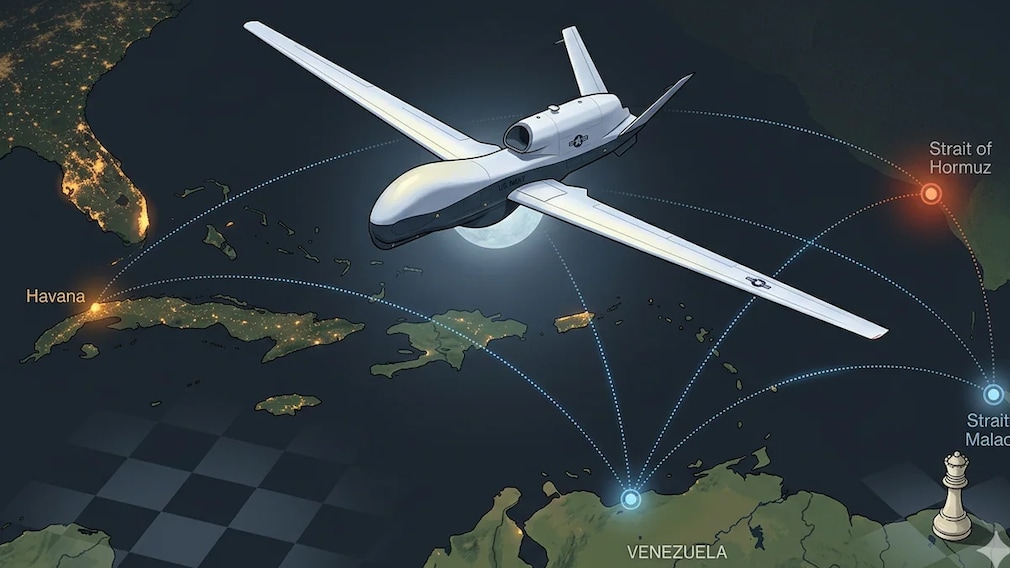
Somewhere above the deep, dark Caribbean Sea, at altitudes commercial jets cannot reach, a winged beast - as large as a Boeing 737 - drew lazy patterns in the night sky. It didn't have weapons. It didn't need any. It was the weapon.
The US Navy's MQ-4C Triton surveillance drone - callsign BLKCAT6 - is a US$240 million machine that can stay airborne for over 24 hours and has a 55,000+ feet operational ceiling. And it conducted extensive reconnaissance off Cuba this week.
Open-source flight tracking data caught it loitering off Havana Wednesday evening. Hours earlier it was monitoring the nearly 200 km-wide strait between Cuba and Jamaica - a key shipping route linking the Panama Canal to the Atlantic Ocean.
The Jamaica Channel, they call it, and it seems the US just made its fourth move on an oil-slicked chessboard linking Cuba, Venezuela, Iran, the Strait of Malacca… and China.
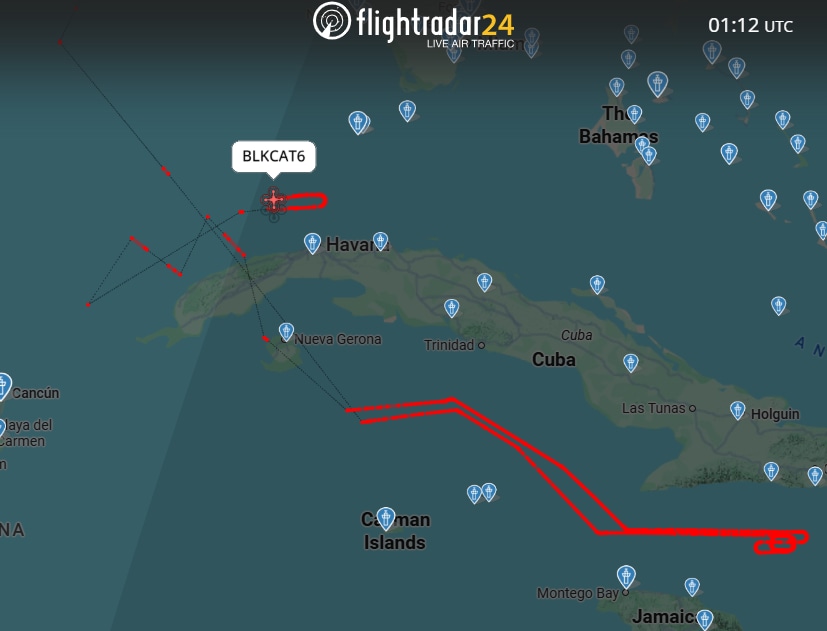
The drone flight map over Cuba. Image posted on X by @Osinttechnical
'China chokepoint calculus'
First, and this is important. Allowing a recon drone's flight path to appear on an open-source network was not an accident. It was a deliberate move, a 'we're watching' message to Beijing.
Second, given the MQ-4C's orbit, it likely also tracked the Windward Passage and Yucatan Channel. These, combined with the Jamaica Channel, are major Caribbean shipping routes.
But their value is not in volume of crude.
Venezuela-China oil shipments have dried up since the US seized the latter's 303+ billion barrels in January. Special forces kidnapped President Nicolas Maduro and installed his deputy, Delcy Rodriguez, who opened them to Washington.
Beijing pivoted to Russia; Jan-Feb 2026 imports from Moscow rose to 40.9 per cent YoY.
The US' second move - queen to Iran and Tehran's Hormuz blockade - plugged between 40 and 45 per cent of China's daily crude demand, though flow has stuttered rather than stopped. With the Israel-Lebanon ceasefire now in effect that flow could increase, but US warships in the GUlf of Oman will still likely play gatekeeper, particularly for China-flagged vessels.
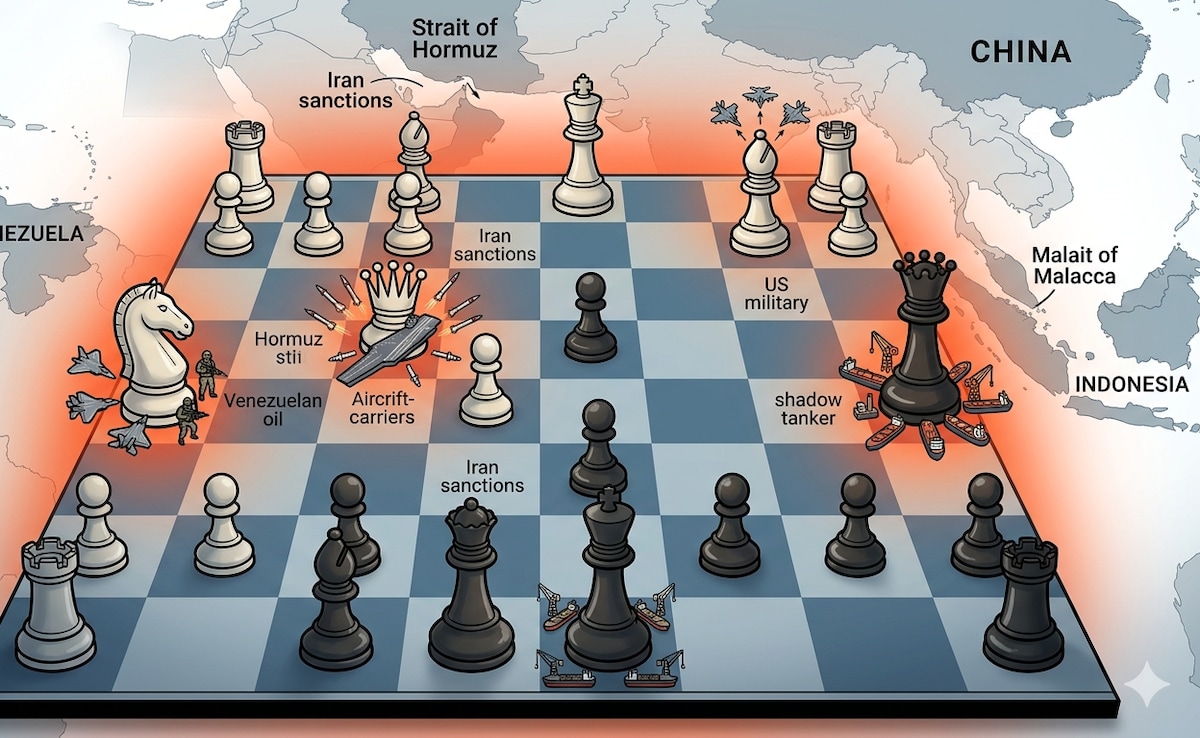
The Venezuela, Iran, Malacca Strait chessboard. Image generated by AI
And the third - bishop to Indonesia, to secure Malacca surveillance - means the US can tighten pressure on China's eastern flank, a route that supplies 80 per cent of its seaborne crude flows.
That underscored Beijing's 'Malacca dilemma' fears.
Move 1, 2, 3: Noose Tightens
Taken together, Venezuela, Iran, and Malacca emphasise what experts have been hinting at since early-2026 - the US is building coercive architecture around China's oil supply.
Malacca Gambit: How China Oil-Choke Strategy Could Backfire On Trump
Beijing has significant reserves, among the largest in the world, a large and diverse list of crude suppliers, and a network of pipelines running through Russia, Central Asia, and Pakistan.
But in a chokepoint scenario these buy time not immunity, though with the latter China could fashion escape routes, either by identifying alternate sources or via diplomatic or economic counterpressure. And its strong message of support to Cuba - reeling under an energy blockade after the US cut off Venezuela supply - offers an insight into what Beijing is planning.
"China expresses its deep concern and opposition to the US' actions on Cuba," its foreign ministry said back in January.
After that China began running fuel to the island.
US knight to Cuba, to control Caribbean sector
Cuba is the US' fourth move. The value of the Caribbean passages is strategic.
Control over the Caribbean means the US can deter Chinese presence and 'shadow tankers' and also extend surveillance and military coverage off its southern coast, specifically Florida.
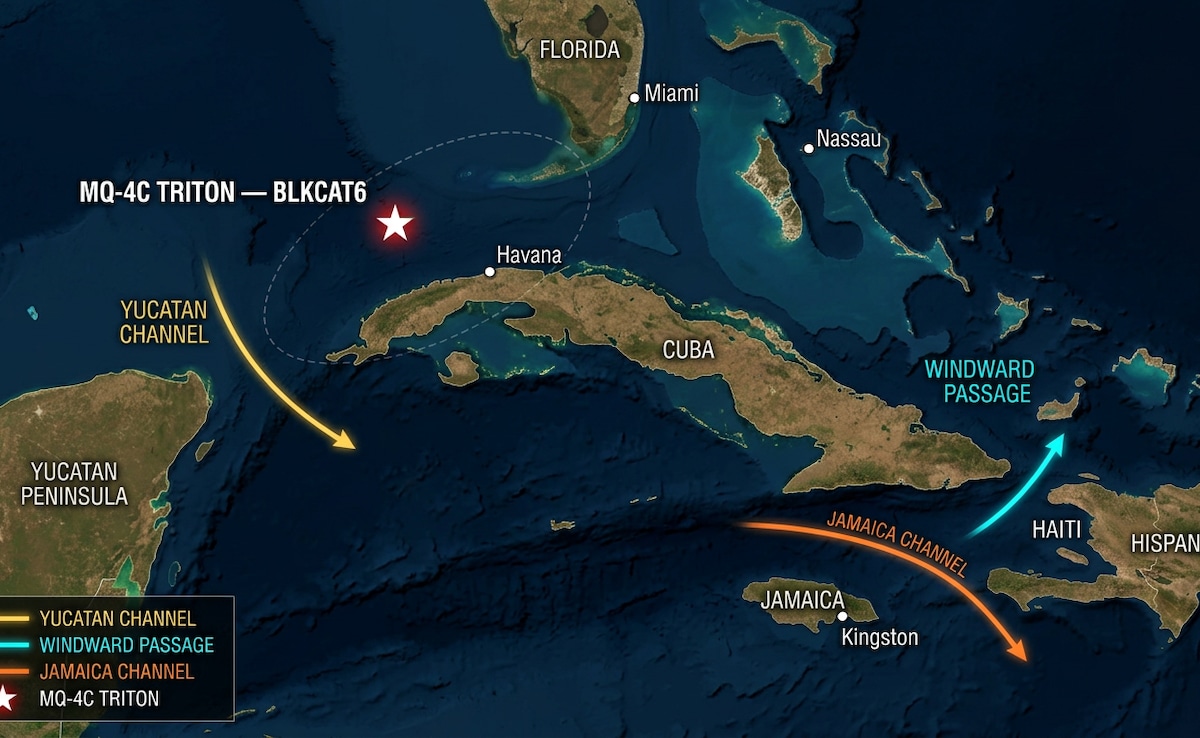
The Caribbean region and the three shipping channels. Image generated by AI
It will also eliminate Chinese local electronic counterintelligence posts, like the one in Bejucal, a small town roughly 30km inland from Havana, and which the MQ-4C was likely also tracking.
The strategic upgrade is significant. A drone can watch but a base offers a military threat to all Chinese ships in the area.
"I could do anything I want with it," Donald Trump said in March. He almost has it. His blockade has Cuba on its knees, except for China, for now. And that suggests a flip of the likely MQ-4C tasking - 'shadow tankers', yes, but carrying fuel to Cuba.
-
Blog: Kolkata Didn't Learn From 2015. Eleven Years Later, It Proved To Be Fatal

The City of Joy isn't a stranger to crowd control. Be it during Pujo or Christmas at Park Street, Eden Gardens cricket matches, or Derbies between Mohun Bagan and East Bengal. But during Pujo, the entire city is on alert.
-
Opinion | Slurs, Threats, Now A Temple Attack Plot: When Did America Become So Hostile To Indians?
The rising tide of anti-India, anti-Hindu, and racist attacks serves as a stark reminder that economic prosperity does not automatically guarantee social immunity from bigotry.
-
A Step Behind Neha Bora: What Rahul Gandhi's Gesture Says About Congress' Gen-Z Pitch
At INDIA bloc's march to Supreme Court, Rahul Gandhi placed himself a step behind two women, hands resting on their shoulders. One was his sister Priyanka. The one on his right was Neha Bora. Here's what the image means for the protest wave now, and for Rahul's politics in general.
-
Opinion | Imran Khan, And The Perils Of Having An 'Opinion' In Bollywood
The reality of the industry is quite grimy. More often than not, its inhabitants have been fairweather friends, happy to sing the praises of whoever is in a position of authority.
-
Exclusive: India's Food Safety Problem Goes Beyond Just Dirty Kitchens - By Tukaram Mundhe
On World Food Day, Maharashtra's Commissioner of Food Safety explains why instead of taking stopgap measures, the entire supply chain in India needs to be held accountable and made transparent.
-
Opinion | India Has Enough Coal. So Why Are Power Plants Running Short? A 76 Million 'Crunch'
As of October 5, as many as 82 of the 191 thermal plants monitored by the Central Electricity Authority were in the 'critical' category
-
Opinion | Starlink, India, And Why Elon Musk Must Know His Billionaire Tantrums Won't Work
India should neither be intimidated by Musk's global influence nor distracted by his theatrics.
-
Blog | 'Baap Da Brat': Kerala Mini Cooper Crash, And Why 'Daddy' Can't Keep Saving You
There are three things you should never underestimate in India: the power of 'jugaad', the elasticity of the law, and the confidence of a 'Baap da Brat' who believes his Papa Posh can fix absolutely anything.
-
Opinion | 'Say Our Name': Why A Tiny Island Nation Wants The World To Get Its Name Right
Standing before the UN hall of nations, Naoero President David Adeang asked the world to unlearn its comfortable habits and speak a restored truth.
-
TVS Succession Row Explained: Why Venu Srinivasan's Family Is Divided Over Wealth
TVS Family Dispute: TVS Holdings is a key entity because it owns a controlling stake in TVS Motor Company. It owns 50.26% of TVS Motor.