UAE Quits OPEC: What It Means For India's Oil Prices, Fuel Bills
Being able to deal with the UAE as a separate seller should give India the chance to re-adjust risk levels and pricing, particularly if some volume of crude is routed via overland pipelines to bypass the Hormuz blockade.
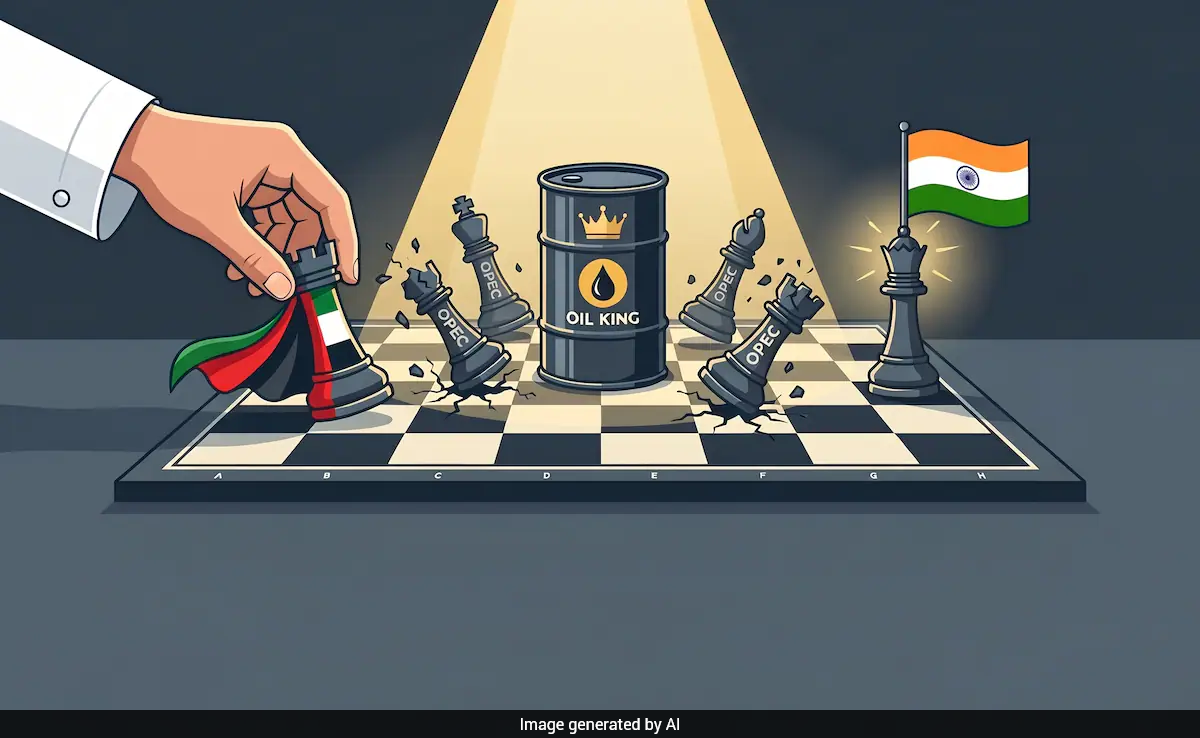
The UAE will leave OPEC and OPEC+ - the world's largest oil-producing blocs, which control 40-50 per cent of global output and influence prices through production quotas - from May 1, the country's state-run WAM news agency said this week.
Exiting OPEC will allow it to delink from 'restrictive' quotas to offset the sharp drop in global supply due to the war. Bloc members are capped at 3.4 million barrels of crude per day but the UAE has an installed capacity at nearly five million.
That increased production should eventually translate into price cuts, and India is among countries looking to benefit, particularly with Delhi looking to diversify import sources to offset global uncertainty and US pressure on Russian purchases.
Overall, the move has consequences for energy markets and net importers like India, though the short-term impact will likely be muted because of continuing supply constraints amid the war in Iran and the UAE's gradual, rather than sharp, rollout.
The most significant, impact, though, will be likely be long-term. Analysts have warned of a 'structural weakening' of OPEC's ability to influence global supply and, therefore, prices. Delinked UAE production could, from one angle, lead to more volatility.
Why UAE quit OPEC, OPEC+
Abu Dhabi announced its exit against turmoil in the global energy trade brought on by the US and Israel's war on Iran; fighting that began February 28 spread quickly to Gulf countries as oil and gas fields, refineries, and depots, were targeted.
UAE energy sites were hit - despite American air defence cover - by Iran, including the Ruwais refinery that can process 922,000 barrels of crude daily, the Fujairah Port that is a critical export terminal, and the Habshan gas fields.
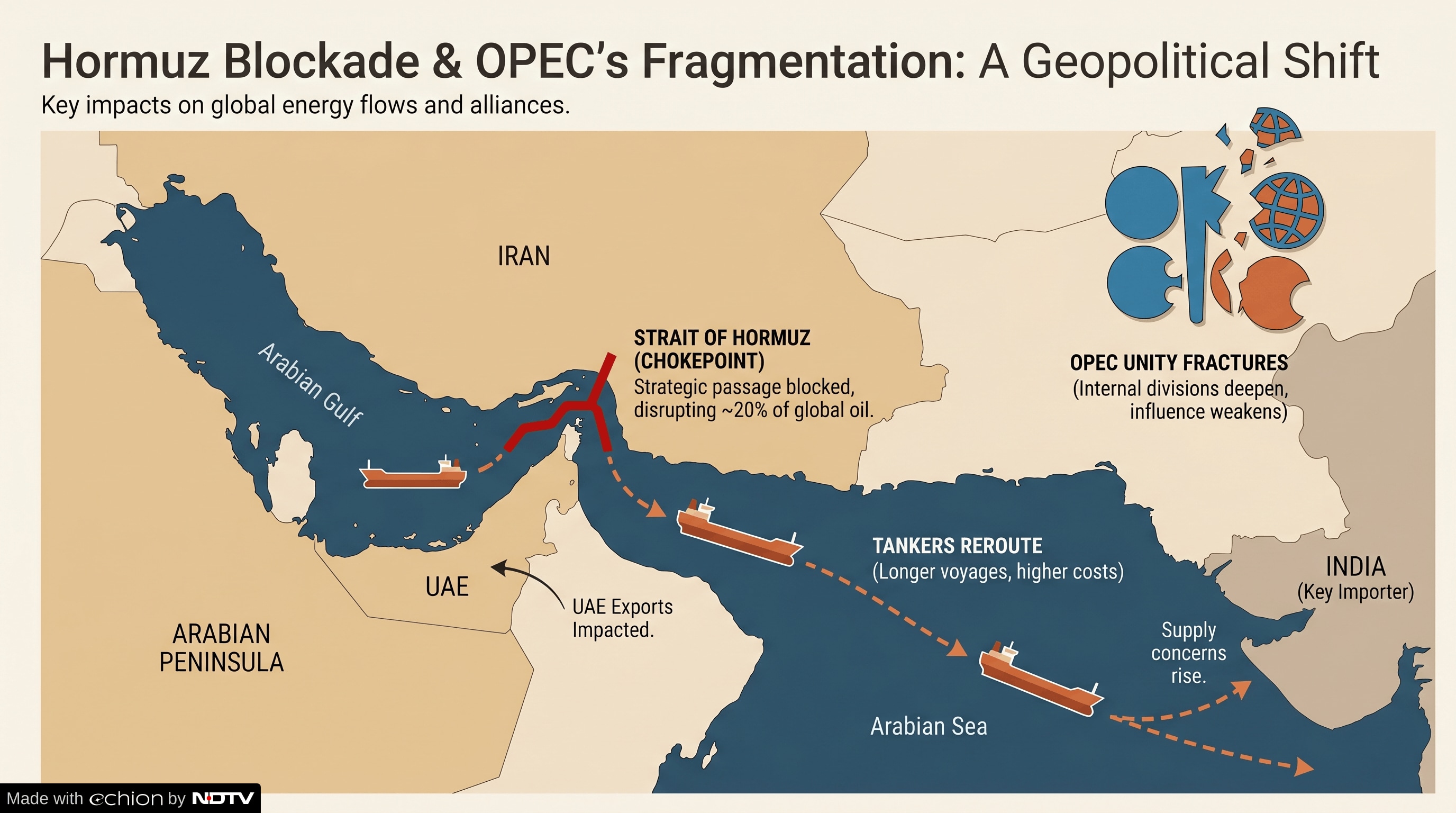
Its oil exports were further squeezed after Iran locked down the Strait of Hormuz - a critical waterway that ships up to 25 per cent of the world's oil - and prices spiked to their highest levels since the start of Russia's war on Ukraine in February 2022.
The UAE has said stepping back from these blocs reflects its "evolving energy profile" and expansion of production, while maintaining a "responsible and reliable role" in global markets.
Behind the remark there is potential for shifts in supply and prices.
Short-term pain, long-term gain?
Likely short-term shifts are fractures.within OPEC and the wider '+' bloc that will likely unsettle markets. UAE leaving could tempt others - reports indicate Kazakhstan might follow - and degrade the bloc's influence over production and prices.
But the long-term impact for India and the rest of the world is seen as positive because quitting will give the UAE flexibility to increase production outside of quotas, as explained earlier. That will increase supply and pressure prices down, benefiting large-scale importers like India, which buys around 85 per cent of its estimated 5.8 million barrels daily consumption.
A majority of that comes from the Middle East. The UAE, Saudi Arabia, and Iraq are among the top five in a list currently headed by Russia and rounded off by the US. India bought an estimated 620,000 per day from the UAE in April 2026.
"The exit of the UAE from OPEC is likely to increase global oil supply flexibility in the medium term… which could soften crude prices. It is likely to be beneficial for India's import bill and inflation in that sense,” Grant Thornton Bharat's Sourav Mitra, Partner (Oil & Gas), told the Financial Express.
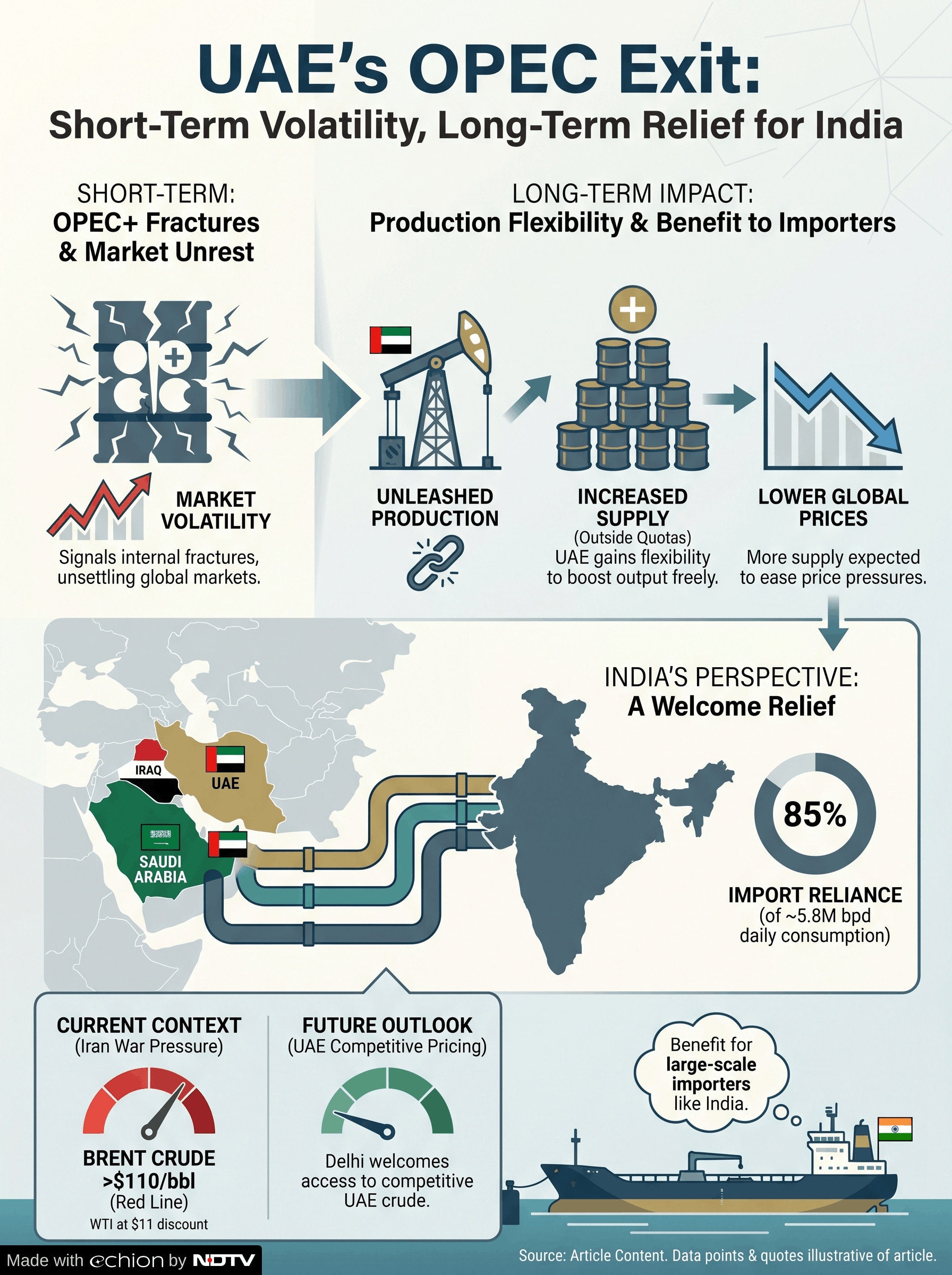
At present, oil prices have been driven upwards by the Iran war; global benchmark Brent crude crossed the $110 per barrel red line earlier this week, while West Texas Intermediate traded at an $11 discount.
Delhi will welcome being able to purchase UAE crude at more competitive prices, though how that will translate into reductions at fuel pumps is unclear. What will likely happen is that OMCs will absorb those discounts to help offset heavy losses from pump sales supported by subsidies..Accrued discounts will likely also feed into shoring up strategic reserves.
The freight risk angle
The war and double blockade across the Strait of Hormuz has spooked the shipping industry; insurance and charter rates have increased dramatically and Iran's demand for a toll - up to $2 million per tanker - has only added to potential costs.
Being able to deal with the UAE as a separate seller should give Indian refineries the chance to re-adjust risk levels and pricing, particularly if some volume of crude is routed via overland pipelines to the country's Fujairah Port on the Gulf of Oman coast to bypass the blockade.
Realistically, India's concern was less about volume than prices. The country has a relatively diverse basket that was increased to 41, the government said, after the Iran war began.
That said, if the UAE chooses to export beyond the OPEC quota - to which it will not be bound from May 1 - this can only be good news for Indian consumers as it will soften prices.
NDTV Special | Saudi-Pakistan Factor Behind UAE's OPEC Exit
But that will likely link to how much the UAE is willing to step out of OPEC's long shadow and the balancing act Abu Dhabi must perform in boosting production and exports while maintaining ties with Gulf neighbours who are now rivals in this market.
-
MK Stalin: The Boy From Chennai's Marina Beach

From a naming ceremony on Chennai's Marina Beach in 1953 to Tamil Nadu Chief Minister - this is the story of Muthuvel Karunanidhi Stalin, the DMK, and the 2026 election.
-
NTR, MGR, Jayalalithaa, Rajinikanth, Pawan Kalyan - Vijay, Respectfully, Is None Of Them
Vijay is unlike anything Tamil Nadu has ever seen. Comparing him to other star-turned-politicians is tempting, but unfair.
-
From Climbing On JP's Car To Ousting Left: Mamata Banerjee's Bengal Journey
Mamata Banerjee's political journey is a testament that she is at her most ferocious when she faces a difficult battle
-
Opinion | 35 US Lawmakers Just Moved A Bill That Could Upend Indian Techies' Careers
For years, Indian students going to America have followed a set path: F-1 student visa, then OPT, and later an H-1B visa. That may soon be off the table, thanks to a group of American lawmakers.
-
Opinion | Iran May Be Doing With Its Nukes What Another 'Rogue' Regime Did 20 Years Ago
A rogue state got away with its nuclear weapons programme decades ago, defying all sanctions. Iran may be going down the same path.
-
Opinion | If Mamata Banerjee Wins Again, It Might Be Only Because Of One Particular Group
Anyone familiar with the recent political and electoral history of West Bengal knows that while the BJP has done extremely well in north Bengal, it has so far failed to breach the Mamata citadel of south Bengal.
-
Opinion | Pak Is Finally Back In Middle East's 'Good Books'. But Can It Stay There?
This is both an enviable and challenging space to be in for the only Islamic nation in the world that has nuclear weapons.
-
Opinion | Can Saudi Arabia, Now Alone At The Top, Manage To Keep Oil Stable?
With the UAE's exit, Saudi Arabia will remain the only swing producer in the cartel to deal with market shocks. Can it fulfil that role alone?
-
Opinion | UAE Can Now Easily Meet An Old American 'Demand'. But There's A Casualty: Saudi
For years, the US had been pressing the Gulf states over low oil prices. One country can make that possible now.