UAE Quits OPEC: What It Means For India's Oil Prices, Fuel Bills
Being able to deal with the UAE as a separate seller should give India the chance to re-adjust risk levels and pricing, particularly if some volume of crude is routed via overland pipelines to bypass the Hormuz blockade.
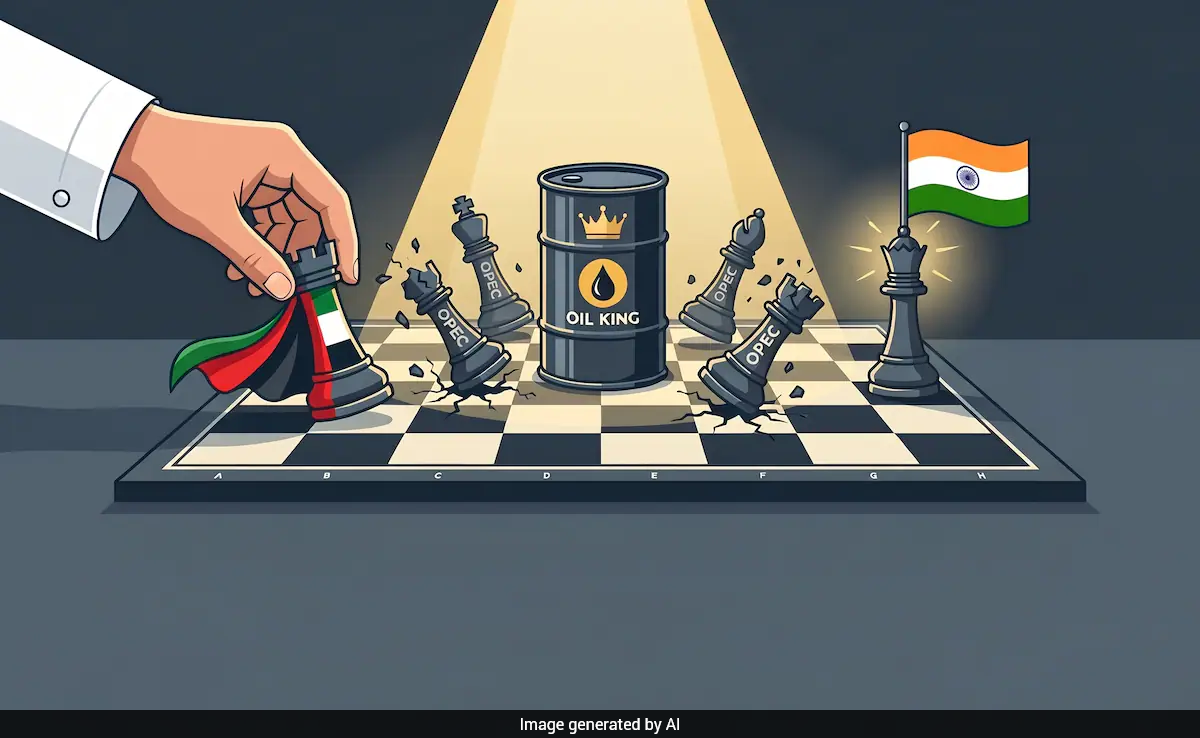
The UAE will leave OPEC and OPEC+ - the world's largest oil-producing blocs, which control 40-50 per cent of global output and influence prices through production quotas - from May 1, the country's state-run WAM news agency said this week.
Exiting OPEC will allow it to delink from 'restrictive' quotas to offset the sharp drop in global supply due to the war. Bloc members are capped at 3.4 million barrels of crude per day but the UAE has an installed capacity at nearly five million.
That increased production should eventually translate into price cuts, and India is among countries looking to benefit, particularly with Delhi looking to diversify import sources to offset global uncertainty and US pressure on Russian purchases.
Overall, the move has consequences for energy markets and net importers like India, though the short-term impact will likely be muted because of continuing supply constraints amid the war in Iran and the UAE's gradual, rather than sharp, rollout.
The most significant, impact, though, will be likely be long-term. Analysts have warned of a 'structural weakening' of OPEC's ability to influence global supply and, therefore, prices. Delinked UAE production could, from one angle, lead to more volatility.
Why UAE quit OPEC, OPEC+
Abu Dhabi announced its exit against turmoil in the global energy trade brought on by the US and Israel's war on Iran; fighting that began February 28 spread quickly to Gulf countries as oil and gas fields, refineries, and depots, were targeted.
UAE energy sites were hit - despite American air defence cover - by Iran, including the Ruwais refinery that can process 922,000 barrels of crude daily, the Fujairah Port that is a critical export terminal, and the Habshan gas fields.
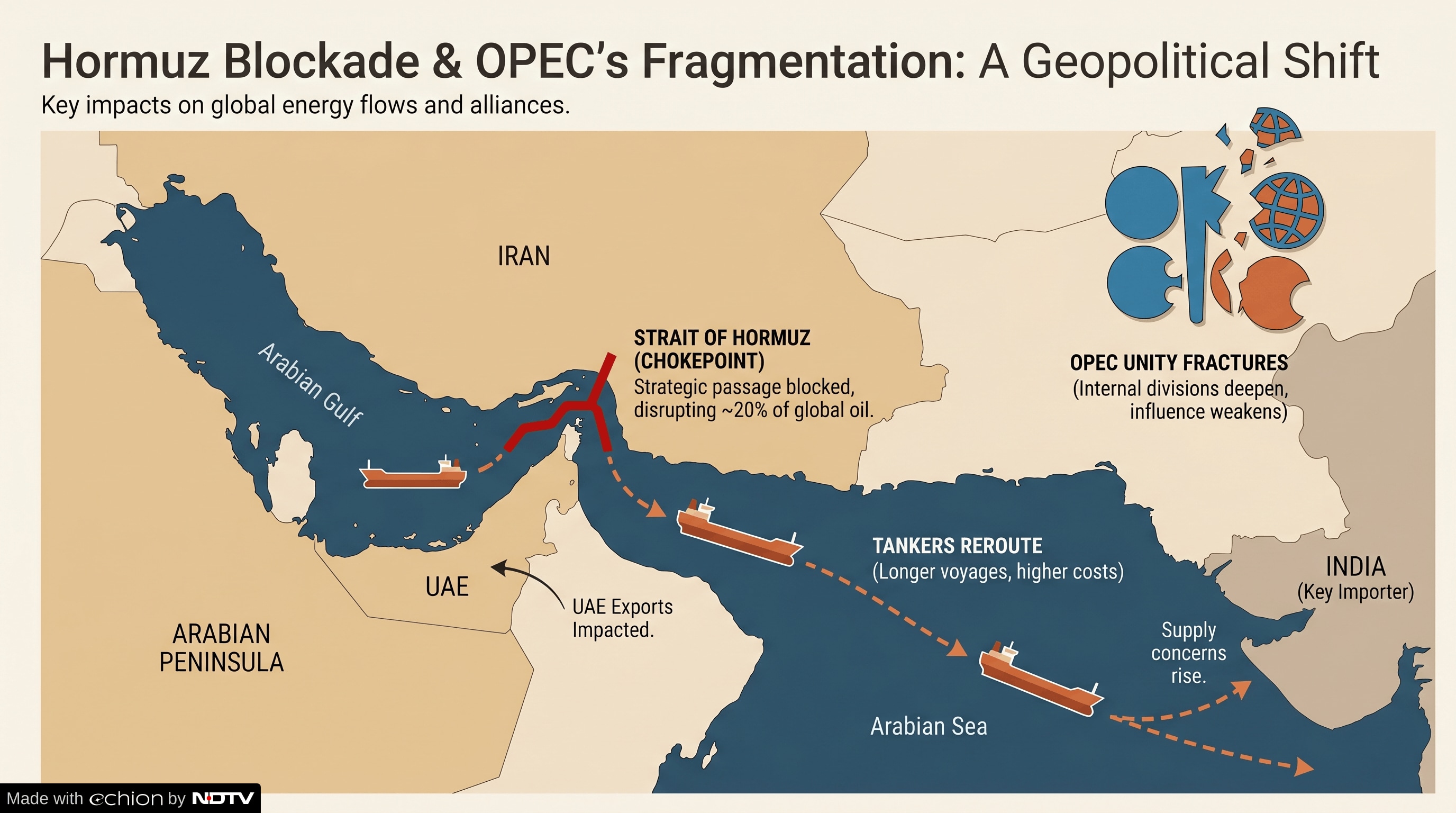
Its oil exports were further squeezed after Iran locked down the Strait of Hormuz - a critical waterway that ships up to 25 per cent of the world's oil - and prices spiked to their highest levels since the start of Russia's war on Ukraine in February 2022.
The UAE has said stepping back from these blocs reflects its "evolving energy profile" and expansion of production, while maintaining a "responsible and reliable role" in global markets.
Behind the remark there is potential for shifts in supply and prices.
Short-term pain, long-term gain?
Likely short-term shifts are fractures.within OPEC and the wider '+' bloc that will likely unsettle markets. UAE leaving could tempt others - reports indicate Kazakhstan might follow - and degrade the bloc's influence over production and prices.
But the long-term impact for India and the rest of the world is seen as positive because quitting will give the UAE flexibility to increase production outside of quotas, as explained earlier. That will increase supply and pressure prices down, benefiting large-scale importers like India, which buys around 85 per cent of its estimated 5.8 million barrels daily consumption.
A majority of that comes from the Middle East. The UAE, Saudi Arabia, and Iraq are among the top five in a list currently headed by Russia and rounded off by the US. India bought an estimated 620,000 per day from the UAE in April 2026.
"The exit of the UAE from OPEC is likely to increase global oil supply flexibility in the medium term… which could soften crude prices. It is likely to be beneficial for India's import bill and inflation in that sense,” Grant Thornton Bharat's Sourav Mitra, Partner (Oil & Gas), told the Financial Express.
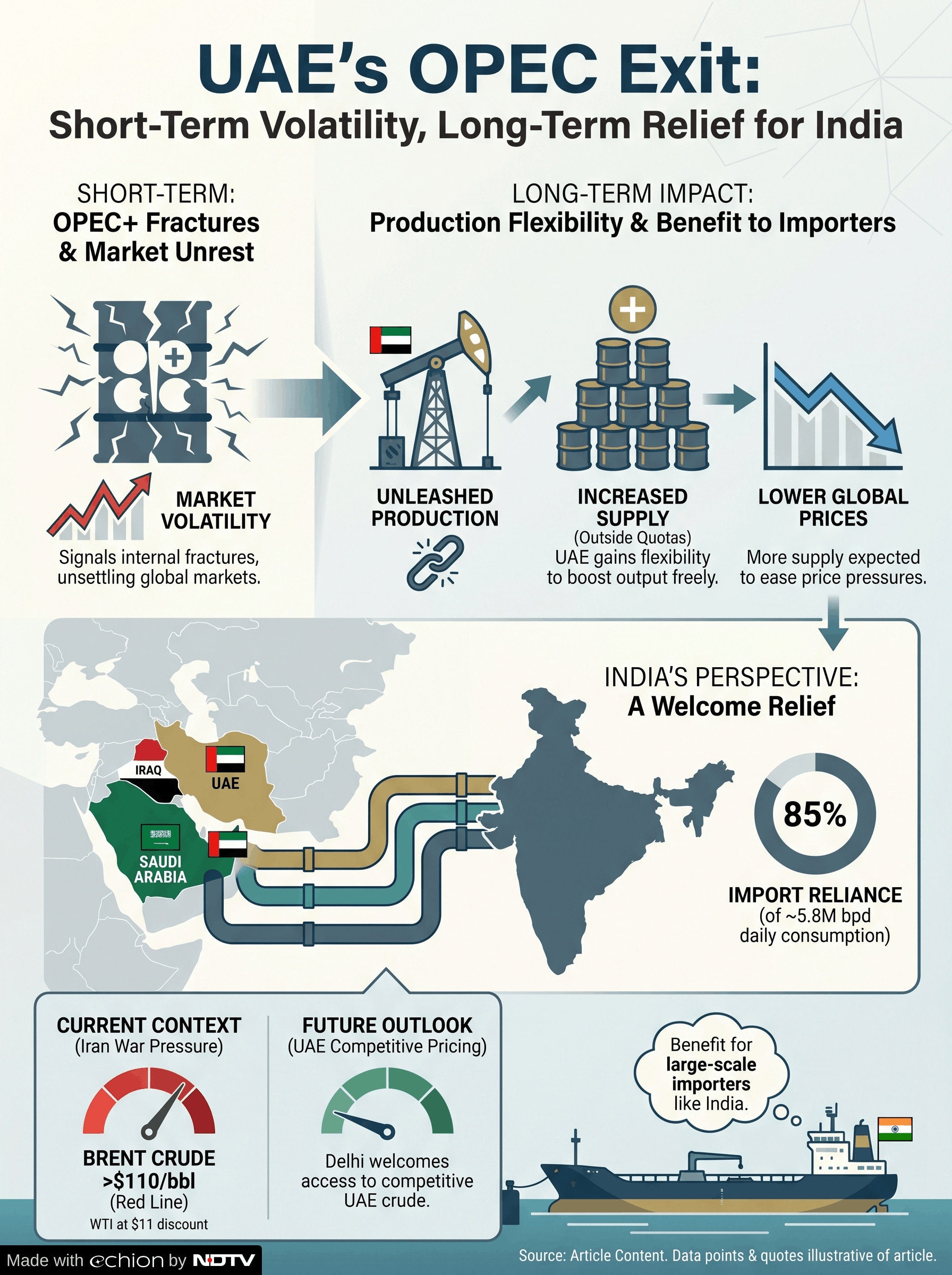
At present, oil prices have been driven upwards by the Iran war; global benchmark Brent crude crossed the $110 per barrel red line earlier this week, while West Texas Intermediate traded at an $11 discount.
Delhi will welcome being able to purchase UAE crude at more competitive prices, though how that will translate into reductions at fuel pumps is unclear. What will likely happen is that OMCs will absorb those discounts to help offset heavy losses from pump sales supported by subsidies..Accrued discounts will likely also feed into shoring up strategic reserves.
The freight risk angle
The war and double blockade across the Strait of Hormuz has spooked the shipping industry; insurance and charter rates have increased dramatically and Iran's demand for a toll - up to $2 million per tanker - has only added to potential costs.
Being able to deal with the UAE as a separate seller should give Indian refineries the chance to re-adjust risk levels and pricing, particularly if some volume of crude is routed via overland pipelines to the country's Fujairah Port on the Gulf of Oman coast to bypass the blockade.
Realistically, India's concern was less about volume than prices. The country has a relatively diverse basket that was increased to 41, the government said, after the Iran war began.
That said, if the UAE chooses to export beyond the OPEC quota - to which it will not be bound from May 1 - this can only be good news for Indian consumers as it will soften prices.
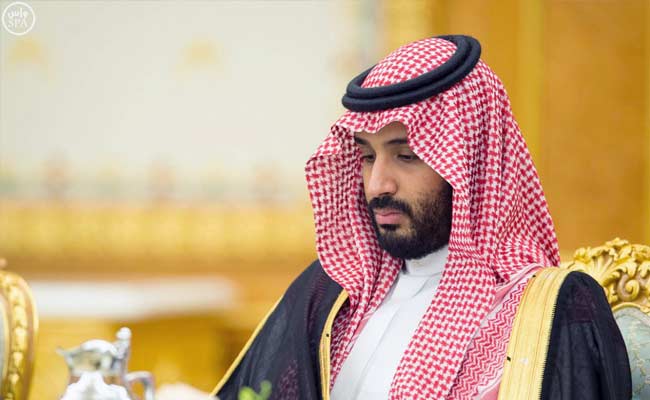
NDTV Special | Saudi-Pakistan Factor Behind UAE's OPEC Exit
But that will likely link to how much the UAE is willing to step out of OPEC's long shadow and the balancing act Abu Dhabi must perform in boosting production and exports while maintaining ties with Gulf neighbours who are now rivals in this market.
-
Opinion | China Claims It Has Cut Troops At The Indian Border. But The Math Doesn't Add Up

The reduction likely has more to do with the deployment along the LAC than the total strength active in the region
-
Opinion | China Is No Longer Waiting For Trump To Set The Rules. And He Knows It
America's old diplomatic tricks with China won't work any longer. Because China has changed, and so has its ambitions.
-
Opinion | 'Blackmail' Diplomacy: Why India Can't Be A Pawn In US' War On Russia
The new sanctions bill is both blackmail and hypocritical: blackmail because it seeks to change India's principled stand, and hypocritical because the US has provided exemptions to others, and itself.
-
Blog | Katrina Kaif, And The Very Indian Problem Of Too Much 'Audacity'
The remarkable thing about many Indian trolls is not that they have opinions, but that they expect - get this, Katrina Kaif, no less - to care about them.
-
Mamata Banerjee Drew Her Party's Symbol By Hand. It's Now Tied To An Indira Gandhi Case
The Election Commission's method for settling such disputes became central in the seminal Congress split of 1969, when Indira Gandhi fought the old guard. The poll body weighed three tests then.
-
Bruised, Limping, Unbowed: Sia Says She Will Be Back On The Bike Soon
There was pain in Sia's steps, anger in her words, and something else - a quiet determination that the road would not be taken away from her.
-
Exclusive: 16 Months After Op Sindoor, Pak Still Fixing Runway India Broke At Sargodha
Sargodha's PAF Base Mushaf lies about 172 km northwest of Lahore and roughly 200 km west of the India-Pakistan border, near Amritsar.
-
Blog | I Lost My Entire Family In Kanishka Bombing. 41 Years Later, Canada Wants The Case Closed
We made the trek through tragedy to search for people in Cork, where I spent 25 days sifting through bodies and body parts in a makeshift morgue to identify our loved ones.
-
Opinion | Pak's Drone Deal With A US Firm Is No Windfall. But India Must Still Be Worried
American military aid to Pakistan has remained suspended since January 2018, during Trump's first term, but a commercial arms sale is separate from this arrangement.
-
Opinion | Saudi Arabia's Yemen Nightmare Has Come Back To Haunt It
After years of costly military intervention beginning in 2015, Saudi Arabia increasingly sought to stabilise its southern border. All that is unravelling fast now