No START To Check US-Russia Nuclear Arms Race. What It Means For India
With New START expiring and uncapping US-Russia nuclear arsenals, India is seen as facing heightened risks, sandwiched between China's 600-warhead surge and Pakistan's buildup while North Korea watches.
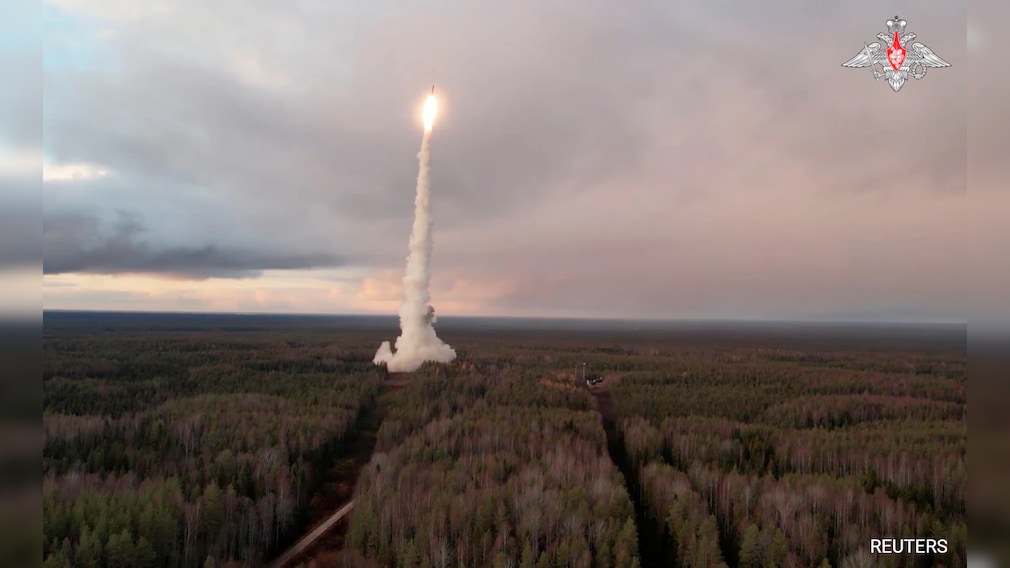
It is 85 seconds to midnight on the Doomsday Clock in Chicago and, amid multiple conflicts in West Asia and another in Ukraine, humanity has never stood so close to a nuclear war.
But on February 5, 2026, the US chose not to extend the New START with Russia – the last nuclear arms control treaty between the Cold War rivals – ending any obligation on either to limit deployed strategic nuclear warheads at 1,550 each and delivery systems at 700 each (plus a total of 800 launchers), and giving both the green light to re-start a nuclear arms race.
This at a time when Russia is modernising its delivery systems; Deputy Foreign Minister Sergei Ryabkov told state media RIA the country's 'nuclear triad', i.e., ground, air, and sea-launched weapons, is at an "advanced stage".
By uncapping build-up of deployed warheads, expiry of the New START also risks further instability in Ukraine and West Asia, and likely raises red flags for Asia and India, which lies sandwiched between two nuclear rivals – China and Pakistan.
Elsewhere in Asia, North Korea, which has historically justified its nuclear ambitions by pointing to the US, will be on alert. The removal of Russia-US caps, however temporary, could accelerate expansion of Pyongyang's estimated stockpile of 50 warheads.
Asked about the treaty, President Donald Trump, whose office was this week busy criticising the Speaker of the Polish Parliament for refusing to co-sign a Nobel Peace Prize nomination – told The New York Times, "If it expires, it expires". He also blamed Joe Biden for having negotiated a bad deal, though his predecessor only extended it by five years, as was allowed by the treaty.
Instead, Trump has called for a new treaty that includes China, with whom the US continues to have trade tariff squabbles. On Wednesday, 24 hours before new START lapsed, Secretary of State Marco Rubio underlined that demand, declaring arms control "impossible" without China.
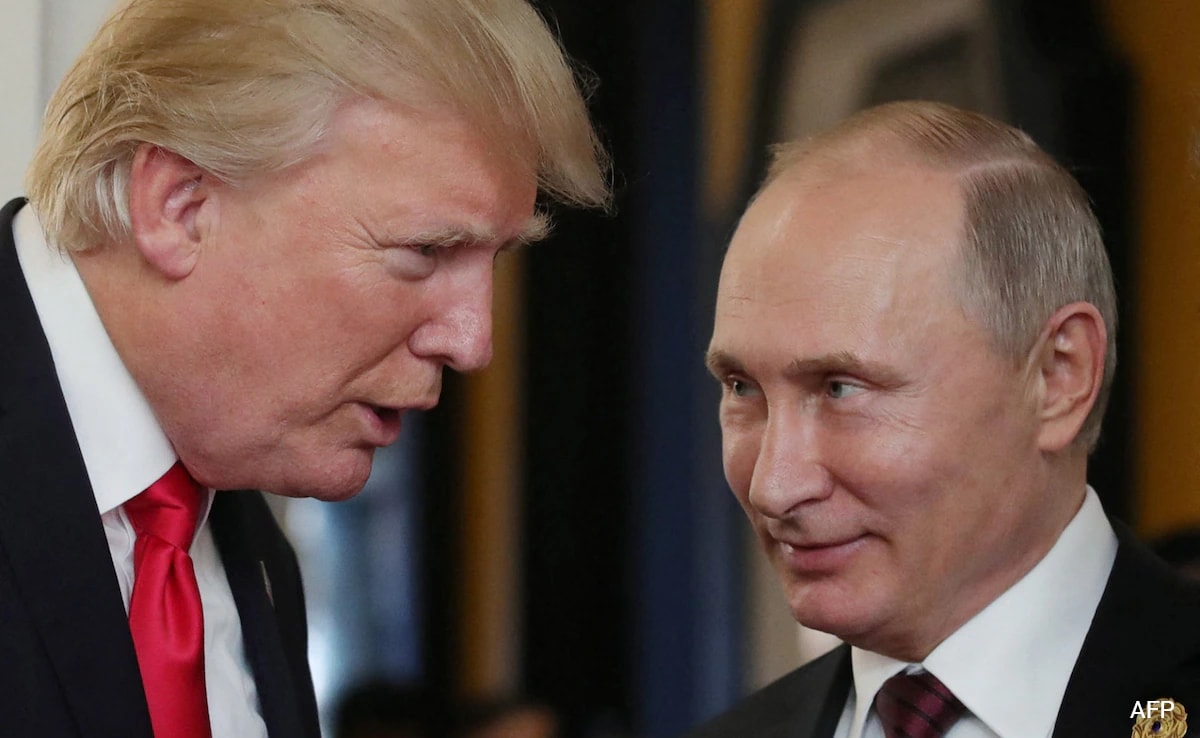
Donald Trump has said he wants any new nuclear treaty to include Russia and China (File).
But Beijing has dismissed that notion; its foreign ministry expressed regret that New START had expired but said it would "not participate in nuclear disarmament negotiations at this stage".
So, what does all this mean for India?
India's China concern
That will likely worry India, particularly since a June 2025 report by the Stockholm International Peace Research Institute suggested China now has at least 600 nuclear warheads and has been expanding by around 100 every year since 2023. Beijing has insisted these are "self-defence" and vowed to follow a "no first-use" policy, but has resisted attempts to limit that stockpiling.
That asymmetry is important for India – which has an estimated stockpile of 180 warheads but also maintains a credible minimum deterrence doctrine – which seeks to balance national security concerns against triggering a nuclear arms race in Asia.
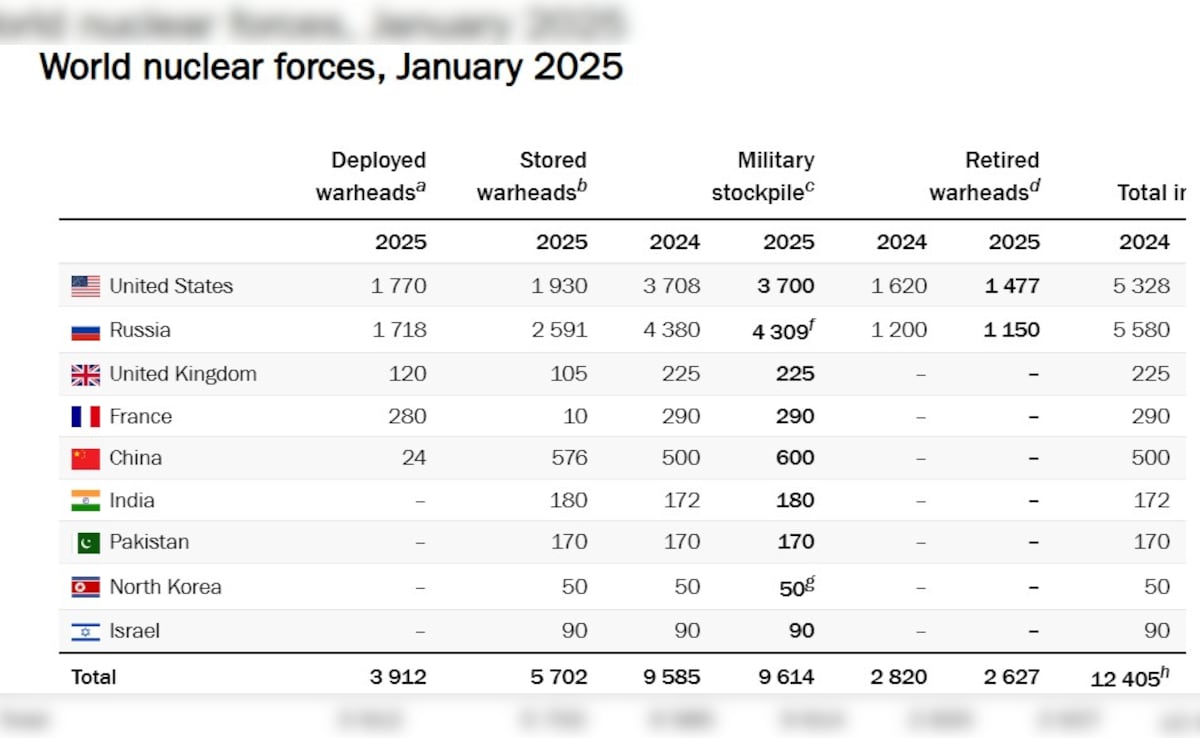
Source: SIPRI Yearbook 2025. For high-res image click here
China agreeing to caps under an expanded START would ease that worry and, significantly, could help ease tension in Delhi over the border stand-off with Beijing.
The Pakistan question
On India's western border, Pakistan has an estimated stockpile of 170 warheads, which the Nuclear Threat Initiative, a US-based nonpartisan watchdog, has reported are in storage.
In November 2025 the NTI also reported Pak is building a stockpile of fissile materials enough to produce at least 14 nuclear warheads every year.
Military, specifically nuclear, tensions between Delhi and Islamabad have worsened since Operation Sindoor – the May 2025 armed response to the Pahalgam terrorist attack that India has said was orchestrated by a Pak-backed terror group.
Another iteration of START, even if it were not to include Pakistan, and there is no indication Trump wants to include it, would still introduce some calm in the region. US-Russia caps could discourage other nations from adding to their stockpiles and buys India some breathing room.
The overview
From a broader perspective, the New START did not expire in a vacuum; that it was to run out was public knowledge. But some would argue the big story isn't the New START itself.
In the 54 years since SALT-1, the Strategic Arms Limitations Talks, the first US-Russia attempt to control their weapons race, nuclear stockpiles have inched down.
Under SALT-1, for example, launchers were capped at 2,358 ICBM/SLBM each, but global superpowers managed without knocking on an apocalypse's door, though that might be more of a statement made in hindsight.
The story is the pivot from a Cold War-era bilateral nuclear stand-off to a world in which multiple nations have nuclear stockpiles, and the reality that any arms control treaty must include all.
In that, perhaps, Trump is right. China must be a part of any new New START and any new global nuclear weapons equation must include Asia.
But allowing the current treaty to expire, particularly with an already-belligerent Russia staring down Europe and seemingly unchecked military escalation in Ukraine, a conflict the world cannot seem to stop, was possibly not the right course of action.
-
Opinion | There Are Two Big Problems Trump May Run Into If He Actually Attacks Iran

It is impossible to predict with certainty if the US will take the military option, but if they do, it will be from a position of discomfort.
-
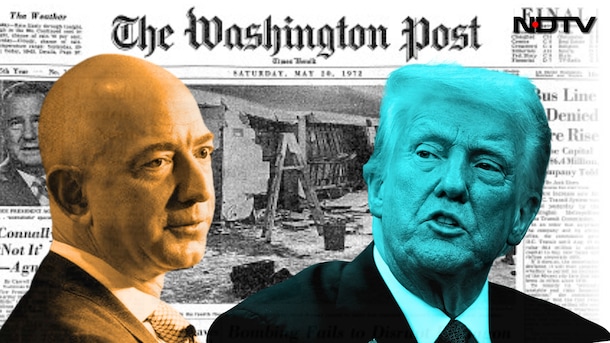
The Washington Post 'Bloodbath': $100 Million Losses And Trump 2.0 Shadow
The Washington Post - which made history by exposing President Richard Nixon in the Watergate scandal - has announced "substantial" cuts to its estimated 1,000-strong journalism roster.
-
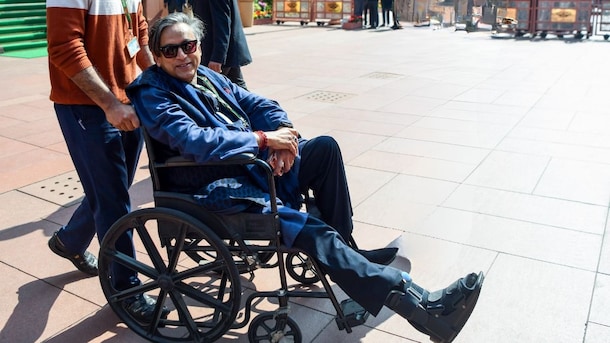
Blog | The Descent Of Man (And MP) - By Shashi Tharoor
"Having spent decades navigating the slippery slopes of policy and the treacherous inclines of debate, it was, quite ironically, a simple marble step that proved to be my undoing."
-
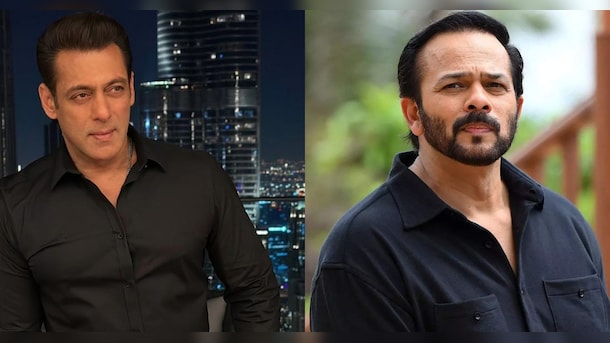
Blog | Salman Khan, Now Rohit Shetty: The Bishnoi Threat Isn't New For Bollywood
The recent attacks on Rohit Shetty and Salman Khan have rekindled flashes from a chapter many thought had long been buried.
-
Opinion | Who Lit The Fire In Balochistan? Pak's Explanation Avoids The Obvious
It's time sensible Pakistanis did a rehash of just who their enemies are. They might get a surprising list.
-
Opinion | Two Peculiar Reasons Behind The Timing Of India-US Trade Deal
India should be clear-eyed about risks. What proclamations give, proclamations can take away. If compliance is judged by mere political mood, sanctions and penalty tariffs can return with little warning.
-
Opinion | Pak's India Match Boycott: How To Self-Destruct To Make A 'Point'
In the long run, it will be Pakistan who will be wounded the most by this, left bleeding from not one but multiple cuts - hefty fines, potential legal action, and maybe even a ban. All for some chest-thumping.
-
Opinion | US Trade Deal: Is This Trump's 'FOMO' After The India-EU Pact?
The India-EU free trade pact wrong-footed the US, turning on its head the very playbook Trump was using to browbeat America's trading partners.
-
Decoding India's EU, US Trade Deals And A Likely $150 Billion Boost
India announced two mega trade deals - one with the European Union and another with the United States - in the space of a week.
-
Opinion | Budget 2026: Is 'Invisible Kerala' Paying The Price For Being 'Unaligned'?
What Kerala needs is not just sympathy or slogans. We need an alternative that commands respect in Delhi and delivers development in Kerala. Right now, we have neither.
-
News Updates
-
Featured
-
More Links
-
Follow Us On
