Eagle Down: How US Carried Out Precision Search And Rescue Op In Hostile Iran
How the United States transformed a tactical failure into a narrative of national resolve.
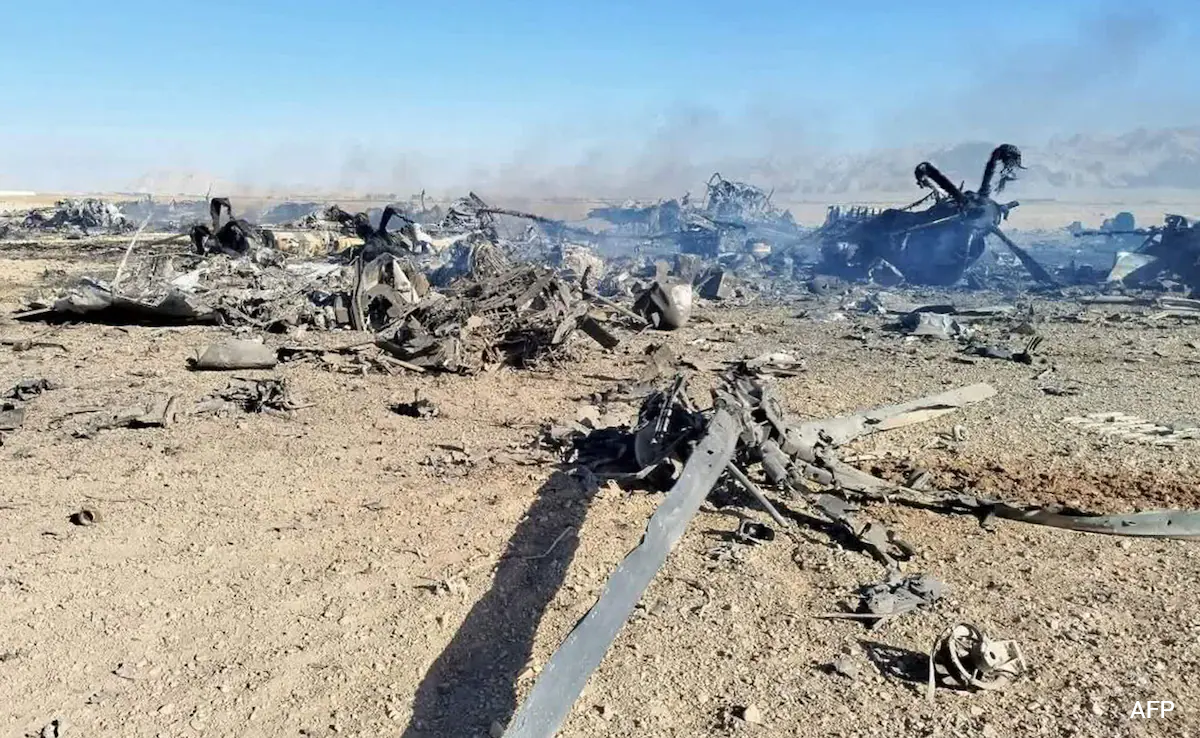
April 3, 2026 - High over the rugged Zagros Mountains in Kohgiluyeh and Boyer-Ahmad Province, southwestern Iran, an F-15E Strike Eagle from the 494th Fighter Squadron (forward-deployed from RAF Lakenheath) knifed through contested airspace during Operation Epic Fury. The twin-engine, two-seat interdiction fighter- armed with Joint Direct Attack Munition (JDAM) precision munitions and carrying conformal fuel tanks for extended range - suddenly shuddered under impact. Iranian air defences, likely an upgraded IRGC system such as the Bavar-373 with Sayyad-series missiles employing active radar and infrared homing, achieved a hit on the Eagle. The crew initiated immediate ejection sequence.
Both aviators cleared the stricken aircraft via ACES II zero-zero ejection seats. Parachutes deployed, and the jet's tail section - bearing the squadron's distinctive red stripe - cartwheeled into the mountains near Dehdasht. Iranian state media quickly broadcast wreckage images, claiming a propaganda victory. The crash site sat two hundred plus kilometers away from friendly territory in steep, high-elevation terrain rising to 7,000 feet: rocky ridgelines, sparse vegetation, limited roads, and natural masking that complicated both evasion and search efforts.
Hour 0: Ejection and Initial Recovery
The pilot's personal survival radio and Personnel Recovery Device (PRD) activated automatically, transmitting encrypted burst signals via SATCOM and captured by the Cospas-SARSAT series satellites. Nearby US ISR assets-likely a mix of RQ-4 Global Hawk, E-3 AWACS, and fighter datalinks- would also have acquired the beacon.
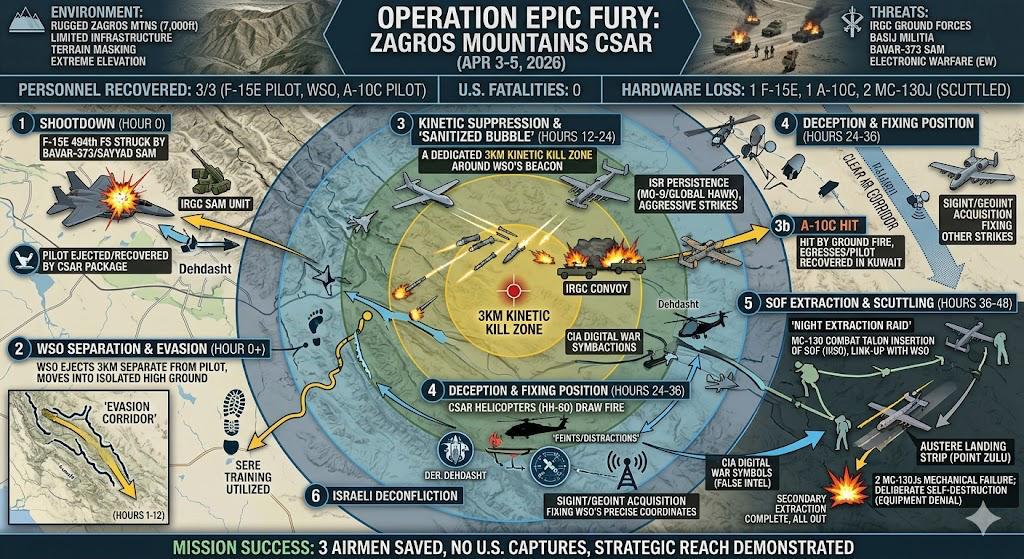
Within 15 minutes, a dedicated CSAR package comprising of a MC-130J Combat King II, designed for C2 and dispensing fuel, and a pair of HH-60W Blackhawk helicopters for low-level clandestine operations deep inside hostile territory, were dispatched to locate the crew inside Iranian territory. These were vectored in under F-35/ F-15E fighter escort. Within hours, the pilot (front seat) was successfully located, and US Special Forces extracted and returned him to friendly control. Standard procedure was adopted: rapid isolation of the signal, suppression of any nearby threats, and helicopter or fixed-wing pickup.
The Weapon Systems Officer (WSO) landed separately, several kilometres away in more isolated high ground. His initial beacon ping registered with satellites before going silent-likely due to deliberate battery conservation, terrain masking in the deep valleys, or early Iranian electronic warfare attempts (on the international 121.5 MHz/ 243 MHz or the 406 MHz SARSAT frequencies). Isolated, the WSO relied on USAF SERE training (Survival, Evasion, Resistance and Escape): map, compass, evasion routes pre-planned from mission briefing, plus a small survival vest containing signalling devices, water purification, medical kit, and the Sig Sauer M18 sidearm.
Hours 1-12: Ground Evasion and Iranian Dragnet
IRGC ground forces, reinforced by Basij militia and local informants, launched a coordinated search. Checkpoints sprang up on approach roads to Dehdasht. State television broadcast appeals with reported bounties equivalent to $60,000 for information leading to capture, alongside inflammatory calls that risked civilian shoot-on-sight incidents. Pickup trucks and foot patrols began sweeping lower elevations.
The WSO, a Colonel level officer, executed classic evasion tactics: movement only during limited visibility windows, use of micro-terrain (washes, ridgelines, boulder fields) to break line-of-sight, stream crossings to defeat tracking dogs or scent, and deliberate counter-tracking (doubling back, false trails). He maintained intermittent encrypted burst communications on his N/PRC-90 or PRC 112 portable radio-short, low-probability-of-intercept (LPI) data packets on frequency-agile waveforms-providing status updates, location estimates, and requests for support without revealing position for long enough to enable accurate triangulation.
Hours 12-24: ISR Persistence and Kinetic Suppression
US assets maintained continuous overhead coverage. MQ-9 Reaper unmanned systems, orbiting at medium altitude with multispectral EO/IR pods and beyond-line-of-sight links, provided persistent full-motion video relayed to the Joint Personnel Recovery Center (JPRC) and CENTCOM. When IRGC convoys or dismounted teams closed within approximately 3 km - dust signatures visible on mountain tracks, troops deploying with small arms and MANPADS-Reapers employed AGM-114 Hellfire missiles for precise, low-collateral engagement. Overhead manned strike aircraft dropped 500-lb JDAMs or conducted strafing runs to interdict follow-on forces, creating a sanitised bubble around the evader's estimated position, while tactically avoiding Iranian MANPADs and other mobile SAM systems in the zone.
During close air support, an A-10C Warthog took ground fire (likely 12.7mm or 14.5mm heavy machine guns, possibly a MANPAD). The aircraft's titanium "bathtub" armour and redundant hydraulic systems allowed the pilot to egress the near hundred odd kilometres of Iranian airspace before ejecting safely over Kuwaiti territory. The A-10 pilot was recovered without serious injury, adding a third airman to the successful tally.
Hours 24-36: Rotary-Wing Pressure and Deception
HC-130J Combat King II tankers provided aerial refuelling for extending loiter times of MH-60 Black Hawk variants (including CSAR-configured HH-60s from rescue squadrons or the 160th SOAR Night Stalkers). Multiple Black Hawk insertions or reconnaissance passes drew small-arms and RPG fire. Defensive aids suites-chaff/flare dispensers, directional infrared countermeasures (DIRCM), and radar warning receivers - combined with nap-of-the-earth flight profiles enabled the helicopters to absorb hits, return to base, and report minor onboard injuries. No aircraft were lost in this phase.
Parallel to kinetic operations, the CIA and the USAF EW components executed a deception and jamming campaign. Through human intelligence cutouts, cyber dissemination, and signals injection, false narratives circulated inside Iran claiming the WSO had already been extracted. The mobile phone nodes and communication equipment were jammed all through. This aimed to degrade search momentum, induce hesitation in IRGC command chains, and create operational windows. Persistent SIGINT, GEOINT, and overhead re-acquisition eventually fixed the WSO's precise grid coordinate despite his movement and the challenging electromagnetic environment.
Hours 36-48: Nighttime Special Operations Extraction
Under full darkness, a layered CSAR package launched. MC-130 Combat Talon variants - equipped with terrain-following/terrain-avoidance radar, extensive EW suites, and precision navigation - penetrated deep to support insertion. Special operations forces (elements of Delta Force, SEAL Team Six, or joint task force personnel) inserted via fast-rope or helicopter, rapidly linked up with the WSO who had climbed to an higher altitude of near 7000 feet (now fatigued, possibly injured from ejection or evasion, but alive and coherent); and established a security perimeter.
Exfiltration proved the most technically demanding phase. MC-130s landed on a remote, unimproved austere strip inside Iran. Rough terrain, possible undetected battle damage, or high-altitude/short-field stresses disabled at least two aircraft on the ground. Commanders assessed that sensitive equipment-classified avionics, crypto gear, terrain databases, and special mission modifications-could not be allowed to fall intact into IRGC hands. Demolition charges were set; the aircraft were deliberately destroyed in controlled explosions. US post-mission analysis confirmed self-destruction rather than enemy action. Reports also indicated a Blackhawk helicopter lost or damaged at the site. Replacement MC-130s were vectored in, completing the extraction of all personnel-the WSO, SOF operators, and any casualties-under covering fire if needed.
To deconflict, Israeli forces conducting concurrent operations in other sectors paused strikes, ensuring clear airspace corridors.
Outcome and Tactical Lessons
All three US airmen survived: the F-15E pilot (quick recovery), the WSO (after roughly 48 hours of evasion and a high-risk night raid), and the A-10 pilot. Zero US fatalities or captures despite operating deep in denied territory against a motivated adversary employing mass search, electronic warfare, and ground fires. Dozens of aircraft participated-fighters for CAP and strike, Reapers for persistent ISR and precision fires, tankers for endurance, MC-130s for infiltration/exfiltration, and helicopters for flexible insertion. The US lost a Reaper, one A-10C, two MC-130 Combat Talons and a MH-6M (some reports indicate two) during this high voltage CSAR.
The operation highlighted integrated joint tactics: SERE discipline at the individual level, layered ISR with real-time kinetic response, deception to shape the battlespace, and special operations aviation for the final "golden hour" recovery. Destruction of compromised aircraft on the ground underscored equipment denial protocols. In the high-threat Zagros environment -mountainous masking, rapid IRGC response, and political stakes-the mission succeeded through meticulous planning, technological overmatch, and disciplined execution.
President Trump publicly confirmed the success of this daring mission, noting the WSO was "safe and sound" despite injuries, and emphasising that no American was left behind. He would privately have been relieved of no further escalation or a public 'hostage' scenario if the rescue had failed. For the IRGC, initial claims of victory dissolved into a demonstration of US reach and resolve. The Iranians will however draw solace from the fact that it was not a walk in the park for the US.
The event will stand as a case study in modern combat search and rescue (CSAR): where technology amplifies human skill, and the imperative to recover personnel drives one of the most complex tactical undertakings in contested airspace. The creed of "Leave No Man Behind" is more than a military protocol; it is a fundamental psychological contract between a nation and its warriors - In the Zagros Mountains, the United States demonstrated this "Credo" serves as the primary driver for what otherwise might look like "tactical madness." Even if the mission that led to the crash is controversial, the act of bringing the airmen home will almost universally be viewed as a moral victory, a narrative of national resolve.
The Iranians deserve the credit for successfully shooting down an USAF F-15E. However, the IRGC's "propaganda victory" of showing the F-15 wreckage was completely neutralised by the fact that they couldn't produce a prisoner. In the end, they had the metal; while the US kept the soul.
(Sameer Joshi is a retired IAF fighter pilot and the CEO of NewSpace Research & Technologies Pvt. Ltd.)
-
Opinion | India's UPI Miracle Has Created A Difficult, Rs 20,000-Crore Question

UPI's whole magic was the Rs 30 payment it charged nothing for. But how long can it stay free?
-
Opinion | Manmohan Singh, Bachchans, And Other Secrets Of 10 Janpath: The Sonia Gandhi Story
She entered politics reluctantly, mastered its power games, chose Prime Ministers, and managed betrayals. Congress's most powerful woman finally tells the world how.
-
Opinion | Why The Congress-Samajwadi 'Merger' Fantasy Could Be Opposition's Biggest Self-Goal
Rahul Gandhi and Akhilesh Yadav do not need to become one another. They need to become better at being themselves, together.
-
Opinion | Mumbai's 'Marathi' Test For Cabbies, And The Art Of Fixing The Wrong Problems
All these years, India's financial capital has worked just fine without a Marathi mandate for its taxiwallahs. Whose problem is the new language rule actually solving now?
-
Opinion | Rs 1.05 Lakh Crore Lost: Inside The Dangerous Rise Of India's Gen Z Stock Traders
Investors under 30 now account for 37.9% of the total investor base in India. But they are also losing money at a much higher rate. Why are they doing it?
-
Opinion | Why A 'Bangladesh' Proposal By Turkish Media Should Worry India
A recent article in Turkish media illustrates how Ankara is turning into a strategic threat for India and its neighbourhood
-
Opinion | 4,800 Indians Removed, 51,000 ICE Arrests: What's Happening In Trump's America?
According to Stop AAPI Hate, Indians are now one of the most targeted groups by ICE, with the highest number of arrests, detentions, and deportations out of all Asian and Pacific Islanders.
-
Opinion | Noakhali To Parliament, What Gandhi, Nehru, Jinnah And Faiz Were Doing On Aug 15, 1947
What was Gandhi doing while Nehru was making his famous midnight speech, and why was Jinnah hosting a lunch as a new nation began fasting? August 15, 1947, looked very different depending on where you stood.
-
Opinion | 79 Years On, India's Enduring Answer To Those Who Had Predicted Its Collapse
Seventy-nine years in the lifespan of an ancient civilisation is a mere heartbeat; yet, in the annals of modern nation-building, it's an audacious triumph.