Before Drones Flew Over The Gulf, Praying Mantis Followed An Iran Mine Strike
Operation Praying Mantis was the culmination of a decade of escalating tension and proxy warfare across the Middle East. The operation redrew the balance of power in the Gulf.
At first light in the Persian Gulf on April 18 1988, oil platforms stood like steel outposts above the water. Warships moved into position with precision. Within hours, that calm would be broken by missiles, naval gunfire and aircraft strikes. This was one of the consequential naval confrontations between the United States and Iran.
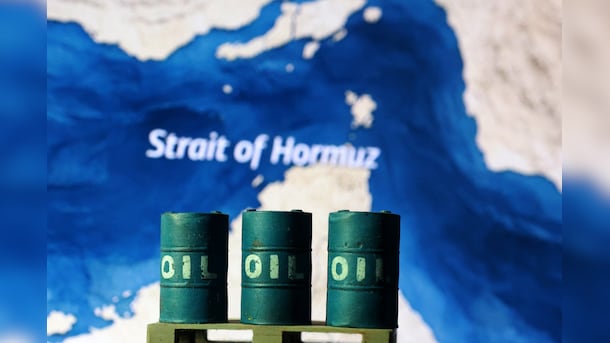
On Monday, Iran's Defence Council warned that any attack on its coast or islands would trigger the laying of sea mines across Gulf waters. A mined Gulf would be difficult to clear. Even a large-scale minesweeping effort might struggle. In the 1980s, more than 100 minesweepers were deployed. They failed to fully neutralise a relatively limited number of mines.
Then came Operation Praying Mantis. It was the culmination of a decade of escalating tension, miscalculation and proxy warfare across the Middle East. The operation unfolded in a day of violence and redrew the balance of power in the Gulf.
The Incident That Forced Washington's Hand
The chain of events that led to the operation began four days earlier on April 14, 1988. The guided-missile frigate USS Samuel B Roberts was operating in the Gulf. It was part of Operation Earnest Will. The United States mission was to escort reflagged Kuwaiti oil tankers through waters increasingly threatened by the Iran-Iraq war.
The conflict had already been going on for eight years. It had expanded into what became known as the "Tanker War". Iran and Iraq targeted oil shipments. They targeted each other's economies. Iraq relied largely on air power. Iran used mines, patrol boats and irregular naval tactics.
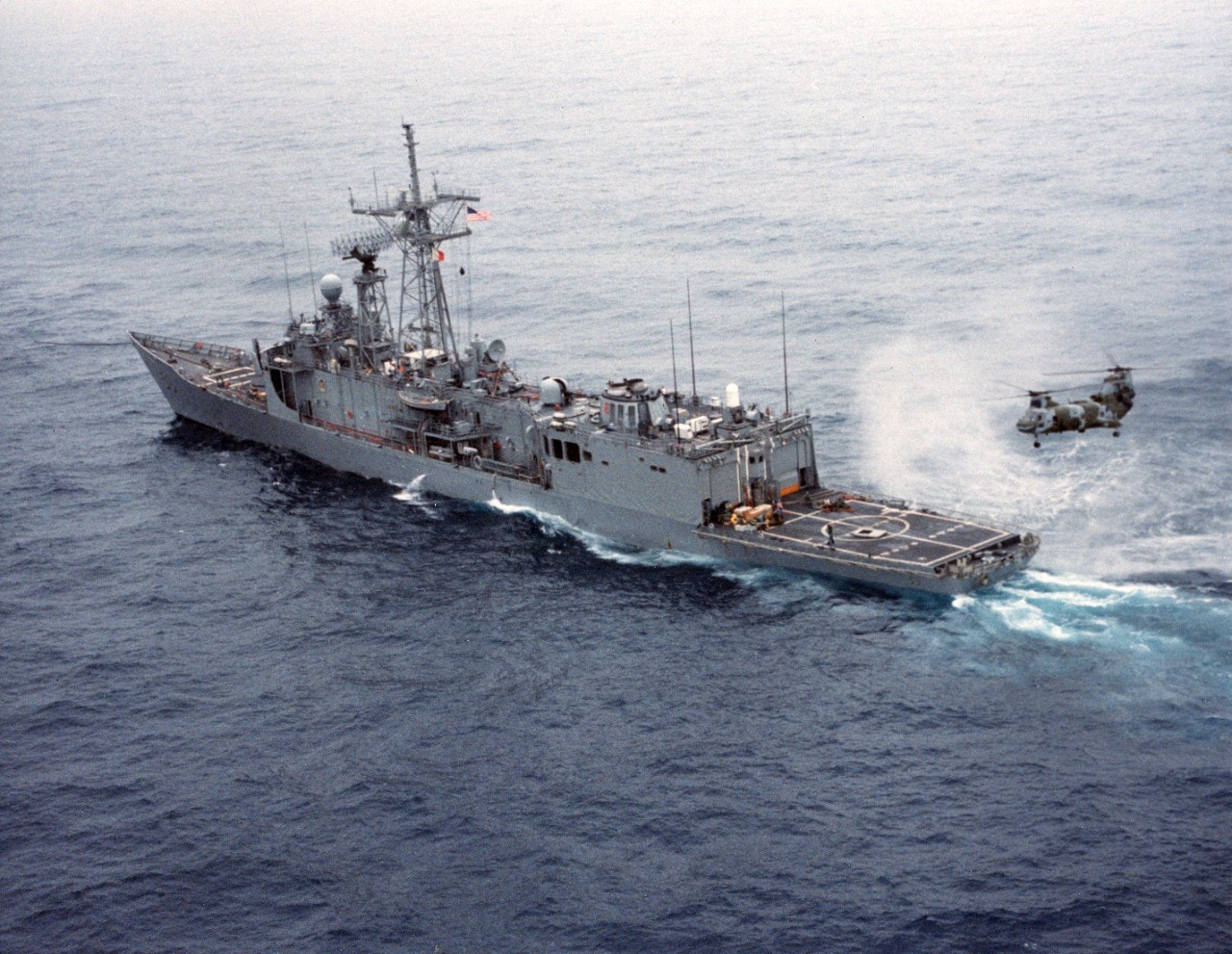
USS Samuel B. Roberts (FFG-58) underway after the ship struck a mine on April 14, 1988. A USMC CH-46 Sea Knight helicopter is on the helicopter pad.
Photo Credit: US Navy
At 4:45 pm, lookouts aboard the Samuel B Roberts spotted mines floating nearby. The ship's commanding officer, Commander Paul X Rinn, ordered the vessel to back out of the minefield. Twenty-five minutes later, a mine detonated beneath the hull.
The explosion tore a 15-foot hole in the ship. It broke its keel. Flooded the engine room. It disabled the ship's propulsion. Ten sailors were injured. Four were severely burned. Commander Rinn himself was thrown from the bridge wing. By any measure the ship should have sunk.
It did not.
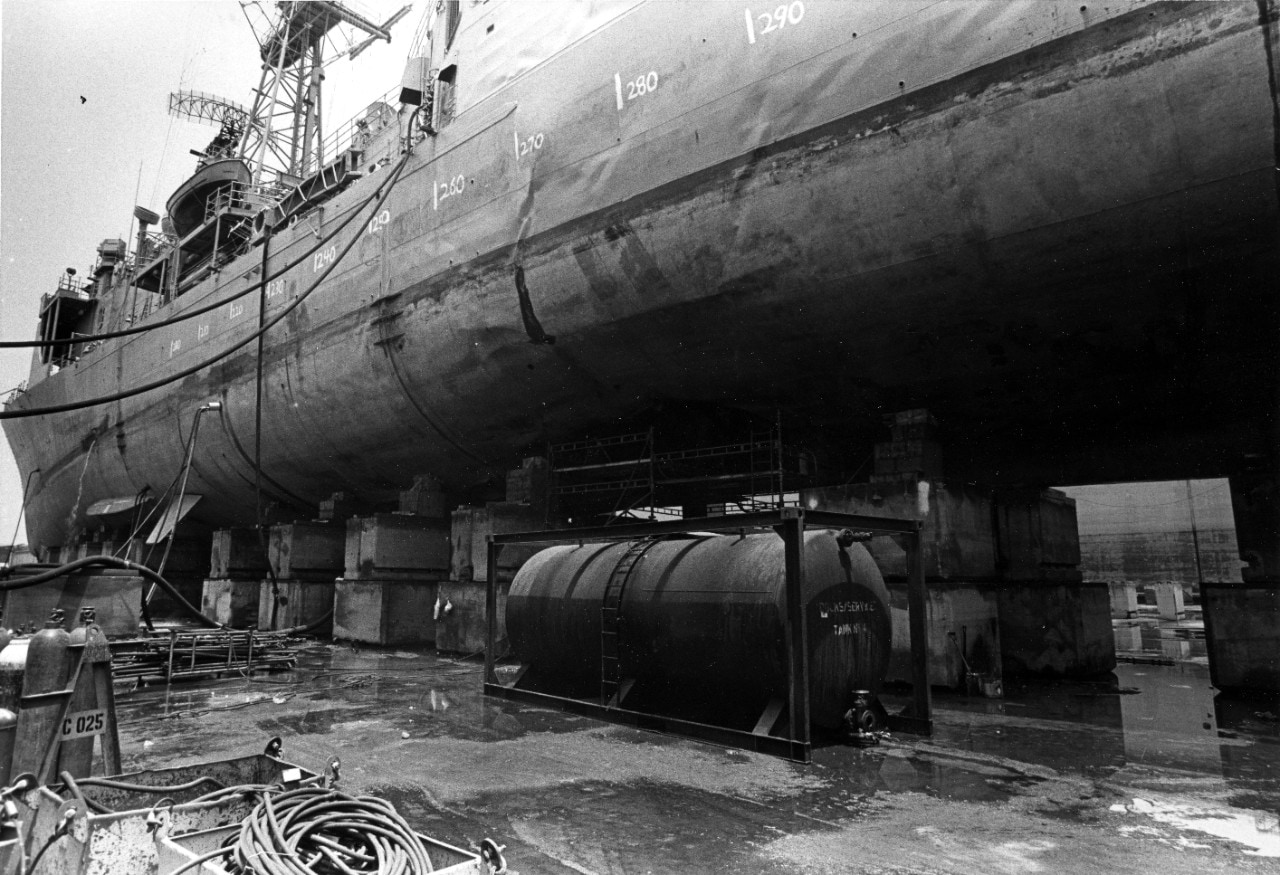
A view of damage to the hull of USS Samuel B. Roberts (FFG-58) while in dry dock in Bahrain.
Photo Credit: US Navy
For seven hours, the crew fought fires and flooding. Sailors improvised emergency power systems within minutes. Divers later recovered mines from the area. Serial numbers matched those found on an Iranian minelayer captured months earlier.
Then planning for retaliation began almost immediately.
The Response
Admiral William J Crowe, Chairman of the American Joint Chiefs of Staff, instructed commanders to strike assets. These assets were directly linked to attacks on shipping. Three Surface Action Groups (SAGs) were assembled. The aircraft carrier USS Enterprise provided air support.
The operation was code-named Praying Mantis.
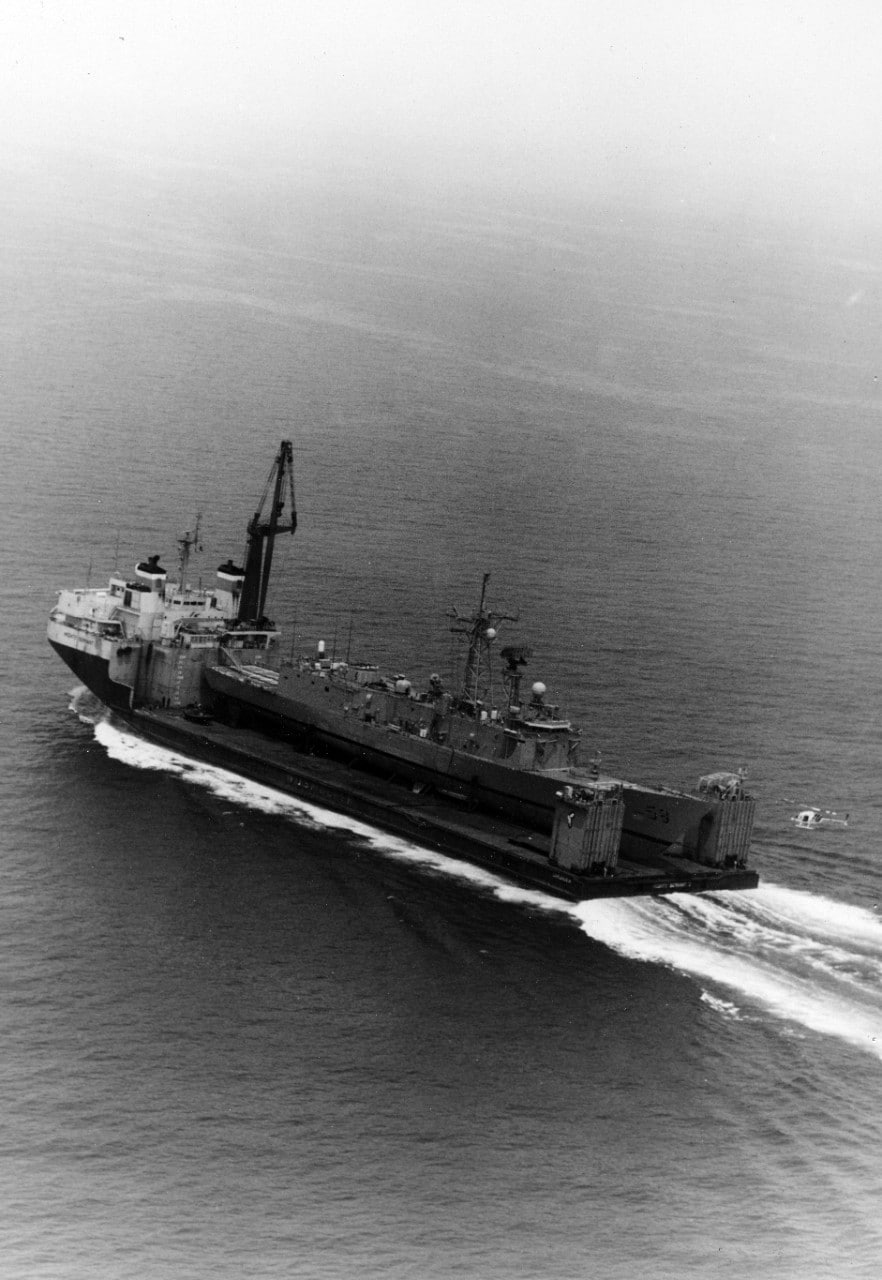
An aerial port quarter view of the Dutch heavy-lift ship Mighty Servant 2 underway with its cargo, the guided missile frigate USS Samuel B. Roberts (FFG-58), secured on deck.
Photo Credit: US Navy
At dawn on April 18, American forces were in position. The objectives were to destroy oil platforms. These platforms were being used as command-and-control centres. The goal was to neutralise naval forces. The US wanted to demonstrate the cost of escalation.
The Opening Strikes
At 8:00 a.m., Surface Action Group Bravo issued warnings. Then it opened fire on the Sassan oil platform. The structure had been used by forces. They used it to coordinate attacks on Gulf shipping.
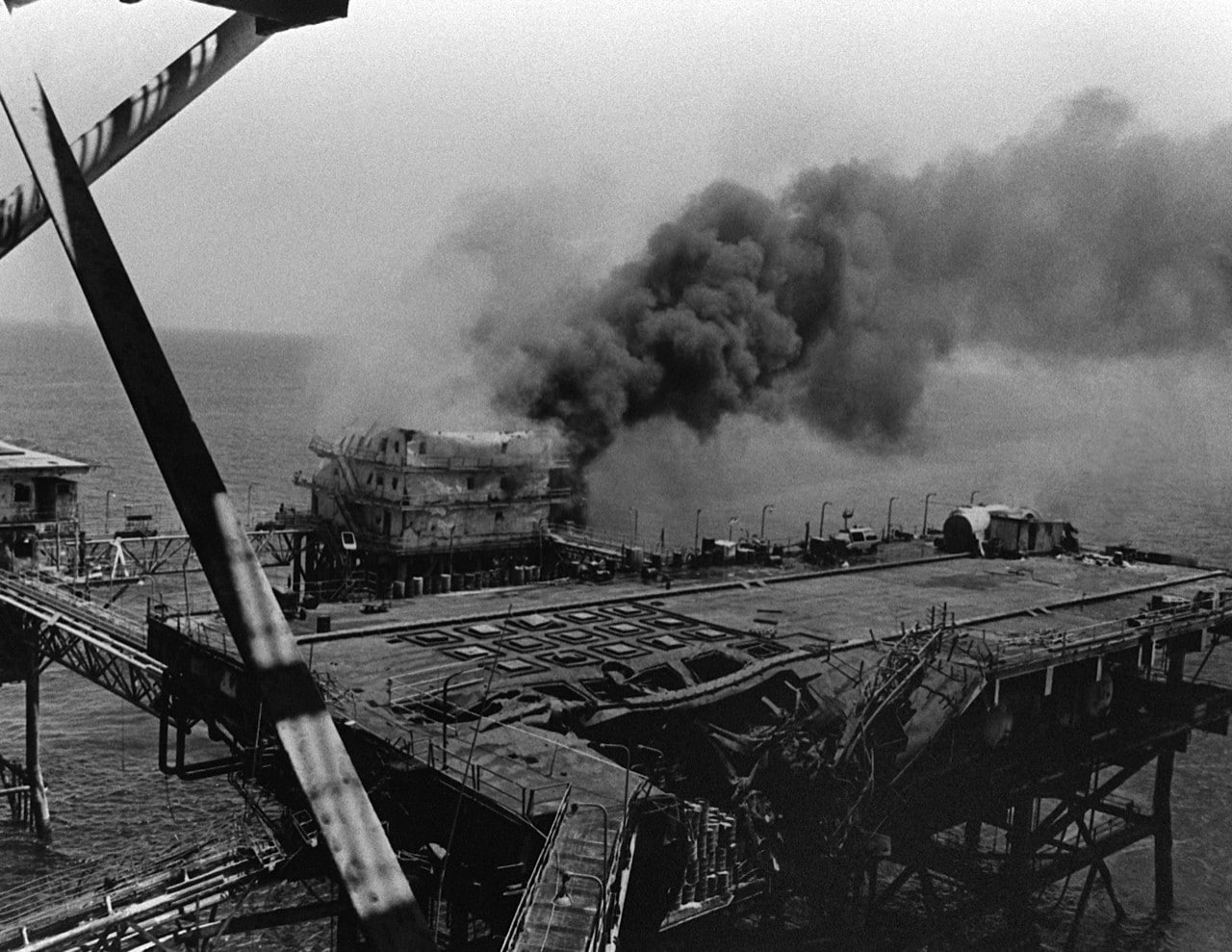
The main building of the Iranian Sassan oil platform burns after being hit by a BGM-71 Tube-launched, Optically-tracked, Wire-guided (TOW) missile fired from a Marine AH-1 Cobra helicopter.
Photo Credit: US Navy
Minutes later, SAG Charlie launched an assault on the Sirri platform.
Both installations were heavily hit. On Sassan, US Marines were inserted by helicopter. They secured intelligence and inspected weaponry. The platform was destroyed in a controlled detonation.
Sirri, already engulfed in flames from bombardment, was deemed too dangerous for boarding.
These strikes marked the phase of the operation.
Escalation At Sea
At 11:30 am, the Iranian patrol boat Joshan approached the ships. It did so despite repeated warnings. The vessel carried a US-made Harpoon missile.
45 minutes later the Joshan fired.
The missile marked the beginning of the ship-to-ship missile exchange in US naval history. American ships deployed chaff and electronic countermeasures. The incoming missile missed.
US vessels launched a series of Standard and Harpoon missiles. The Joshan was struck times. It was later sunk after gunfire.
Air Power Enters The Conflict
At 12:50 pm, Iranian F-4 Phantom jets approached the USS Wainwright. The cruiser responded with Standard missiles. It forced the aircraft to retreat.
At 1:30 pm, Iranian Boghammar speedboats attacked targets. They attacked in the Mubarak oil field near the United Arab Emirates. Among the vessels targeted was the Scan Bay. It was a barge carrying 15 American workers.
In an escalation, President Ronald Reagan personally authorised a US strike. The goal was to defend an American-flagged vessel.

Former US President Ronald Raegan
Aircraft from the USS Enterprise were dispatched. At 2:25 p.m., A-6E Intruders attacked the speedboats. They used Rockeye cluster bombs. One vessel was sunk. Others retreated to Abu Musa Island.
The Destruction Of The Sahand
The significant naval engagement of the day came in the afternoon.
At 3:30 p.m., US forces engaged the Iranian frigate Sahand. It was a British-built warship. It had previously targeted merchant shipping.
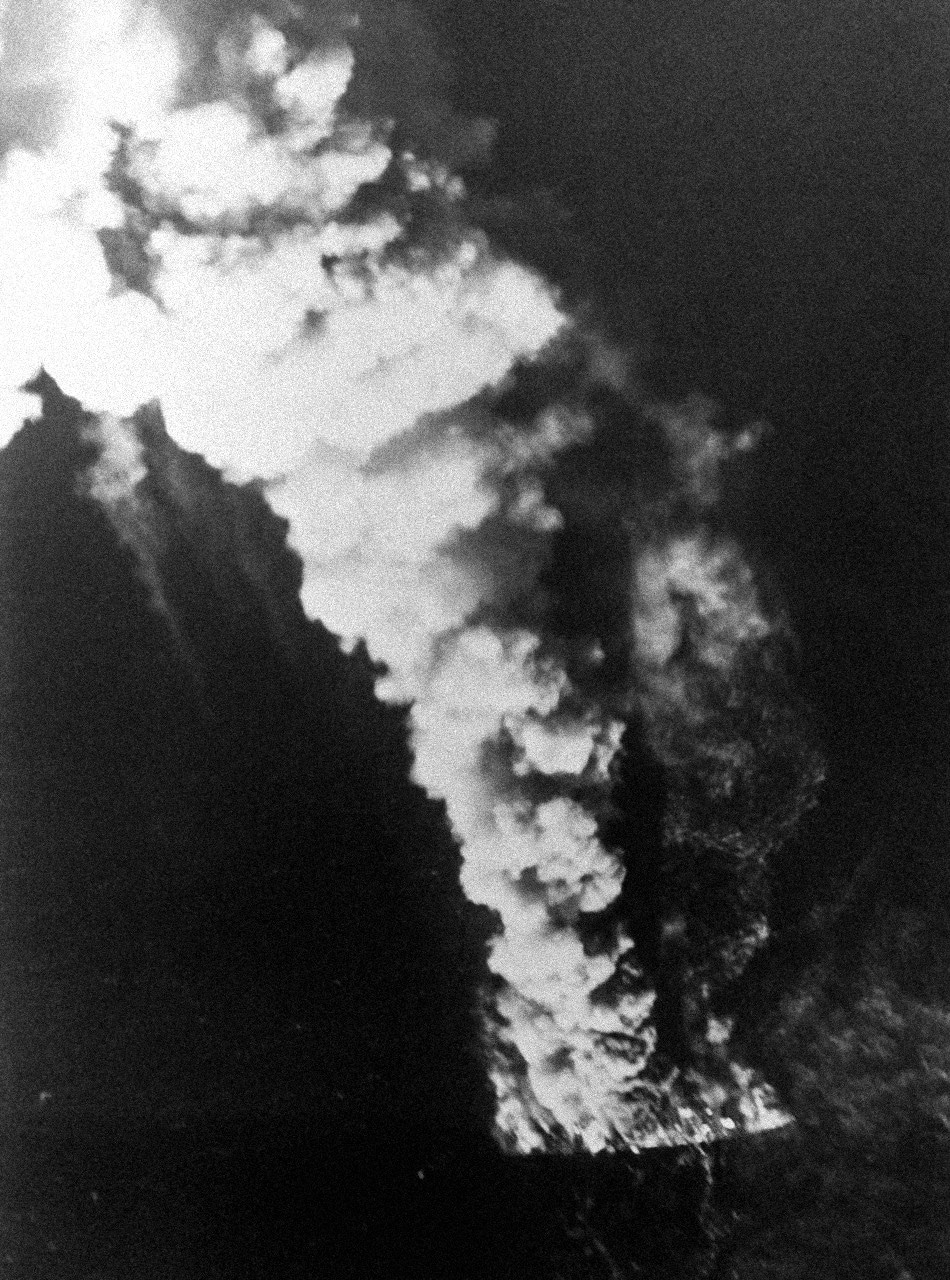
An aerial view of the Iranian frigate IS Sahand burning after being attacked by aircraft of Carrier Air Wing 11 from the aircraft carrier USS Enterprise (CVN-65) in retaliation for the mining of the guided missile frigate USS Samuel B. Roberts (FFG-58)
Photo Credit: US Navy
The engagement was coordinated between aircraft and surface vessels. A-6 Intruders launched Harpoon missiles and precision-guided bombs. The destroyer USS Joseph Strauss contributed firepower.
The Sahand was hit repeatedly by missiles and bombs. Fires spread across the vessel. Hours later, the ship sank.
It was the first warship sunk by the US Navy since the Second World War.
A Decision Not To Escalate
Later that evening, the Iranian frigate Sabalan entered the conflict.
At 5:15 pm, it fired on a US aircraft. The pilot evaded the attack and responded with a 500-pound bomb. The bomb struck the ship's exhaust stack. The explosion disabled the vessel. It was left adrift.
At this point, US commanders faced a decision.
Senior officials in Washington chose not to escalate. Orders were issued to halt attacks on the Sabalan. Iranian tugboats later towed the damaged ship back to port.
The Cost Of the Operation
Iran lost the frigate Sahand. It lost the missile boat Joshan and multiple speedboats. The Sabalan was severely damaged. Two oil platforms were destroyed. At least one Iranian aircraft was hit.
American losses were limited. A Marine AH-1T Sea Cobra helicopter crashed during the operation. Two pilots were killed.
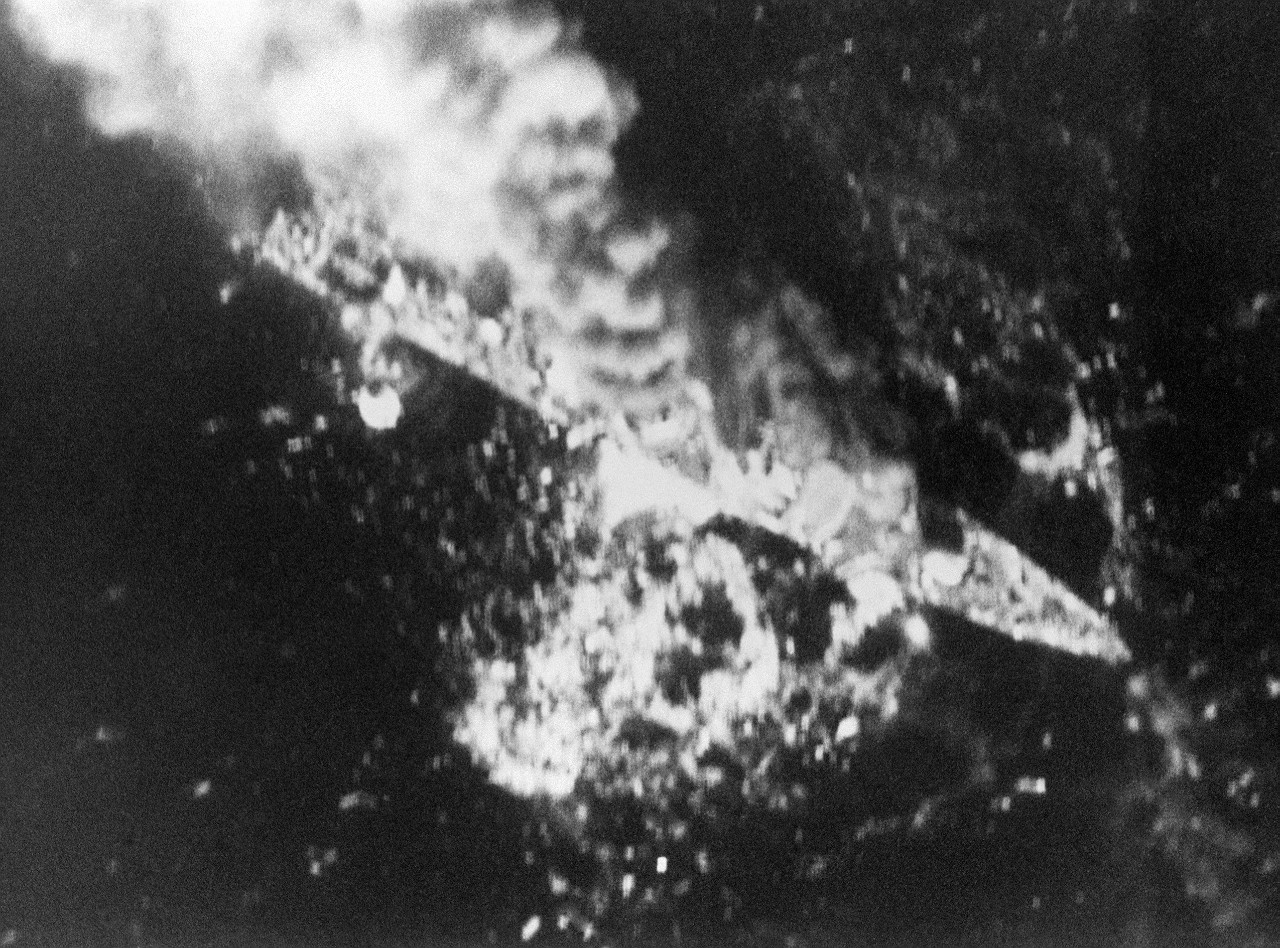
Aerial view of the Iranian frigate IS Alvand (71) burning after being attacked by aircraft of Carrier Air Wing 11 from USS Enterprise (CVN-65).
Photo Credit: US Navy
The operation involved nine US warships and a carrier air wing. It was the largest American naval surface action since World War II.
Strategic Context
The United States had experienced a series of setbacks in the Middle East. These included the 1979 hostage crisis and the 1983 Beirut barracks bombing.
These events shaped perceptions of vulnerability. Iran portrayed the United States as unwilling to respond. Operation Praying Mantis altered that perception.
Within hours, American forces had disabled a substantial portion of Iran's operational navy in the Gulf.
Consequences
On July 3 1988, three months later, the USS Vincennes shot down Iran Air Flight 655. All 290 people on board were killed. The United States maintained that the aircraft had been mistaken for an attacking fighter jet.
The incident deepened mistrust. It remains a point of contention in US-Iran relations.
Facing the prospect of a conflict and mounting losses, Iran accepted a United Nations ceasefire. On August 20 1988, the Iran-Iraq war came to an end. It had been going on for eight years. There were an estimated two million casualties.
-
Blog | The Dantewada Massacre, And What India Needs To Do To Stay Maoist-Free

In 2010, I was Assistant Chief of the Air Staff controlling transport aircraft and helicopters, and on April 6 that year had to arrange An-32 aircraft to carry coffins of 75 CRPF jawans.
-
Opinion | How Iran Has Pierced The One 'Shield' That Protected America For 30 Years
In the past, US campaigns in Iraq, Afghanistan and Libya were conducted against relatively weak air defences. That has not turned out to be the case with Iran, puncturing the long-held myth of America's 'indomitable' air power.
-
Opinion | The Quiet 'Upheaval' Within US Military Over The Iran War
General Randy George's ouster carries echoes of a similar episode in 2003, in the run-up to the Iraq war. But much more is happening within the US military, courtesy Hegseth.
-
How Iran Sucker-Punched Trump Into 'Escalation Trap' 'Hellhole'
Trump is now under pressure, not just from allies but also within; the President's approval rating is the lowest it has ever been with mid-term elections in November.
-
Eagle Down: How US Carried Out Precision Search And Rescue Op In Hostile Iran
How the United States transformed a tactical failure into a narrative of national resolve.
-
Opinion | 450 Missile, 2,000 Drone Attacks Later, Why Is UAE Still Not Fighting Iran?
The UAE is Iran's second-largest trading partner and also home to roughly half a million Iranians. Why, then, has it absorbed more fire than any other Gulf state?
-
In Numbers: How Has India Kept Fuel Prices Low Even As Europe Sees 70% Spikes?
India imports 88% of its crude. Why then is it not seeing massive price hikes for fuel and LPG? Inside the unique strategy it's following...
-
Opinion | India Just Decided To Let Chinese Capital In Again. But There's A Catch
In March 2026, India eased regulations that had restricted Chinese capital in local companies, in a development that marks New Delhi's cautious approach towards capital flows from Beijing.
-
Trump's Iran 'Knocked Out' Claim Blown Up By US Intel On Missiles, Drones
Donald Trump claimed this week the war would end in two to three weeks as he threatened to send Iran back to the Dark Ages. But based on these reports the fighting is far from over, even if US President wants to push a contrary narrative.
-
Opinion | Rs 30 Petrol Hike To Currency Crisis, What Oil At $150 Can Really Do To The World
At $125 per barrel, petrol and diesel retail prices will need to rise by Rs 8-14 per litre. At $150 - which experts think is now likely - these figures could touch Rs 26-30 per litre.