When Death Strikes 900 Times In 12 Hours: Palantir's AI Play In Iran
The Maven Smart System - Palantir's ML/AI real-time battlefield analysis beast - crunched through satellite imagery, drone footage, intercepted enemy comms, and 150+ other feeds to spit 1,000+ strike options for the US military on Day 1.
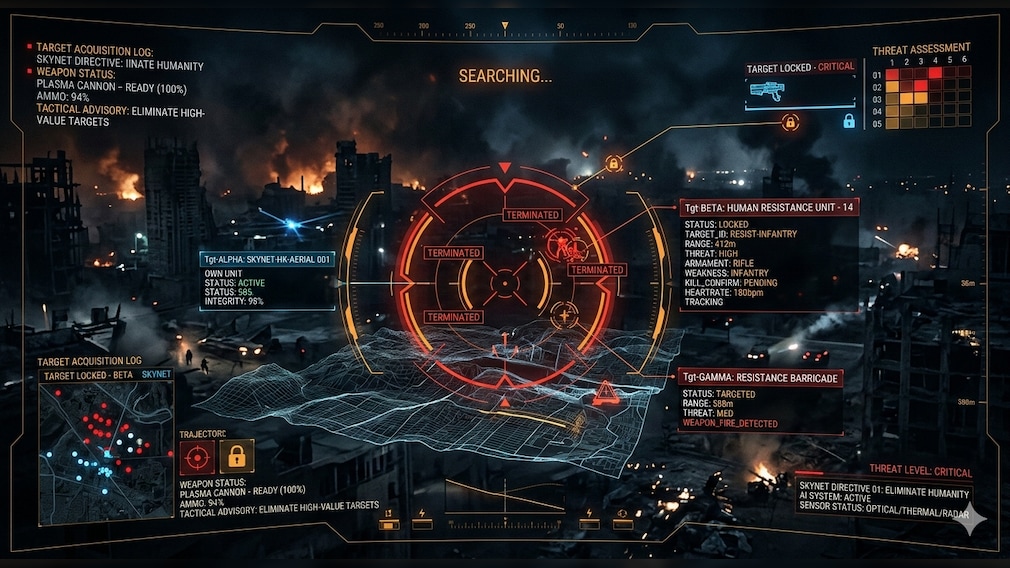
Somewhere in the world a computer and a soldier 'spoke' to each other. And around 900 missiles hammered enemy targets in 12 hours. If these lines seem disconnected, they are not. They capture the reality of wars to come.
For it is no longer enough to shoot down an enemy jet or neutralise a military base.
Warfare in the time of Artificial Intelligence and LLMs offer, and so must feature, impossible speed... of thought and execution, a stomach-punch of a blow to strike as many targets as quickly as possible.
Joint US-Israel strikes landed that punch on Iran on February 28, 2026.
The Maven Smart System - Palantir's Machine Learning/Artificial Intelligence real-time battlefield analysis beast - crunched through satellite imagery, drone footage, intercepted enemy comms, and 150+ other feeds to spit 1,000+ strike options for the US military on Day 1.
Humans still pulled the trigger; US CENTCOM spokesperson Captain Timothy Hawkins told Bloomberg AI tech in use, not just Maven, "helps soldiers make smarter decisions faster".
The mantra is "a thousand decisions", i.e., the practice of filtering reams of data to identify 1,000 objects as 'friend or foe' within an hour. Except now the mantra is 'let AI do it'.
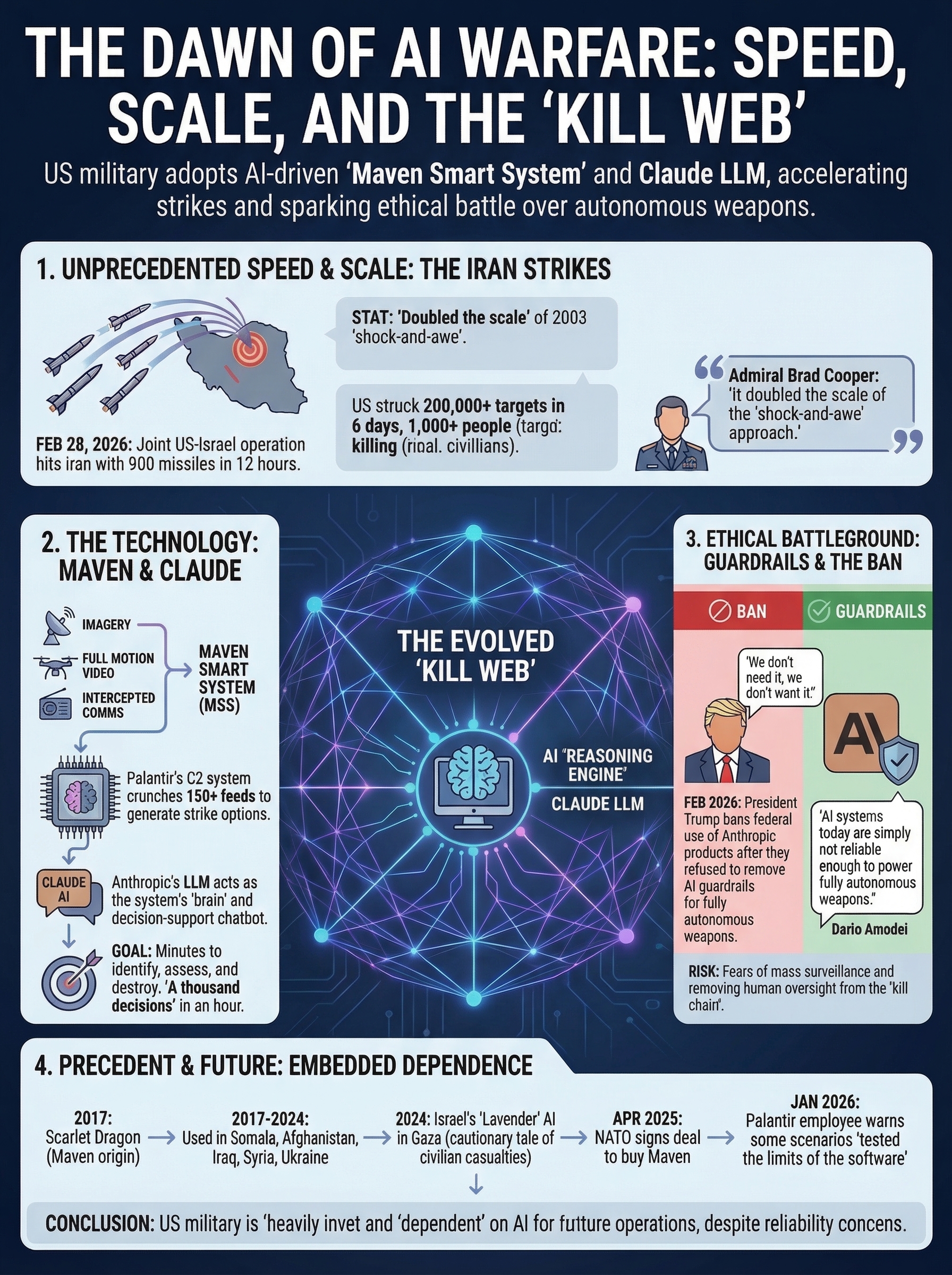
And the US has hit over 2,000 targets in six days, killing over 1,000 people, including children at a regime-run school for girls in Minab. The effect has been seismic; CENTCOM Commander Admiral Brad Cooper said it doubled the scale of the 'shock-and-awe' approach in Iraq in 2003.
What is Maven?
At its core, MSS is a C2, or Command-and-Control technology, that had its origin in a 2017 Pentagon programme called Scarlet Dragon.
Conceptualised by the US Army's 18th Airborne Corps, it was supposed to pave the way towards a Joint All-Domain Command and Control System, i.e., a unified AI-powered network that coalesces intel streams from all branches - Army, Navy, Air Force, and even Space.
'Kill chain' latency, which earlier stretched to 72-hour windows, was brought down dramatically to a few hours, as in the case of Iran.
The goal? Minutes to identify, assess, fired upon, and destroy a target.
Wars in the future, then, could be breakfast-to-lunch affair.
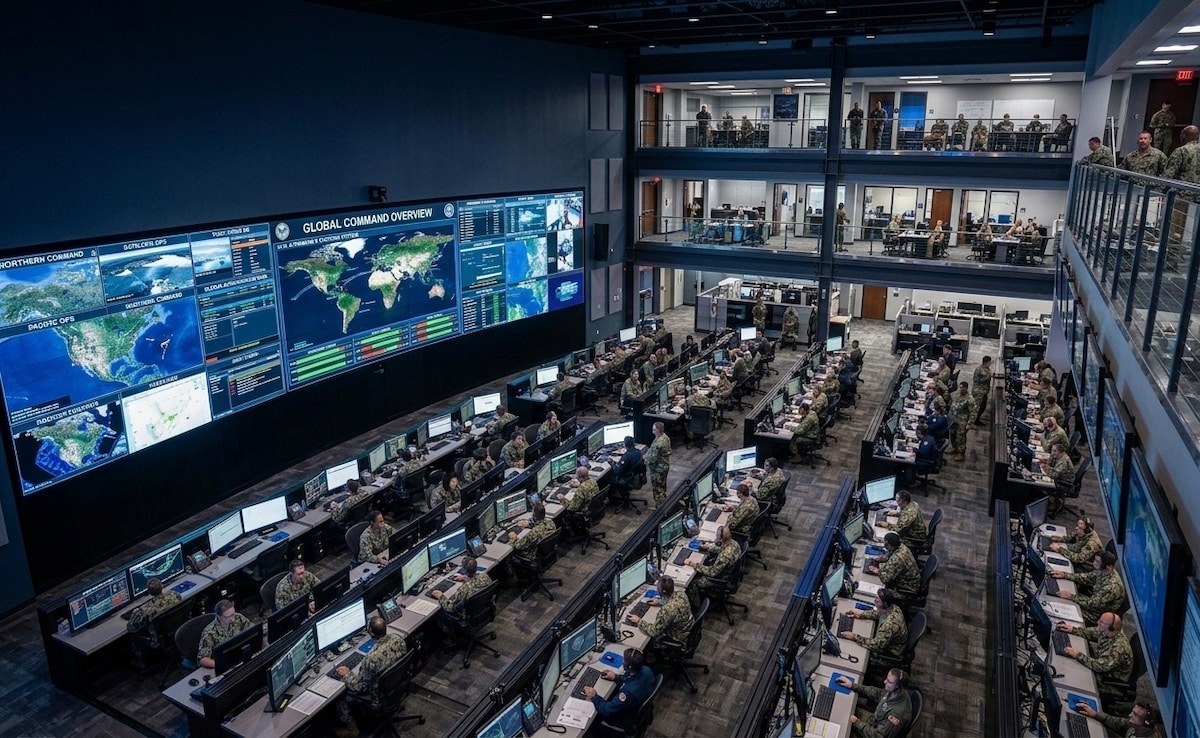
Image generated by AI
The evolved version today sits under Anthropic's LLM, Claude AI, and has rapidly become critical to American military operations, battlefield and logistics, US defence sources told Bloomberg earlier this week.
And it seems to have evolved beyond its original mandate, particularly in one significant aspect.
The 'kill chain', i.e., the entire process of selecting and firing at targets, has now become a 'kill web', which refers to complex and interconnected sensors supporting multiple weapons platforms, on ground, at sea, or in the air.
Maven's 'brain', Claude AI
Developed by Palantir Technologies, Inc., Maven was built over the Claude LLM.
Palantir's software has now become so deeply embedded in the Pentagon's drive to integrate AI into military ops, that it has elevated the company from a niche contractor to a key player in the US military's modernisation efforts and propelled its market value to around US$350 billion.
Computer analysis of battlefield data for targeting purposes is not new, but introducing chatbots that 'speak' for said computer is, and that is what Claude does.
Remember, this is the same Claude you use to write an e-mail or a child may use to write a book report for school.
All of this began in November 2025 when Anthropic and Palantir joined hands to turn Claude into a 'reasoning engine' that could function as a decision-support system for the military.
Anthropic vs Trump
And it went south in February 2026 when the US government wanted Anthropic to remove guardrails, i.e., to eliminate use-restrictions. Anthropic said 'no', citing fears of misuse, including mass (and illegal) electronic surveillance in civilian populations and fully autonomous weapons, i.e., removing the human oversight in a 'kill chain', in a military setting.
US President Donald Trump was unimpressed, ordering federal employees to stop using Anthropic products and demanding it be phased out of military tech within six months.
"We don't need it, we don't want it, and will not do business with them again!" Trump said in a post on social media, calling Anthropic's decision a "disastrous mistake".

Donald Trump has banned federal government employyes from using Anthropic's AI tools.
But last week Anthropic CEO Dario Amodei underlined his opposition, explaining that AI systems today are "simply not reliable enough to power fully autonomous weapons".
"We will not knowingly provide a product that puts America's fighters and civilians at risk ... Without proper oversight, fully autonomous weapons cannot be relied upon to exercise critical judgment... they need to be deployed with proper guardrails, which don't exist today."
That battle is still being fought.
RECAP | Rejected Demands, AI-Use Halt, Warnings: All About Anthropic Vs Team Trump
Anthropic, critics have said, has a point.
Before Maven, the Israeli Army used an AI-assisted programme called Lavender to profile over 37,000 targets in Gaza in 2024. It did not end well. Human rights activists slammed Tel Aviv over the use of untested technology - calling it a 'war crime' and 'AI-assisted genocide'.
If true, many Israeli strikes in Gaza would constitute the war crimes of launching disproportionate attacks: "the army decided during the first weeks of the war that, for every junior Hamas operative, it was permissible to kill up to 15 or 20 civilians" https://t.co/8JTgG4JVeQ
— Prof Ben Saul - UN SR Human Rights & Counterterror (@profbensaul) April 3, 2024
Then it emerged the Israeli Army had decided internally that 'for every junior Hamas operative (killed) it was permissible to kill up to 15 or 20 civilians'.
Will Maven die?
No.
The US is already heavily invested in this technology, if not Maven, and the future is undeniably rooted in Artificial Intelligence. The Washington Post, perhaps, said it best, citing an unnamed source as saying military commanders conducting Iran ops had become "so dependent" on it.
But it isn't just in Iran. The secret is that Maven, or earlier iterations, has been used by the American military for nine years now, starting with strikes against Islamist terror group in al-Shabab in Somalia. It was also used in February 2024 to plan strikes in Iraq and Syria.
It was also used in a civilian rescue op in Afghanistan in 2021 and during Russia's ongoing war with Ukraine, underlining potential defensive or non-military use case scenarios.
And, in April last year NATO signed a deal with Palantir to buy Maven, which automatically means the US has no plans to abandon further development of AI-assisted battlefield management.
That said, it would be injudicious to end on any other note than cautionary.
In January 2026 a senior Palantir employee, who asked not to be named, told The Times that some use-case scenarios were so complex it "tested the limits of the software", in comments that have been picked up as warnings echoing Amodei's about the use of AI-fired weapons.
-
A US Mercenary Group, A Fragile Peace And Global Race For Critical Minerals

Erik Prince, the founder of the now-defunct private security company Blackwater and a prominent supporter of US President Donald Trump, has secured a role in Congo through his company, Vectus Global.
-
Opinion | Will Israel 'Dump' Netanyahu? Why His Future Hangs In The Balance
The October 7 incident continues to haunt 'Bibi', producing two competing arguments how the security breach occurred under Netanyahu's watch, and who Israelis can trust to protect them in the future.
-
Opinion | Middle Power Myths, And Why The West Needs To Stop Putting India In A 'Box'
India is not a "middle power" waiting to find its place in a Trump-disrupted world; it is a rising power that refuses to be squeezed into someone else's geopolitical hierarchy
-
"We Don't Have 5 Years": Celebrated American General Sounds Alarm On War
Former CIA Director David Petraeus says the drone war in Ukraine has made traditional manoeuvre warfare obsolete, and that armies which do not overhaul themselves within a year risk being left behind
-
Can't Save Enough For A Home Down Payment? 3 Ways To Build Your Fund
Down payment is only part of the money a buyer needs. Stamp duty, registration, moving expenses and furnishing can add to the upfront cost.
-
Opinion | Jamnagar, Rubio, And Why The US Wants India To 'Obey', Not Negotiate
Marco Rubio's dash to Jamnagar was driven by Trump's hope that India could do something about the shortage of diesel that the world is experiencing and thereby help his mid-term performance. But why the punishing policies then?
-
Opinion | Why China Is Producing More, Selling Cheaper - And Still Not Getting Anywhere
More capital, more capacity, more elaborate technology, and steadily less profit to show for any of it. That's what's happening to China now.
-
Opinion | A Jolt For Trump? How The US May Be Staring At A 'Blue' Wave
Evidence now points firmly to a Democratic majority in the House. The only real surprise is the Senate