From Aircraft To Lives: Why "Friendly Fire" Can Be Such A Big Enemy
There is not even a millimetre of room for error in judgment - and this is one of the biggest contributors to friendly fire incidents
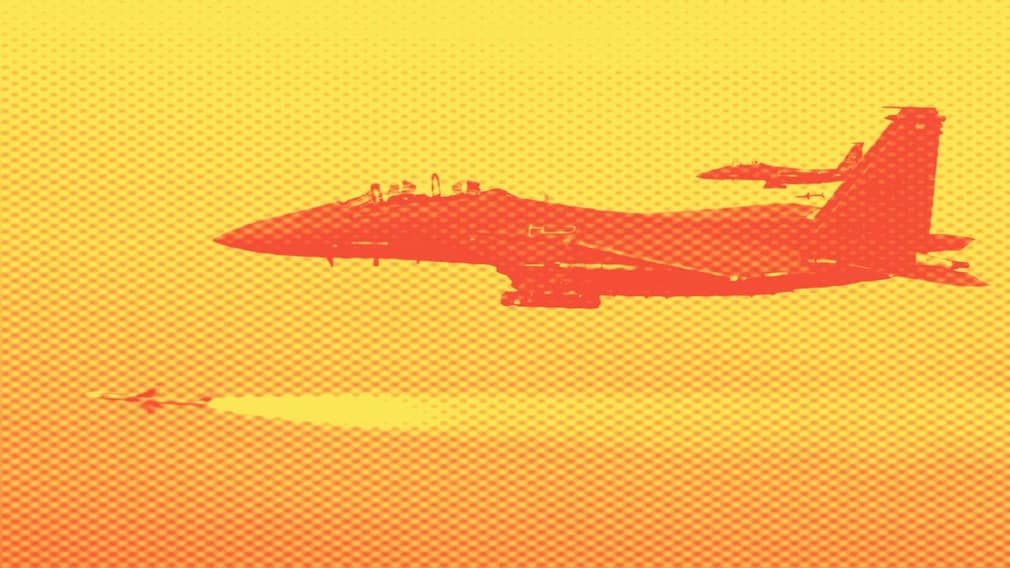
For military aircraft flying in contested airspace monitored by air defence systems operating in their highest alert level, the risk of a blue-on-blue or friendly fire incident rises exponentially.
That is, in the fog of war, the risk of friendly fire becomes very high. Every conflict around the world has seen blue-on-blue incidents.
From as recent as the war in Ukraine to the Gulf War in 1991, the countries involved have lost some personnel and equipment to actions taken by their own forces.
The latest happened today, if what the US Central Command (CENTCOM) said is true.
It said three F-15E Strike Eagle fighter jets "flying in support of Operation Epic Fury went down over Kuwait due to an apparent friendly fire incident". Kuwait has acknowledged this incident, CENTCOM said.
Some social media handles likely run from Iran have claimed Iranian surface-to-air missiles (SAM) blasted the American 4.5-generation fighter jets over the skies of Kuwait. This claim has not been verified.
The F-15E Strike Eagle is a twin-seater fighter jet. All the six aircrew ejected safely over Kuwait, and are in stable condition, CENTCOM said.
Chaotic Situation
Iran has been firing missiles at many Gulf countries in its counterattack to the joint US-Israel strikes that began on Saturday last. Hundreds of ballistic missiles and weaponised drones launched from deep inside Iranian territory have been intercepted by air defence systems in the United Arab Emirates, Saudi Arabia, and Israel, among others.
These countries in the Middle East have bases housing American troops and military hardware including radars that can detect ballistic missile launches. The island kingdom of Bahrain is home to the US Navy's 5th Fleet.
A lot is at stake. Every American ally in the region has their hands on the firing trigger of their air defence systems. They have probably gone through different scenarios and trained for a day like this again and again in the preceding years. No one wants to second guess an incoming threat.
A mistake in identifying a genuine incoming airstrike could lead to a successful mission for the enemy. No one wants that. So, the people whose eyes are glued to the radar screens of air defence systems have to take calls on the fly, trusting their training, instinct and technology. There is not even a millimetre of room for error in judgment - and this is one of the biggest contributors to friendly fire incidents.
The Problem
A common answer that most defence analysts agree narrows down to the difference between operating in a safe airspace and flying over enemy territory. In layperson's terms, the Kuwaiti air defence systems would have taken out the American jets when they were at their most 'relaxed' state, away from any Iranian threat.
However, there would have been no guarantee the F-15E Strike Eagles would have gone unscathed in hostile Iranian airspace if the Islamic nation's air defence systems had not either been jammed by very capable electronic warfare aircraft or a majority of the assets already destroyed by US-Israel strikes.
The Western aircraft that are said to be crisscrossing the skies over Iran are all modern stealth aircraft. While not completely invisible, it would be extremely hard for Iran to get them.
But an aircraft like the F-15E Strike Eagle - which traces its roots to the 1970s with the development of the F-15A single-seater air superiority fighter - is the opposite of the definition of stealth.
Theoretically, chances are high that the 4.5 generation F-15E Strike Eagles entering Iranian airspace would have been taken out by Iran's vast air defence network - if the US jets did not have the aid of modern jammers and standoff anti-radiation missiles that seek and destroy SAM radars autonomously.
Kuwaiti Air Defence
While no details are available about how exactly the three F-15E Strike Eagles were shot down, defence analysts have shared some theories that are common with friendly fire incidents.
The US fighter jets flying in the friendly Kuwaiti airspace would likely have enjoyed a sense of security since they faced no active threats. Anything could have happened - from gaps in communication between older and newer platforms to plain ol' human error.
Kuwait's air defence network includes several batteries of battle-tested Western equipment such as the Patriot PAC-2 and PAC-3 medium-to-long range SAMs that double up as anti-ballistic missile systems.
In the medium range category, Kuwait uses an unknown number of Italy's Spada 2000. The older MIM-23 Hawk medium range SAM is still in service in the small nation that faced an Iraqi invasion under dictator Saddam Hussein's rule, which had triggered the Gulf War in 1991. It's not known how many MIM-23 Hawk SAMs Kuwait has.
In the short-range role, Kuwait's Skyshield 35 system works as a shield against threats to civilian infrastructure and military bases from low-flying aircraft, drones, and missiles.
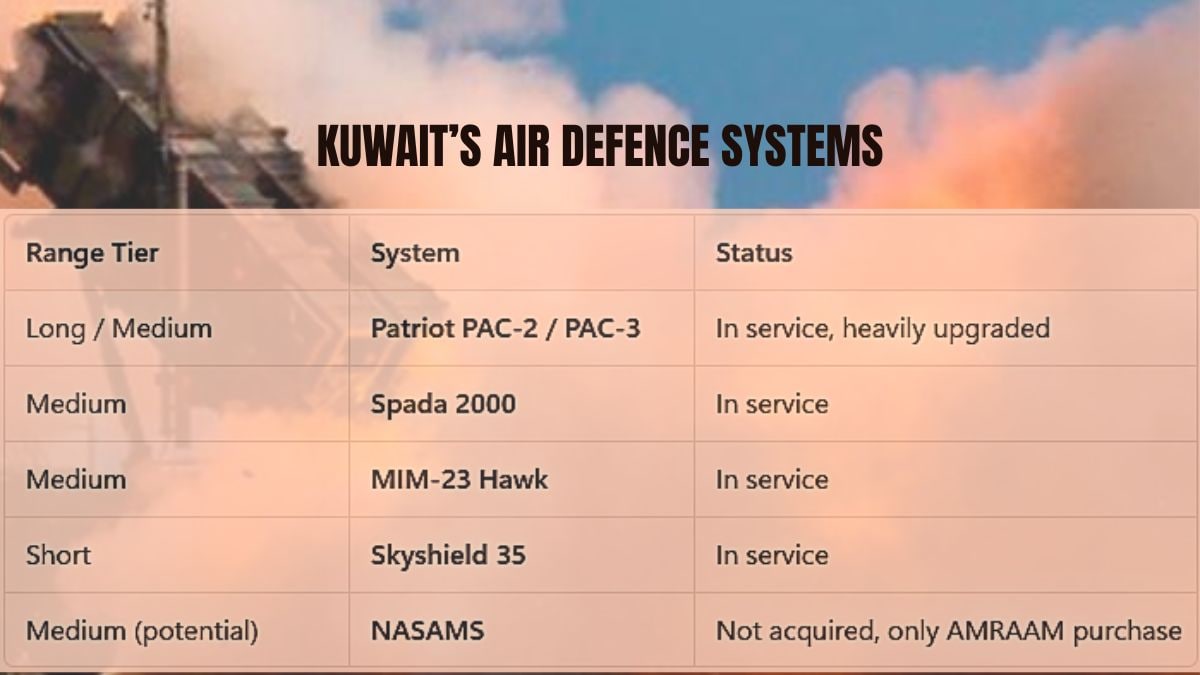
All these are capable systems if operated by skilled hands in an ideal environment. Explained another way, what it means is that it wouldn't be difficult for these SAMs to shoot down friendly aircraft by accident in an airspace considered to be safe and one's own.
Iran's Air Defence
Iran, a country much larger than Kuwait, has a bigger network of air defence systems with a larger number of SAMs and equipment models. The Islamic nation, whose supreme leader Ayatollah Khamenei was killed in the US-Israel strikes, uses a standard layered system of a mix of homegrown and imported systems.
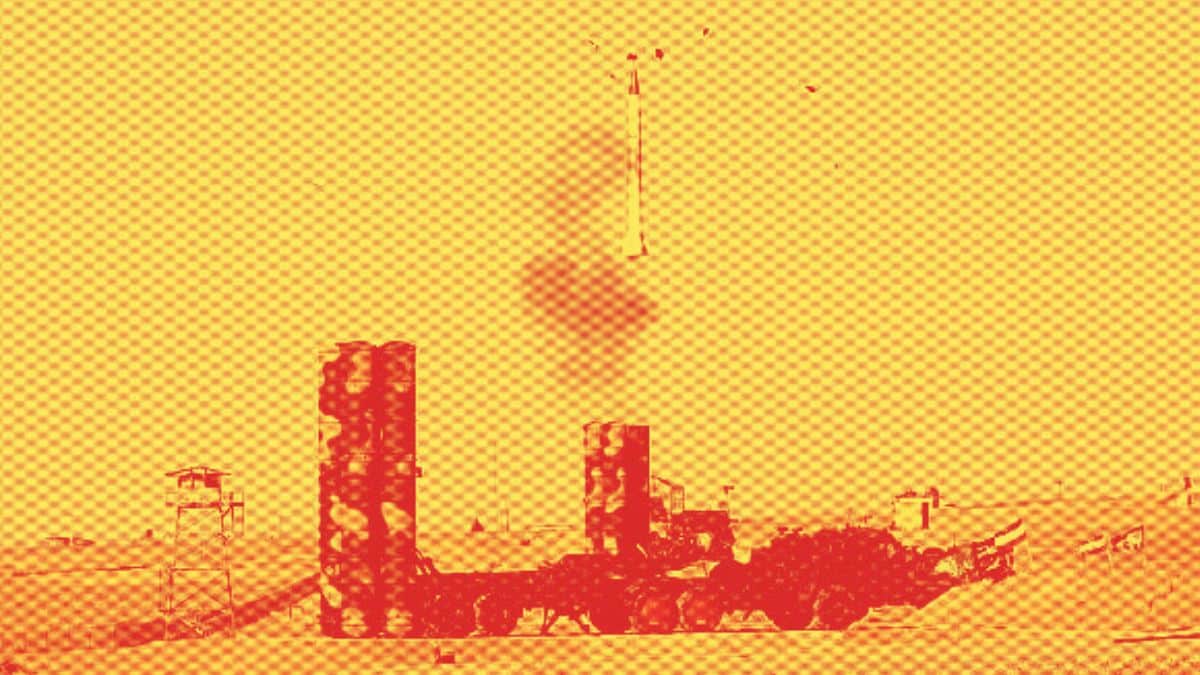
Iran uses the homegrown Bavar-373 SAM in the long-range category. The state media claims it has a range of some 300 km, comparable to the Russian S-300 system. A variant of this Russian system, S-300PMU2, adds muscle to Iran's long-range air defence capability.
In 2023, Iran showed to the world what it claimed to be its latest homegrown long-range SAM system, Arman.
Iran's top bragging rights on air defence may well be the Chinese HQ-9 that it received in 2025. The exact number is not known.
There are a mix of short-range and point defence systems spread across the length and breadth of the Islamic country. These include Khordad-15, Raad-2, and Mersad. While Raad-2 traces its roots to the Soviet Union's days, the Mersad is an upgraded version of the legacy American MIM-23 Hawk from the 1970s.
-
Opinion | The 'AIPC' Was Once Congress' Boldest Idea. What Happened To It?

Tharoor, to Chakravarti, to Yaskhi now, the fate of a Congress 'experiment' that started in 2017 will tell you a lot
-
Woman Biker Hit, Air Force Veteran Attacked: The Lawlessness In Gurugram
What gives confidence to some elements in Gurugram to break the law again and again in full public view and on camera?
-
Opinion | When The Feed Braves The Flood
NDTV drops the 24x7 and stakes its next chapter on presence as it inaugurates a new identity
-
The Politics Of Blue: Why Akhilesh Yadav-vs-Mayawati Over A Colour Is Just One Shade Of History
A movie starring Rajinikanth tells us how colours can carry meaning beyond what meets the eye. The latest row over Akhilesh Yadav's party adopting blue, and Mayawati objecting, can be a starting point for understanding the many shades of history.
-
2 Indians Survived 9/11, Then American Justice System Became Their Nightmare
Pulled off a Texas train hours after 9/11, two Indian men were plunged into America's largest terror manhunt.
-
Opinion | Building BRICS In New Delhi
For India as the host nation, chairing the summit tests the core tenet of its modern foreign policy: strategic autonomy.
-
Can India 'Mediate' Between Iran And UAE At BRICS? Gulf Envoy Suggested It Once
At the very start of the Israel-US war on Iran, it was a UAE diplomat who had suggested as much.
-
I Went Looking For A PG In Delhi's Kamla Nagar. Here's What I Found
In every PG visited by NDTV in Delhi's Kamla Nagar, the conversation began with amenities. Nothing in the sales pitch was about how secure the building was.