The US Was Right: Iran Has A 'Nuclear' Weapon, But It's Not A Missile
The US-Israel war on Iran has taught Tehran a valuable lesson - it may not have a nuclear weapon, but it controls the Strait of Hormuz, a vital oil and gas shipping route that gives it strategic leverage akin to a nuclear deterrent.
Nuclear weapons. Specifically, an estimated 440kg of 60 per cent enriched uranium, short of the 90 per cent weaponisation threshold but enough to make eight to 12 bombs, if needed. That was the target the United States painted on the map of Iran likely hanging in Defence Secretary Pete Hegseth's office, and in the Pentagon war room, before this war began.
For decades the US, Europe, and Israel have feared Iran getting a nuclear weapon.
The argument has always been that a nuke for Tehran might prompt other regional powers - like Saudi Arabia, Egypt, or Turkey - into a nuclear arms race in a volatile part of the world, one that supplies it with a third of all oil and gas, and vast amounts of fertilisers and other raw materials.
The not-so-public concern has always been loss of strategic control over West Asia, i.e., fears that a nuclear-capable Iran rewrites regional power equations and weakens Western ties with other Arab states, costing it a key trade and military hub connecting Europe and the rest of Asia.
And for decades - most of which it laboured through under debilitating economic sanctions and threats of war - Iran felt it needed nuclear weapons to protect its national security.
But, as it turns out, Iran never really needed a nuclear deterrent.
It had the Strait of Hormuz.
Iran Found Its 'Nuclear Weapon'. Now The US Has To Adapt
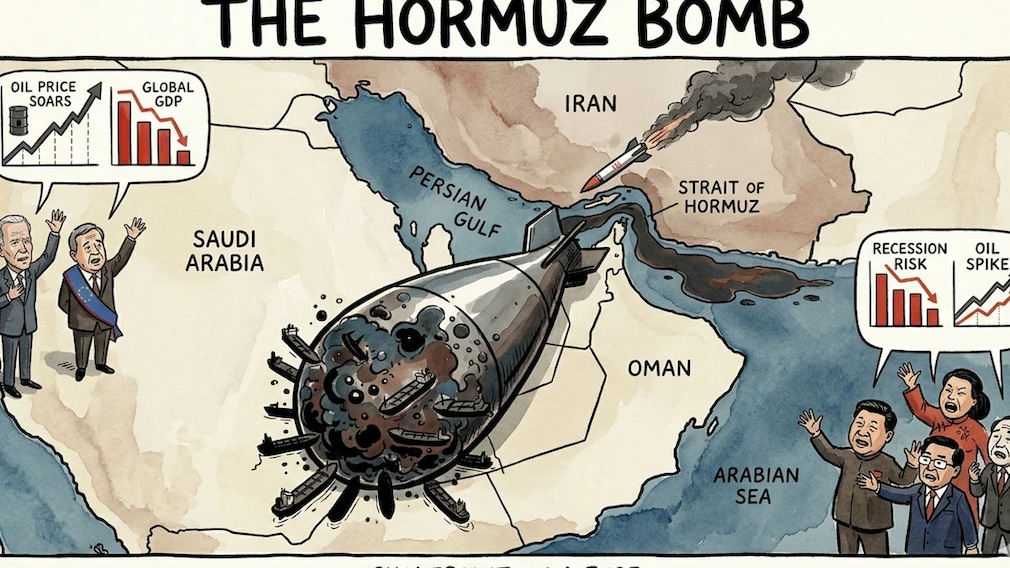
Tehran's throttling of tanker traffic revealed the channel - which handles 20-25 per cent of the world's seaborne crude oil and gas trade - to be the geographical equivalent of a nuke.
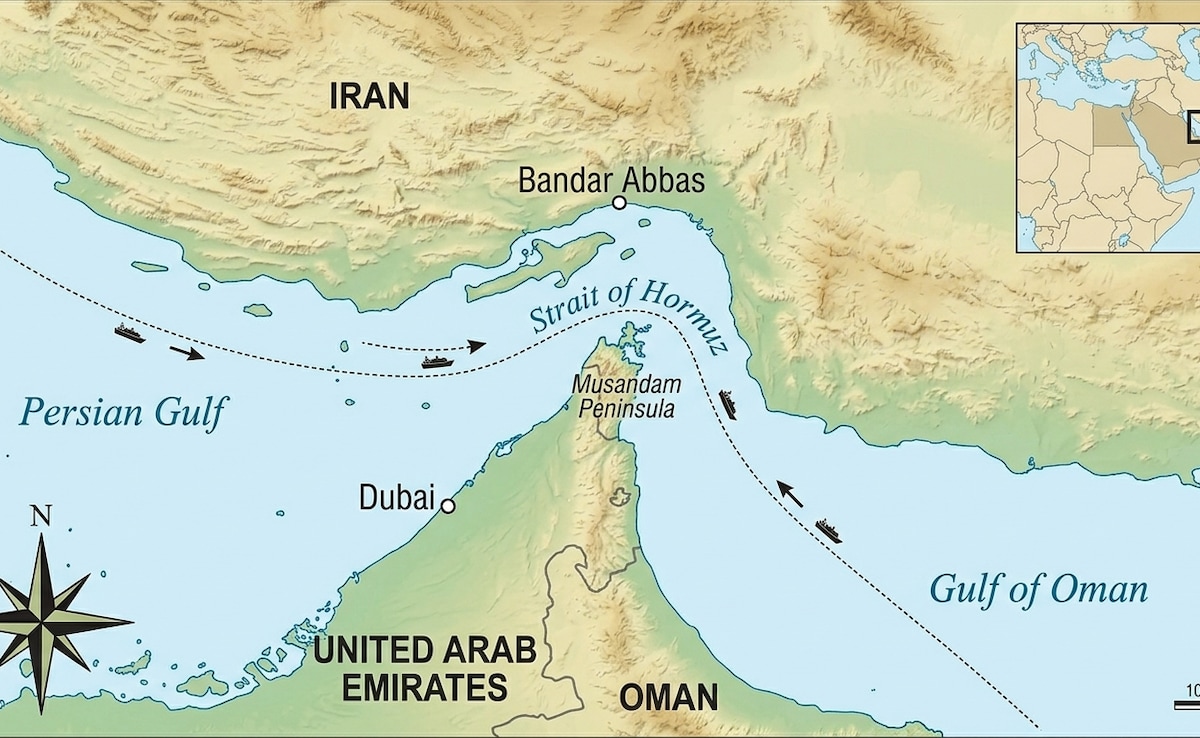
Image generated by AI
The US rushing into war meant Iran dropped that nuke, primed and ready to detonate, into the world's lap. And it learned a valuable lesson, one already the centrepiece of its military strategy going forward, hence the demand for its 'authority' over the waterway to be recognised.
That point is critical because it suggests the Hormuz chokepoint will reshape regional geopolitics well after this war is over. It hands Iran a potent trump card for future conflicts.
The Hormuz-shaped nuke
The Hormuz connects the Persian Gulf to the Gulf of Oman and the Indian Ocean.
Specifically, it connects crude export terminals in Saudi Arabia and the UAE to markets in Asia and beyond. Before the war an estimated 20-21 million barrels passed through it daily.
The majority was bought by India, China, South Korea, and Japan; these four purchased an estimated 76 per cent in 2025 and together accounted for 30 per cent of global GDP.
Crude shipped through the Hormuz is also a critical source of energy for smaller (and poorer) Asian countries, including Bangladesh, Pakistan, Sri Lanka, and the Philippines, as well as southeast nations like Cambodia and Laos, all of which are now in fuel-rationing mode.
The impact of Iran choking crude quickly reshaped the global economy.
Last month American financial services firm Morningstar said global losses could run from $330 billion to $2.2 trillion, depending on how long the war lasts and the degree of paralysis.
The US Federal Reserve was less pessimistic, but still said that even a single quarter's closure could lower global GDP growth rate by an annualised 2.9 per cent.
For India, the chokehold could translate into a potential one per cent loss in GDP, a setback limited by the country being better equipped to deal with oil price volatility than others.
Arming the 'nuke'
The strait is less than 33km wide at its narrowest point - a kink that takes it past Iran's mountainous western coast and past the watchful eyes of the fortified Kharg and Qeshm islands, and gives it control over one of only two recognised shipping lanes in the passage.
Once the war began Tehran choked the strait to drive Brent crude prices past the $110 a barrel red line and forcing fuel and gas price hikes for consumers in Europe, the US, Africa, and Asia.
All it really had to do was warn tankers against crossing and fire at a few to make its point, and insurance providers and ship owners did the rest, driving up premiums and charter rates.
Transit numbers tumbled within hours. Crude stored in port terminals built up, forcing oil production to slow down or even shut. And cue the biggest oil crisis in decades.
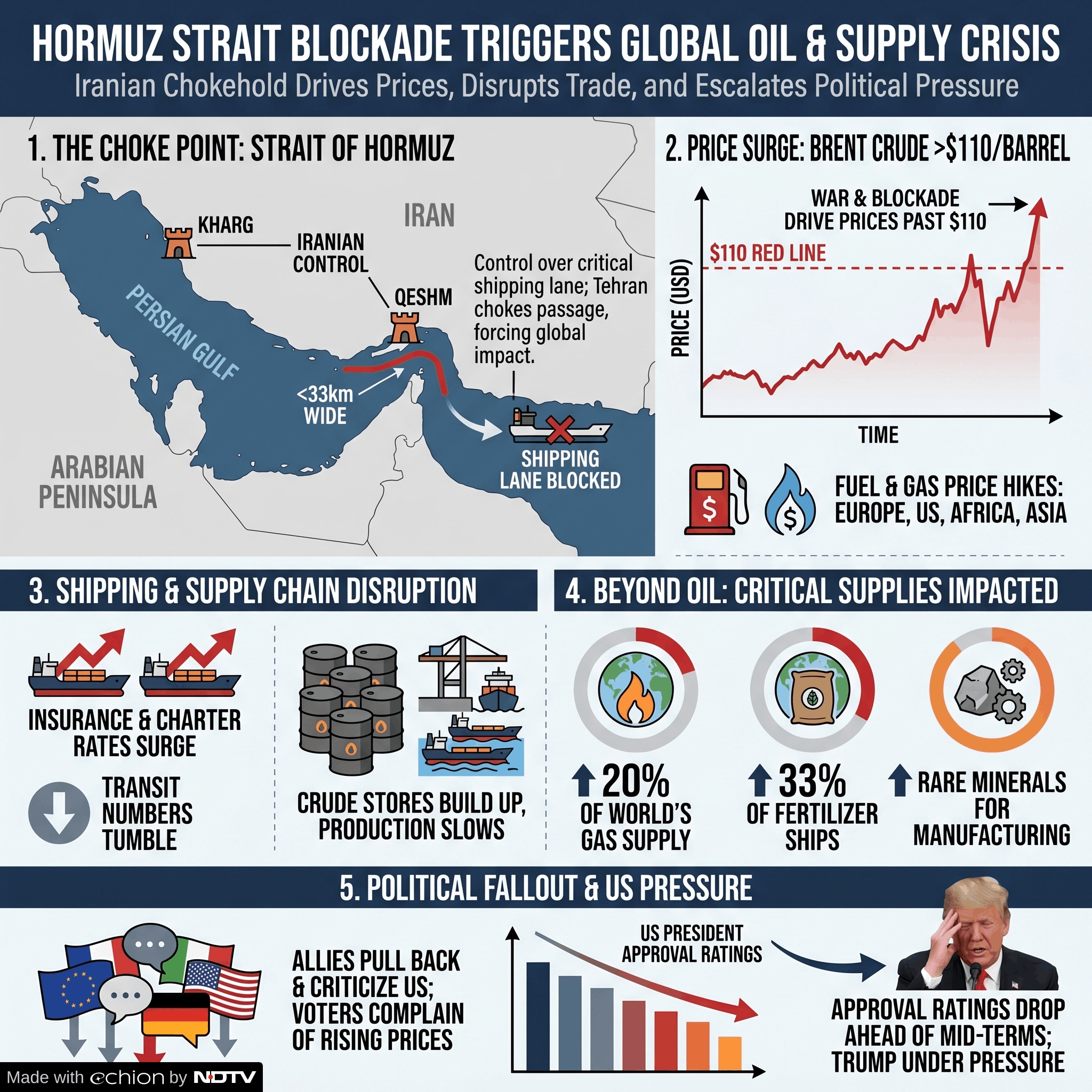
It wasn't just oil. Around 20 per cent of the world's gas supply and 33 per cent of its fertiliser ships through the Hormuz, as well as rare minerals needed for manufacturing processes.
Allies in Europe, already upset because they were not consulted at the start of the war, have begun pulling back and even criticising the US as their electorates complain of rising prices. And American voters began grumbling over fuel prices too, driving down the president's approval ratings ahead of the November mid-term election.
And this put US President Donald Trump under pressure.
The pressure was evident in Trump's rants on Truth Social, in which he repeatedly demanded Iran re-open the strait or face dire consequences. Iran laughed off the threats. The strait remained closed. And there was little the US could do.
But what after peace?
US and Iran negotiators are expected in Pakistan this week for a second round of talks.
Vance Heads For Deal Do-Over, This Time With No One Across Table
And the world will be willing both sides to reach an agreement, or at least extend the ceasefire.
But whether or not the fighting resumes, Iran knows the Hormuz gives it a critical advantage over the US.
$4.5 Billion A Month Jackpot: Why Iran Wants Hormuz 'Authority'
How much it can squeeze out of that advantage is an entirely different debate, one which the US and the global community has already taken up. The US has made its displeasure clear at the prospect of Iran levying tolls up to $2 million per ship.
Other Gulf countries - for whom the Hormuz is a critical export avenue - have voiced similar concerns and the United Nations has stressed that strategically important waterways like the Hormuz must remain open and free to global shipping.
But Iran has made it equally clear that it disagrees and that it is not a signatory to the United Nations Convention on the Law of the Sea, a statute that sets out the law for international waters. Iran firmly believes the Hormuz - at least the 12 nautical miles (roughly 22km) from its coastline that it is legally entitled to - is its sovereign territory.
-
Opinion | A Rs 5,000 Fine Can't Fix India's 'Babu' Raj. But It's A Start

A new bill in Delhi imposes a fine of Rs 250 a day on bureaucrats, with a Rs 5,000 ceiling, if their service for citizens is delayed without a valid justification. Can this fix India's great 'Babu' bottleneck?
-
Opinion | Kaveri To J-20, How China Overtook India In A 40-Year-Old Race To Build Fighter Jets
Both launched ambitious military jet engine programmes during the 1980s. Both depended heavily on Soviet and Russian technology. Four decades later, however, the finish line tells two dramatically different stories.
-
Opinion | US Attack On Chabahar, And Why It's Time India Stopped Playing By Others' Whims
As the US destroys Chabahar in Iran, one thing is clear: India cannot wait eternally for the whims of others to do what is vital for its own interests.
-
Beyond Low Cost: Why Foreigners Choose India's Healthcare Over The West
India's medical tourism industry is estimated to be worth $12.32 billion in 2026. It is growing much faster than the country's overall tourism sector.
-
Opinion | Is Sharad Pawar Planning To Merge NCP With NDA? Behind The Ongoing Calculations
The NCP patriarch, turning 86 this year, will have to take a decision soon - before someone else takes it for him.
-
Opinion | Maa Behen, Obsession, And The Gaze That Eats Itself
Every society has a woman it has already judged. Every man has a story about her. Cinema has long inherited both.
-
'School Fees Are Just The Beginning': The Hidden Cost Of Educating Children
Tuition classes, digital devices, transport, uniforms, extracurricular activities, and competitive exam coaching have made education a costly affair.
-
NDTV Probe: CSAM, Sexually Suggestive Content, Gun Culture On Social Media
The probe has uncovered a wider pattern of exploitative and illegal content slipping past moderation, raising questions about the consistency and effectiveness of enforcement.
-
Ice Stupas To Education Reforms: The 'Fast' Evolution Of Sonam Wangchuk
Sonam Wangchuk remains a prominent figure whose activism spans climate change, education reform, democratic rights and environment conservation.
-
Opinion | Pakistan's Iran Problem Isn't Going Anywhere
Despite its glowing successes, and for all its mediation efforts, Pakistan's toughest audience may be in Iran itself