Hitting A Bullet With A Bullet: No Such Thing As Ballistic Missile Shield
The most effective ballistic missile defence remains what it has always been: not letting the missile launch in the first place

Ballistic missile technology is crazy good. To try to stop an incoming ballistic missile is crazier, like "hitting a bullet with a bullet". This line from a work of fiction is easy to understand for the layperson who has no interest whatsoever in intercepting a ballistic missile or destroying the world.
But time, tide and technology wait for none.
The development of the atomic bomb and ballistic missile technology grew into a friendship that promised the end of the world on demand - the nuclear warhead would ride the ballistic missile from one place on Earth to somewhere far away on the other side of the Blue Planet.
For decades, humanity imagined the ballistic missile only with cautionary tales of Doomsday and post-apocalyptic dread.
That imagery is changing, data shows.
These days and in recent years, reports say, hundreds of ballistic missiles have been fired during the Israel-Iran and Ukraine-Russia war. Between 1980 and today, some 5,500 ballistic missiles have been fired in combat. This includes those launched in wars involving the Soviet Union-Afghanistan, Iran-Iraq, Russia-Ukraine, Houthis, Armenia-Azerbaijan, Libya, and the US. Whether Saudi Arabia and Israel have fired ballistic missiles in combat is not known; they have never publicly acknowledged it.
The last two years saw a spike in ballistic missile use beginning with the Red Sea Crisis when Yemen's Houthis, supported by Iran, launched many of them on Israel, an analysis by the Armed Conflict Location and Event Data (ACLED) said. The Houthis also created its first "locally made" ballistic missile, the Burkan-1, an extended-range version of a Soviet-era Scud based on Iran's Shahab-1, said ACLED, a research body supported by the United Nations Complex Risk Analytics Fund. The Yemen-backed group had another first to their name - they launched the world's first anti-ship ballistic missile in November 2023, the US Central Command (CENTCOM) said.

A pattern that emerges is that ballistic missiles are becoming the new 'local' rockets, and shifting away from the strategic use reputation it carries, though their strategic use will always remain in the background.
All these developments bring an important question: what are countries doing to defend against ballistic missile attacks?
No country can intercept every ballistic missile fired at it. The real-world success rate of interceptions is likely around half of the results achieved under controlled test conditions that are more favourable than any actual war would provide.
A ballistic missile warhead in the final moments before impact, or terminal phase, travels between Mach 5 and 10 times the speed of sound or more, depending on the type. The interceptor has to calculate where the incoming warhead will be in real-time, with sensors that can be jammed or confused, against an object that may be trying to dodge it. The window to kill the threat in the terminal phase can be as short as a few seconds.
The problem compounds at each phase of the missile's trajectory. Destroying the missile just after launch when it is slowest or before it can shower multiple warheads is theoretically the most attractive choice. The practical problem is geography: a launch can happen from anywhere.
A ballistic missile travels the longest in the midcourse. This gives a lot more time to interceptors to attempt a kill, but this is also a zone where decoys are said to be effective. A missile carrying one real warhead and 10 balloons of the same radar cross-section may force the interceptor to guess.
A myth about ballistic missile defence is that a high test success rate means operational reliability. It is not, and the gap between the two is not a technical footnote - it is the central question.

Controlled tests are conducted with knowledge of the missile's trajectory, type, and timing. The interceptor knows, broadly, what is coming. Real-world use assumes none of this. The US Missile Defense Agency's own test record for the Ground-Based Midcourse Defence showed a success rate of 55 per cent.
This means there may not be any such thing as a ballistic missile defence shield that can stop threats in absolute numbers. It is, at best, a probabilistic filter. No country that fields ballistic missiles with nuclear warheads is deterred by the existence of missile defence systems in the way that popular imagination suggests.
Russia and China have both invested heavily in hypersonic glide vehicles, which manoeuvre unpredictably in the atmosphere and are specifically designed to defeat interceptors. The existence of these weapons is, itself, a commentary on how seriously major powers take the shield question.
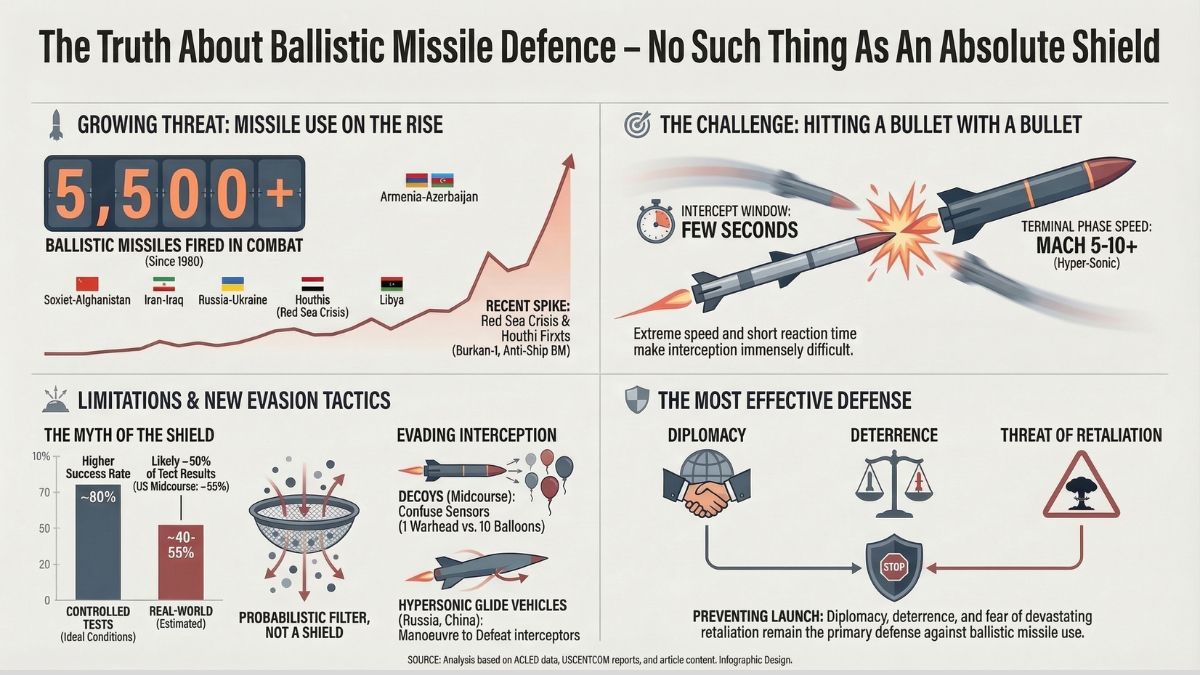
The most effective ballistic missile defence remains what it has always been: not letting the missile launch in the first place. Diplomacy, deterrence, and the threat of devastating retaliation have done more to prevent ballistic missile use than any interceptor system yet built.
It took a work of fiction to perfectly convey to the layperson what ballistic missile defence is all about.
In the 2025 thriller 'A House of Dynamite' directed by Kathryn Bigelow of 'Zero Dark Thirty' fame, two top US government officials were shown discussing their options, with just minutes left for an intercontinental ballistic missile to hit Chicago.
"Once the kill vehicle separates, our midcourse intercept system has a success rate of 61 per cent," one of the officials said.
"So, it's a coin toss? That's what 50 billion dollars buys us?" the other said.
"We are talking about hitting a bullet with a bullet," the first official replied.
-
When Death Strikes 900 Times In 12 Hours: Palantir's AI Play In Iran

The Maven Smart System - Palantir's ML/AI real-time battlefield analysis beast - crunched through satellite imagery, drone footage, intercepted enemy comms, and 150+ other feeds to spit 1,000+ strike options for the US military on Day 1.
-
For Ayatollah Khamenei, Death Came In Form Of A Blue Sparrow From Space
The 86-year-old supreme leader, who had spent much of the previous weeks sheltering deep underground amid fears of Israeli strikes, had surfaced to attend a high-level meeting. Within hours, he would be dead.
-
Opinion | How Pakistan Became World's Only Muslim Nuclear-Powered Nation - Secretly
Trump is bombing Iran now for allegedly building nuclear weapons. But America had once let Pakistan illegally develop an N-bomb right under its nose. This is the scandalous story of 'Project 706'...
-
Opinion | Will The Iran War Force Pakistan To Pick 'Sides'?
Given its economic dependence on Gulf countries and strategic leanings toward the US, Pakistan will aim to contain any overt anti-American positioning in public protest or state rhetoric.
-
'Did It My Way': Nitish Kumar Quits As Chief Minister After 20 Years Reshaping Bihar Politics
Nitish Kumar this week brought the curtains down on a two-decade journey as Chief Minister of Bihar ahead of a shift to the Rajya Sabha.
-
Why US Sinking Iran Warship Is A Major Wake-Up Call For India's Submarine Arm
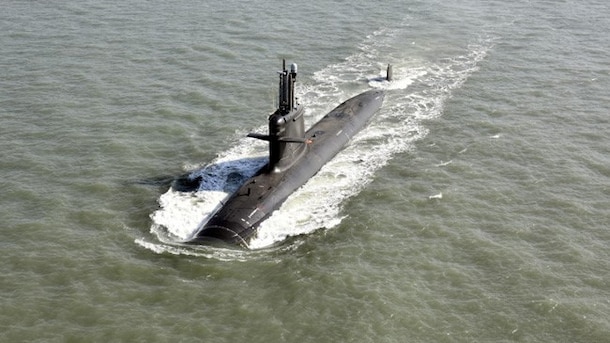
Project 75-India, the programme meant to field six next-generation submarines with submerged endurance-boosting air independent propulsion (AIP) tech and land-attack missile capability, was conceived in the late 1990s.
-
Opinion | A Dark Truth: Why Iran, Ukraine Get Bombed, But Pak, Israel, N Korea Don't
With the Iran blitz, the message to smaller and military states is shaping up to be this: 'build the damn bomb - if not legally, then the way Pakistan did in the 1970s'.
-
Opinion | How 12 'Insurers' Sitting In London Paralysed Hormuz - All With A Phone Call
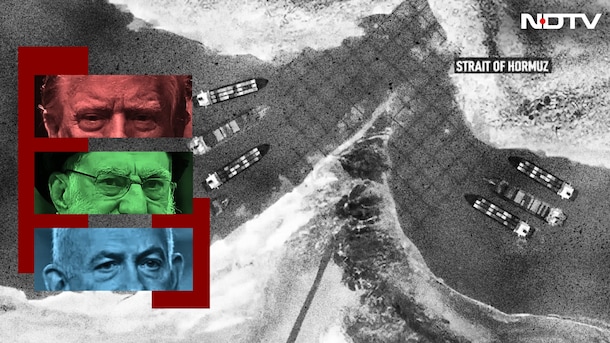
By March 3, there were zero active tanker transits inside the Hormuz Strait. Not because of Iran, or Trump. But simply because an 'underwriter' in London picked up the telephone.
-
Khamenei Falls, World Reels: Iran's War Sucks In NATO, Arabs In 72 Hours
Iran's Supreme Leader Ayatollah Ali Khamenei tracked for months in an elaborate espionage operation died Saturday afternoon after a missile struck his compound in the city centre.
-
Opinion | Iranian Ship Sinks: How A 2016 Deal With US Could Spell Trouble For India
Touted as the first major naval casualty in the Indian Ocean since the Second World War, the attack by the US on IRIS Dena brings the Iran crisis eerily close to home. And a 2016 deal with the US isn't helping.







-
News Updates
-
Featured
-
More Links
-
Follow Us On
