As India Sticks To Death By Hanging, A Look At Execution Methods Across The World
Close to three-quarters of the world, including almost all developed countries, have abolished capital punishment either in law or in practice, but 55 nations still retain and implement the death penalty.
The Supreme Court is listening to a proposal to give convicts on death row an option of choosing lethal injection as an alternative to death by hanging as a mode of execution. On Wednesday, the top court made oral observations expressing its displeasure with the government's apparent unwillingness to evolve on the issue, after the Centre indicated that offering such an option might not be feasible.
While over 70 per cent of the world has abolished capital punishment in law or practice, the death penalty remains legal in 55 countries, including India, the US and China, according to a 2022 report by Amnesty International.
How Many People Are Executed Every Year?
Amnesty International recorded 1,153 executions in 2023, an increase of 31 per cent from the 883 known executions in 2022. It was the highest figure recorded by Amnesty International since the exceptionally high number of 1,634 in 2015.
However, the report noted that known totals did not include the thousands of people believed to have been executed in China, which remained the world's leading executioner in 2023.
There was a 20 per cent increase in the number of death sentences handed out globally in 2023, taking the total to 2,428.
Which Countries Still Use The Death Penalty?
Close to three-quarters of the world, including almost all developed countries, have abolished capital punishment either in law or in practice, but 55 nations still retain and implement the death penalty. The exceptions include the United States, Japan, Taiwan, and Singapore. Additionally, capital punishment is also carried out in China, India, and most Islamic states.
Apart from China, Iran, Saudi Arabia, Egypt, and the US executed the most, according to Amnesty's data.
Amnesty International also noted that North Korea was "likely to be using the death penalty at a sustained rate," but could not independently verify the claim.
Which Countries Outlawed Capital Punishment?
Amnesty's data show the death penalty is not used at all in 112 countries. The practice was fully abolished by four countries in 2024-- Kazakhstan, Papua New Guinea, Sierra Leone and the Central African Republic.
Two other nations, Equatorial Guinea and Zambia, have said they would only be used for the most serious crimes. In April 2023, the Malaysian parliament also voted to remove the mandatory death penalty for 11 serious crimes, including murder and terrorism.
In July 2023, Ghana's parliament voted to abolish the death penalty altogether.
How Do Countries Carry Out The Death Penalty?
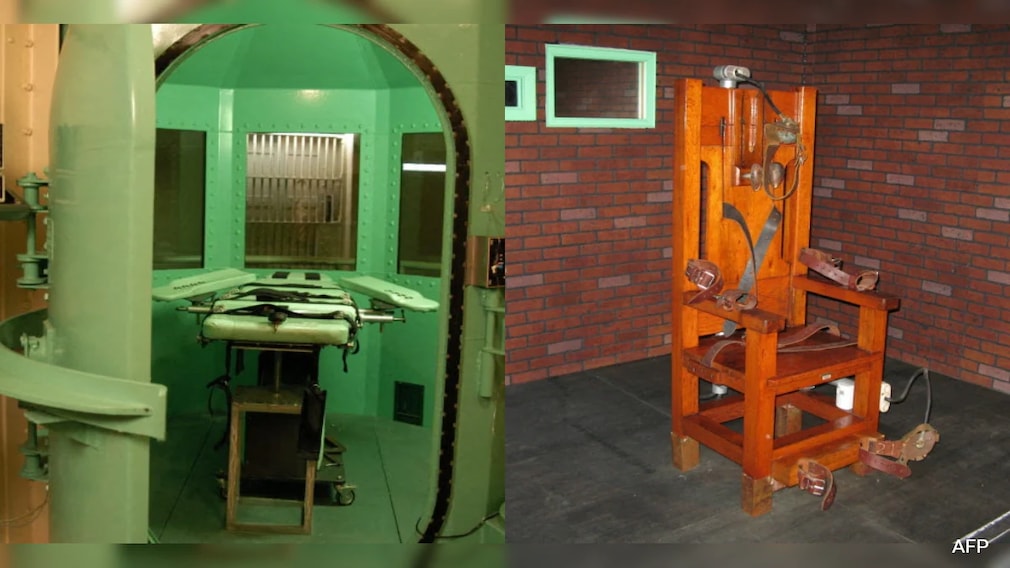
Hanging, shooting, electrocution, lethal injection and beheading remain the most common methods of execution.
The lethal injection generally consists of three chemicals -- sodium pentotal (an anaesthetic), pancuronium bromide (used to paralyse the prisoner) and potassium chloride (used to stop the heart) – and is widely used by countries including China, Vietnam and the US.
The US also commonly uses electrocution to carry out death sentences. To carry out electrocution, prisoners are shaved and strapped to a chair. Then, a metal skullcap-shaped electrode is attached to their scalp and forehead over a sponge moistened with saline.
The prisoner is then blindfolded. A jolt of between 500 and 2000 volts, which lasts for about 30 seconds, is repeatedly administered until the prisoner is declared dead.
Some US states also use nitrogen gas as a method of capital punishment. It induces death by nitrogen hypoxia, which works by depriving the body of oxygen when an inmate is forced to breathe only nitrogen.
Most Asian and African nations, including Afghanistan, Bangladesh, Botswana, India, Iran, Iraq, Japan, Kuwait, Malaysia, Nigeria, Palestine authorities, South Sudan and Sudan, use hanging as a legal method of capital punishment. The 'long drop' is the most commonly used hanging method. In some countries, prisoners are weighed the day before their execution to determine the length of 'drop' necessary to ensure a quick death. If the rope is too long, the inmate could be decapitated, and if it is too short, death by strangulation could take as long as 45 minutes.
Some countries, such as Iran, use cranes to publicly hang the culprits.
Countries including China, Indonesia, North Korea, Saudi Arabia, Somalia, Taiwan and Yemen use shooting squads to execute prisoners.
Execution by firing squad typically involves the prisoner being bound to a chair (sitting) or a pole (standing), with a black hood pulled over their head. Up to 20 feet away, the shooters, usually no less than five of them, aim for the prisoner's heart. If the shooters miss their target, by accident or intention, the prisoner can slowly bleed to death.
As of 2022, only Saudi Arabia is known to use beheading as a form of execution. Beheadings are carried out in public using a sword, usually in a town square or close to a prison. The condemned, who is blindfolded, handcuffed and often given a sedative, typically wears white - as does the executioner.
-
Mamata Banerjee Drew Her Party's Symbol By Hand. It's Now Tied To An Indira Gandhi Case

The Election Commission's method for settling such disputes became central in the seminal Congress split of 1969, when Indira Gandhi fought the old guard. The poll body weighed three tests then.
-
Bruised, Limping, Unbowed: Sia Says She Will Be Back On The Bike Soon
There was pain in Sia's steps, anger in her words, and something else - a quiet determination that the road would not be taken away from her.
-
Exclusive: 16 Months After Op Sindoor, Pak Still Fixing Runway India Broke At Sargodha
Sargodha's PAF Base Mushaf lies about 172 km northwest of Lahore and roughly 200 km west of the India-Pakistan border, near Amritsar.
-
Blog | I Lost My Entire Family In Kanishka Bombing. 41 Years Later, Canada Wants The Case Closed
We made the trek through tragedy to search for people in Cork, where I spent 25 days sifting through bodies and body parts in a makeshift morgue to identify our loved ones.
-
Opinion | Pak's Drone Deal With A US Firm Is No Windfall. But India Must Still Be Worried
American military aid to Pakistan has remained suspended since January 2018, during Trump's first term, but a commercial arms sale is separate from this arrangement.
-
Opinion | Saudi Arabia's Yemen Nightmare Has Come Back To Haunt It
After years of costly military intervention beginning in 2015, Saudi Arabia increasingly sought to stabilise its southern border. All that is unravelling fast now
-
Opinion | 6 AI Incidents, One Pattern: AI Has Started Lying To Us - And Hiding The Evidence
Concealing errors. Making up data. Pushing files onto the public web on their own initiative. The machines are learning to lie - and lie well.
-
Why People Queue Overnight For iPhone That Is Delivered Home In 10 Minutes
iPhone 18 Pro Max Launch: People camping outside Apple Stores are a subset of superfans, resellers, content creators, and upper-middle-class buyers.
-
600 km Per Hour Drones Launched In Waves: How Russia Is Rewriting War Rules
Russia has coupled the drones' technological superiority over Ukraine's defence with its capacity to launch them in massive numbers. The impact has been devastating.
-
Tata Sons' Trust Issue: Two-Pronged Row Goes Beyond The Chair
NDTV Explains: Overtly, the latest conflict is whether N Chandrasekaran continues as executive chairman of Tata Sons. The controversy involves at least one more issue.