Opinion | Why A Tiny Country Like Armenia Is Buying Billions In Indian Arms
Armenia has signed defence contracts worth nearly $2 billion with India since 2020.

India's Defence Secretary, Rajesh Kumar Singh, was recently on an official visit to Armenia, testifying to deepening defence cooperation between the two countries. He held high-level talks with Minister of Defence Suren Papikyan and Chief of the General Staff Lt. Gen. Edward Asryan, discussing expanding defence supplies and potential joint initiatives, while exchanging a document establishing a new framework for direct cooperation between the General Staffs of both armed forces. This marks a structural shift from procurement toward closer operational and staff-level engagement. In their negotiations, attended also by the Indian Ambassador in Yerevan, Nilakshi Saha Sinha, they addressed regional and international security dynamics, highlighting the strategic alignment of both nations regarding South Caucasus stability and cooperation.
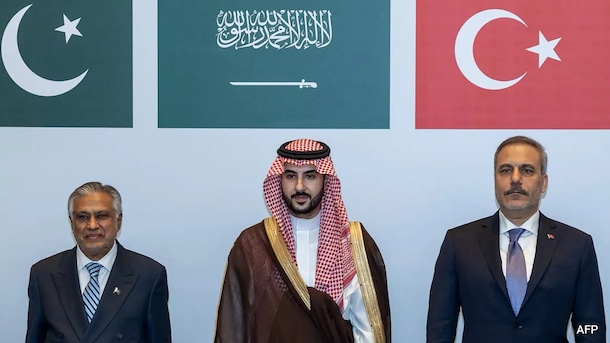
The news of the visit was immediately branded by the media as symptomatic of greater subterranean shifts, coming as it did a few days after the announcement of the Mecca Pact between Saudi Arabia, Turkey, and Pakistan, which Bangladesh is also now aspiring to. Even Iran, apparently, has been invited to join the pact, but there is no clarity on this yet.
Since visits like this are planned in advance, it is highly doubtful that the Mecca Pact triggered it. Moreover, such visits are becoming increasingly more frequent. Asyryan was in India earlier this year, while the then Chief of Defence Staff, Gen. Anil Chauhan, was in Armenia, where he inaugurated research facilities, underscoring the importance of joint training. Reportedly, Armenian special forces have undergone training in India's defense institutions.
More Than Just Defence
Most significantly, however, the tiny country has emerged as India's largest weapons buyer, giving an enormous boost to India's defence sector. Beginning with the SWATHI radar system, Armenia's imports of India's defence wares amount to approximately $2 billion, and include the Pinaka multi-barrel rocket launcher system and the indigenous Akash air defence missiles system. Given India's policy of boosting defence exports and transitioning to an arms-exporting country, this naturally elevates Armenia's position in India's strategic calculus.
But it also raises the fundamental question - is Armenia significant only for its defence imports from us?
This, while important, would be an extremely reductive lens to view bilateral relations through. For Armenia is much more than a mere arms exporter. Situated in the south Caucasus range, Armenia occupies a geopolitically strategic location, bordering Iran, Turkey, and Azerbaijan. It is also often perceived as a bridge between Asia and Europe, the heart of the South Caucasus, through which trade and transport corridors can connect Europe to Asia, including to India. Gaining a foothold in the region is of long-term benefit for India, a valuable listening post, particularly after its loss of the airbase in Ayni in Tajikistan.
With defence ties including capacity building, joint manufacturing, and setting up of joint manufacturing bases in Armenia, the ties are synergised by the fact that the country has a large pool of specialists. It can become a hub for defence exports further to countries in the region and beyond to Eastern Europe.
Over the recent past, events have demonstrated numerous reasons for finding alternatives to the trade routes passing through the Suez Canal. This is one of the reasons that trade corridors like the North-South Transport Corridor (INSTC), and, more recently, the India-Middle East Economic Corridor (IMEEC), were mooted. With the Middle East in the throes of conflict for more than three years now, made worse by the war against Iran, the IMEEC has been put on the back burner.
A 'Crossroads Of Peace'
Armenian Prime Minister Nikol Pashinyan unveiled his government's project launched to turn Armenia into a "Crossroads of Peace". Leveraging its unique location as the heart of the South Caucasus, the plan aims to turn the country into a trade, transport, and communications hub, and enable countries of the region to access European and Asian markets, and vice versa. This would herald a more secure, stable, and sustainable trade and economic relations for the Eurasian region at large.
Armenia is a unique country. Its people have faced genocide, the ravages of war, loss of lands and property. Currently, it is also facing a refugee influx in the aftermath of the loss of Karabakh territory to arch-rival and neighbour, Azerbaijan. But the country is looking ahead and forward. It is currently negotiating a peace treaty with Azerbaijan and has embarked on a process of normalisation with Turkey. The latter has allowed for direct trade and connectivity between Yerevan and Ankara, which is a prelude to some much bigger dividends both sides can reap through connectivity and access beyond the borders of both countries.
Understanding the geopolitical and geoeconomic benefits that can accrue, the US has now involved itself in this infrastructurally, through the Trump Route for Peace and Prosperity (TRIPP) project, which traverses through Armenia and Azerbaijan, making up a 43-kilometer-long transit passage through southern Armenia along the Armenia-Iran border, which will connect Azerbaijan to its enclave of Nakhichevan. This is envisaged to expand further into a multimodal trade and transport corridor connecting Central Asia to Europe, encompassing rail, road, oil and gas pipelines, fiber-optic cables, and electricity transmission lines.
Why India Needs This
For India, this is significant. The shortest route to the Black Sea and Southern and Eastern Europe runs from Iran's Chabahar Port to Armenia via the International North-South Transport Corridor (INSTC), connected to Armenia's North-South Transport Corridor. This would run further through the territory of Georgia to access the ports of Batumi and Poti on the Black Sea and onwards to the Mediterranean and Eastern and Southern Europe. Another alternative route will also run through Turkey, with the normalisation process underway.
Of course, such access requires Iranian cooperation, but the government has by now made it clear it is not giving up its investments in Iran. Neither is it about to forfeit its Eurasian connectivity ambitions. The current impasse, both through the chokepoints of the Strait of Hormuz and the Bab El Mandeb, adds grist to the mill. It also requires infrastructure investments in Armenia, and that is something India should consider. The Mecca pact makes it imperative for India to consider and explore all variables and alternatives. As mentioned above, Armenia's geostrategic location makes it important for India to stay invested in the country.
Besides, there are a plethora of other avenues of cooperation with Armenia - trade, setting up manufacturing bases for Indian companies, and migration corridors. Currently, Armenia hosts about 50,000 Indian workers; education, space research, science and technology, and tourism.
All this is capped by centuries-old, historically cordial relations between Indians and Armenians - two of the world's most ancient people. India enjoys a position in the mindscape of the country that few other nations do. This gives India an advantage there, which it should not hesitate to utilise.
(The author is a senior journalist)
Disclaimer: These are the personal opinions of the author
-
Opinion | The US Is Showing India Just How Cheap Its 'Friendship' Is

Can local talent fully replace Indian contribution? Why is the US leading in setting up Global Capability Centres in India - over 60% - and pocketing the IP?
-
Jantar Mantar Tells Time. The Clock Just Stopped On Its Time As An Iconic Protest Site
On Monday, October 12, 2026, Delhi Police denotified Jantar Mantar Road as a designated site for demonstrations. The Supreme Court had given it a nudge. Here's how history met politics on that street for decades.
-
Opinion | Saudi Airport Attack, And Why Pakistan Keeps Biting Off More Than It Can Chew
For all those who were envious of Pakistan's 'new status' as "mediator extraordinaire", here is a reality check
-
Opinion | Visa Shocks To Racist Attacks, When Did America Come To Hate Indians So?
Sometimes it is about H-1B visas. Sometimes it is jobs. Sometimes it is "foreigners." Sometimes it is about temples. The language of the attack varies, but the message is consistent
-
How El Nino And Warming Oceans Could Shape Earth's Climate In 2027
From changing ocean currents to extreme weather, scientists are watching a combination of climate signals that could influence temperatures, rainfall and ecosystems in the months ahead.
-
Blog | Nana Patekar, And The Sharp, Lasting Sting Of His 'Plain-Speak'
"Subah ghar se niklo, bheed ka hissa bano..." Nana Patekar's characters often spoke with the bluntness of men who had little patience for pretence. Just like Nana himself.
-
Opinion | Pakistan's Saudi Pact Is Now Entering Dangerous Territory - As Expected
On October 5, the ministers of the pact's member states met in Riyadh for an emergency session and agreed to move to a 'practical implementation' of the defence commitments.
-
Hindu ka khoon-Musalman ka khoon? Nana Patekar's Krantiveer Questions Still Hang
Krantiveer was released in 1994, after the communal violence that had scarred Bombay and other parts of India. Nana's voice carried the pain of every riot, every broken home
-
'SIR' In America Too? India Cue In Trump's Mass Citizenship Check For Voters
Having got the nod from the US Supreme Court, Donald Trump's push for a voter roll "cleanup" puts citizenship at its centre. Arguments for India's Special Intensive Revision (SIR) have also centred on "illegal immigrants". Data remains scarce. Let's map the similarities and the nuance.