Opinion | Why Does Trump Want To Sell Arms To A US 'Adversary'? Inside His Strange Bargain
Trump's aides maintain that no such offer had been made. But the story points to a larger strategy
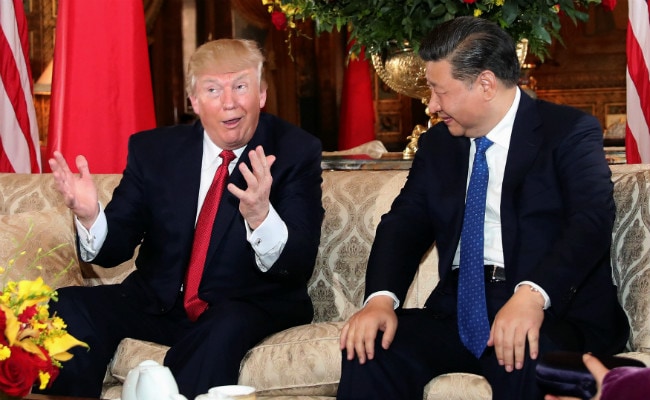
The Trump administration's handling of Taiwan arms sales points to a broader shift in the way Washington is managing its China policy. A roughly USD 14 billion package for Taiwan, primarily air-defence systems, missiles and counter-drone capabilities, has reportedly been kept in abeyance, with Trump describing it as a “very good negotiating chip” with Beijing. The message is unmistakable: Taiwan's security assistance is no longer being treated simply as an element of US deterrence policy, but also as an instrument in the wider US-China bargain. That approach may offer Washington tactical leverage. But it also creates strategic uncertainty for Taiwan and, more importantly, for US allies and partners across the Indo-Pacific.
Taiwan As An Instrument
Congress advanced the roughly USD 14 billion package earlier in 2026, but Trump has yet to give final approval. Following his May summit with Xi Jinping in Beijing, he said the package was being held “in abeyance” and that its fate “depends on China.” He also acknowledged that Taiwan arms sales had been discussed with Xi in considerable detail.
This is significant because it moves beyond the traditional logic of US arms transfers to Taiwan. The Six Assurances, alongside the Taiwan Relations Act, have long provided the framework within which Washington has maintained Taiwan's defensive capacity while avoiding an explicit commitment to Taiwanese independence. Consulting Beijing over the timing or substance of arms deliveries risks giving China a degree of influence over a policy that Washington has historically sought to keep within its own strategic calculus.
The administration has offered more than one explanation for the delay, including the desire to retain leverage with Beijing and pressure on US munitions stocks because of military operations involving Iran. These explanations need not be mutually exclusive. But from the perspective of allies, the important issue is not merely why a particular package is delayed. It is whether future security commitments can similarly become contingent on unrelated negotiations with Beijing.
A previous package of roughly $11 billion was approved in late 2025, underscoring that the administration has not abandoned arms transfers to Taiwan. The question, therefore, is less about an immediate rupture in policy than about the emerging pattern of conditionality.
The China Arms-Sale Episode
The reported remarks by US Ambassador to China David Perdue add another layer of uncertainty. Last week, following Xi's state visit to Washington, Perdue said on Fox News that Trump had at one point asked Xi whether China would like to buy US weapons, arguing that Washington sells arms to countries around the world. The White House and State Department quickly rejected the suggestion that there was an actual offer or plan to sell weapons to China, pointing to US law prohibiting such sales. Trump himself disputed Perdue's characterisation, suggesting that the ambassador may have been referring to Taiwan and saying that China would probably prefer superior American equipment, while adding that such a sale had not been discussed.
The episode is therefore best understood as a contested account rather than evidence of an actual US plan to arm China. Yet the fact that the remark required such rapid clarification is itself revealing. Strategic signalling is not simply about what governments intend; it is also about what allies and adversaries believe Washington is prepared to contemplate.
The Alliance Problem
For US allies, Taiwan is not an isolated issue. Japan, Australia, the Philippines and South Korea all have an interest in the credibility of American deterrence in the western Pacific. A conflict over Taiwan would have consequences for regional sea lanes, military deployments, supply chains and the broader balance of power. This makes the handling of Taiwan arms sales a test of alliance confidence.
If Washington can temporarily suspend a major Taiwanese arms package to gain leverage with Beijing, allies will inevitably consider what this means for their own security relationships with the United States. The concern is not necessarily that Washington will abandon Taiwan. Rather, it is that security commitments could become increasingly transactional, with their implementation conditioned by the demands of a larger US-China bargain.
That perception could encourage greater hedging. Japan and Australia may accelerate indigenous defence capabilities; Southeast Asian partners may diversify security relationships; and governments across the region may become more cautious about aligning themselves too closely with Washington during periods of intensified US-China competition.
The practical consequences are also important. Taiwan already faces long delivery timelines for many American systems. Additional delays thus have effects beyond the immediate political signal. They complicate defence planning and force modernisation and the sequencing of military capabilities. The wider US problem of competing munitions demands, from Europe and the Middle East to the Indo-Pacific, only reinforces these pressures.
Beijing's Opportunity
For China, the episode offers both a diplomatic and informational advantage. Beijing has consistently opposed American arms sales to Taiwan, which it regards as part of its territory, and has sought to constrain or delay such transfers. If Chinese objections can contribute to postponing US weapons deliveries, Beijing gains something more consequential than a single policy concession: evidence that diplomatic engagement with Washington can influence the operational tempo of American support for Taiwan.
Chinese state media has already used Trump's comments to question the reliability of American backing for Taipei. Such narratives serve Beijing's broader objective of persuading Taiwan that dependence on the United States carries risks, and that accommodation with China may ultimately be unavoidable. The strategic question, therefore, is whether Beijing is being given a de facto role in determining the timing of US military assistance to Taiwan. That would represent a significant shift in the regional balance of signalling.
The Larger Dilemma
The central tension is between transactional diplomacy and strategic consistency. Trump's approach places a premium on using every available instrument-trade, agriculture, aircraft purchases, military sales and diplomatic engagement - to shape Chinese behaviour. From that perspective, delaying Taiwan arms sales can be presented as pragmatic statecraft rather than abandonment.
But deterrence depends not only on capabilities; it depends on expectations. Allies and adversaries must have some confidence that commitments will survive changes in the diplomatic weather. If weapons deliveries to Taiwan become another variable in summit negotiations with Xi, the United States risks creating uncertainty precisely where deterrence requires clarity.
The distinction between a temporary delay and an indefinite freeze is thus crucial. A short postponement linked to logistics, stockpile management or immediate diplomatic circumstances is one thing. A prolonged delay explicitly conditioned on Beijing's satisfaction would send a very different signal.
For Washington's partners, the issue is consequently larger than the USD 14 billion package itself. They will be watching whether the package, or a modified version of it, eventually moves forward, whether the administration continues to reaffirm the Taiwan Relations Act and Six Assurances, and whether future US-China summits produce similar conditionality.
The reported discussion about possible US arms sales to China, even after being denied and disputed, adds to the uncertainty. At a time when the Indo-Pacific is already adjusting to a more contested balance of power, Washington's challenge is not simply to negotiate effectively with Beijing. It is to ensure that the pursuit of a better US-China relationship does not generate doubts among the very partners whose confidence underpins American strategy in Asia.
Disclaimer: These are the personal opinions of the author
-
Opinion | 'Lies, Damned Lies, Statistics': On The Controversy Around India's GDP Growth Figures

The debate is less about a single figure than about a decade-long erosion of trust in official statistics.
-
Opinion | Why India Cannot Keep 'Overestimating' Its Value To Washington
Some of India's value to Washington came from the tension between the US and China. That is changing now.
-
Opinion | India Has A 'Lobbying' Problem In Washington, And It Has Come Back To Haunt It
While the EU, Japan, the UK and South Korea secured quick deals, India's efforts were getting drained in prolonged negotiations and the wrong kind of lobbying.
-
India Is Getting Old Before Getting Rich, Will Turn 'Aged' In 16 Years: Moody's
Countries with the steepest fertility declines today will age the fastest in the coming decades. India's drop has been steep.
-
Opinion | The AI Boom Has Run Into A Big 'Debt' Trap Problem. Inside The 5% Danger Line
For most of the AI buildout's first two years, hyperscalers funded it the easy way: out of operating cash flow. That era is over.
-
Opinion | Iran To Saudi, Pakistan Is Now Fast Running Out Of Sides To Play
Pakistan's long history of playing all parties to its own benefit may have reached the end of its road.
-
Gyanesh Kumar Has An Immunity Pin. Why A Petition Says He Can't Use It
The Opposition wants the Chief Election Commissioner prosecuted for alleged manipulation of voter rolls, but a 2023 law stands in the way. A petition in the Supreme Court now says the law has a gap.
-
Opinion | Is The World Staring At A Big Stock Market Crash - And Recession? 5 Uneasy Signs
On Wednesday, the US bond market recorded its worst day since Trump's "Liberation Day" tariffs rattled markets in April 2025. The 30-year US Treasury yield topped 5.43%, putting it on track for its highest close since 2004.
-
Form 6 For New Voters: When A Small Change Triggered A Big Row
In July 2026, the online version of Form 6 on the ECI's ECINet portal was modified to include a new declaration.
-
Opinion | Saudi Arabia's China Turn Has Begun - After Learning Much The Hard Way
Leaning on China just makes sense for the Saudis right now. The question is, can its other great 'ally' stomach it?